Other Ways to Say Structural Inequalities: 30 Clear Alternatives
“Structural inequalities” is a useful phrase when discussing unequal opportunities, resources, treatment, or outcomes that are connected to institutions and wider social systems. However, repeating it throughout an essay, report, research paper, or policy document can make your writing sound monotonous.
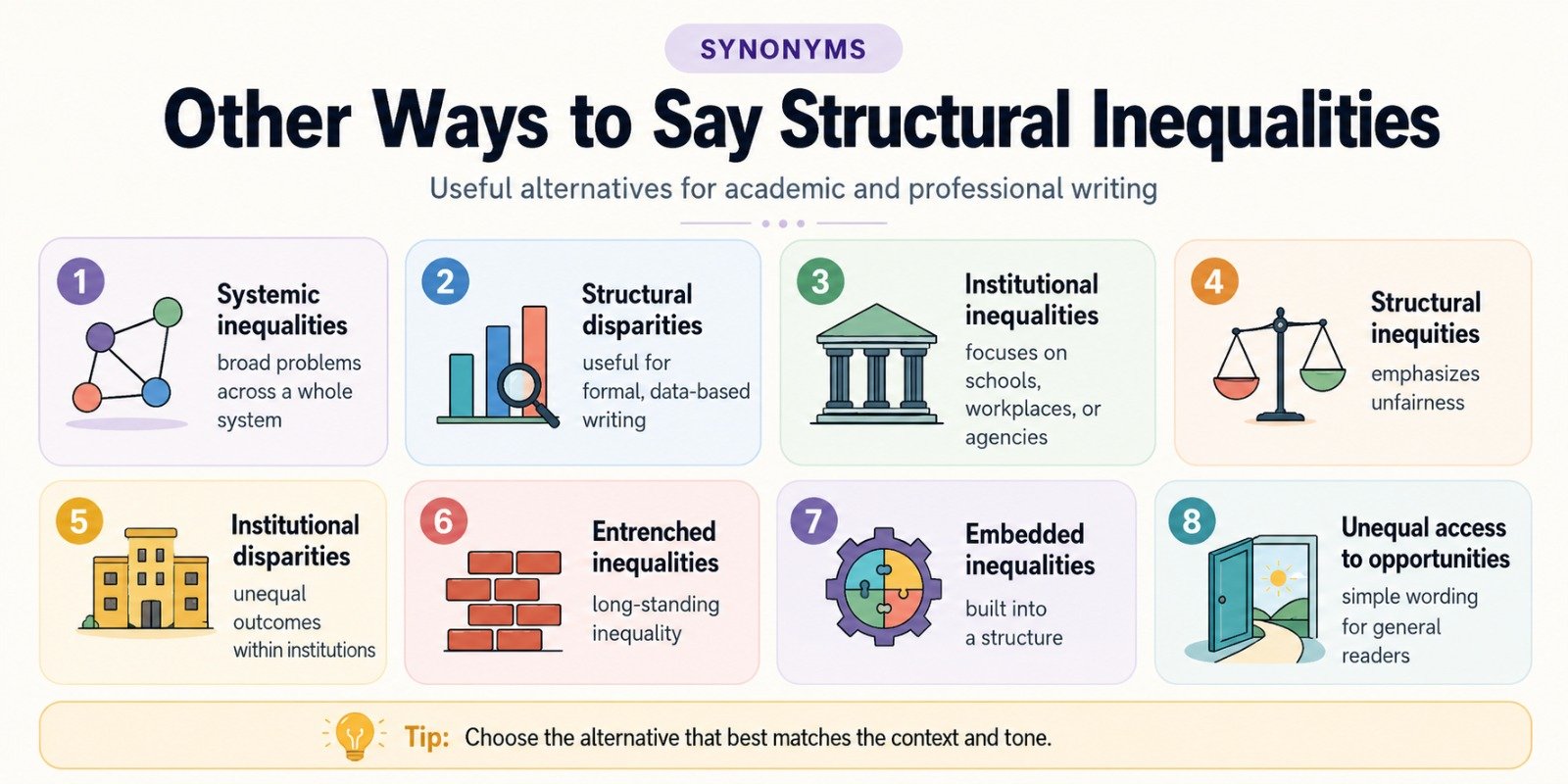
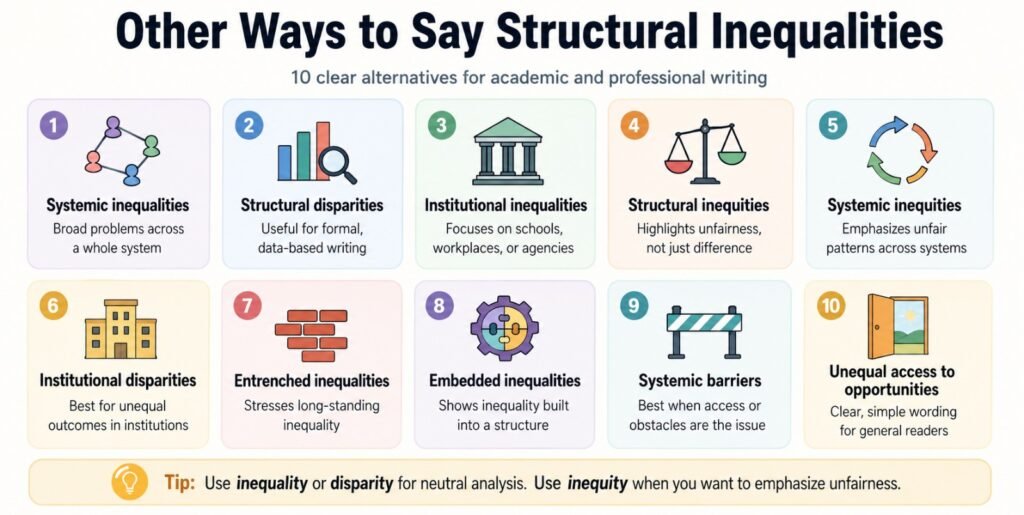
Some of the best other ways to say structural inequalities are systemic inequalities, institutional inequalities, structural disparities, systemic disparities, institutional inequities, entrenched inequalities, systemic disadvantages, unequal social structures, and embedded disparities.
The alternatives aren’t completely interchangeable. Some simply describe an unequal condition, while others emphasize unfairness, institutional causes, or long-lasting disadvantage. Choosing the right phrase depends on what you actually want to communicate.
What Does “Structural Inequalities” Mean?
Structural inequalities are unequal conditions or outcomes that are linked to the organization and operation of institutions or social systems rather than simply to individual choices.
For example, inequalities involving education, employment, housing, healthcare, wealth, or access to other resources may be described as structural when institutional practices help produce or preserve those differences. The University of Pennsylvania describes structural inequality in terms of disparities in wealth, resources, and outcomes associated with institutional practices.
The key word is structural. It suggests that the inequality exists within, or is reinforced by, a larger structure.
That distinction matters because simply replacing “structural inequalities” with “differences” can remove an important part of the meaning.
Best Alternatives to Structural Inequalities
The following table helps you choose an alternative according to the meaning you want to emphasize.
| Alternative | Main Emphasis | Best Used For |
|---|---|---|
| Systemic inequalities | Inequality across a broader system | Academic and policy writing |
| Institutional inequalities | Inequality linked to institutions | Education, workplaces, government |
| Structural disparities | Unequal outcomes or conditions | Research and formal reports |
| Systemic disparities | Differences produced across systems | Analytical writing |
| Structural inequities | Unfair structural conditions | Social justice and policy discussions |
| Systemic inequities | Unfairness within a wider system | Healthcare, education, public policy |
| Institutional disparities | Differences connected to institutions | Data-driven reports |
| Institutional disadvantages | Disadvantages created or reinforced institutionally | Education and employment |
| Entrenched inequalities | Long-established inequality | Historical or social analysis |
| Embedded inequalities | Inequality deeply incorporated into a system | Academic discussion |
| Persistent disparities | Inequalities continuing over time | Research and statistics |
| Unequal social structures | Systems organized unequally | General explanatory writing |
| Systemic barriers | Obstacles produced by a system | Access and opportunity discussions |
| Patterns of disadvantage | Repeated disadvantage affecting groups | Accessible formal writing |
| Unequal access to opportunities | Opportunity-focused inequality | Education and employment |
Academic Other Ways to Say Structural Inequalities
Academic writing often requires more precision than a simple synonym list can provide. The strongest replacement is the phrase that matches the cause or type of inequality being discussed.
Other Ways to Say Structural Inequalities: Systemic Inequalities
Systemic inequalities is one of the closest alternatives to “structural inequalities.”
It works particularly well when inequality is connected to several interacting parts of a larger system.
Example:
“Researchers examined systemic inequalities affecting access to higher education.”
Here, “systemic” suggests that the problem isn’t confined to a single decision or organization.
Other Ways to Say Structural Inequalities: Institutional Inequalities
Use institutional inequalities when your discussion focuses specifically on organizations or institutions.
These might include schools, universities, workplaces, healthcare organizations, government agencies, financial institutions, or legal systems.
Example:
“The study explores institutional inequalities within the education system.”
This alternative is narrower than “systemic inequalities” because it puts institutions at the center of the discussion.
Other Ways to Say Structural Inequalities: Structural Disparities
Structural disparities is particularly useful in research papers, reports, and analytical writing.
“Disparity” refers to a noticeable difference or imbalance and is commonly associated with inequality. Thesaurus resources include terms such as disparity, disproportion, imbalance, and difference among words related to inequality.
Example:
“The findings reveal significant structural disparities in access to healthcare.”
This wording works well when discussing measurable differences.
Other Ways to Say Structural Inequalities: Institutional Disparities
Institutional disparities combines two useful ideas: unequal outcomes and their connection to institutions.
Example:
“The researchers found institutional disparities in promotion rates.”
This can sound more neutral than “institutional injustice” because it describes a difference without automatically making a moral judgment about it.
Other Ways to Say Structural Inequalities: Entrenched Inequalities
Use entrenched inequalities when emphasizing that unequal conditions have existed for a long period and are difficult to change.
Example:
“The reforms were introduced to challenge entrenched inequalities in the labor market.”
“Entrenched” adds the idea of persistence, so it isn’t always a direct substitute for “structural.”
Other Ways to Say Structural Inequalities: Embedded Inequalities
Embedded inequalities suggests that unequal practices or outcomes have become deeply incorporated into an institution or system.
Example:
“The report considers how embedded inequalities affect educational outcomes.”
This phrase works particularly well when describing patterns that have become part of normal institutional processes.
Formal Other Ways to Say Structural Inequalities
If you’re writing a report, policy document, dissertation, or formal essay, these phrases are particularly useful:
Systemic Disparities
This phrase sounds analytical and works well when discussing differences occurring throughout a system.
Example:
“The proposal seeks to reduce systemic disparities in public services.”
Persistent Inequalities
Use this when duration is important.
Example:
“Persistent inequalities remain visible across income groups.”
It means inequalities that continue over time, but it doesn’t necessarily explain why those inequalities exist.
Institutional Disadvantages
This expression shifts attention from unequal conditions to the disadvantages people experience.
Example:
“The policy aims to reduce institutional disadvantages faced by rural students.”
Unequal Distribution of Resources
This is more specific than “structural inequalities.”
Use it when the problem relates directly to money, services, funding, facilities, or other resources.
Example:
“The study identified an unequal distribution of educational resources between regions.”
Patterns of Disadvantage
This is a clear alternative when you want formal language without sounding overly technical.
Example:
“Long-standing patterns of disadvantage remain visible across the sector.”
Other Ways to Say Structural Inequalities in Simple English
Sometimes the best alternative isn’t more academic. If you’re writing for the general public, simpler wording may communicate the idea more effectively.
Barriers Built Into the System
This expression explains the concept in plain English.
Example:
“Some communities continue to face barriers built into the system.”
It works best when the inequality involves obstacles to access or opportunity.
Unequal Systems
“Unequal systems” is short and easy to understand.
Example:
“Reformers argue that unequal systems can limit opportunities for certain groups.”
It is less precise than “structural inequalities,” so it may not be suitable for every research paper.
Unequal Access to Opportunities
This is an excellent option when discussing employment, education, promotion, housing, or similar opportunities.
Example:
“The program was created to address unequal access to employment opportunities.”
Long-Standing Social Disadvantages
Use this when both duration and disadvantage matter.
Example:
“The initiative focuses on communities affected by long-standing social disadvantages.”
Unfair Differences Within a System
This conversational alternative works when explaining the concept to readers unfamiliar with academic terminology.
Example:
“The report looks at unfair differences within the healthcare system.”
Structural Inequites or Structural Inequalities?
The correct spelling is structural inequities, not “structural inequites.”
But there is also an important meaning difference between inequities and inequalities.
Structural Inequalities
Inequality primarily describes an unequal condition, difference, or distribution. Merriam-Webster includes social disparity and unequal distribution or opportunity among its meanings.
For example:
“Researchers identified structural inequalities in access to higher education.”
The sentence identifies unequal conditions without necessarily stating that every difference is morally unjust.
Structural Inequities
Inequity carries a stronger idea of unfairness or injustice. Merriam-Webster explains the relationship between equity and fairness and notes that inequity commonly refers to unfairness or injustice.
For example:
“The organization is working to address structural inequities in healthcare.”
This version makes the fairness issue more prominent.
A useful rule is:
Inequality = an unequal condition
Inequity = an unfair or unjust condition
The distinction can become more nuanced in specialist fields, but this is a useful guideline for general writing.
Another Way to Say Structural Inequalities in an Essay
When writing an essay, you don’t need to replace every occurrence of “structural inequalities.” Repeating an important technical term can actually improve clarity when it is the central concept.
Instead, vary your language only when another phrase accurately represents the point you’re making.
For example:
“Structural inequalities continue to influence educational opportunities. These systemic disparities are especially visible when access to well-funded schools is compared across communities. Addressing such institutional disadvantages may require changes in funding, policy, and access.”
Notice that the alternatives aren’t inserted randomly. Each one slightly changes the focus.
“Structural inequalities” introduces the overall issue.
“Systemic disparities” describes unequal outcomes across the system.
“Institutional disadvantages” focuses on the disadvantages associated with institutions.
That type of variation is much stronger than swapping words simply to avoid repetition.
Not Every Synonym for “Inequality” Works Here
A general thesaurus may provide many synonyms or related words for “inequality,” including difference, disparity, disproportion, bias, discrimination, injustice, unfairness, and variation.
However, adding “structural” in front of every one of those words does not automatically create a natural synonym.
For example:
Structural disparity can sound natural.
Structural injustice can work, but it makes a stronger moral claim.
Structural discrimination refers more specifically to discriminatory processes and isn’t simply another name for every structural inequality.
Structural difference is too broad in many contexts.
Structural variation usually has a different meaning and should not normally replace “structural inequality.”
This is why context matters more than simply choosing the first synonym from a thesaurus.
Systemic Inequality vs. Structural Inequality
Systemic inequality is probably the closest general alternative to structural inequality, but the two terms can place emphasis in slightly different places.
“Structural” directs attention toward established structures, institutions, rules, and arrangements.
“Systemic” emphasizes the way inequality exists throughout or is produced by a larger system.
Compare:
“Structural inequalities in housing policy have affected access to affordable homes.”
“Systemic inequalities across housing, employment, and education can reinforce one another.”
The first focuses on structure. The second highlights the wider system.
In everyday academic and professional writing, however, the terms often appear in closely related discussions.
Social Inequality vs. Structural Inequality
Social inequality is broader.
It describes unequal access to status, opportunities, resources, or outcomes within society.
Structural inequality is more specific because it identifies systems or institutions as an important part of how that inequality is created or maintained.
For example:
“Income inequality is one form of social inequality.”
“Policies that consistently limit opportunities for certain communities may contribute to structural inequality.”
Use social inequality when discussing inequality generally. Use structural inequality when the system or institutional arrangement is central to your argument.
When “Systemic Barriers” Is Better Than “Structural Inequalities”
Sometimes a synonym isn’t the best choice at all.
If your sentence is specifically about obstacles preventing people from accessing something, systemic barriers may communicate your meaning better.
Compare:
“Structural inequalities affect access to higher education.”
“Systemic barriers make higher education harder to access for some students.”
The second sentence focuses clearly on the obstacles causing unequal access.
Similarly, you might choose:
Unequal access to healthcare when access is the issue.
Funding disparities when money is the issue.
Institutional discrimination when discriminatory practices are the issue.
Economic inequality when income or wealth is the issue.
Specific wording usually makes formal writing stronger.
Choosing the Right Alternative
Before replacing “structural inequalities,” consider what part of the idea matters most.
If you’re discussing the whole system, use systemic inequalities.
If you’re focusing on organizations or institutions, choose institutional inequalities or institutional disparities.
If you’re describing measurable differences, structural disparities may be more neutral and precise.
If you want to emphasize unfairness, structural inequities or systemic inequities may be better.
If you’re discussing problems that have existed for a long time, consider entrenched inequalities or persistent inequalities.
If you’re explaining the concept to a general audience, expressions such as barriers built into the system, unequal systems, or unequal access to opportunities may be clearer.
Frequently Asked Questions
What is another way to say structural inequalities?
One of the closest alternatives is systemic inequalities. Other useful options include institutional inequalities, structural disparities, systemic disparities, embedded inequalities, institutional disadvantages, and structural inequities. The best choice depends on the exact meaning of the sentence.
What is the correct spelling: structural inequites or structural inequities?
The correct spelling is structural inequities. “Inequites” is a misspelling of “inequities.”
Are structural inequalities and structural inequities the same?
Not exactly. Structural inequalities describes unequal conditions or outcomes connected to social or institutional structures. Structural inequities places additional emphasis on the unfairness or injustice of those conditions.
Can I say “systemic inequality” instead of “structural inequality”?
Often, yes. Systemic inequality is one of the closest alternatives. However, “structural” tends to emphasize established structures and institutional arrangements, while “systemic” can emphasize how inequality operates throughout a broader system.
What is another academic word for inequality?
Depending on the sentence, disparity, imbalance, disproportion, inequity, or discrepancy may work. “Disparity” is particularly common when describing differences in outcomes, but none of these words is automatically interchangeable in every context.
Is “institutional inequality” a natural phrase?
Yes. Institutional inequality is useful when inequality is specifically associated with institutions such as schools, workplaces, government bodies, healthcare organizations, or legal systems.
What is a simpler way to explain structural inequality?
You might describe it as inequality built into a system, barriers created by the system, or unequal access to opportunities caused by institutional structures. These versions are easier for a general audience to understand.
Conclusion
The strongest alternative to structural inequalities depends on what your sentence needs to emphasize. Systemic inequalities is a close general substitute, structural disparities suits neutral analytical writing, institutional inequalities focuses attention on organizations, and structural inequities highlights unfairness. More specific expressions such as systemic barriers or unequal access to opportunities can be even better when they describe the problem more precisely.
Good word choice isn’t just about finding a different synonym; it is about matching the language to your context, audience, tone, subject, and level of formality. Clarifyra focuses on those distinctions so that alternative wording makes your writing clearer rather than simply different.