Stuffie or Stuffy: Which Is Correct?
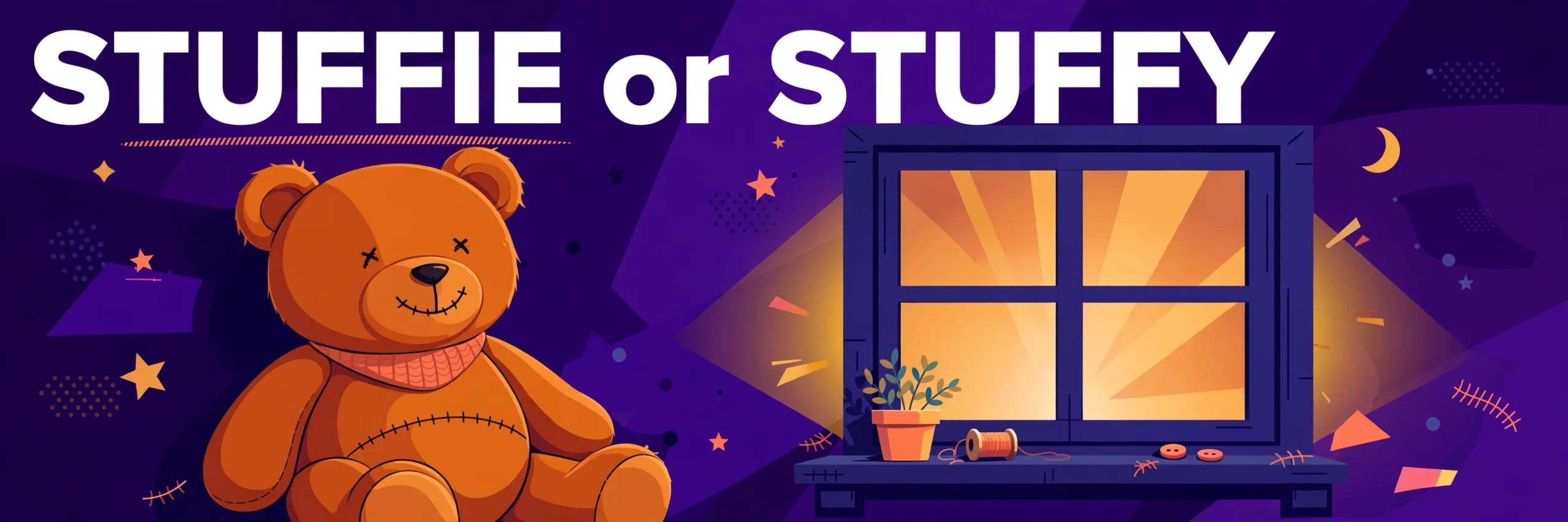
They sound exactly alike, they are spelled almost alike, and they have almost nothing to do with each other. A stuffie is a soft toy — a teddy bear, a plush elephant, a cloth animal a child carries everywhere. Stuffy is an adjective with three distinct senses: a room with no fresh air, a person who is far too formal and dull, and a nose blocked by a cold. The only thing the two words share is their pronunciation: both are /ˈstʌf.i/ in British and American English.
That makes this pair a classic homophone trap, and a spelling trap too. The difference is a single letter — ie against y — and the words belong to different parts of speech, so choosing the wrong one changes the meaning of the sentence completely. This article sets out what each word means, how to use each one, and the memory hooks that keep them apart.
Quick Answer: A stuffie is a noun: a stuffed toy animal, short for stuffed animal — “her favourite stuffie is a worn grey elephant.” Stuffy is an adjective with three senses: (1) a room or building that is warm and has no fresh air; (2) a person, or their manner, that is very formal, serious, and boring; (3) a nose blocked by a cold. Both are pronounced /ˈstʌf.i/. If you mean the toy, write stuffie; in every other case, write stuffy.
Stuffie or Stuffy at a Glance
| Word | Part of speech | Pronunciation | Meaning | Example |
|---|---|---|---|---|
| stuffie | Noun (countable) | /ˈstʌf.i/ (UK and US) | A stuffed toy animal; short for stuffed animal | “The toddler hugged her stuffie all night.” |
| stuffy | Adjective | /ˈstʌf.i/ (UK and US) | (1) lacking fresh air; (2) stiffly formal and dull; (3) blocked nose | “Open a window — it’s stuffy in here.” |
What Stuffie Means
Stuffie is the informal, affectionate word for a stuffed toy animal. Cambridge defines it as a noun, short for stuffed animal: “a toy animal made from cloth and filled with a soft material so that it is pleasant to hold,” with soft toy as its synonym. Its example sentence is exactly the sort of sentence the word lives in: “The company is known for its cute stuffed animals, and this elephant stuffie is no exception.”
The word belongs to the language of childhood and of toy shops. Parents buy stuffies, children name them, collectors display them. Wikipedia’s article on stuffed toys lists stuffies alongside plush toys, plushies, and teddies as names for the same soft, sewn, stuffed objects, noting that in Britain and Australia they are also called soft toys or cuddly toys. The spelling follows the familiar pattern of affectionate diminutives ending in -ie: think doggie, birdie, kiddie. That -ie ending is itself a clue — it signals something small, cute, and informal.
Note the register. Stuffie is casual and playful; a toy catalogue or a product listing might use it, but a formal report would say stuffed animal or soft toy instead. It is a real dictionary word, not a misspelling, and Cambridge records it as standard informal English. Its plural is stuffies — the y changes to ies because it follows a consonant sound pattern (the i of -ie behaves as a vowel here, but the established plural is stuffies, matching doggie → doggies).
Examples of stuffie in use
- “Her favourite stuffie is a one-eared rabbit she has had since she was two.”
- “The shop sells handmade stuffies shaped like foxes, owls, and bears.”
- “He packed his daughter’s stuffie first, before anything else, for the long flight.”
- “This elephant stuffie is made from organic cotton and recycled filling.”
What Stuffy Means
Stuffy is an adjective, and it carries three senses that dictionaries record separately. Oxford Advanced Learner’s Dictionary lists them in this order: (1) of a building or room, “warm in an unpleasant way and without enough fresh air”; (2) informal and disapproving, “very serious, formal, boring or old-fashioned”; (3) especially in North American English, “if you have a stuffy nose, your nose is blocked because you have a cold.” Cambridge divides the same ground into its “without air” and “formal” senses, and gives the pronunciation as /ˈstʌf.i/ in both British and American English. The comparative is stuffier and the superlative stuffiest.
The first sense is the oldest. Dictionary.com dates stuffy to 1545–55, formed from stuff + -y, and its earliest meaning was about air: a stuffy room is close, poorly ventilated, and oppressive. “It gets very hot and stuffy in here in summer,” in Oxford’s example, is the sentence every reader recognises. The image behind the word is of a space packed full — stuffed — with stale air and no room for anything fresh.
The second sense is a metaphor built on the first. A stuffy person is like a stuffy room: closed up, airless, and unwelcoming to anything new. Oxford calls this use informal and disapproving — “a stuffy, formal family,” “plain, stuffy clothes” — and Cambridge marks it as disapproving too. It describes someone conventional, narrow-minded, and resistant to new ideas: “he was steady and rather stuffy.” The related noun is stuffiness and the adverb is stuffily (“in a way that is old-fashioned, formal, and boring”).
The third sense is the most literal in a different way: a stuffy nose is one blocked with mucus, so that breathing is difficult. It is especially common in American English, and it is the sense behind the familiar complaint “I’ve got a stuffy nose and a sore throat.” Here stuffy describes the same condition as blocked or congested, and it is the only one of the three senses that is about the body rather than a room or a character.
Examples of stuffy in use
- “Open the window — this room is stuffy.” (no fresh air)
- “The committee was run by a stuffy old chairman who hated change.” (formal and dull)
- “She stayed home with a stuffy nose and a fever.” (blocked nose)
- “The lecture hall grew stuffier as the afternoon wore on.” (comparative)
Why the Two Are Confused
The confusion is almost entirely a matter of sound. Both words are pronounced /ˈstʌf.i/ — identical in British and American English — so the ear gives no help at all. The spelling difference is a single letter at the end, and the two words even come from the same root: both are built on stuff. A stuffie is a toy stuffed with soft material; a stuffy room is one that feels stuffed full of stale air. The shared root makes the pair feel related, but the meanings have travelled in different directions, and they are now entirely separate words.
There is one more complication worth knowing about. Some dictionaries record stuffy as a noun meaning a stuffed toy — a synonym of stuffie. This noun use of stuffy is real but much rarer than the adjective, and it is not the sense any major learner’s dictionary leads with. In practice, if you mean the toy, write stuffie; the noun use of stuffy survives mainly in older or specialist sources, and using it risks being read as the adjective. This article follows Cambridge and Oxford, which both treat stuffie as the toy and stuffy as the adjective.
Stuffie vs Stuffy Side by Side
| Test | Stuffie | Stuffy |
|---|---|---|
| Part of speech | Noun | Adjective |
| What it describes | A soft toy animal | A room, a person, or a nose |
| Register | Informal, affectionate | Neutral (room, nose); disapproving (person) |
| Comparative | — (nouns don’t take -er) | stuffier, stuffiest |
| Plural | stuffies | — (adjectives have no plural) |
| Spelling clue | Ends in -ie, like doggie | Ends in -y, like other adjectives (musty, dusty) |
Correct vs Incorrect
| Correct | Incorrect | Why |
|---|---|---|
| “The child cuddled her stuffie.” | “The child cuddled her stuffy.” | The toy is a stuffie; stuffy is an adjective |
| “It’s stuffy in this classroom.” | “It’s stuffie in this classroom.” | A room with no air is stuffy |
| “He is a stuffy old professor.” | “He is a stuffie old professor.” | Formal and dull is stuffy |
| “I can’t breathe through my stuffy nose.” | “I can’t breathe through my stuffie nose.” | A blocked nose is stuffy |
| “The shelf was full of stuffies.” | “The shelf was full of stuffys.” | Plural of stuffie is stuffies, not stuffys |
Common Mistakes
Writing “stuffy” for the toy. This is the most common error, and it comes from the fact that stuffy is by far the more familiar word. If you can put the or a in front of it and it names a thing — “a stuffie,” “the stuffie” — it is the noun, spelled with -ie. If it describes something — “a stuffy room,” “a stuffy nose” — it is the adjective, spelled with -y.
Writing “stuffie” for the adjective. The reverse error is rarer but it happens, usually by analogy with the toy. “A stuffie room” looks wrong the moment you see it, because -ie endings belong to nouns of endearment, not to adjectives. Adjectives in this family end in -y: musty, dusty, fusty — and stuffy.
Forgetting the comparative pattern. The comparative of stuffy is stuffier and the superlative is stuffiest: the y changes to i before -er and -est, because it follows a consonant. “More stuffy” is acceptable in speech, but stuffier is the dictionary form.
Using “stuffy” for a person without noticing the insult. Calling a room stuffy is a complaint about ventilation; calling a person stuffy is a judgement about their character. The person sense is marked disapproving in both Cambridge and Oxford, so use it deliberately, not casually — and never in a reference or a formal description.
Assuming “stuffie” is a misspelling. It is not. Cambridge records it as a standard informal noun, and spellcheckers that flag it are behind the dictionaries. The same goes for plushie, its close cousin. Both are legitimate modern words.
Frequently Asked Questions
Is stuffie a real word?
Yes. Cambridge defines stuffie as a countable noun, short for stuffed animal, meaning a toy animal made from cloth and filled with soft material. It is informal, but it is a real dictionary word, not a misspelling of stuffy.
What does stuffy mean?
It depends on what it describes. A stuffy room is warm and has no fresh air; a stuffy person is very formal, serious, and boring; a stuffy nose is blocked by a cold. All three senses are recorded by Oxford and Cambridge.
Are stuffie and stuffy pronounced the same?
Yes — both are /ˈstʌf.i/ in British and American English. They are true homophones, which is exactly why they are confused in writing. Only the spelling and the meaning differ.
The Takeaway
Think of it this way: the toy is small and cute, so it gets the cute spelling — stuffie, with its -ie ending, like doggie. Everything else is stuffy: the airless room, the formal bore, and the blocked nose. The two words sound identical, so your spelling has to do all the work — and now you know which letter does it.
Sources: Cambridge Dictionary — stuffie; Oxford Advanced Learner’s Dictionary — stuffy.