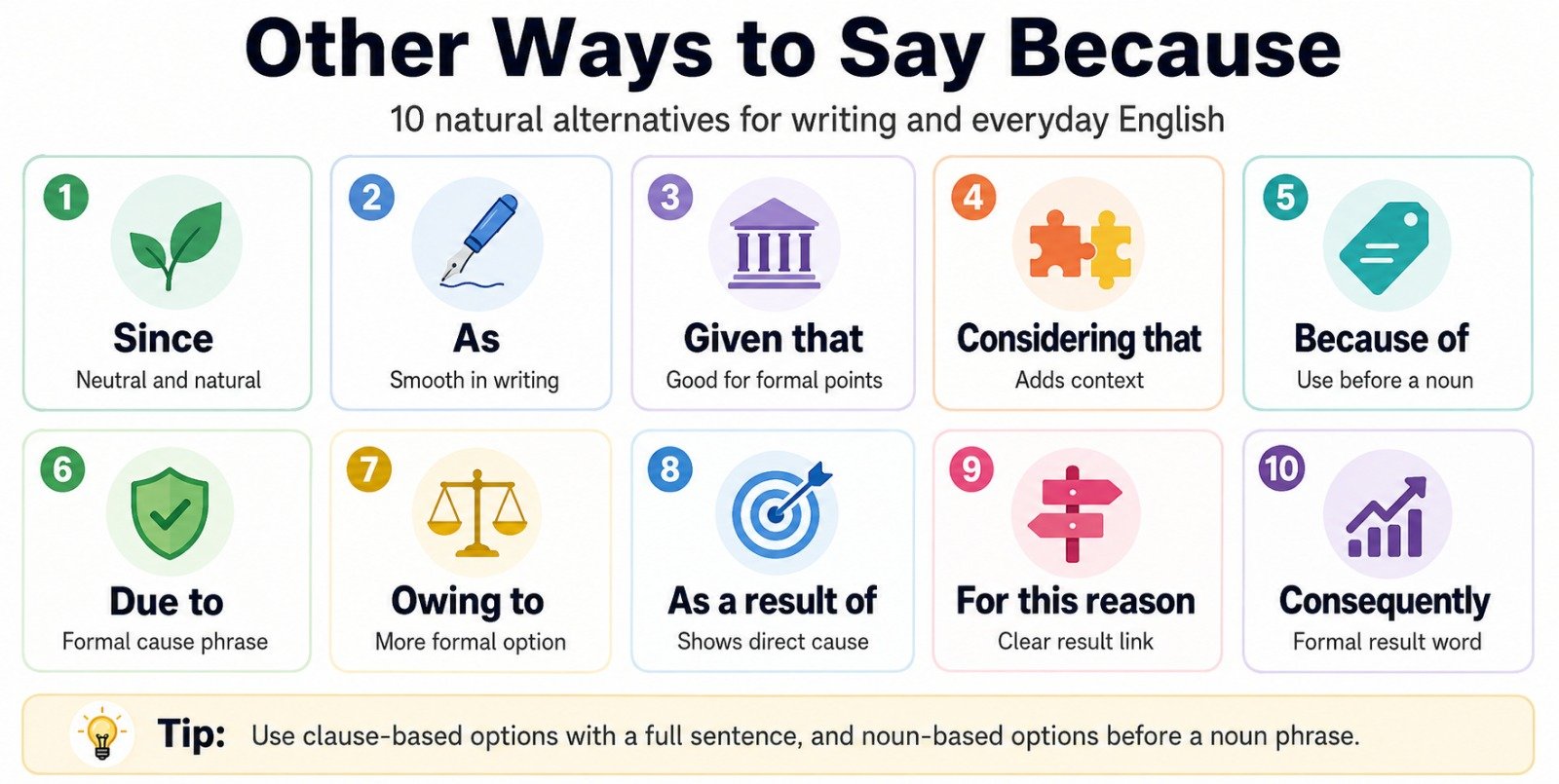
Other Ways to Say Because: 35 Natural Alternatives for Writing and Conversation
“Because” is one of the clearest words in English for explaining a reason, but using it repeatedly can make an essay, email, report, or conversation sound repetitive. The best other ways to say because depend on sentence structure, tone, and whether you are introducing a cause or describing its result.
Some alternatives, such as since, as, and given that, can introduce a complete clause. Others, including due to, owing to, and because of, normally come before a noun or noun phrase. Choosing correctly matters because many words associated with cause and effect are related without being grammatically interchangeable.
A Quick Comparison of Alternatives to Because
The table below shows which expressions work naturally in different situations and, importantly, what should follow them.
| Alternative | Tone | Grammar Pattern | Best Used For |
|---|---|---|---|
| Since | Neutral | Since + clause | Everyday and written English |
| As | Neutral/Formal | As + clause | Smooth explanations |
| Given that | Formal | Given that + clause | Essays, reports, professional writing |
| Considering that | Neutral/Formal | Considering that + clause | Adding context to a reason |
| Seeing that | Conversational | Seeing that + clause | Informal explanations |
| For | Formal/Literary | Independent clause + for + clause | Formal or literary writing |
| Because of | Neutral | Because of + noun phrase | Direct causes |
| Due to | Neutral/Formal | Due to + noun phrase | Reports and formal writing |
| Owing to | Formal | Owing to + noun phrase | Formal explanations |
| On account of | Neutral/Formal | On account of + noun phrase | Explaining circumstances |
| As a result of | Neutral/Formal | As a result of + noun phrase | Clear cause-and-effect relationships |
| Thanks to | Neutral | Thanks to + noun phrase | Usually positive causes |
| In light of | Formal | In light of + noun phrase | Decisions based on circumstances |
| By virtue of | Very formal | By virtue of + noun phrase | Legal or highly formal contexts |
| On the grounds that | Formal | On the grounds that + clause | Decisions and justifications |
Common Other Ways to Say Because
For most readers, the most useful alternatives are the ones that sound natural without making a sentence unnecessarily formal.
Other Ways to Say Because: Since
Since is one of the easiest substitutes when the reason is already known or is not the main point of the sentence.
Example:
“Since the office was closed, we returned the following morning.”
Compare that with:
“The office was closed because of a power failure.”
The first uses a clause after since, while the second uses a noun phrase after because of.
Other Ways to Say Because: As
As can introduce a reason in a smooth, understated way. It is common in written English, though it can occasionally be ambiguous because as has several other meanings.
Example:
“As the weather was getting worse, we decided to leave early.”
When absolute clarity is important, because may still be the better choice.
Other Ways to Say Because: Given That
Given that means that a particular fact or circumstance should be taken into consideration.
Example:
“Given that the deadline is tomorrow, we should finish the review today.”
It works especially well when the reason is something the reader should already recognize as relevant.
Other Ways to Say Because: Considering That
Considering that is useful when you want to frame the reason as an important circumstance rather than a simple cause.
Example:
“Considering that she had very little preparation time, her presentation was impressive.”
It often carries the sense of “when you take this fact into account.”
Other Ways to Say Because: Seeing That
Seeing that is conversational and works best when the reason seems obvious or already established.
Example:
“Seeing that everyone is here, we can start the meeting.”
It can sound too casual for highly formal academic writing.
Other Ways to Say Because: For
For can introduce an explanation, but it is more literary and formal than because.
Example:
“We decided to return home, for the road conditions were becoming dangerous.”
In ordinary conversation, most people would naturally use because or since instead.
Other Ways to Say Because in an Essay
Essay writing often benefits from variety, but replacing every occurrence of because is unnecessary. The goal should be precision, not simply avoiding repetition.
Other Ways to Say Because in an Essay: Given That
Given that is particularly useful when introducing an accepted fact or a condition that supports an argument.
Example:
“Given that access to education affects long-term employment outcomes, policymakers should consider affordability when designing new programs.”
This wording sounds analytical without becoming overly complicated.
Other Ways to Say Because in an Essay: Since
Since is concise and natural in academic prose.
Example:
“Since the sample size was relatively small, the results should be interpreted cautiously.”
However, since can also refer to time, as in “since 2020.” If that creates ambiguity, use because instead.
Other Ways to Say Because in an Essay: Considering That
This phrase works when a writer wants readers to weigh a circumstance before accepting a conclusion.
Example:
“Considering that the two groups received different levels of training, a direct comparison may be misleading.”
It is especially helpful in analytical and argumentative essays.
Other Ways to Say Because in an Essay: In Light of
In light of normally precedes a noun or noun phrase rather than a complete clause.
Example:
“In light of the new evidence, the original conclusion deserves reconsideration.”
It is useful when an action, interpretation, or decision changes because new information has become available.
Other Ways to Say Because in an Essay: Owing to
Owing to has a formal tone and works before a noun phrase.
Example:
“The experiment was postponed owing to equipment failure.”
It can add variety in reports and formal essays, but repeating it frequently may make prose sound stiff.
Other Ways to Say Because in an Essay: As a Result Of
As a result of highlights a direct cause-and-effect relationship.
Example:
“Consumer confidence declined as a result of continued economic uncertainty.”
It is especially appropriate when the causal relationship itself matters to the argument.
Alternatives That Come Before a Noun
One of the easiest ways to choose the correct expression is to check what comes immediately afterward.
Other Ways to Say Because Before a Noun: Due To
Due to commonly introduces the cause of a situation.
Example:
“The flight was delayed due to severe weather.”
The phrase is widely used in modern English, particularly in business, journalism, and formal communication.
Other Ways to Say Because Before a Noun: Owing To
Owing to functions similarly but often sounds more formal.
Example:
“The event was canceled owing to safety concerns.”
It fits reports and formal announcements better than relaxed conversation.
Other Ways to Say Because Before a Noun: On Account Of
On account of means “because of.”
Example:
“The park remained closed on account of flooding.”
It is correct and natural, although slightly less common than because of or due to in everyday speech.
Other Ways to Say Because Before a Noun: Thanks To
Thanks to generally introduces a positive or beneficial cause.
Example:
“Thanks to your careful planning, the project finished ahead of schedule.”
It can also be used sarcastically:
“Thanks to the traffic, we missed the beginning of the show.”
Because tone changes the meaning, use it carefully in formal writing.
Other Ways to Say Because of This
Because of this usually refers back to an idea or event already mentioned. In this context, the best alternatives often introduce a consequence rather than another reason.
Consider:
“The server stopped working. Because of this, customers could not place orders.”
Several alternatives can make the connection smoother.
Other Ways to Say Because of This: As a Result
As a result clearly introduces the consequence of the previous statement.
Example:
“The server stopped working. As a result, customers could not place orders.”
It is suitable for essays, reports, business writing, and general prose.
Other Ways to Say Because of This: Therefore
Therefore presents a logical consequence.
Example:
“The evidence was incomplete. Therefore, the committee postponed its decision.”
It is more formal than because of this and works particularly well in analytical writing.
Other Ways to Say Because of This: Consequently
Consequently means that something happened as a consequence of what came before.
Example:
“Several suppliers increased their prices. Consequently, production costs rose.”
Its formal tone makes it particularly useful in reports and essays.
Other Ways to Say Because of This: For This Reason
For this reason is direct and readable.
Example:
“The bridge requires extensive repairs. For this reason, it will remain closed until September.”
It is often a good choice when therefore feels too formal.
Other Ways to Say Because of This: Accordingly
Accordingly indicates that an action or result follows logically from known circumstances.
Example:
“Demand has fallen considerably. Accordingly, the company has adjusted its production schedule.”
It works best in professional and formal contexts.
Other Ways to Say Because of That
Because of that has nearly the same conversational function as because of this, with that usually referring to something slightly less immediate in the discussion.
Other Ways to Say Because of That: For That Reason
For that reason is one of the closest natural alternatives.
Example:
“He had already committed to another project. For that reason, he declined the offer.”
Other Ways to Say Because of That: As a Consequence
This expression emphasizes that one event produced another.
Example:
“The company ignored several early warnings. As a consequence, the problem became more expensive to fix.”
Other Ways to Say Because of That: This Led To
This led to is especially useful when describing a sequence of events.
Example:
“Several key employees left within the same month. This led to delays across multiple projects.”
Unlike a simple synonym, it explicitly expresses progression from cause to result.
Other Ways to Say Because of That: Consequently
Consequently offers a concise formal alternative.
Example:
“The application was submitted after the deadline. Consequently, it could not be considered.”
Because vs. Because Of
Although the expressions look similar, their grammatical structures are different.
Use because before a complete clause containing a subject and verb:
Correct:
“We left because the weather was getting worse.”
Use because of before a noun, pronoun, or noun phrase:
Correct:
“We left because of the worsening weather.”
A common mistake is:
Incorrect:
“We left because of the weather was getting worse.”
You could correct it as either:
“We left because the weather was getting worse.”
or:
“We left because of the worsening weather.”
Understanding this difference also makes it easier to use alternatives such as due to, owing to, and as a result of correctly.
Cause Words and Result Words Are Not the Same
Not every expression connected with cause and effect is a direct synonym for because.
Compare these sentences:
“Sales fell because demand weakened.”
“Demand weakened. Therefore, sales fell.”
The meaning is closely related, but the grammar is different. Because introduces the cause within a sentence, whereas therefore connects an established cause with its result.
The same is generally true of consequently, thus, hence, and as a result. They are excellent alternatives when restructuring a sentence, but they cannot simply be dropped into every position where because appears.
How to Choose the Right Alternative
Choosing among the many other ways to say because becomes easier when you consider what kind of sentence you are writing.
For everyday speech, because, since, and as usually sound the most natural. If the reason must be unmistakably clear, because remains hard to beat.
In academic writing, given that, considering that, since, in light of, and as a result of can provide useful variety. The best option depends on whether the words following the expression form a clause or a noun phrase.
Professional writing generally favors clarity over elaborate wording. Due to, given that, as a result, and for this reason tend to sound polished without being unnecessarily complicated.
Very formal expressions such as inasmuch as, by virtue of, and on the grounds that should be reserved for contexts where that level of formality is genuinely appropriate.
Common Mistakes When Replacing Because
Other Ways to Say Because Should Match the Grammar
Do not replace because with an expression that requires a different grammatical structure.
Incorrect:
“Due to she was ill, she stayed home.”
Correct:
“Because she was ill, she stayed home.”
Or:
“Due to her illness, she stayed home.”
Other Ways to Say Because Should Preserve the Meaning
A phrase may be grammatically possible without conveying exactly the same idea.
For instance, thanks to commonly suggests that the cause produced a desirable result:
“Thanks to their support, we completed the project.”
Using it for an unpleasant outcome may sound sarcastic.
Other Ways to Say Because Should Fit the Tone
A simple conversation rarely needs a phrase such as inasmuch as.
Natural:
“Since you’re already here, let’s start.”
Unnecessarily formal:
“Inasmuch as you are already present, let us commence.”
The second sentence may be grammatically acceptable, but it does not sound natural in an ordinary conversation.
Useful Alternatives by Situation
Other Ways to Say Because in Formal Writing
Useful options include:
- Given that
- Owing to
- In light of
- As a result of
- On the grounds that
- By virtue of
- Considering that
These expressions are most effective when their slightly formal tone matches the document.
Other Ways to Say Because in Everyday English
Natural choices include:
- Since
- As
- Seeing that
- Now that
- Because of
For ordinary conversation, simple wording is usually preferable to impressive-sounding vocabulary.
Other Ways to Say Because in Professional Communication
Useful workplace options include:
- Due to
- Given that
- Considering that
- As a result
- For this reason
- In light of
For example:
“Given that the client requested additional changes, we have revised the delivery schedule.”
Or:
“The client requested additional changes. As a result, we have revised the delivery schedule.”
Both are professional, but they organize the cause-and-effect relationship differently.
Frequently Asked Questions
What Are Other Ways to Say Because?
Common alternatives include since, as, given that, considering that, seeing that, and for. When followed by a noun phrase, options such as due to, owing to, on account of, and as a result of may be appropriate.
What Are Other Ways to Say Because in an Essay?
Useful choices for essays include since, given that, considering that, in light of, owing to, and as a result of. Select one according to sentence structure and the level of formality you need.
What Is a Formal Alternative to Because?
Given that is a natural formal alternative before a clause, while owing to, in light of, and as a result of work well before noun phrases. On the grounds that can be appropriate when giving a formal justification.
Can I Use Since Instead of Because?
Often, yes. For example, “Since it was raining, we stayed inside” expresses essentially the same reason as “Because it was raining, we stayed inside.” However, since can also refer to time, so because may be clearer if the sentence could be misunderstood.
What Are Other Ways to Say Because of This?
Depending on the sentence, you can use as a result, therefore, consequently, for this reason, accordingly, or as a consequence. These usually introduce a result rather than functioning as direct grammatical replacements.
What Are Other Ways to Say Because of That?
Natural alternatives include for that reason, as a result, consequently, as a consequence, and this led to. The best choice depends on how directly you want to connect the cause with its outcome.
Is “Due To” the Same as “Because”?
Not grammatically. Because normally introduces a clause: “We stayed home because it was raining.” Due to generally precedes a noun phrase: “The cancellation was due to rain.”
Can “Therefore” Replace “Because”?
Not directly in most sentences. Because introduces a reason, while therefore introduces a logical result. You normally need to restructure the sentence when changing from one to the other.
Is “As” Always a Good Replacement for Because?
No. As can mean “because,” but it also has other meanings involving time, manner, or comparison. When there is any risk of ambiguity, because is clearer.
Conclusion
There is no single replacement that works everywhere. The most natural other ways to say because depend on whether you are introducing a clause, a noun phrase, or the consequence of an earlier statement. Since and as work well in many ordinary sentences, given that and considering that fit thoughtful or formal writing, while due to, owing to, and as a result of are useful before noun phrases. For consequences, therefore, consequently, and for this reason may be the stronger choice.
The key is not to replace “because” merely for variety, but to choose wording that preserves the intended meaning and sounds right for the audience. At Clarifyra, those small differences in grammar, tone, and context are what make it easier to say exactly what you mean.
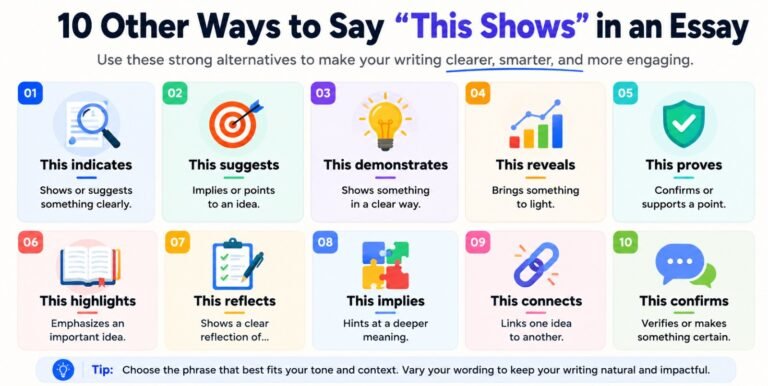
Also Read | Other Ways to Say “This Shows” in an Essay: 25 Better Alternatives