Have a Good Day: Meaning, Better Alternatives, Translations and Examples
“Have a good day” is one of the simplest ways to end a conversation on a positive note. It works with coworkers, customers, friends, family members, and even strangers, which is why it appears so often in everyday English.
Still, the phrase can sound warmer, more professional, more casual, or more personal depending on how you word it. It also raises practical questions such as what it means exactly, how to say it in Spanish or French, and when expressions like “Have a great day” or “Have a good one” may fit better.
What Does “Have a Good Day” Mean?
“Have a good day” is a polite wish for someone to experience a pleasant, successful, or enjoyable day.
You normally say it when a conversation is ending rather than when it is beginning.
For example:
- “Thanks for stopping by. Have a good day!”
- “I’ll send you the document this afternoon. Have a good day.”
- “See you tomorrow. Have a good day at work.”
The expression does not usually imply anything specific. You are not necessarily wishing someone success with a particular task. You are simply expressing goodwill about the rest of their day.
That makes it different from phrases such as:
- Good luck with the interview — focused on one event.
- Hope the meeting goes well — focused on a specific situation.
- Have a safe trip — focused on travel.
- Take care — a broader farewell concerned with someone’s well-being.
Is “Have a Good Day” Formal or Casual?
It is best described as neutral and polite.
You can use it in:
- shops and restaurants,
- customer-service conversations,
- workplace chats,
- emails,
- phone calls,
- messages to friends,
- conversations with people you do not know well.
It is friendly without being overly personal.
“Have a Good Day” Compared With Similar Expressions
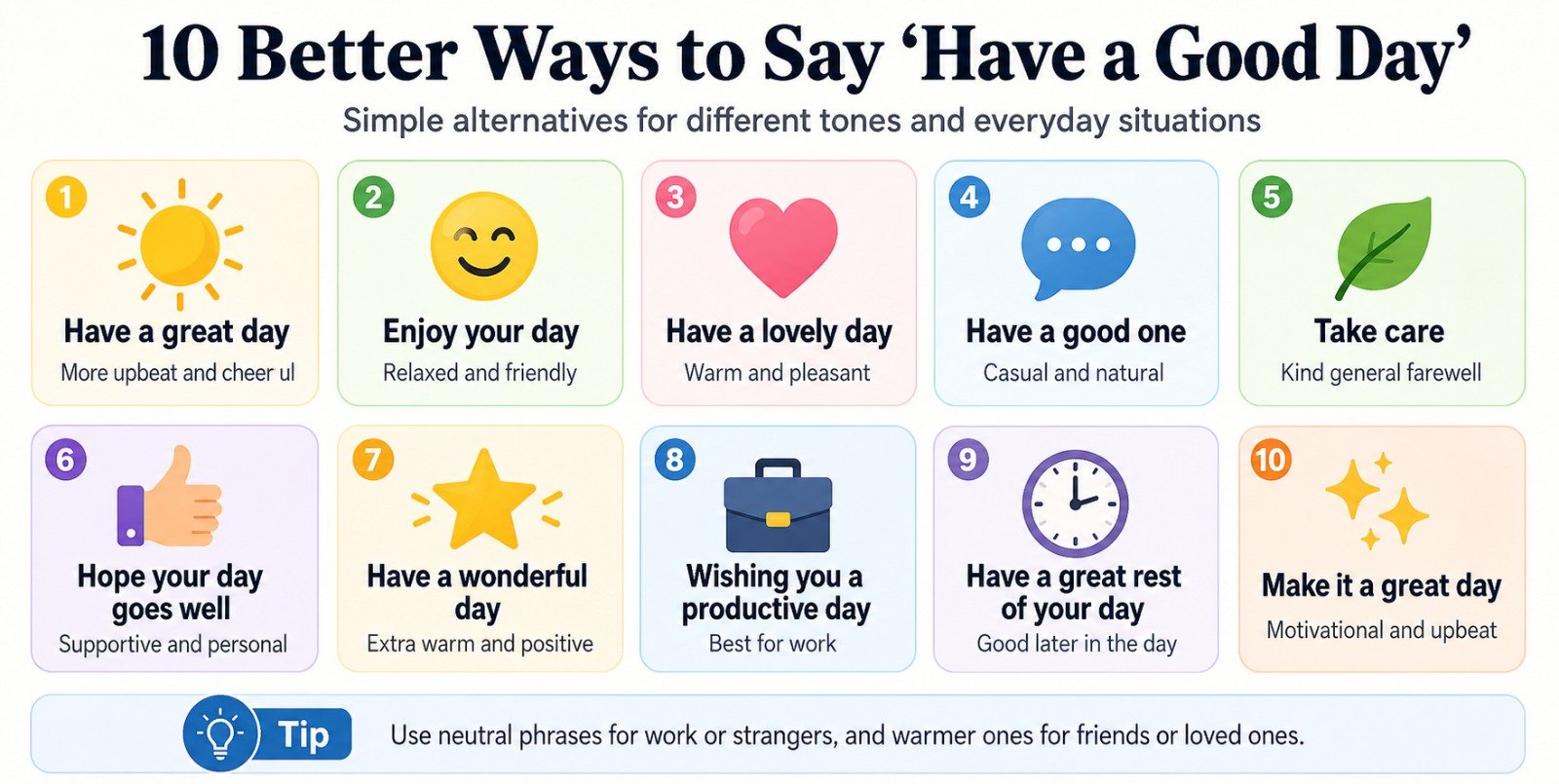
Not every alternative carries exactly the same tone. A phrase that works naturally with a close friend may sound too casual in a formal email, while an enthusiastic expression may feel excessive during a routine business interaction.
| Expression | Tone | Best Used For | Important Difference |
|---|---|---|---|
| Have a good day | Neutral, friendly | Almost any everyday situation | Safe general choice |
| Have a nice day | Polite, conventional | Customers, strangers, service settings | Slightly more traditional |
| Have a great day | Warm, upbeat | Friends, coworkers, customers | More enthusiastic |
| Enjoy your day | Friendly, relaxed | Casual and everyday situations | Emphasizes enjoyment |
| Have a wonderful day | Warm, expressive | Personal messages | More affectionate |
| Have a good one | Very casual | Friends and informal conversation | Less suitable for formal writing |
| Hope your day goes well | Supportive | Work, friends, someone facing a busy day | Sounds more personal |
| Take care | Warm but broad | Farewells of many kinds | Not specifically about the day |
| Wishing you a productive day | Professional | Workplace communication | Focuses on productivity rather than enjoyment |
| Make it a great day | Motivational | Encouraging messages | Suggests personal agency |
Better Ways to Say “Have a Good Day”
You do not need to replace the expression every time. “Have a good day” is already natural English. Alternatives are most useful when you want to adjust the tone.
Friendly Everyday Alternatives
Have a great day
A little more enthusiastic than the original.
“Thanks for meeting me for lunch. Have a great day!”
Enjoy your day
Relaxed and friendly without sounding overly enthusiastic.
“Everything is sorted now. Enjoy your day!”
Hope you have a good day
Adding “hope” makes the wish feel slightly more personal.
“You’ve got a busy morning ahead. Hope you have a good day.”
Hope your day goes well
This works especially well when you know someone has work, school, appointments, or other plans ahead.
“Good luck getting everything finished. Hope your day goes well.”
Have a lovely day
Warm and pleasant. It can sound slightly softer than “Have a great day.”
“It was nice talking to you. Have a lovely day.”
Casual Ways to Say It
Have a good one
Very common in informal spoken English.
“I’m heading out. Have a good one!”
It does not literally mention “day,” so it can sometimes also refer loosely to the evening, weekend, or whatever period follows.
Enjoy!
Useful when the other person is about to do something pleasant.
“You’re heading to the beach? Enjoy!”
It is not a direct replacement in every situation because it needs an obvious enjoyable activity or context.
Take it easy
A relaxed farewell that can suggest resting or not overworking.
“You’ve done enough for today. Take it easy.”
Again, this does not mean exactly the same thing as “Have a good day.”
Catch you later
Suitable when you expect to speak again.
“I’ve got to go. Catch you later!”
This is a farewell, not a wish for someone’s day, so use it only when that distinction fits.
Professional Ways to End a Conversation Positively
“Have a good day” is completely acceptable in professional settings, but there are times when you may want wording that feels slightly more polished.
Have a great rest of your day
Natural when the day is already underway.
“Thank you for your time this morning. Have a great rest of your day.”
Wishing you a productive day
Appropriate when work or productivity is relevant.
“I’ve attached the revised schedule. Wishing you a productive day.”
This expression may sound strange in a purely social situation because it emphasizes work rather than enjoyment.
Hope the rest of your day goes smoothly
Useful after helping someone resolve a problem.
“Your account has now been updated. I hope the rest of your day goes smoothly.”
All the best for the rest of your day
Polite and slightly more formal.
“Thank you again for your assistance. All the best for the rest of your day.”
Take care
A concise professional closing when you want warmth without sounding overly familiar.
“I appreciate the update. Take care.”
Sweet and Warm Alternatives
When you are writing to someone you care about, a standard farewell may feel a little impersonal.
You could say:
- Hope today treats you kindly.
- Have the loveliest day.
- Hope something good happens to you today.
- Wishing you a peaceful day.
- Hope your day is full of good moments.
- Have an amazing day, you deserve it.
- Sending you good thoughts for today.
- Hope your day makes you smile.
- Make today a beautiful one.
- Thinking of you. Have a wonderful day.
For a partner:
“Hope work goes quickly today. Have an amazing day, love.”
For a close friend:
“You’ve got this. Hope today is a really good one.”
These options are warmer than the neutral original and may not suit customers, unfamiliar colleagues, or formal correspondence.
Is “A Have a Good Day” Correct?
The wording “a have a good day” is generally incorrect when you are trying to use the phrase as a farewell.
Incorrect:
“I wish you a have a good day.”
Correct:
“I hope you have a good day.”
Correct:
“Have a good day.”
Correct:
“Wishing you a good day.”
The article “a” belongs before the noun phrase “good day,” not before the entire verb phrase “have a good day.”
There are rare situations where words may be hyphenated and used descriptively, such as:
“She sent him a have-a-good-day message.”
That is possible as creative wording, but it is not the standard form people should use when simply wishing someone well.
Have a Good Day in Spanish
A natural way to say “Have a good day” in Spanish is:
Que tengas un buen día.
It is appropriate in informal situations when speaking to one person.
A more formal version is:
Que tenga un buen día.
The difference comes from the form of address:
- tengas corresponds to informal tú
- tenga corresponds to formal usted
How Do You Say “Have a Good Day” in Spanish Naturally?
Useful expressions include:
| Spanish | Natural English Meaning | Context |
| Que tengas un buen día | Have a good day | Informal, one person |
| Que tenga un buen día | Have a good day | Formal, one person |
| Que pasen un buen día | Have a good day | Addressing multiple people |
| Que pases un buen día | Have a good day / Enjoy your day | Informal |
| Buen día | Good day | Greeting in some regions and contexts |
Que tengas un buen día is a safe choice when talking casually to someone you know.
Example:
“Nos vemos mañana. ¡Que tengas un buen día!”
“See you tomorrow. Have a good day!”
A word-for-word translation is not always the best guide when switching languages. Spanish grammar and levels of formality determine which version sounds natural.
Have a Good Day in French
The most natural everyday French expression is:
Bonne journée !
Although it translates literally more closely to “Good day,” its practical use often corresponds to English “Have a good day.”
For example:
“Merci, au revoir. Bonne journée !”
“Thank you, goodbye. Have a good day!”
Another option is:
Passe une bonne journée !
This is informal and means “Have a good day” or “Spend a good day.”
For a formal or plural form:
Passez une bonne journée !
Bonjour vs Bonne Journée
These expressions are easy for English speakers to confuse.
Bonjour is mainly used as a greeting:
“Bonjour, Madame.”
“Hello/Good morning, ma’am.”
Bonne journée is normally used when leaving:
“Au revoir. Bonne journée !”
“Goodbye. Have a good day!”
So if you want to wish someone well as the conversation ends, bonne journée is usually the better phrase.
How Do You Say “Have a Good Day” in Sign Language?
There is no single universal sign language used everywhere in the world.
American Sign Language (ASL), British Sign Language (BSL), Auslan, and other sign languages are distinct languages with their own grammar and vocabulary.
If you mean American Sign Language, the idea of “Have a good day” can be communicated using ASL signs associated with GOOD and DAY, but English should not automatically be translated word for word into ASL.
That distinction matters because ASL has its own grammatical structure rather than being spoken English represented with hand movements.
For accurate learning, use a reputable ASL dictionary or instruction from a qualified Deaf or ASL educator, particularly when you need the complete phrase rather than isolated signs.
What Is a “Have a Good Day” GIF?
A Have a Good Day GIF is an animated image sent to wish someone a pleasant day.
Instead of sending only:
“Have a good day!”
you might send an animation featuring:
- sunshine,
- flowers,
- coffee,
- a waving character,
- a smiling animal,
- hearts,
- encouraging gestures,
- funny reactions.
GIFs work especially well in casual digital communication because they add emotion that plain text may not convey.
When a GIF Works Well
A GIF can make sense when messaging:
- a partner,
- a family member,
- a friend,
- a close coworker,
- a group chat.
It is usually less appropriate in a formal business email unless your workplace culture is already casual.
For example:
“Hope the presentation goes well today! Have a great day ☀️”
A positive animated GIF could naturally accompany that message.
What Is a “Have a Good Day” Meme?
A Have a Good Day meme combines the positive message with humor, irony, a reaction image, or a familiar internet format.
Unlike a straightforward GIF, a meme may intentionally make the phrase funny.
For instance, a meme could contrast the cheerful words “Have a good day” with an exaggerated picture of someone struggling through Monday morning.
The meaning depends heavily on the image.
A meme may communicate:
- sincere positivity,
- playful sarcasm,
- work humor,
- Monday frustration,
- encouragement,
- exaggerated cheerfulness.
That makes memes better suited to friends, social media, and casual chats than to formal communication.
“Today Is a Good Day to Have a Good Day” Meaning
“Today is a good day to have a good day” is a motivational saying built around deliberate repetition.
It means that the present day is an opportunity to choose a positive attitude, notice good moments, and make the best of what happens.
It does not literally guarantee that the day will be easy.
The idea is closer to:
“Approach today with a positive mindset.”
You may see the phrase on:
- motivational graphics,
- mugs,
- posters,
- social-media captions,
- morning messages,
- journals,
- workplace signs.
Example:
“Fresh coffee, clear skies, and no meetings until noon. Today is a good day to have a good day.”
What Does “It’s a Good Day to Have a Good Day” Mean?
“It’s a good day to have a good day” expresses essentially the same motivational idea.
The repetition is intentional. That is what makes the sentence catchy and memorable.
It can sound cheerful, optimistic, or slightly playful.
For example:
“The weekend starts tonight. It’s a good day to have a good day.”
It works well as a caption or encouraging message but would sound too slogan-like in most formal correspondence.
Choosing the Right Expression
A useful alternative should match the relationship and situation rather than simply sounding different.
If you are talking to a customer, “Have a good day” is safe and natural.
If you are talking to a friend, “Have a good one” may sound more relaxed.
If you are messaging your partner, “Hope you have a beautiful day” can feel warmer.
If someone has a difficult schedule ahead, “Hope your day goes smoothly” shows more awareness of their situation.
And if you are ending a professional email, “Have a great rest of your day” can sound friendly without becoming overly personal.
That is why alternatives should not be treated as exact synonyms. Tone matters just as much as dictionary meaning.
Common Mistakes to Avoid
Using an overly warm expression with a stranger
“Have the most beautiful day ever!” may be friendly, but it can feel excessive during an ordinary customer-service exchange.
Use:
“Have a great day.”
Using “Have a good one” in very formal writing
This phrase is natural in speech but may feel too casual in a formal business letter.
Prefer:
“Wishing you a pleasant day.”
Confusing French greetings and farewells
Use bonjour when greeting someone and bonne journée when wishing them a pleasant day as you leave.
Translating sign language word for word
Sign languages have their own grammar. Individual English words should not automatically be strung together as though they were spoken English.
Assuming “Take care” means exactly the same thing
“Take care” is a farewell expressing general goodwill. It does not specifically mean that you hope someone enjoys their day.
Natural Examples in Different Situations
At a Shop
“Here’s your receipt. Have a good day!”
With a Coworker
“I’ve sent over the final version. Have a great afternoon.”
In an Email
“Thanks again for your help. Have a great rest of your day.”
To a Friend
“I’ve got to run. Have a good one!”
To Your Partner
“Hope everything goes smoothly at work. Have an amazing day ❤️”
Before an Important Event
“Good luck with your interview. Hope the rest of your day goes brilliantly.”
Notice that the last example gives a more specific wish than simply saying “Have a good day.”
Frequently Asked Questions
Is “Have a good day” grammatically correct?
Yes. “Have a good day” is a grammatically correct imperative expression commonly used as a polite farewell. The subject “you” is understood rather than spoken: “(You) have a good day.”
Is “Have a good day” polite?
Yes. It is friendly, neutral, and appropriate in most everyday interactions, including workplaces, shops, phone calls, and casual emails.
What is another way to say “Have a good day”?
Natural alternatives include “Have a great day,” “Enjoy your day,” “Have a lovely day,” “Hope your day goes well,” and “Have a good one.” The best choice depends on how formal or personal you want to sound.
Which is better: “Have a nice day” or “Have a good day”?
Neither is universally better. Both are polite. “Have a nice day” can sound slightly more conventional, while “Have a good day” is extremely neutral and versatile.
Can I say “Have a good day” in an email?
Yes. It works well in friendly and professional emails, especially near the closing. For a slightly warmer variation, try “Have a great rest of your day.”
How do you say “Have a good day” in Spanish?
A common informal expression is “Que tengas un buen día.” A formal version addressed to one person is “Que tenga un buen día.”
How do you say “Have a good day” in French?
A very natural expression is “Bonne journée !” You can also say “Passe une bonne journée !” informally or “Passez une bonne journée !” formally or to multiple people.
Can “Have a good day” sound rude or sarcastic?
It can if your tone, context, or previous words make it sound dismissive. The phrase itself is polite, but spoken emphasis can change how it is interpreted.
For example, an irritated “Fine. Have a good day.” may sound like an attempt to end the conversation abruptly.
Is “Have a good one” the same as “Have a good day”?
They are similar in many casual situations, but “Have a good one” is less specific and more informal. “One” may refer generally to the day, evening, weekend, or whatever comes next.
Final Thoughts
“Have a good day” remains one of the easiest and most versatile English farewells because it works across so many relationships and situations. You only need an alternative when you want to make your message warmer, more casual, more professional, or more specific to what the other person is about to do.
A friend may appreciate “Have a good one,” a colleague may suit “Hope your day goes smoothly,” and someone close to you may respond better to “Hope you have a beautiful day.” Understanding those small changes in tone is exactly the kind of wording choice Clarifyra is designed to make clearer, so your message sounds right for the person and the moment.
Also Read | 100+ Other Ways to Say “Have a Good Day” for Any Situation