Ways to Say Goodnight in Different Languages: 25+ Useful Expressions
Saying goodnight is a small gesture, but it can sound warmer and more personal when you use another language. Some expressions are simple translations of “goodnight,” while others mean “sleep well,” “sweet dreams,” or carry a more affectionate tone. Below are natural ways to say goodnight in different languages, with pronunciations and notes on when each expression fits.
Goodnight in Different Languages: Quick Reference
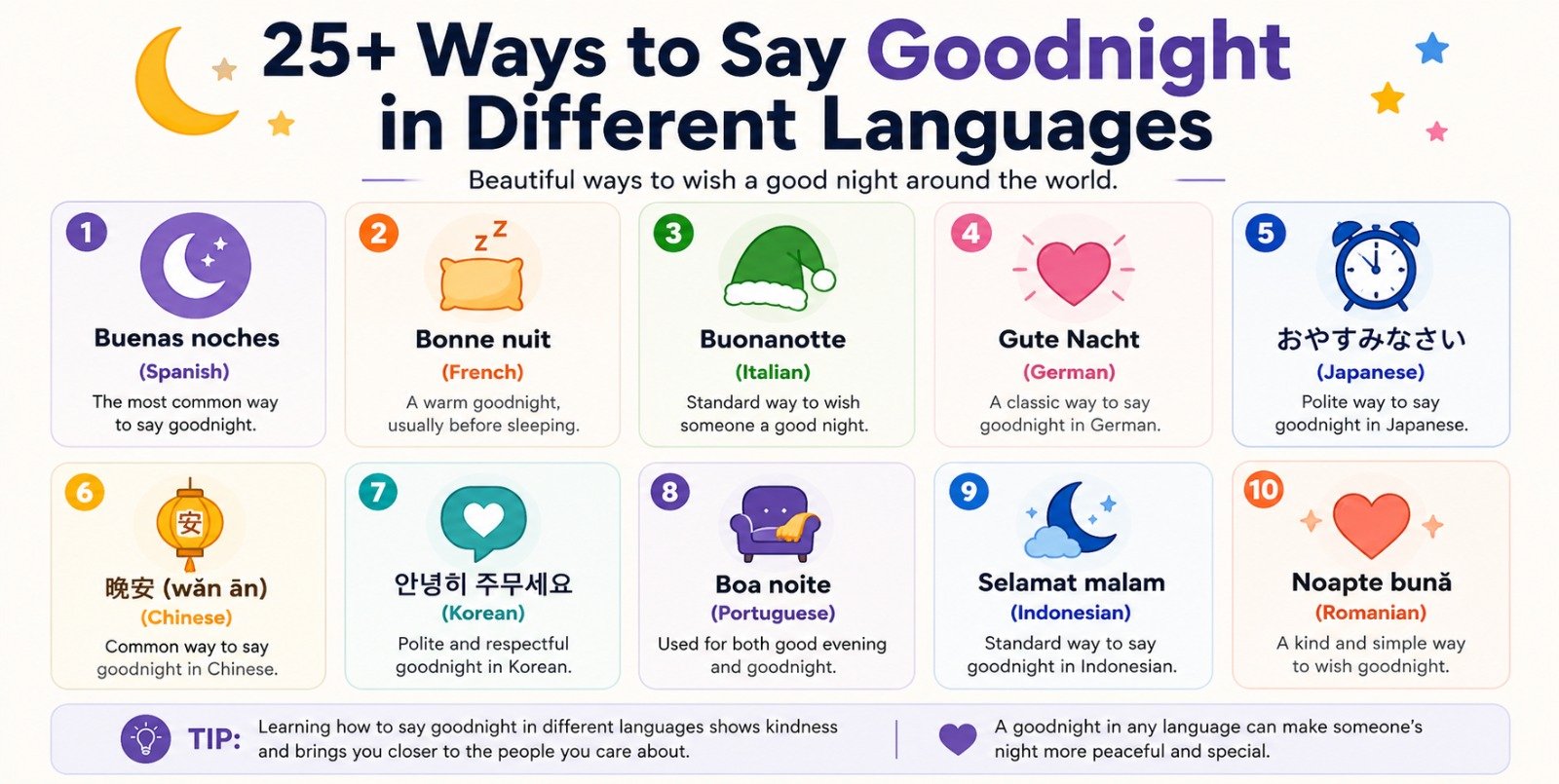
| Language | Goodnight | Pronunciation / Romanization | Typical Use |
|---|---|---|---|
| Spanish | Buenas noches | BWEH-nas NOH-ches | Standard nighttime farewell |
| French | Bonne nuit | bun NWEE | Usually when someone is going to sleep |
| Italian | Buonanotte | bwo-na-NOT-teh | Standard bedtime farewell |
| German | Gute Nacht | GOO-teh nakht | Before bed or late-night farewell |
| Japanese | おやすみなさい | Oyasuminasai | Polite goodnight |
| Mandarin Chinese | 晚安 | wǎn ān | Standard goodnight |
| Korean | 안녕히 주무세요 | annyeonghi jumuseyo | Polite/respectful goodnight |
| Portuguese | Boa noite | BO-ah NOY-teh | Good evening or goodnight |
| Dutch | Goedenacht | KHOO-duh-nakht | Goodnight |
| Greek | Καληνύχτα | Kaliníkhta | Goodnight |
| Russian | Спокойной ночи | Spokoynoy nochi | Wishing someone a peaceful night |
| Polish | Dobranoc | doh-BRAH-nots | Goodnight |
| Swedish | God natt | goo naht | Goodnight |
| Norwegian | God natt | goo naht | Goodnight |
| Danish | Godnat | goh-nat | Goodnight |
| Finnish | Hyvää yötä | HOO-vah OO-uh-tah | Goodnight |
| Turkish | İyi geceler | ee-YEE geh-jeh-LER | Goodnight |
| Indonesian | Selamat malam | suh-LAH-maht MAH-lahm | Good evening/night |
| Romanian | Noapte bună | NWAHP-teh BOO-nuh | Goodnight |
| Hungarian | Jó éjszakát | yoh AY-sa-kaat | Goodnight |
Pronunciations written in English letters are only approximations. Native pronunciation can contain sounds that do not have an exact English equivalent.
Also Read | 100 Funny Ways to Say Goodnight: Fun, Weird and Silly Ideas
Ways to Say Goodnight in Spanish
The standard way to say goodnight in Spanish is:
Buenas noches
It can mean both “good evening” and “goodnight,” depending on when and how it is used.
If you meet someone in the evening, buenas noches can work as a greeting. If you’re leaving late at night or going to bed, the same phrase works as a farewell.
Other natural bedtime expressions include:
- Dulces sueños — Sweet dreams
- Que duermas bien — Sleep well
- Descansa — Get some rest
- Que descanses — Rest well
- Buenas noches y dulces sueños — Goodnight and sweet dreams
Example:
“Buenas noches, nos vemos mañana.”
“Goodnight, see you tomorrow.”
How to Say Goodnight My Love in Spanish
For someone you’re romantically close to, you can say:
Buenas noches, mi amor. — Goodnight, my love.
Other affectionate options include:
- Dulces sueños, mi amor. — Sweet dreams, my love.
- Que duermas bien, cariño. — Sleep well, darling.
- Buenas noches, corazón. — Goodnight, sweetheart.
These expressions are warmer than a neutral buenas noches, so they work best with a partner or someone you already address affectionately.
How to Say Goodnight in Japanese
A standard polite way to say goodnight in Japanese is:
おやすみなさい — Oyasuminasai
It is commonly used when someone is heading to bed.
With close friends, relatives, or people you’re comfortable with, the shorter form is common:
おやすみ — Oyasumi
The difference is mainly one of politeness.
Oyasuminasai — polite
Oyasumi — casual and familiar
Oyasuminasai vs. Konbanwa
These two Japanese expressions are not interchangeable.
こんばんは (Konbanwa) means “good evening.” You might use it when greeting someone at night.
おやすみなさい (Oyasuminasai) means “goodnight” and is associated with ending the day or going to sleep.
For example, you could greet someone at an evening event with konbanwa, but say oyasuminasai to a host or family member before going to bed.
How to Say Goodnight in French
The usual French expression is:
Bonne nuit
It literally corresponds closely to “good night,” but its natural use matters.
French speakers generally use bonne nuit when someone is actually finishing the night or preparing to sleep.
If you’re leaving friends early in the evening and they are continuing their night, bonne soirée is often more appropriate.
Compare:
- Bonsoir — Good evening
- Bonne soirée — Have a nice evening
- Bonne nuit — Goodnight
Example:
“Je vais me coucher. Bonne nuit!”
“I’m going to bed. Goodnight!”
This distinction is important because translating “goodnight” word for word without considering the situation can make an otherwise correct expression sound slightly unnatural.
How to Say Goodnight in Italian
The standard Italian expression is:
Buonanotte
It is commonly used when saying goodbye late at night or when someone is heading to sleep.
Do not confuse it with:
Buonasera — Good evening
Buonasera is normally used when greeting someone during the evening, whereas buonanotte brings the evening to a close.
Other useful expressions include:
- Sogni d’oro — Sweet dreams
- Dormi bene — Sleep well
- Buonanotte, amore mio — Goodnight, my love
Example:
“Buonanotte, ci vediamo domani.”
“Goodnight, we’ll see each other tomorrow.”
Sogni d’oro has a particularly warm, affectionate feel and can be used with family members, children, or someone close to you.
How to Say Goodnight in Chinese
In Mandarin Chinese, one of the clearest ways to say goodnight is:
晚安 — wǎn ān
It is pronounced approximately like “wahn ahn,” although Mandarin tones are important for accurate pronunciation.
- 晚 (wǎn) relates to evening or lateness.
- 安 (ān) carries the sense of peace or safety.
Together, 晚安 functions naturally as “goodnight.”
Example:
“晚安,明天见。”
Wǎn ān, míngtiān jiàn.
“Goodnight, see you tomorrow.”
Because Chinese pronunciation depends on tones, learning the phrase from native audio is more reliable than relying only on English-style pronunciation guides.
How to Say Goodnight in German
The standard German expression is:
Gute Nacht
It is used when someone is going to bed or when you’re saying goodbye at the end of the night.
A common informal alternative is:
Schlaf gut — Sleep well.
You may also encounter:
Träum süß — Sweet dreams / Dream sweetly.
Compare:
- Guten Abend — Good evening
- Gute Nacht — Goodnight
Example:
“Gute Nacht, bis morgen.”
“Goodnight, see you tomorrow.”
Like French and Italian, German makes a useful distinction between an evening greeting and a bedtime farewell.
How to Say Goodnight in Korean
Korean goodnight expressions change depending on the relationship between speakers and the level of politeness required.
A polite expression is:
안녕히 주무세요 — Annyeonghi jumuseyo
It is appropriate when speaking respectfully, such as to parents, older relatives, or someone toward whom you normally use polite speech.
With someone close to you, you may hear:
잘 자 — Jal ja
It means something close to “sleep well” or an informal “goodnight.”
Compare:
안녕히 주무세요 — polite and respectful
잘 자 — casual and familiar
Using the right level of politeness matters more in Korean than simply choosing the closest English translation.
More Ways to Say Goodnight Around the World
Once you move beyond the most commonly learned languages, you’ll find plenty of other useful nighttime expressions.
Portuguese: Boa noite
This can function as “good evening” or “goodnight,” depending on context.
Greek: Καληνύχτα (Kaliníkhta)
A standard way to wish someone goodnight.
Russian: Спокойной ночи (Spokoynoy nochi)
A common bedtime expression that conveys the idea of wishing someone a peaceful night.
Polish: Dobranoc
The standard Polish goodnight.
Dutch: Goedenacht
A standard form of goodnight, though conversational usage may vary by situation.
Turkish: İyi geceler
Used to wish someone a good night.
Romanian: Noapte bună
Literally and naturally used for “goodnight.”
Swedish: God natt
A straightforward way to say goodnight.
These expressions are useful to learn, but knowing a translation is only the first step. The relationship between speakers and the exact moment of the evening can affect what sounds most natural.
Goodnight and Good Evening Aren’t Always the Same
One of the easiest mistakes to make when learning another language is assuming that “good evening” and “goodnight” are interchangeable.
English itself separates them:
“Good evening” generally opens an interaction.
“Goodnight” usually ends one.
Several other languages make a similar distinction:
| Language | Evening Greeting | Nighttime Farewell |
| French | Bonsoir | Bonne nuit |
| Italian | Buonasera | Buonanotte |
| German | Guten Abend | Gute Nacht |
| Japanese | Konbanwa | Oyasuminasai |
Spanish works somewhat differently because buenas noches can often serve both functions.
The safest approach is to learn how a phrase is actually used rather than translating individual words.
Romantic Ways to Say Goodnight in Different Languages
A plain goodnight can become more affectionate by adding words such as “my love” or using an equivalent of “sweet dreams.”
| Language | Romantic Expression | Meaning |
| Spanish | Buenas noches, mi amor | Goodnight, my love |
| French | Bonne nuit, mon amour | Goodnight, my love |
| Italian | Buonanotte, amore mio | Goodnight, my love |
| German | Gute Nacht, mein Schatz | Goodnight, my darling |
| Spanish | Dulces sueños, mi amor | Sweet dreams, my love |
| Italian | Sogni d’oro | Sweet dreams |
A romantic expression should match the relationship. Something equivalent to “my love,” “darling,” or “sweetheart” may sound overly intimate when used with a casual acquaintance.
How to Choose the Right Goodnight Expression
When using goodnight in another language, consider more than the literal translation.
Think about the time. An evening greeting and a bedtime farewell can require different expressions.
Consider your relationship. A phrase you’d use with your partner may sound inappropriate with a coworker or stranger.
Pay attention to formality. Japanese and Korean especially have expressions that change according to politeness and social relationship.
Be careful with literal translations. A phrase can be grammatically understandable without being the expression native speakers normally choose.
Use affectionate phrases selectively. “Sweet dreams” and “my love” communicate more warmth than a neutral goodnight.
Learning these small distinctions will make your wording sound much more natural.
Frequently Asked Questions
What is the most common way to say goodnight in Spanish?
Buenas noches is the standard Spanish expression. Depending on the situation, it can mean either “good evening” or “goodnight.”
How do you say goodnight my love in Spanish?
You can say “Buenas noches, mi amor.” For a more affectionate bedtime message, “Dulces sueños, mi amor” means “Sweet dreams, my love.”
How do Japanese people say goodnight?
A polite expression is おやすみなさい (oyasuminasai). Among close friends and family, the shorter おやすみ (oyasumi) is common.
What is the difference between bonne nuit and bonsoir?
Bonsoir means “good evening” and is normally used as an evening greeting. Bonne nuit means “goodnight” and is more appropriate when someone is leaving for bed or ending their night.
How do you say goodnight in Chinese?
In Mandarin Chinese, 晚安 (wǎn ān) is a common way to say “goodnight.”
What does Gute Nacht mean?
Gute Nacht is German for “goodnight.” Guten Abend, by comparison, means “good evening.”
How do you say goodnight politely in Korean?
A respectful expression is 안녕히 주무세요 (annyeonghi jumuseyo). With close friends or people younger than you, 잘 자 (jal ja) is a more casual option.
Final Thoughts
Learning how to say goodnight in another language is more useful when you also understand the relationship, formality, and timing behind the expression. A standard phrase may work perfectly before bed but sound unusual as an evening greeting, while romantic versions should be reserved for people you’re genuinely close to. Clarifyra focuses on these small differences in meaning and usage so you can choose wording that sounds natural for the situation rather than relying on translation alone.
Also Read | 75 Different Ways to Say Goodnight for Any Situation