Validity Meaning: Definition, Examples and How to Use It
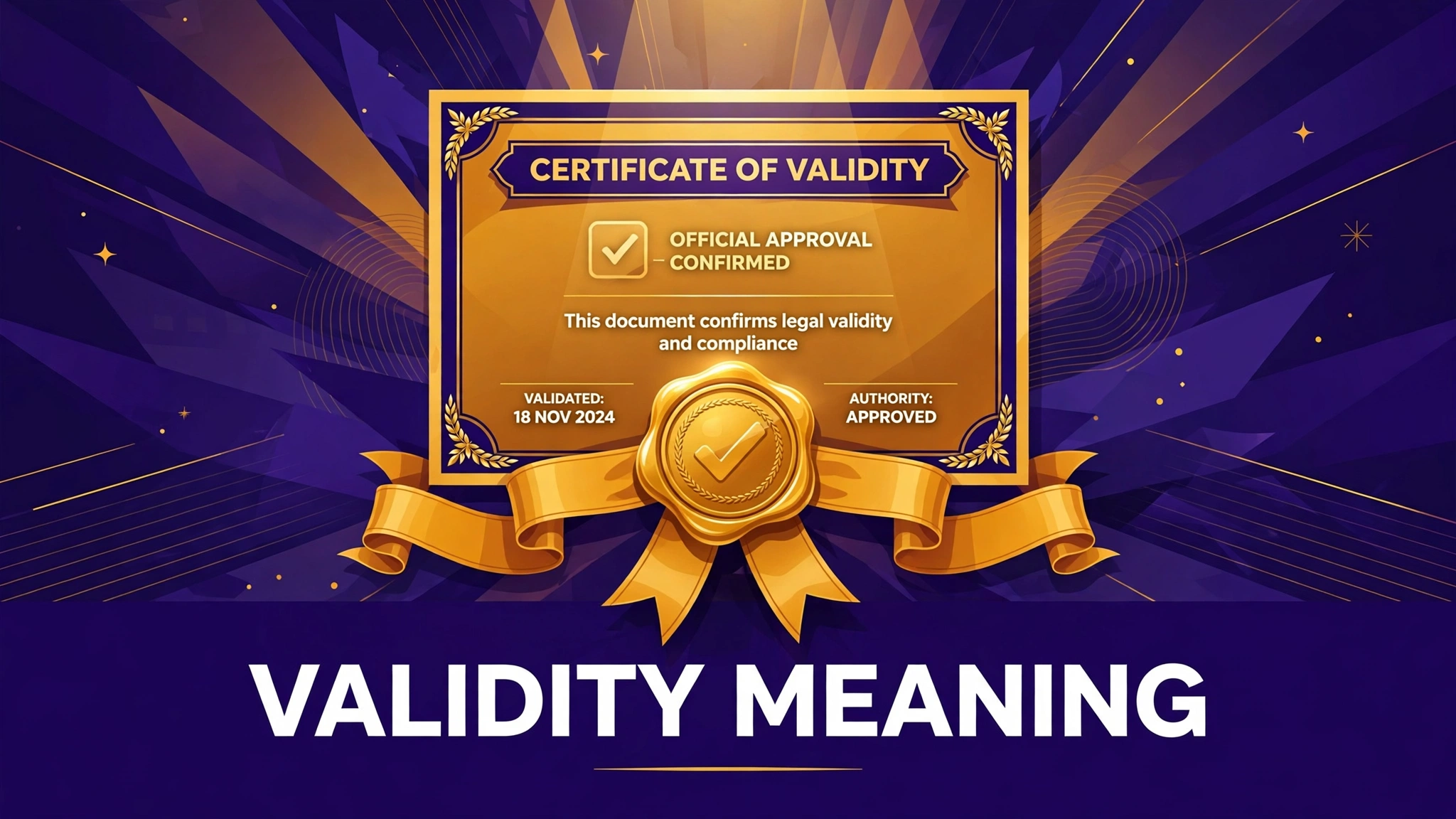
Validity is the noun form of valid: it names the quality of being valid — legally acceptable, logically sound, or genuinely true. A contract’s validity is what makes it enforceable in court. An argument’s validity is what makes its conclusion trustworthy. A test’s validity is what makes its results worth acting on. One word, but it operates in three quite different arenas: law, logic, and everyday judgement.
What the Dictionaries Say About “Validity”
| Dictionary | Definition of validity |
|---|---|
| Merriam-Webster | “The quality or state of being valid: such as a: the state of being acceptable according to the law” (“The validity of the contract is being questioned”) “b: the quality of being well-grounded, sound, or correct” (“the validity of an argument/theory”). |
| Cambridge Dictionary | Noun [U] — “the fact of having legal force, or being legally acceptable” — “Election observers challenged the validity of the vote.” |
| Collins COBUILD | Uncountable noun, usually with a possessive — “this argument has lost much of its validity“. Synonyms: soundness, force, power, grounds. |
Notice the pattern across all three: validity is almost always possessed by something else — the validity of a contract, an argument, a result, a claim. It is a property you assess, challenge, confirm or lose, not a thing you hold in your hand.
The Three Arenas of Validity
1. Legal validity: does it hold up in law? This is the most concrete sense. A contract, licence, passport, ticket or will has validity when it satisfies the legal requirements — proper signatures, correct dates, authorised issuers. “Your passport is no longer valid” means it has lost its legal validity. Lawyers challenge validity; courts uphold or strike down it.
2. Logical validity: does the reasoning hold up? In logic and philosophy, a valid argument is one whose conclusion follows necessarily from its premises — if the premises are true, the conclusion must be true. Note the precision here: a logically valid argument can still have false premises. “All cats are reptiles; Felix is a cat; therefore Felix is a reptile” is logically valid but factually absurd. In everyday use, people stretch validity to mean general soundness: “a valid point”, “the validity of her concerns”.
3. Scientific and testing validity: does it measure what it claims to? Researchers ask whether a test, survey or study has validity — whether it genuinely measures the thing it purports to measure, and whether its results can be trusted. “Researchers questioned the validity of the test results” is Merriam-Webster’s own example. This is the sense behind phrases like face validity (does it look right?) and construct validity (does it capture the real concept?).
How to Pronounce “Validity”
Cambridge gives the British pronunciation as /vəˈlɪd.ə.ti/ — vuh-LID-ih-tee, with the stress on the second syllable. The American pronunciation is /vəˈlɪd.ə.t̬i/ — the same stress pattern, but the t softens toward a quick d sound (vuh-LID-ih-dee) in the American manner.
The common error is stressing the first syllable (“VAL-ih-dih-tee”) by analogy with valid — but the noun shifts the stress to lid. Say vuh-LID-ih-tee, four syllables, stress on the second.
Where the Word Comes From
Collins traces the family to Latin validus, meaning “strong, robust” — from valēre, “to be strong, be well” (the same root that gives us valour and the farewell vale). Merriam-Webster notes valid entered English in 1571, via Middle French valide, “in good health, having legal force”.
The history is revealing: validity began as strength — the strength of a body, then the strength of a legal claim, then the strength of an argument. When you question the validity of a report, you are asking, in the word’s oldest sense, whether it is strong enough to stand.
“Validity” in Sentences: Examples Across Registers
Legal and official:
- Election observers challenged the validity of the vote.
- The validity of the contract is being questioned in court.
- Always check the validity of your travel insurance before you fly.
Academic and technical:
- Other researchers have questioned the validity of the test results.
- The study’s validity depends on whether the sample truly represents the population.
- Later he acknowledged that there was no validity to his report.
Everyday:
- Her criticism had some validity, even if the tone was harsh.
- I doubt the validity of a diet that promises results in three days.
- Check the validity of the email before clicking on anything.
Note the typical verb partners: you question, challenge, doubt, confirm, establish or acknowledge validity. The word lives in the vocabulary of assessment.
Common Mistakes: Validity vs. Validation (and Others)
Validity vs. validation. The most frequent confusion, and an important one. Validity is the state — the quality of being valid. Validation is the act — the process of checking or confirming that something is valid. A passport has validity (or has lost it); the border officer’s scanning of it is validation. You question a claim’s validity; you perform validation on a parking ticket machine.
Validity vs. veracity. Veracity means truthfulness — whether a statement is true. Validity is broader: a claim can be sincere (veracious) yet invalid (poorly grounded), and an argument can be logically valid yet built on false premises. Keep the two apart.
Countability. Validity is uncountable — Cambridge marks it [U], Collins “[usually with poss]”. You cannot have “two validities” or “a validity”; you question the validity of something. (The plural validities appears in specialist statistics writing, but ordinary English never needs it.)
“Validness”. Collins lists validness as a rare alternative noun, but validity is the standard form in every register. Use validity.
FAQs About “Validity”
What is the difference between validity and reliability?
In research methods, reliability means consistency — the test gives the same result each time. Validity means accuracy — the test measures what it claims to measure. A broken clock is perfectly reliable (always wrong in the same way) but has no validity as a timepiece. Good research needs both.
Can a person have validity?
Not directly — validity is a property of claims, documents, arguments and results, not of people. You can say someone’s argument or concern has validity, but calling a person “valid” is slang with a different meaning (genuine, worthy of respect) and “validity” does not follow it.
What does “of questionable validity” mean?
It means the thing’s soundness or legality is in doubt — a diplomatic way of saying it may not hold up. “Findings of questionable validity” is reviewer-speak for “we do not trust these results.”
Is “validate” the verb of “validity”?
Yes. To validate something is to confirm its validity — to check a ticket, to ratify a decision, to give official sanction. The adjective is valid; the adverb is validly (“she validly argued her case”).
Useful Phrases Built on “Validity”
Validity rarely travels alone. It anchors a family of set phrases that do precise work in law, academia and journalism:
- Question/challenge the validity of — to raise doubts formally. “The defence challenged the validity of the confession.”
- Of dubious/questionable validity — diplomatically saying something may not hold up. “Findings of questionable validity were excluded.”
- Lose its validity — to cease being acceptable. “The old regulation lost its validity after the ruling.”
- Establish/confirm validity — to prove soundness. “Further trials established the validity of the method.”
- Face validity — whether something looks right on its face (a term of art in research design).
- Internal/external validity — in research, whether a study’s conclusions follow from its own design (internal) and whether they generalise beyond it (external).
Note how many of these are verbs of assessment — questioning, challenging, establishing, confirming. Validity is not a word for describing things at rest; it is a word for things under examination. When you reach for it, you are usually about to judge.
The Takeaway
Validity names the quality of being valid — legally enforceable, logically sound, or well-grounded in fact. Pronounced vuh-LID-ih-tee and descended from Latin validus, “strong”, it is the word English reaches for whenever something’s right to be trusted is on trial: a contract’s, an argument’s, a test result’s. Remember that it is uncountable, that it belongs to things assessed (the validity of something), and that it names the state — while validation names the act of confirming it.
Dictionary source: Merriam-Webster entry for “validity”