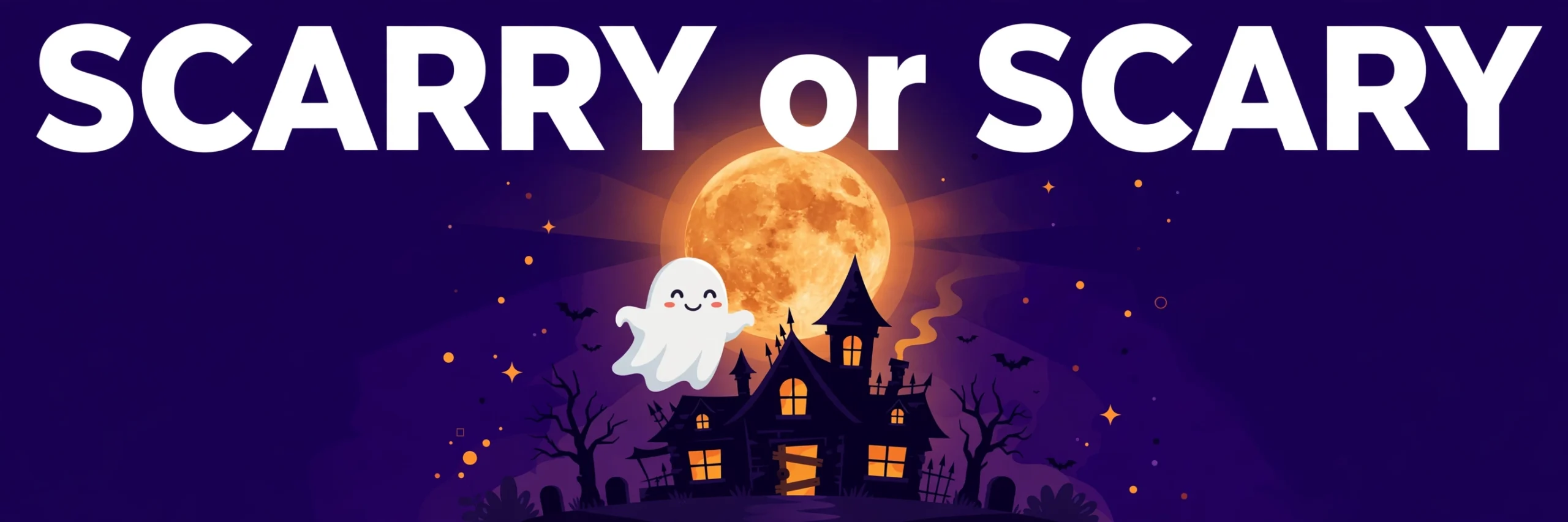
Scarry or Scary: Which Is Correct?
When something makes your heart beat faster, the word you want is scary, with one r. Scarry, with two, is not a misspelling of it in the way most people assume — it is a real but very rare word with a completely different meaning, “bearing marks of wounds,” or scarred. It never means frightening. So the short version of the answer is simple: if you mean frightening, write scary every time, in every variety of English. The longer version is worth knowing, because the instinct behind scarry is reasonable — and understanding why it fails will stop you making the same mistake with other words.
Quick Answer: Use scary (one r) for anything frightening — a scary movie, a scary moment, a scary thought. Scarry (two rs) is a rare adjective meaning scarred, from scar, and it never means frightening. Scarey is listed by Cambridge as a British variant of scary, but scary is the standard spelling everywhere. Remember it this way: scare has one r, so scary has one r too.
What the Dictionaries Say
Cambridge Dictionary defines scary as an adjective meaning “frightening,” marks it informal and B1 level, and gives the pronunciation as UK /ˈskeə.ri/ and US /ˈsker.i/. Oxford Learner’s Dictionaries agrees on the meaning and the pronunciation — UK /ˈskeəri/, US /ˈskeri/ — and adds the word forms: comparative scarier, superlative scariest. Merriam-Webster defines scary as “causing fright: alarming,” and records its first known use in 1582.
Merriam-Webster also records two less familiar senses of scary: “easily scared,” as in a scary horse — a horse that startles easily, not one that frightens people — and “feeling alarm or fright.” Both are real and old, and both are far less common than the main sense of “causing fright.” In ordinary writing, scary means the thing that causes the fear, not the person feeling it.
The entry for scarry is where the dictionaries deliver their surprise. Merriam-Webster does list scarry — as an adjective meaning “bearing marks of wounds,” in other words scarred, with a first known use in 1653. It comes from scar plus -y, exactly as scary comes from scare plus -y. A scarry face is a face marked by scars; a scary face is a face that frightens you. The distinction is real, and it is the reason this article cannot simply say “scarry is not a word.” It is a word. It is just never the word you want when you mean frightening.
Then there is the third spelling. Cambridge’s entry for scary carries a small note: “informal (UK also scarey).” That means Cambridge records scarey — scare plus y with the e kept — as a British variant. It is not the standard spelling, and no style guide recommends it, but it is not an invention either. The Oxford English Dictionary’s earliest citation spells the word “skearye”: spelling took centuries to settle, and scary is the form it settled on.
Why Scarry Feels Right
Nobody writes scarry out of carelessness. They write it because English has trained them to double consonants. Think of the words that end in a consonant plus y: carry becomes carries, marry becomes marries, worry becomes worries. A writer who knows that pattern looks at scare and reasons, quite sensibly, that something with a doubled letter must be involved. The trouble is that the doubling in carries and marries belongs to a different rule: when a verb ends in a consonant plus y, the y changes to i before -es is added. Scary is not a verb form at all. It is an adjective made by adding -y to the noun scare, and the rule for that is different: a silent e at the end of the base word is dropped before a vowel suffix, so scare plus y becomes scary, just as ice plus y becomes icy.
The doubled r has a second source. The word scar itself is short and common — but its own family doubles it: scarred, scarring. A writer thinking of a scarred, frightening face can easily blend the two families in their head and produce scarry. If the face is frightening, it is scary. If it is marked by scars, it is scarred — or, if you want the rare dictionary word, scarry, though almost no modern reader will recognise it, and scarred is the better choice in every practical situation.
Scary, Scared, and Frightening: Three Words That Are Not the Same
Part of the confusion around scary comes from its neighbours. Scary, scared, and frightening all belong to the same family of fear, but they point in different directions, and mixing them up produces sentences that say the opposite of what the writer means.
| Word | What it describes | Example |
|---|---|---|
| Scary | The thing that causes fear | It was a scary movie. |
| Scared | The person who feels fear | I was scared during the movie. |
| Frightening | The thing that causes fear (more formal) | The statistics are frightening. |
| Scarred | Marked by scars, physical or emotional | He was scarred by the accident. |
| Scarry | Marked by scars (rare, dictionary word) | A scarry face. (Use scarred instead.) |
The distinction between scary and scared is the one that matters most in practice. A film is scary; the person watching it is scared. Writing “I was scary during the film” says you were frightening the other people in the cinema, which is probably not what happened. The same pattern holds across the whole family: boring describes the lecture, bored describes the audience; exciting describes the match, excited describes the fans. Adjectives ending in -ing and -y describe the cause; adjectives ending in -ed describe the person affected. Once that pattern clicks, the scary versus scared choice stops being a memory test and becomes a meaning test.
How to Use Scary Correctly
Scary is an adjective: it comes before a noun (a scary story) or after a linking verb (the story was scary). Its comparative is scarier and its superlative scariest — change the y to i and add -er or -est, keeping the single r throughout.
Oxford’s collocations show the words scary most often keeps company with: movie, story, moment, experience, thought, and dream. People rarely call a person scary in neutral writing — Cambridge’s example “She’s a scary woman” is deliberately edgy — and they almost never call an object scary unless it is part of an experience, like a ride or a film.
Correct vs Incorrect
| Incorrect | Correct | Why |
|---|---|---|
| That was a scarry movie. | That was a scary movie. | For “frightening,” only scary (one r) is correct. |
| It was the scarriest night of my life. | It was the scariest night of my life. | The superlative is scariest, one r, y to i. |
| The house looked scarry in the dark. | The house looked scary in the dark. | Scarry means scarred, not frightening. |
| I was scary when the lights went out. | I was scared when the lights went out. | Scary describes the cause; scared describes the person feeling fear. |
| His face was scary from the accident. | His face was scarred from the accident. | A face marked by scars is scarred, not scary. |
| The exam was very scarry. | The exam was very scary. | One r: scare plus y, with the e dropped. |
Common Mistakes to Avoid
1. Doubling the R because of “carry” and “marry”
This is the root of the error, and it is worth naming plainly. The doubling rule that gives us carries and marries applies to verbs ending in a consonant plus y when a suffix is added. Scary is an adjective formed from a noun, and the rule there is to drop the silent e: scare becomes scary, ice becomes icy. Two different word-building processes, two different results. If you remember that scary comes from scare, the spelling takes care of itself.
2. Saying “scarry is not a word”
It is tempting, and it is the kind of confident claim that gets repeated in grammar guides — but Merriam-Webster lists scarry as an adjective meaning scarred, in use since 1653. The accurate statement is narrower and more useful: scarry is a real word, but it never means frightening, and it is so rare that most readers will read it as a typo. In practice, never use it: if you mean scarred, write scarred; if you mean frightening, write scary.
3. Mixing up “scary” and “scared”
This is the most common error in the whole family, and it survives proofreading because both words are correctly spelled. “I was scary” is grammatical English — it just means you were frightening other people. The test is direction: does the word describe the thing producing the fear, or the person experiencing it? The thing is scary; the person is scared. The same test sorts out boring and bored, exciting and excited.
4. Writing “scarey” in formal or American writing
Cambridge records scarey as a British variant, so it is not simply wrong — but it is not standard either. American readers will read it as a mistake, spellcheckers will flag it, and no current style guide recommends it. Use scary everywhere. The variant is worth knowing about only so that you recognise it when you meet it in older British books, and so that you do not “correct” it aggressively when quoting them.
Frequently Asked Questions
Is “scarry” ever correct?
Yes, in exactly one narrow sense: as a rare adjective meaning “bearing marks of wounds,” or scarred. Merriam-Webster lists it with a first known use in 1653. But it never means frightening, it is so uncommon that most readers will take it for a typo, and scarred says the same thing more clearly.
Is “scarey” correct in British English?
Cambridge lists scarey as a British variant of scary, so it has dictionary recognition in the UK. Even so, scary is the standard spelling in British English too. Use scary in Britain and America alike.
What is the comparative of “scary”?
Scarier, and the superlative is scariest. Both change the y to i before adding -er or -est, and both keep the single r. “More scary” and “most scary” are also heard, but scarier and scariest are the standard forms listed by Oxford and Cambridge.
What is the difference between “scary” and “scared”?
Scary describes the thing that causes fear — a scary film, a scary noise. Scared describes the person who feels the fear — I was scared, she looked scared. If you swap them, you reverse the meaning: “I was scary” says you frightened other people.
The Takeaway
Scary, with one r, is the only standard spelling for “frightening,” in British and American English alike. Scarry is a real but rare word meaning scarred, and it should never be used for “frightening” — scarred does its job better anyway. Scarey survives as a British variant in Cambridge’s entry, but scary is the standard form everywhere. The spelling follows the base word: scare has one r, so scary, scarier, and scariest have one r too.
Sources: Cambridge Dictionary (scary; scare); Oxford Learner’s Dictionaries (scary); Merriam-Webster (scary; scarry; scare); Collins Dictionary (scary).