Racquet or Racket: Which Is Correct?
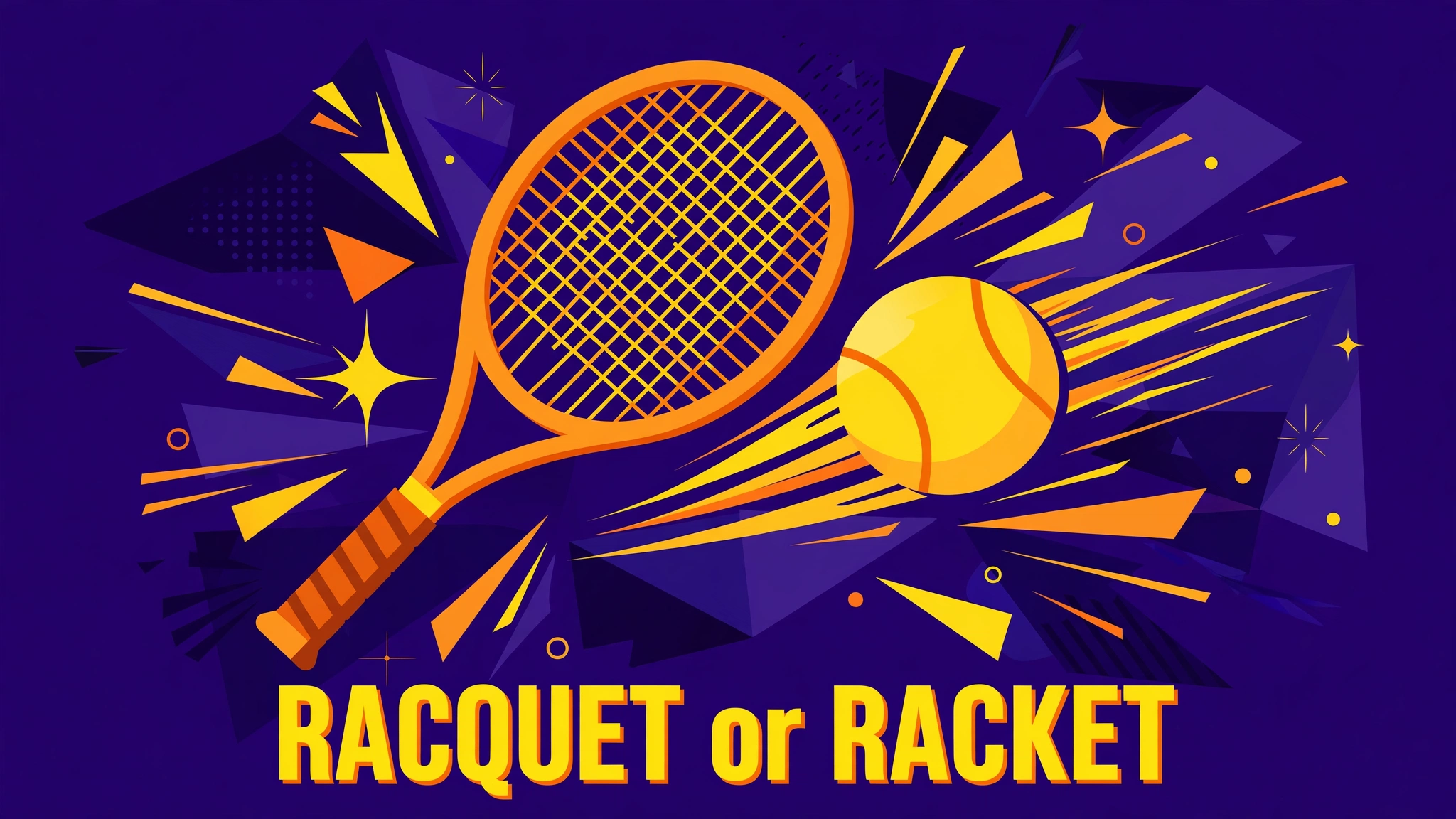
Is it racquet or racket? For the piece of sports equipment — the thing you swing at a tennis ball — both spellings are correct. This isn’t a case of one right answer and one mistake. The dictionaries list both, side by side, for the same object.
The confusion exists because racket is also, separately, a loud noise and a criminal scheme (“a protection racket”) — senses where racquet is never used. So the real question isn’t “which spelling is correct?” but “which spelling for which meaning?” — and the answer depends on what you’re describing.
What the Dictionaries Actually Say
This is one of those cases where checking first genuinely changes the article. It would be easy — and wrong — to declare one spelling the winner. Here’s what the references record:
- Merriam-Webster treats them as one entry: looking up “racquet” serves you the “racket” entry, whose first sense is “a lightweight implement… used for striking the ball or shuttlecock in various games (such as tennis, racquets, or badminton).” Both headwords, one definition.
- Collins lists them together: “racket² or racquet /ˈrækɪt/” — “a bat consisting of an open network of nylon or other strings stretched in an oval frame with a handle, used to strike the ball in tennis, badminton, etc.”
- Oxford Learner’s Dictionaries carries both as nouns in its sports vocabulary.
So neither spelling is a misspelling, and neither is “more correct” in any absolute sense. What varies is convention — which spelling particular sports, publishers, and regions prefer.
When to Use “Racquet”
Racquet is the spelling you’ll see most in the commercial and organizational world of the sports themselves:
- Squash and racquetball overwhelmingly prefer racquet — it’s in the sport’s name (“racquetball”) and on most squash equipment.
- Tennis retail and coaching lean toward racquet in product names and pro-shop signage, though racket appears too.
- The game “racquets” — the four-walled court game ancestral to squash — is spelled with a q (Merriam-Webster notes it’s “usually racquets, plural in form but singular in construction”).
If you’re writing for a sports audience or naming equipment, racquet is the safer, more conventional choice — it signals “sports equipment” instantly and can never be misread as noise.
When to Use “Racket”
Racket is Merriam-Webster’s primary headword and the only spelling that covers all the senses:
- The sports implement — equally correct: “her tennis racket“
- Loud noise — only racket: “the kids were making such a racket“
- A fraudulent scheme — only racket: “a protection racket,” “a drug racket“
If you only want to remember one spelling, remember racket: it works everywhere racquet works, plus the two senses racquet can’t touch. Racquet, by contrast, is fenced into the sports-equipment sense — “what a racquet” for noise is simply wrong.
A Short History of the “Q”
The q spelling is the older-looking one, and its story is genuinely interesting. The word comes from Middle French raquette, which Collins traces further back to Arabic rāhat, “palm of the hand” — because the earliest form of the game was played by striking the ball with the hand. The French-derived racquet preserves that lineage visually; racket is the anglicized streamlining. Both have been in English since the 1500s, so neither can claim to be the “original” in any useful sense — they’re twin spellings that diverged and never reconciled.
Correct vs. Incorrect
| Correct | Incorrect |
|---|---|
| She bought a new tennis racquet. | — (also fine as “racket”) |
| She bought a new tennis racket. | — (also fine as “racquet”) |
| The neighbours’ party made such a racket. | The neighbours’ party made such a racquet. |
| Police smashed the smuggling racket. | Police smashed the smuggling racquet. |
| He plays racquets at his club. (the court game) | He plays rackets at his club. (for the game name — use the q) |
Common Mistakes
1. “Correcting” someone’s “racquet” to “racket” (or vice versa)
The most common error around this pair isn’t a misspelling — it’s a false correction. Both spellings are dictionary-listed for the sports implement. If a squash player writes racquet and you “fix” it to racket, you’ve corrected something that wasn’t wrong.
2. Using “racquet” for noise or crime
“What a racquet the kids are making” and “a drug racquet” are both wrong. The noise and scam senses belong to racket alone. This is the one hard boundary in the whole pair.
3. Assuming it’s a US/UK split
It’s tempting to file this as “Americans write racquet, Brits write racket” (or the reverse), but the dictionaries don’t support a clean regional rule — both spellings appear on both sides of the Atlantic. The real pattern is contextual (sport vs. general prose), not geographical.
4. Inconsistent spelling within one document
Since both are correct for the equipment, the only real sin is mixing them: “his racquet… her racket” in the same article looks sloppy. Pick one and stick with it — style guides usually bless either, as long as you’re consistent.
Racquets (the Game): A Spelling With History
There’s one more racquet worth knowing: the game itself. Racquets — plural in form, singular in meaning — is the four-walled court game ancestral to squash, played with a small hard ball. The Oxford English Dictionary distinguishes it from the newer squash principally by that harder ball, and notes the game is now played in covered indoor courts, “in North America now usually in form racquets.”
This matters for spelling because the game’s name is one place where the q is effectively mandatory: “he plays racquets at his club” is standard, while “he plays rackets” would more likely be read as the plural of the equipment. It’s a neat illustration of the pair’s logic — racquet belongs to the sporting world, racket to everything else, and where the two overlap (the implement), both are welcome.
Quick Check: Test Yourself
Choose the correct spelling in each sentence. Answers follow.
- Her new tennis (racquet / racket) cost a fortune. (either is correct — both accepted)
- Stop making such a (racquet / racket)!
- The police shut down an illegal gambling (racquet / racket).
- He plays (rackets / racquets) twice a week at the club. (the court game — racquets)
- She restrung her badminton (racquet / racket) before the tournament. (either is correct)
Answers: 1. either, 2. racket, 3. racket, 4. racquets, 5. either. The pattern to internalize: racquet is fenced into sport; racket roams free.
Pronunciation
Both spellings are pronounced identically: /ˈrækɪt/ (RAK-it) in both British and American English. The q is silent in the way q is always silent before u in this position — it changes the look of the word, not the sound. (The court game “racquets” is pronounced the same way: RAK-its.)
FAQs
Is “racquet” just a misspelling of “racket”?
No. Merriam-Webster lists both under a single entry, Collins prints “racket or racquet” for the sports-implement definition, and Oxford Learner’s carries both as nouns. A misspelling doesn’t get its own headword in three major dictionaries.
Which spelling should I use in an essay?
Either — but be consistent. If your essay is about tennis equipment specifically, racquet reads as slightly more “insider.” In general prose, racket is the safer default because it also covers the noise and scam senses if you need them later in the piece.
Why do squash and tennis prefer “racquet”?
Tradition and branding. The sports’ governing bodies, equipment makers, and specialist press settled on the French-derived q spelling generations ago, and racquetball locked it in permanently as a compound. General dictionaries followed usage rather than leading it.
Can “racket” be a verb?
Yes, in two senses matching the noun: to make a racket (“the kids were racketing around upstairs” — noisy behavior) and, in sports, to strike with a racket. Both are rare in modern writing, but they’re dictionary-listed.
The Takeaway
For the sports implement, racquet and racket are both correct — the dictionaries list them together, and the choice is a matter of context and consistency, not correctness. But racket alone covers noise and criminal schemes, so when in doubt, racket is the spelling that can never be wrong. Just never write racquet for a noise — that’s the one boundary that actually matters.