Pygmalion Meaning: Myth, Play, and the Pygmalion Effect
Pygmalion is a name that has escaped its story. It began as a king in Greek mythology who fell in love with a statue he had carved, and it now names a play by George Bernard Shaw, a psychological effect, and, in the dictionary, a kind of person: someone who shapes another person, the way a sculptor shapes stone. This article explains what Pygmalion means, where the name comes from, how to pronounce it, and what people mean when they use it today.
The search for “Pygmalion meaning” usually has one of three things in mind: the myth, the play, or the effect. All three are connected, and the word’s meaning changes with the context — and confusing them is the most common mistake people make with it.
Quick Answer: Pygmalion, pronounced /pɪɡˈmeɪlɪən/, is a proper noun from Greek mythology: a king of Cyprus who carved an ivory statue of a woman, fell in love with it, and saw it brought to life by Aphrodite as Galatea. By extension, a “Pygmalion” is a mentor or creator who shapes another person, the name of Shaw’s 1913 play about Henry Higgins and Eliza Doolittle, and the source of the Pygmalion effect — the finding that high expectations can improve a person’s performance.
What Does “Pygmalion” Mean?
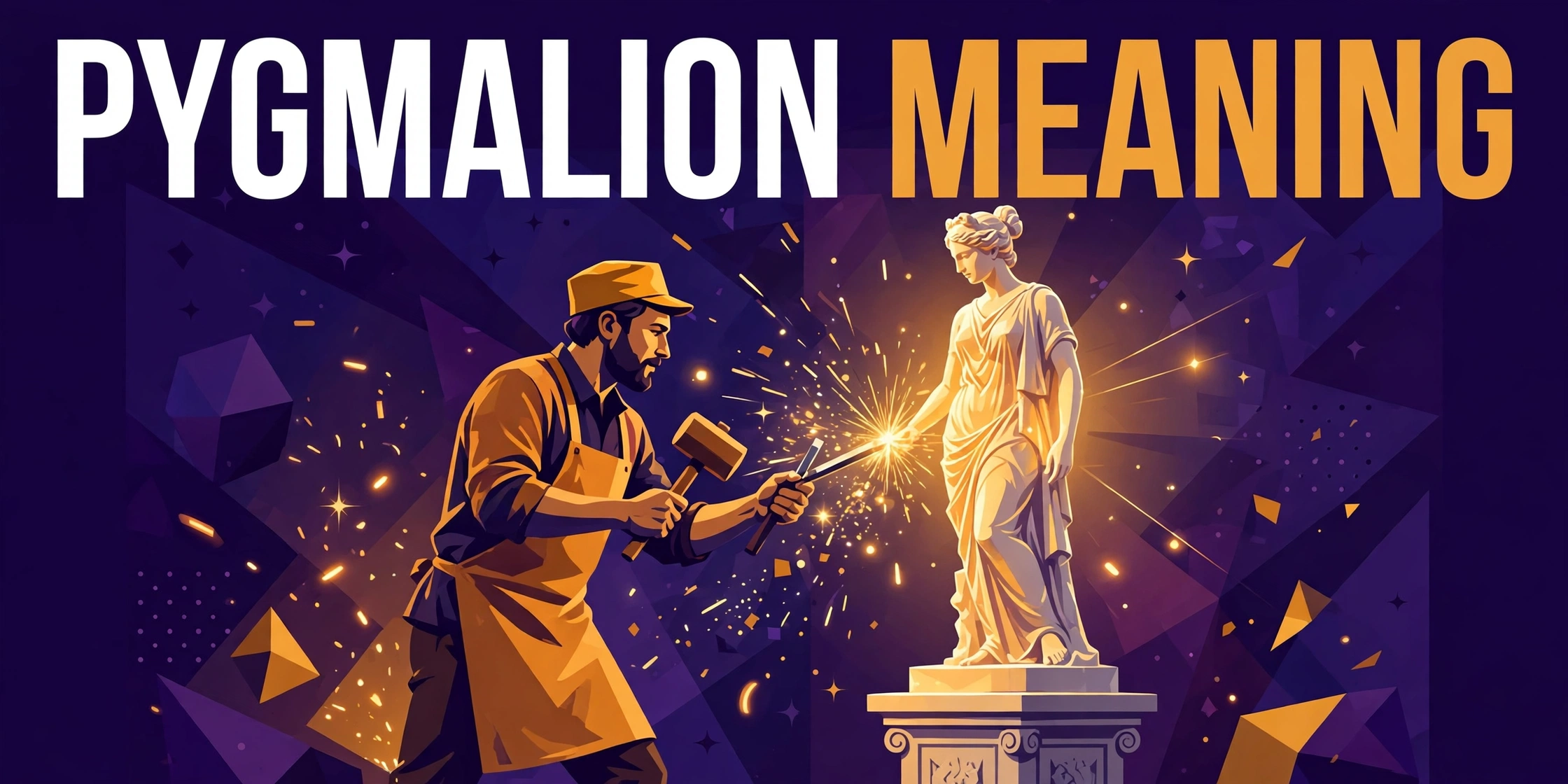
Collins English Dictionary defines Pygmalion as a noun of Greek mythology: a king of Cyprus who fell in love with a statue of a woman he had sculpted, which his prayers brought to life as Galatea. The American Heritage Dictionary gives the same story: “A king of Cyprus who carved and then fell in love with a statue of a woman, which Aphrodite brought to life as Galatea.” Random House adds that the statue was ivory, and that Pygmalion was a sculptor as well as a king.
The story, as told by the Roman poet Ovid in his Metamorphoses, is simple and strange. Pygmalion, disgusted by the women of Cyprus, resolved to remain unmarried and carved a statue of a woman so beautiful that he fell in love with his own creation. He prayed to Aphrodite to give the statue life, and the goddess granted his prayer: the ivory warmed under his touch, the statue breathed, and Pygmalion married her. In Ovid’s telling the statue is not named; the name Galatea was given later, by other writers, and it has stuck.
There is a second Pygmalion in Greek mythology, and he is easy to confuse with the first: Pygmalion, king of Tyre, the brother of Dido, the legendary founder of Carthage, who murdered Dido’s husband for his wealth. The two share a name and nothing else. When people say “Pygmalion” without qualification, they mean the sculptor of Cyprus, not the king of Tyre — and the dictionaries record the sculptor, not the murderer.
How to Pronounce “Pygmalion”
Collins gives the British pronunciation as /pɪɡˈmeɪlɪən/ and the American as /pɪɡˈmeɪljən/ or /pɪɡˈmeɪliən/. The stress falls on the second syllable, “MAY”, and the word has four syllables: pig-MAY-lee-un. Wordsmith.org gives the respelling “pig-MAYL-yuhn, -MAY-lee-uhn”, which captures the two accepted American variants: one with a y glide (“MAYL-yuhn”) and one without it (“MAY-lee-uhn”).
The common errors are stressing the first syllable — “PIG-ma-lee-on” — and pronouncing the g softly, as in giant. The g is hard, as in pig, which is the word the first syllable rhymes with. The final syllable is a weak “-un” or “-uhn”, never a stressed “-on”.
| Form | Pronunciation | Notes |
|---|---|---|
| Pygmalion (UK) | /pɪɡˈmeɪlɪən/ | Stress on the second syllable |
| Pygmalion (US) | /pɪɡˈmeɪljən/, /pɪɡˈmeɪliən/ | Two variants; both accepted |
| Galatea | /ɡæləˈtiːə/ | The statue brought to life |
| Aphrodite | /æfrəˈdaɪti/ | Goddess who answers the prayer |
Pygmalion in Real Sentences
- “In the myth, Pygmalion fell in love with a statue he had carved, which Aphrodite brought to life as Galatea.”
- “Shaw’s Pygmalion turns the myth into a comedy of class and language.”
- “The new manager is a Pygmalion figure, remaking every junior in his own image.”
- “The Pygmalion effect suggests that teachers who expect more from their pupils often get more.”
- “He treated his protégé like a Pygmalion project, and she resented it.”
- “The play’s most famous line, ‘Not bloody likely!’, made the word Pygmalion a euphemism for ‘bloody’ for a time.”
Shaw’s “Pygmalion” and “My Fair Lady”
George Bernard Shaw’s play Pygmalion, first performed in 1913, is the reason the name is familiar to people who have never read Ovid. In the play, Professor Henry Higgins, a phonetician, bets that he can take Eliza Doolittle, a Cockney flower seller, and teach her to speak and behave so well that she can pass as a duchess at a garden party. He succeeds — and the play asks what the success has cost her. Shaw called Higgins “Pygmalion Higgins” in his notes: Higgins sculpts Eliza the way Pygmalion sculpted his statue, and, like Pygmalion, he falls for his own creation.
The play was a success, and its title became a byword for a mentor, especially a man who mentors a woman. Wordsmith.org dates the earliest documented use of Pygmalion in this sense to 1926. The play also gave the musical My Fair Lady, which is how many people now meet the name for the first time.
The play has another distinction. At the time, the word “bloody” was considered highly obscene in Britain, and Eliza’s line “Walk! Not bloody likely!” caused a sensation on the first night. For a while afterwards, people used “Pygmalion” as a euphemism for “bloody”, saying “Not Pygmalion likely”. Wordsmith.org records Pygmalion as an adjective in this sense, with its earliest documented use in 1914. The euphemism is long dead, but it is a good reminder that a word’s history can be stranger than its definition.
The Pygmalion Effect
The Pygmalion effect is a psychological phenomenon in which higher expectations lead to better performance — a form of self-fulfilling prophecy. The American Psychological Association’s Dictionary of Psychology defines it as “a consequence or reaction in which the expectations of a leader or superior engender behavior from followers or subordinates that is consistent with these expectations”. In plain terms: if a teacher believes a pupil is bright, the teacher treats the pupil differently — more attention, more encouragement, more challenging work — and the pupil, responding to that treatment, performs better. The expectation becomes true because it was held.
The effect is named after Shaw’s play, and it was first studied systematically by the psychologists Robert Rosenthal and Lenore Jacobson in their 1968 book Pygmalion in the Classroom. Teachers were told that certain pupils — chosen at random — were about to show a spurt in ability. By the end of the year, those pupils had improved more than their classmates: the teachers’ expectations had changed the way they taught, and the teaching had changed the results.
Two cautions belong here. Later research has found the effect real but usually small: a 2005 meta-analysis of thirty-five years of research concluded that self-fulfilling prophecies in classrooms do occur, but the effects are usually small and temporary. And the effect works in both directions: low expectations can also become self-fulfilling, depressing performance rather than raising it.
Pygmalion vs Mentor, Svengali, and Muse
Pygmalion as a common noun is close to mentor, but the two are not interchangeable. A mentor guides and advises; a Pygmalion remakes. The Pygmalion shapes the other person in his own image, choosing what she will become, and the word carries a note of control that mentor does not. That is why the word is often used critically: “a Pygmalion project” suggests a relationship in which one person is the sculptor and the other is the stone.
Svengali is darker still. Svengali, from George du Maurier’s novel Trilby, is a hypnotist who controls a young singer and makes her career while destroying her will. A Pygmalion shapes; a Svengali dominates. Pygmalion is a creator and a lover, Svengali is a manipulator.
Muse is the opposite direction of the same story. A muse inspires the artist; Pygmalion is the artist, and the statue is the work. Galatea is his creation, not his muse, and the story’s power comes from the fact that the creation comes alive and answers back.
Common Mistakes with “Pygmalion”
1. Confusing the two Pygmalions
The sculptor of Cyprus and the king of Tyre share a name and nothing else. The king of Tyre murdered his brother-in-law for his wealth; the sculptor carved a statue and married it. When the word is used without qualification, it means the sculptor.
2. Calling Galatea the sculptor’s wife from the start
In Ovid’s telling, the statue has no name; Galatea is a later addition, given by other writers. Saying “Pygmalion and Galatea” is standard, but the name is not Ovid’s.
3. Treating the Pygmalion effect as a guarantee
High expectations help, but they do not guarantee results, and the research shows the effect is usually small. Expectations shape the way people are treated, and the way people are treated shapes how they perform — sometimes a lot, usually a little.
Frequently Asked Questions
Who was Pygmalion?
Pygmalion was a king of Cyprus and a sculptor in Greek mythology who carved an ivory statue of a woman, fell in love with it, and saw it brought to life by Aphrodite. The statue is usually called Galatea, a name given by later writers rather than by Ovid, who first told the story.
What is the Pygmalion effect?
It is the psychological finding that higher expectations can lead to better performance, because the expectations change the way a teacher, manager, or coach treats the person — and that treatment changes the result. It is a form of self-fulfilling prophecy, first studied by Rosenthal and Jacobson in 1968.
What does “Pygmalion” mean as a common noun?
It means a mentor or creator who shapes another person, especially a man who mentors a woman — after Shaw’s Henry Higgins. The word carries a note of control: a Pygmalion remakes the other person in his own image, rather than simply advising them.
Is “Pygmalion” the same as “My Fair Lady”?
Not quite. Pygmalion is Shaw’s 1913 play; My Fair Lady is the musical adapted from it, with music by Frederick Loewe. The musical softens Shaw’s ending and adds songs; the play is sharper, and its ending is less romantic.
How do you pronounce “Pygmalion”?
/pɪɡˈmeɪlɪən/ in British English and /pɪɡˈmeɪljən/ or /pɪɡˈmeɪliən/ in American English — “pig-MAY-lee-un”, with a hard g and the stress on the second syllable.
The Takeaway
Pygmalion is a name with three lives: a sculptor in Greek myth who loved the statue he carved, a play by Shaw about a man who remakes a flower seller, and a psychological effect in which expectations shape performance. Pronounced /pɪɡˈmeɪlɪən/, it has also become a common noun for a mentor who shapes another person — a compliment when the shaping is generous, a criticism when it is control. Remember the statue, the play, and the effect, and the word will not confuse you again.
Sources: definitions and pronunciations were checked against Collins, the American Heritage Dictionary, and Random House’s dictionary via The Free Dictionary; the Pygmalion effect is defined as in the APA Dictionary of Psychology. The 1926 and 1914 first-use dates and the “bloody” euphemism follow Wordsmith.org; the Rosenthal and Jacobson study and the 2005 meta-analysis are reported from secondary summaries. The Pygmalion-versus-Svengali distinction is a usage judgement grounded in the dictionary entries.