Embossed Meaning: Definition, Uses, and Examples
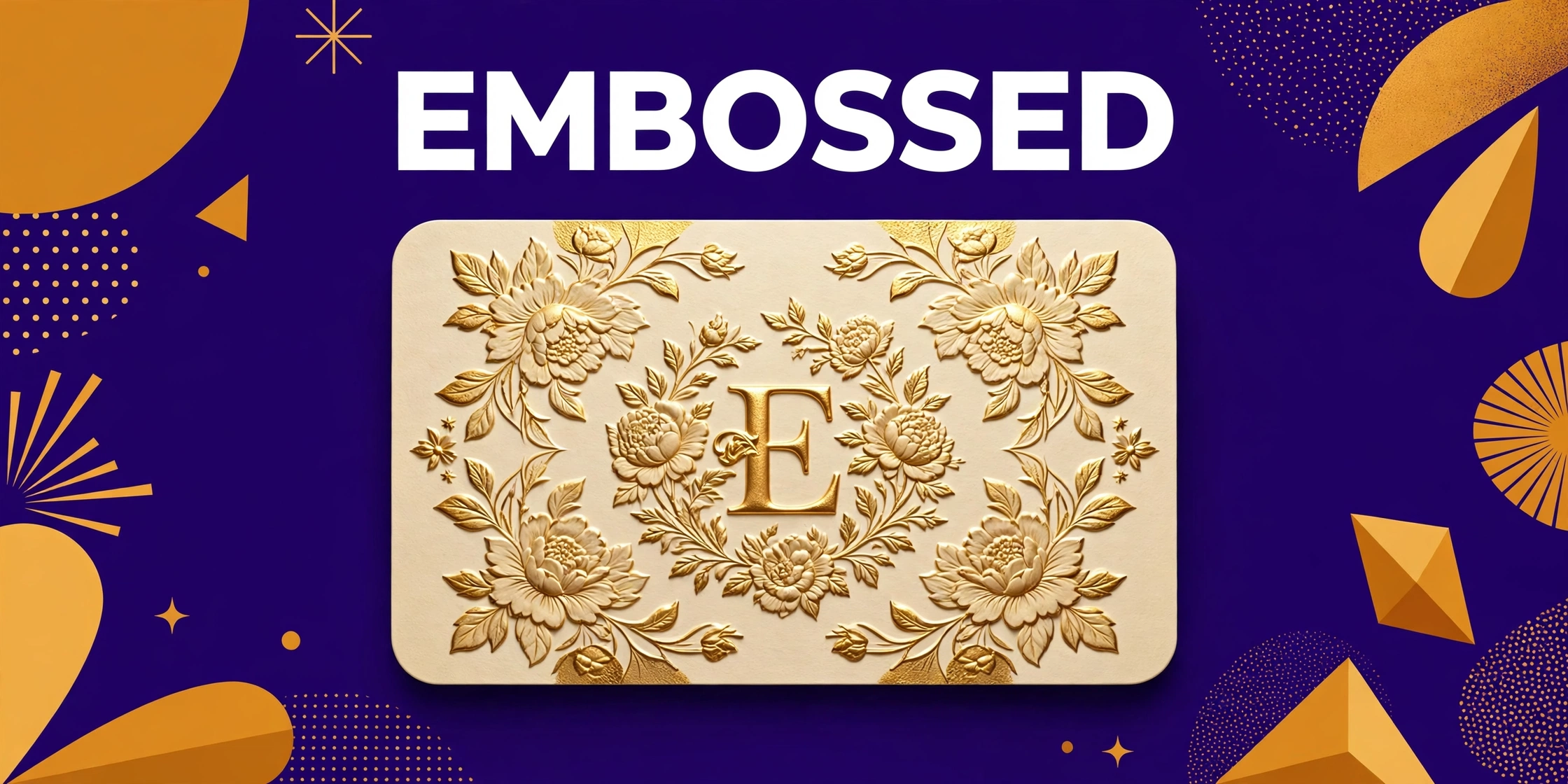
Run your thumb across a wedding invitation and feel the letters rise under your finger. Look at a leather wallet and see the maker’s name pressed into the surface. Hold a credit card and notice the numbers standing out from the plastic. In each case the surface has been decorated with a raised design — and the word for that is embossed.
Embossed is a precise, useful adjective, but it is often confused with its neighbours: engraved, debossed, printed and stamped. They all mark a surface, but they do it in different directions and for different reasons. This guide defines embossed exactly, explains how embossing works, shows where you will meet it, and clears up the confusions.
Quick Answer: Embossed is an adjective meaning decorated with a raised design or pattern — the design stands out above the surface, so you can feel it with your fingers. It is the past participle of the verb emboss (to raise a design in relief). Pronounced UK /ɪmˈbɒst/ and US /ɪmˈbɑːst/. The opposite is debossed (pressed in, not raised).
What Does Embossed Mean?
Oxford Advanced Learner’s Dictionary defines embossed as an adjective meaning “(of paper, leather, etc.) having a surface decorated with a raised design or piece of writing”, with the example “embossed stationery”. Merriam-Webster gives the same sense more briefly: “ornamented with or having the form of a raised pattern, design, image, etc.”, with the example “an embossed envelope”. Both definitions agree on the essential point: the design is raised above the surface.
That raised quality is what makes embossed different from merely printed or written. A printed letter sits flat on the paper, in ink. An embossed letter is part of the paper itself, pushed up from below or pressed down from above so that it stands in relief. You can feel it as well as see it, and the light catches it differently as you tilt the surface — which is exactly why it is used for invitations, certificates, book covers and luxury packaging, where touch and appearance both matter.
Grammatically, embossed is the past participle of the verb emboss used as an adjective. You can say “embossed paper”, “embossed leather”, “an embossed invitation”, or use it after a linking verb: “The cover is embossed.” In passive sentences it is the verb itself: “The stationery was embossed with the hotel’s name.”
| Form | Part of speech | Meaning | Example |
|---|---|---|---|
| emboss | Verb | To put a raised design on a surface | “They emboss the logo on every cover.” |
| embossed | Adjective / past participle | Having a raised design | “Embossed stationery” |
| embossing | Noun / present participle | The process or result of embossing | “Gold embossing on the title” |
| embosser | Noun | A person or machine that embosses | “The embosser pressed the seal.” |
| embossment | Noun | Embossed work; raised ornamentation | “The embossment caught the light.” |
How to Pronounce Embossed
The verb emboss is pronounced UK /ɪmˈbɒs/ and US /ɪmˈbɔs/ or, for speakers with the cot–caught merger, /ɪmˈbɑs/. The adjective embossed adds a t sound at the end: UK /ɪmˈbɒst/, US /ɪmˈbɑːst/. The stress falls on the second syllable in both varieties: em-BOSS, em-BOSSED. The first syllable is short and unstressed — “im” or “em”, never “ee”.
The final -ed is pronounced as /t/, not as a separate syllable: “em-BOSST”, not “em-BOSS-ed”. This follows the normal English rule for verbs ending in a voiceless sound like /s/: the -ed is pronounced /t/, as in pressed or missed. A common learner error is to add an extra syllable, so it is worth practising: em-BOSSED is two syllables, not three.
How Embossing Works
Embossing is a mechanical process, not a printing one. In its classic form, the material — paper, leather, card or metal foil — is pressed between two dies: a raised male die and a recessed female die that fit together like a mould and its counterpart. Pressure forces the material into the shape of the dies, raising the design on one side and creating a matching hollow on the other. No ink is needed, although embossing is often combined with foil (gold or silver) or ink for extra effect.
There are several common methods. Blind embossing uses no ink or foil at all — the design is visible only through shadow and touch, which gives it a quiet, expensive feel. Foil embossing presses metallic foil into the raised design, so the letters shine. In craft and hobby contexts, heat embossing uses embossing powder and a heat gun: the powder melts and hardens into a raised, glossy design on a greetings card. Braille is also a form of embossing — raised dots pressed into paper so they can be read by touch — and the machines that produce it are called braille embossers.
Where you meet embossed surfaces
- Stationery and invitations: wedding invitations, headed notepaper and business cards with a raised monogram or logo.
- Books: hardback covers with the title or an ornament raised in cloth or leather, often in gold foil.
- Leather goods: wallets, belts and handbags with a brand name or pattern pressed into the leather.
- Packaging: luxury boxes, wine labels and chocolate packaging with raised patterns.
- Certificates and seals: official documents with a raised seal pressed by a notary or institution.
- Cards and coins: credit cards with raised numbers (now less common), and coins with raised designs struck by a die.
- Wallpaper and textiles: embossed wallpaper with a raised pattern, and fabrics with a raised weave.
Embossed vs Engraved vs Debossed vs Printed
This is the confusion that causes most mistakes, and it is worth settling carefully. All four words describe marking a surface, but they describe different physical results.
| Term | What happens to the surface | Can you feel it? | Typical use |
|---|---|---|---|
| Embossed | Design raised above the surface | Yes — it stands out | Invitations, book covers, leather |
| Debossed | Design pressed into the surface | Yes — it sinks in | Leather goods, stationery, book covers |
| Engraved | Design cut into the surface | Yes — fine incised lines | Jewellery, plaques, printing plates |
| Printed | Ink laid on the surface | No — flat | Books, posters, everyday documents |
Embossed and debossed are exact opposites: embossing raises the design, debossing sinks it. Both are done with dies and pressure, and both are common on the same kinds of objects — a leather wallet might have an embossed logo on the front and a debossed pattern on the back. Engraved is different again: engraving cuts lines into the surface with a tool, removing material, while embossing reshapes the material without removing any. A useful test is the back of the sheet: embossing and debossing both leave a mark on the reverse side, while engraving and printing do not change the reverse in the same way.
In everyday speech people sometimes say “embossed” when they mean “engraved” or even “printed in a fancy font”. In careful writing, keep the distinction: if the design is raised, it is embossed; if it is cut in, it is engraved; if it is flat ink, it is printed.
Embossed in Real Sentences
- “The hotel’s name was embossed on the stationery.” (Oxford’s example pattern)
- “She chose thick cream card with her initials embossed in gold.”
- “The leather cover was embossed with a pattern of leaves.”
- “An embossed envelope arrived, and she knew at once it was a wedding invitation.”
- “The certificate bore an embossed seal from the university.”
- “He ran his thumb over the embossed title on the book’s spine.”
Notice the two prepositions that follow the verb. You emboss a surface with a design (“embossed with the hotel’s name”) and you emboss a design on a surface (“the name was embossed on the stationery”). Both are correct; they simply describe the same action from opposite sides.
Common Mistakes with Embossed
| Mistake | Why it is wrong | Correct version |
|---|---|---|
| “The invitation was embossed in ink” | Embossing is a raised shape, not ink; ink is printing | “The invitation was printed in gold ink” or “The invitation was blind-embossed” |
| Calling a sunken design “embossed” | A sunken design is debossed, the opposite | “The logo is debossed into the leather” |
| “Embossed” for engraved jewellery | Engraving cuts into metal; embossing raises it | “The ring was engraved with their initials” |
| Pronouncing it “em-BOSS-ed” (3 syllables) | The -ed is pronounced /t/, not as a syllable | “Em-BOSSED” (2 syllables) |
| “Embossed” as a verb in the wrong form | The base verb is emboss; embossed is the past form | “They emboss the covers” (present); “They embossed the covers” (past) |
| Using embossed for any fancy lettering | Fancy flat lettering is calligraphy or printing | Reserve embossed for genuinely raised designs |
Word Origin
Emboss entered English in the late Middle English period, from Old French embocer, from em- (“in, into”) + boce (“boss, protuberance, swelling”). The root boss still survives in English as a noun meaning a raised knob or stud — a boss on a shield, a boss on a ceiling — and it is the same idea: something that sticks out. Merriam-Webster dates the verb emboss to the 15th century and the adjective embossed to 1541. The archaic second sense of the verb, “to drive a hunted animal to bay or to exhaustion”, comes from a different Old French source and has nothing to do with raised designs; you will not meet it outside historical dictionaries.
Frequently Asked Questions
What does embossed mean on a wedding invitation?
It means the text or design is raised above the surface of the card, so you can feel it with your fingers. Embossed invitations are usually made by pressing the card between dies, sometimes with gold or silver foil on the raised letters.
What is the difference between embossed and debossed?
Embossed means raised above the surface; debossed means pressed into the surface. They are opposites, made by the same process in reverse. If the design stands out when you run your finger over it, it is embossed; if it sinks in, it is debossed.
Can you emboss at home?
Yes, for paper crafts. Heat embossing uses a stamp, embossing ink, embossing powder and a heat gun, and it is a standard technique in card-making. True die embossing of leather or thick card needs a press and is usually done professionally.
Is embossed printing expensive?
It costs more than ordinary printing, because it needs custom dies and a press, but the price has fallen as the process has become more common. Blind embossing (no foil, no ink) is usually the cheapest option; foil embossing costs more.
What is embossed leather?
Leather with a pattern or design pressed into it so that it stands in relief — for example, a crocodile pattern or a brand name. The pattern is made by pressing the leather between heated plates or rollers.
Is Braille embossed?
Yes. Braille is read by touch, and its raised dots are produced by embossing paper (or plastic) with a braille embosser. It is one of the most important practical uses of embossing.
The Takeaway
Embossed means decorated with a design that stands out in relief from the surface — raised, not printed and not cut in. Remember the pair: embossed is up, debossed is down, engraved is cut in, printed is flat. Pronounce it em-BOSSED, two syllables, and use it only where a surface has genuinely been raised. Once that distinction is clear, the word is easy to use and hard to misuse.
Sources: definitions, senses and pronunciation checked against Oxford Advanced Learner’s Dictionary (embossed /ɪmˈbɒst/, emboss /ɪmˈbɒs/), Merriam-Webster (embossed, emboss) and Cambridge Dictionary (embossed); etymology from Merriam-Webster and Oxford Learner’s Dictionaries.