Duality Meaning: What Does Duality Mean?
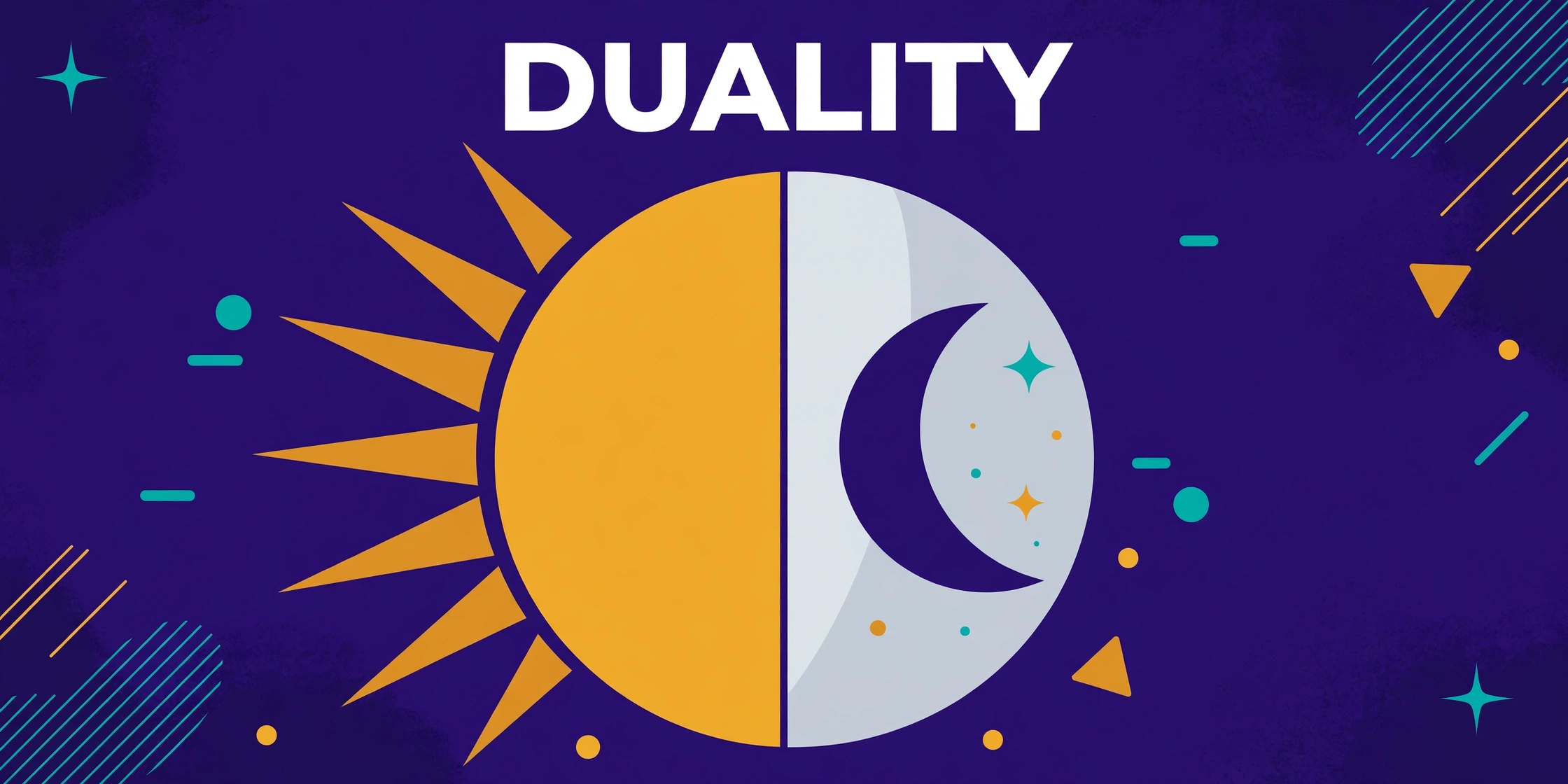
Duality is the state of having two parts — two sides, two aspects, two natures that belong to one thing. The duality of human nature is the old observation that the same person can be kind and cruel, generous and selfish, brave and afraid. Light has a duality: it behaves as both a wave and a particle. The word is formal, and it is used when the two parts matter equally: a duality is not a contradiction to be resolved, but a pair to be held together. That is what separates it from its neighbours, dualism and dichotomy, which describe division rather than doubleness.
Quick Answer: Duality (noun, formal, pronounced UK /dʒuːˈæl.ə.ti/, US /duːˈæl.ə.ti/ — joo-AL-uh-tee in British English, doo-AL-uh-tee in American English) means the state of having two parts or aspects — “the duality of human nature,” “the wave-particle duality of light.” It is usually uncountable, but it has a plural, dualities. It differs from dualism, a philosophical doctrine that mind and body are separate, and from dichotomy, a division into two opposed groups. The two parts of a duality can be complementary, not just opposed.
What the Dictionaries Say
Oxford Learner’s Dictionaries defines duality as a noun, formal, uncountable or countable, plural dualities: “the state of having two parts or aspects.” Its word origin is late Middle English, from late Latin dualitas, from dualis, from duo, “two.” Merriam-Webster gives a fuller definition: “the quality or state of having two different or opposite parts or elements: dualism,” and adds a second sense, “a difference between two opposite things: a division into two opposite groups: dichotomy.” Its example is “the duality of human nature,” and it dates the first known use to 1532.
Cambridge Dictionary’s example sentences show the technical use clearly: “The heart of quantum mechanics is the wave-particle duality: matter and light possess both wave-like and particle-like attributes.” The pronunciation is where the two standard forms differ: Cambridge gives UK /dʒuːˈæl.ə.ti/ and US /duːˈæl.ə.ti/. In British English the word begins with the j sound of jump; in American English it begins with a plain d. Oxford also records the British variant /djuːˈæləti/, with a dy sound at the start.
| Dictionary | Definition of duality | Notes |
|---|---|---|
| Oxford Learner’s | The state of having two parts or aspects | Formal; plural dualities |
| Merriam-Webster | The quality or state of having two different or opposite parts or elements | First known use 1532 |
| Cambridge | — (technical use shown in examples) | UK /dʒuːˈæl.ə.ti/, US /duːˈæl.ə.ti/ |
The General Sense: Two Parts of One Thing
In ordinary use, duality describes anything that has two sides which cannot be reduced to one. The duality of human nature is the classic example: people are capable of kindness and cruelty, and neither side is the “real” person with the other as an exception. The duality of a job might be its freedom and its insecurity — the same arrangement that lets you choose your hours also leaves you without a safety net. In each case the word says that the two parts belong together, and that describing only one of them would be incomplete.
That belonging-together is the key to the word, and it is what makes duality different from a simple contrast. A contrast sets two things against each other; a duality says that two things are aspects of one thing. The two parts may be opposed, but they may also be complementary: the wave and the particle are not enemies, and neither is the public and the private self. The word is neutral about whether the two parts get along.
Duality in Physics: Wave and Particle
The most famous duality is the wave-particle duality of light and matter, and it is the example Cambridge gives. Light behaves as a wave in some experiments — it spreads, interferes, and diffracts — and as a stream of particles, called photons, in others. Neither description is wrong, and neither is complete on its own. The same is true of electrons and other particles: they show wave-like behaviour in one experiment and particle-like behaviour in another. Physicists call this a duality because the two descriptions are both needed, and because no single picture captures the whole thing.
The wave theory of light was established in the 19th century, and the particle theory returned with Einstein’s explanation of the photoelectric effect in 1905, for which he won the Nobel Prize. Quantum mechanics, built in the 1920s, holds the two descriptions together, and the phrase “wave-particle duality” is now the standard name for that holding-together.
Duality in Philosophy: Mind and Body
In philosophy, duality most often means the mind-body duality: the idea that a person has both a mind and a body, and that the two are different kinds of thing. The classic statement is Descartes’ dualism, the doctrine that mind and matter are two separate substances, and the mind-body problem — how an immaterial mind can affect a material body — has occupied philosophers ever since. But duality and dualism are not the same word, and the difference matters. Dualism is the doctrine, the claim that the two are separate substances. Duality is the state of affairs, the fact that there are two aspects to describe, whether or not they are separate substances.
The same distinction applies outside philosophy. In religion, the duality of good and evil describes the coexistence of two forces; the doctrine that they are separate, warring powers is dualism. If you are describing a doctrine, the word is dualism. If you are describing the fact that something has two parts, the word is duality.
Duality vs Dualism vs Dichotomy
These three words are constantly confused, and they deserve a direct comparison, because each one draws a different line.
| Word | Meaning | Typical use |
|---|---|---|
| Duality | The state of having two parts or aspects | Human nature, light, a city, a job |
| Dualism | The doctrine that two things are separate and independent | Mind and body; good and evil |
| Dichotomy | A division into two mutually exclusive groups | True or false; us or them; public or private |
| Duplicity | Deceitful double-dealing; saying one thing and doing another | A different word entirely — do not confuse it |
The practical difference is one of attitude. A duality holds two parts together; a dichotomy splits them apart. To say there is a duality between work and life is to say that one person has both, and that both matter; to say there is a dichotomy is to say they are opposed, and you must choose. Dualism goes further still: it claims the two parts are different in kind. And duplicity is not a member of this family at all — it means deceit.
How to Pronounce Duality
Duality is pronounced with the stress on the second syllable: joo-AL-uh-tee in British English, doo-AL-uh-tee in American English. The difference is in the first sound. In British English it is /dʒ/, the j of jump, so the word begins like jewel. In American English it is /d/, a plain d, so the word begins like dual itself. Oxford also records the British variant /djuːˈæləti/, where the first sound is dy, but the j form is the standard British pronunciation, and the d form is the standard American one. The vowel in the stressed syllable is the long a of pal in both varieties, and the final syllable is the unstressed -tee.
The word family is built on the Latin root duo, “two.” Dual is the adjective: a dual purpose, a dual citizen. Dualism is the doctrine described above, dichotomy is the division into two, and duplicity is deceit. The plural of duality is dualities (“the dualities of modern life”), and the adjective formed from it is dualistic — “a dualistic view of the world.”
Correct vs Incorrect
| Incorrect | Correct | Why |
|---|---|---|
| The duplicity of human nature. | The duality of human nature. | Duplicity means deceit; duality means having two aspects. |
| His dualism of kindness and cruelty. | His duality of kindness and cruelty. | Dualism is a doctrine; the two-sidedness of a person is a duality. |
| There is a dichotomy of wave and particle. | There is a duality of wave and particle. | Wave and particle are complementary aspects, not mutually exclusive groups. |
| The duality between the two teams. | The rivalry between the two teams. | Duality describes two parts of one thing, not two separate things. |
| Dualities is a singular noun. | Duality is the singular; dualities is the plural. | Dualities is the plural form, as Oxford records. |
Common Mistakes to Avoid
1. Confusing duality with duplicity
This is the most common error, and it is a serious one. Duality is neutral: it describes a thing with two aspects. Duplicity is a criticism: it describes a person who says one thing and does another. To call someone’s character a duplicity is to accuse them of deceit; to call it a duality is to say they are complicated.
2. Using “duality” for any pair
A duality is two aspects of one thing, not two separate things. There is a duality of mind and body in one person, but there is no duality of cats and dogs — those are two different animals, and the word for that is a pair, or a contrast. If the two things do not belong to a single thing, duality is the wrong word.
3. Treating a duality as a problem to solve
A duality is not a contradiction, and it does not need to be resolved. Light is both a wave and a particle, and that is a fact about light, not a mistake in our thinking.
Frequently Asked Questions
What does “duality” mean in simple terms?
The state of having two parts or aspects. The duality of human nature means people have two sides — kind and cruel, generous and selfish — and both are real. In physics, the wave-particle duality means light behaves as both a wave and a particle.
What is the difference between duality and dualism?
Duality is the state of having two parts. Dualism is the doctrine that two things — usually mind and body, or good and evil — are separate and independent substances. If you are describing a doctrine, the word is dualism; if you are describing the fact of two parts, the word is duality.
What is the difference between duality and dichotomy?
A duality holds two parts together as aspects of one thing; a dichotomy splits things into two mutually exclusive groups.
How do you pronounce “duality”?
UK /dʒuːˈæl.ə.ti/ — joo-AL-uh-tee, with a j sound at the start. US /duːˈæl.ə.ti/ — doo-AL-uh-tee, with a plain d. The stress is on the second syllable in both varieties.
Is “duality” countable?
Usually it is uncountable — “the duality of human nature.” But Oxford records a countable use with the plural dualities, as in “the dualities of modern life.”
The Takeaway
Duality is the state of having two parts or aspects — the duality of human nature, the wave-particle duality of light. It is pronounced joo-AL-uh-tee in British English and doo-AL-uh-tee in American English, with the stress on the second syllable. Keep it apart from dualism, which is a doctrine about two separate substances, from dichotomy, which splits things into two opposed groups, and above all from duplicity, which means deceit. A duality is not a problem to be solved; it is two sides of one thing, held together.
Sources: Oxford Learner’s Dictionaries (duality); Merriam-Webster (duality); Cambridge Dictionary (duality, examples); Oxford Advanced American Dictionary (duality).