Combustion Meaning: Definition, Examples and How to Use It
Light a candle, start a car, or strike a match, and you have set off combustion — the chemical process that has powered human life since the first campfire and still drives most of the world’s engines. It is one of those words that sounds technical and distant, but describes something you meet every day: burning, in its precise, scientific sense.
Quick Answer: Combustion (noun, pronounced “kum-BUS-chun”, /kəmˈbʌs.tʃən/) is the process of burning — more precisely, a chemical process in which a substance combines with the oxygen in the air to produce heat and light. It is the reaction behind candles, campfires, and internal combustion engines, and it is an uncountable noun: you say “combustion”, not “a combustion”.
What Does “Combustion” Mean?
The dictionaries give the same core definition in two registers: the plain “process of burning” and the scientific “chemical process”. Oxford Learner’s Dictionaries gives both, Merriam-Webster adds a third, figurative sense, and Cambridge’s definition text was not retrievable from the page fetched, which showed only example sentences.
| Dictionary | Definition of combustion |
|---|---|
| Oxford Learner’s Dictionaries | Noun, /kəmˈbʌstʃən/, [uncountable]: 1. “the process of burning.” 2. (specialist) “a chemical process in which substances combine with the oxygen in the air to produce heat and light.” Word origin: late Middle English, from late Latin combustio(n-), from Latin comburere, “burn up”. Related: combustion chamber, “a space in which combustion takes place, for example in an engine.” |
| Merriam-Webster | Noun: 1. “an act or instance of burning” — “Smoke is produced during combustion.” 2. “a usually rapid chemical process (such as oxidation) that produces heat and usually light” — “The carburetor mixes fuel with air for combustion”; also “a slower oxidation (as in the body).” 3. “violent agitation: tumult.” First known use: 15th century. Etymology: Middle English combustioun, “burning, calcination”. |
| Cambridge Dictionary | Cambridge lists combustion and the fetched page shows only example sentences, so its definition wording is not quoted here; the definitions above rest on Oxford Learner’s and Merriam-Webster, which agree on the core sense. Cambridge’s examples include “Mix together air, fuel, and heat and you get combustion, the chemical reaction that powers most engines in planes, trains and automobiles.” |
| Collins | Collins was consulted but its full combustion entry was not retrievable at the time of writing; the definitions above rest on Oxford Learner’s and Merriam-Webster, which agree on the core sense. |
How to Pronounce “Combustion”
Combustion is pronounced with the stress on the second syllable: “kum-BUS-chun”. It has three syllables: com-, -bus-, -tion.
- British English: /kəmˈbʌs.tʃən/ — “kum-BUS-chun”, with the weak first syllable “kum” and the -tion pronounced “-shun”.
- American English: /kəmˈbʌs.tʃən/ — the same pronunciation; the stress and the “-shun” ending are identical on both sides of the Atlantic.
The Science: Fuel, Oxygen, Heat, and What Comes Out
Strip away the jargon and combustion is a trade: a fuel and an oxidant — almost always the oxygen in the air — react together, and the reaction releases energy as heat and usually light, while the fuel is transformed into new substances. Wood becomes ash, carbon dioxide and water vapour; petrol becomes carbon dioxide and water vapour, plus, when the burn is imperfect, carbon monoxide and soot. That transformation is the point of the definition: combustion is not just “things getting hot”, it is a chemical change in which the fuel is used up and new compounds appear.
Three ingredients have to be present, and fire-safety teaching calls them the fire triangle: fuel, oxygen, and heat. Take away any one of them and combustion stops, which is why fires are fought by removing one side of the triangle — smothering a fire cuts off oxygen, cooling it removes heat, and clearing fuel away starves it. The fire triangle is standard fire-safety teaching rather than a dictionary definition, and it is presented here as background, not as a dictionary claim.
Combustion needs a starting temperature, called the ignition temperature: the lowest temperature at which a substance catches fire. Below it, nothing happens; above it, the reaction sustains itself, because the heat it releases keeps the fuel hot enough to keep reacting. A match provides that first heat for a candle; a spark plug provides it, thousands of times a minute, inside a car engine.
Complete and Incomplete Combustion
The distinction that matters most in practice is between complete and incomplete combustion, and it is a question of how much oxygen is available.
| Type | What happens | Products | Example |
|---|---|---|---|
| Complete combustion | The fuel burns in a plentiful supply of oxygen. | Carbon dioxide and water vapour; maximum heat released. | A well-adjusted gas flame, burning blue; a clean-burning candle. |
| Incomplete combustion | The fuel burns with too little oxygen. | Carbon monoxide, soot (carbon), and water vapour; less heat. | A yellow, smoky flame; a badly ventilated heater; a diesel engine’s black exhaust. |
Engines, Spontaneous Combustion, and the Figurative Sense
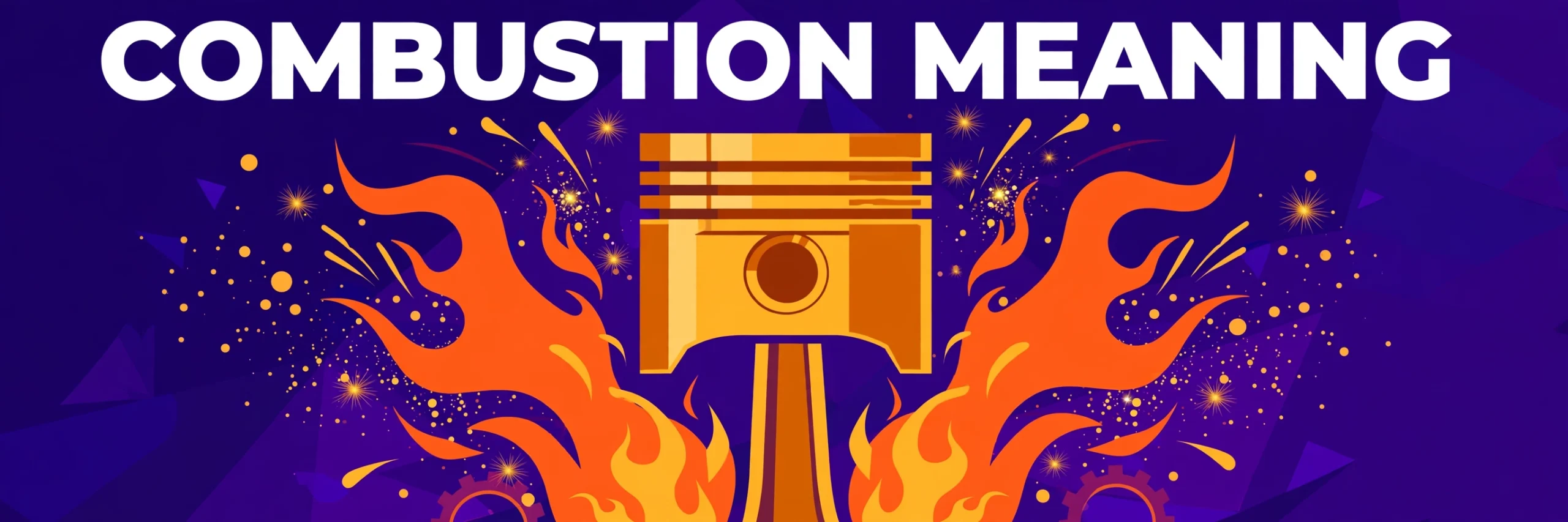
The word’s most familiar compound is the internal combustion engine: a heat engine in which the combustion that generates the heat takes place inside the engine itself, in the cylinders, instead of in a separate furnace. Merriam-Webster dates the term to 1884, and the idea is the contrast with the older steam engine, an external combustion engine, in which fuel burned in a boiler and the steam drove the machine. In a petrol engine, the fuel-air mixture is drawn into the cylinder, compressed, ignited by a spark, and the expanding gases drive the piston down; in a diesel engine, the mixture ignites from the heat of compression alone, with no spark plug. The phrase “internal combustion” is now often shortened to “ICE” in writing about electric vehicles, and “internal-combustion purist” has become a label for drivers who prefer petrol engines to electric ones.
Spontaneous combustion is the other compound worth knowing. Oxford defines it as “the burning of a mineral or vegetable substance caused by chemical changes inside it and not by fire or heat from outside”: a pile of oily rags, a heap of damp hay, or a heap of coal can heat up from slow oxidation inside the pile until it catches fire on its own, with no spark and no flame applied from outside. The human version — a body bursting into flames without an outside source — is a popular myth that Cambridge’s examples note has never been captured with solid evidence. The real phenomenon is mundane, industrial, and preventable: it is why oily rags are stored in metal bins and hay is dried before it is stacked.
Combustion vs Burning, Fire, and Explosion
| Word | What it means | How it differs from combustion |
|---|---|---|
| Combustion | The chemical process of a fuel reacting with oxygen to produce heat and light. | The base word; the scientific term for the process. |
| Burning | The everyday word for the same process. | The plain synonym: “the process of burning” is Oxford’s first definition of combustion. Burning is less technical and covers more, including sunburn and a burning feeling. |
| Fire | The visible flames, heat and light of burning. | The visible result, not the process: combustion can happen without a visible flame, and fire is what you see when it does flame. |
| Explosion | A sudden, violent release of energy, often from very rapid combustion. | A matter of speed: an explosion is combustion happening so fast that it produces a shock wave. Not all combustion explodes. |
| Oxidation | A chemical process in which a substance combines with oxygen. | The broader term: all combustion is oxidation, but not all oxidation is combustion — rusting is oxidation without fire. |
Correct vs Incorrect
| Correct | Incorrect | Why |
|---|---|---|
| Spelled combustion: c-o-m-b-u-s-t-i-o-n. | Spelled combusion or combuston. | The word contains -bust-, from Latin comburere; there is no combusion. |
| Pronounced “kum-BUS-chun”, stress on the second syllable. | Pronounced “COM-bus-tee-on” or “kum-bus-TEE-on”. | The stress is on -bus- and -tion is pronounced “-shun”. |
| Combustion is an uncountable noun: “during combustion”. | “A combustion happened in the engine.” | Oxford marks it [uncountable]; use “combustion took place” or “an act of combustion” for a single instance. |
| The internal combustion engine burns fuel inside its cylinders. | The internal combustion engine burns fuel in a separate boiler. | Burning in a separate boiler is an external combustion engine — a steam engine. |
| Incomplete combustion produces carbon monoxide. | Incomplete combustion produces only carbon dioxide. | Carbon dioxide is the product of complete combustion; starved of oxygen, the fuel makes carbon monoxide and soot instead. |
| The adjective is combustible; the verb is combust. | The adjective is combustionable. | Combustible is the standard adjective; combustionable is not a word. |
Common Mistakes
Equating combustion with fire
Fire is the visible part of combustion, but the two are not the same. Combustion is the chemical reaction; fire is the flame, heat and light you can see. Slow combustion — smouldering, glowing, the oxidation of food in the body — happens without any flame at all. Saying “there was no combustion because there was no flame” is wrong.
Thinking combustion always needs a flame to start
It needs heat, not a flame. A spark, a hot surface, or the heat of compression in a diesel engine will do, and spontaneous combustion needs no outside source at all — the heat builds up inside the material itself. A flame is one way to supply the ignition temperature, not the only one.
Confusing combustion with explosion
An explosion is very rapid combustion, but most combustion is not explosive: a candle, a gas hob and a car engine all burn in a controlled way. The difference is the rate of the reaction and whether the gases can expand freely. Calling every combustion an explosion overstates the violence, and calling an explosion “just combustion” understates it.
FAQs
What does combustion mean in simple terms?
It means burning: a chemical process in which a fuel combines with oxygen in the air to produce heat and light. A candle, a campfire and a car engine all run on combustion.
What is an internal combustion engine?
An engine in which fuel burns inside the engine itself, in the cylinders, instead of in a separate furnace. Petrol and diesel car engines are internal combustion engines; a steam engine, which burns fuel in a boiler, is an external combustion engine.
What is complete and incomplete combustion?
Complete combustion happens with plenty of oxygen and produces carbon dioxide and water vapour. Incomplete combustion happens with too little oxygen and produces carbon monoxide and soot as well, which is why it is dirtier and more dangerous.
What is spontaneous combustion?
Burning caused by chemical changes inside a material — such as a pile of oily rags or damp hay heating up by slow oxidation — with no flame or heat applied from outside.
The Takeaway
Combustion is the process of burning — pronounced “kum-BUS-chun” — and, in its scientific sense, a chemical process in which a fuel combines with oxygen to produce heat and light. It needs fuel, oxygen and enough heat to start, and it can be complete, giving carbon dioxide and water, or incomplete, giving carbon monoxide and soot. It is the reaction inside every petrol and diesel engine, the reason a pile of oily rags can catch fire on its own, and the process behind every candle and campfire. Fire is what you see; combustion is what is happening.
Sources: Oxford Learner’s Dictionaries, “combustion” and “spontaneous combustion”; Merriam-Webster, “combustion” and “internal combustion engine”; Cambridge Dictionary, “combustion”. Definitions checked 16 November 2026.