Shawl Meaning: Definition, Examples and How to Use It
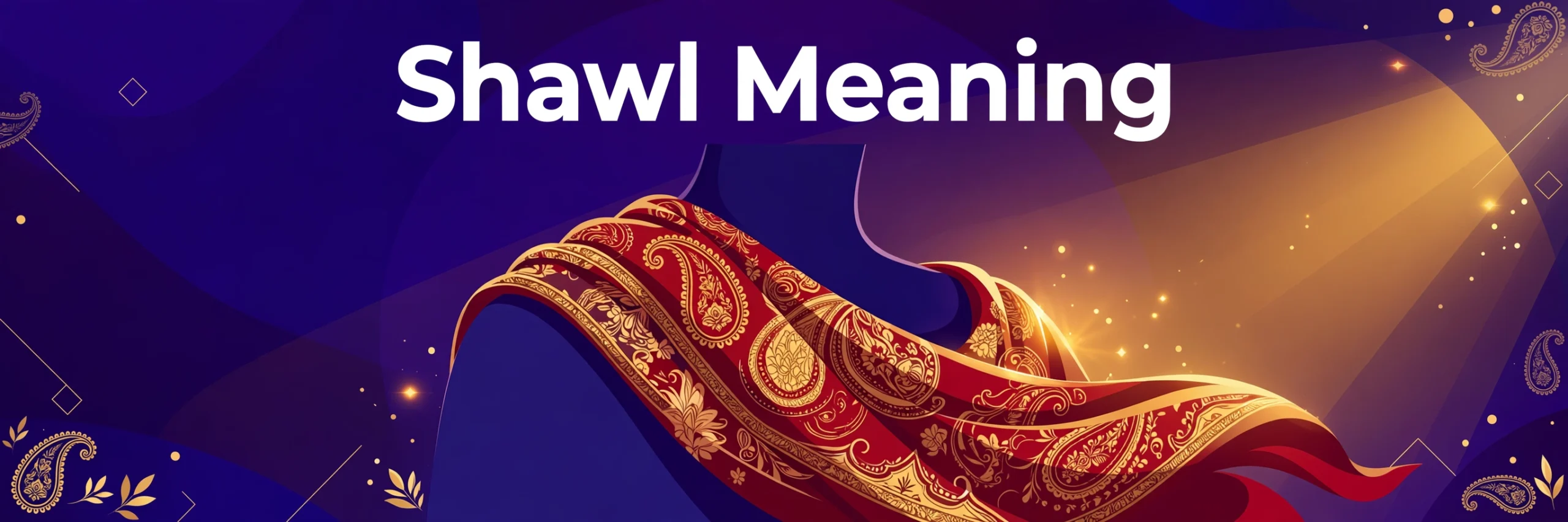
A shawl is a large piece of fabric worn loosely over the shoulders or head, or wrapped around a baby for warmth. Bigger and more enveloping than a scarf, simpler than a coat, it is one of the oldest garments in continuous use — and one of the few English clothing words that arrived via Persian and Urdu rather than French or Latin.
Shawls carry cultural weight far beyond their simple shape: the Kashmiri pashmina that became a European status symbol, the Jewish prayer shawl (tallit), the paisley patterns of Paisley, Scotland. The word itself is a small history of global trade.
What the Dictionaries Say About “Shawl”
| Dictionary | Definition of shawl |
|---|---|
| Collins COBUILD | “A large piece of woollen cloth which a woman wears over her shoulders or head, or which is wrapped around a baby to keep it warm.” |
| Oxford Languages (via bab.la) | “A piece of fabric worn over the shoulders or head or wrapped round a baby.” |
| Webster’s New World (via Collins) | “An oblong or square cloth worn, esp. by women, as a covering for the head or shoulders.” |
Every definition agrees on the essentials: large, loose, draped — over shoulders, head, or a baby. No buttons, no sleeves, no tailoring. A shawl is defined by what it isn’t as much as by what it is: it is fabric doing the work of a garment through draping alone.
How to Pronounce “Shawl”: UK and US
One syllable, rhyming with all, call, and tall.
- UK: /ʃɔːl/ — shawl, with the long open “aw” vowel
- US: /ʃɔl/ — shawl, slightly shorter, the vowel of caught
The spelling is phonetic in a way English rarely manages: sh + aw + l says exactly what it is. The plural is simply shawls. The verb to shawl (“to wrap in a shawl,” recorded since Webster’s 1913) gives us shawled — “a baby shawled in blankets” — a word that survives mostly in literary and journalistic writing.
Where Does “Shawl” Come From? A Persian Word with a Travel History
Collins dates shawl to 1655–1665 and traces it to Persian shāl, probably arriving via Urdu — which makes sense, since the magnificent woven shawls of Kashmir reached Europe through Mughal India and the East India trade. Oxford Languages adds a charming detail: the word may be named after Shāliāt, a town in India associated with their manufacture.
The 17th-century dating matters. This was the era when Kashmiri shawls — woven from the impossibly fine undercoat of Himalayan goats — began arriving in Europe as luxury goods. By the early 1800s they were the height of fashion (Josephine Bonaparte reportedly owned hundreds), and the Scottish town of Paisley grew rich weaving imitations, giving us the paisley pattern: the teardrop motif copied from Kashmiri shawls. The word shawl is, in miniature, the story of early globalisation.
The Main Types of Shawl
Pashmina and cashmere shawls
The luxury originals. Pashmina (from Persian pashm, “wool”) denotes shawls woven from the fine undercoat of the Changthangi goat of the Himalayas; cashmere is the broader trade term for the same fibre. A true hand-woven Kashmiri shawl can take months to make and pass the famous “ring test” — fine enough to draw through a finger ring.
Prayer shawls
In Judaism, the prayer shawl is the tallit (tallith) — a rectangular garment with fringed corners (tzitzit) worn by Jewish men during morning prayer. This is a distinct, technical sense of shawl: here the draped cloth carries religious obligation, not just warmth.
Evening and bridal shawls
The fashion sense: a silk, lace, or beaded shawl draped over an evening dress — warmth plus elegance, the modern descendant of the Regency-era craze. Stole is often used interchangeably here, though strictly a stole is narrower.
The shawl collar
A menswear borrowing: a shawl collar is the smooth, rounded collar of a tuxedo jacket or cardigan that curves around the neck like a draped shawl, with no notch or peak. If you have ever wondered what a shawl has to do with a dinner jacket — that curve is the answer.
Shawls in literature and culture
The shawl is a favourite prop of novelists because it signals so much so quietly: respectability, poverty, piety, or wanderlust, depending on who wears it. From the shawled grandmothers of Victorian fiction to the pashmina-draped travellers of modern airports, the garment reads instantly. It also carries real political history — Kashmiri weavers, Paisley mill workers, and the women who wore their shawls as statements of identity all belong to the word’s story.
Shawl vs Scarf vs Stole vs Wrap
These get mixed up constantly in shops and writing alike:
| Shawl | Scarf | Stole | |
|---|---|---|---|
| Size | Large — covers shoulders, head, or a baby | Smaller — wraps the neck | Medium-narrow — drapes over shoulders |
| Shape | Square, rectangular, or triangular | Long and narrow | Long and narrow, wider than a scarf |
| Worn | Draped over shoulders/head | Around the neck | Over the shoulders, often formal |
Rule of thumb: if it wraps your neck, it is a scarf; if it drapes your shoulders generously enough to function as a light garment, it is a shawl. Wrap is the vaguest of the four — a marketing term that can mean almost any of them.
Examples of “Shawl” in Sentences
- She pulled a woollen shawl tightly around her shoulders against the evening chill.
- The baby slept, shawled in a soft white blanket.
- Her grandmother’s paisley shawl had been woven in Kashmir over a century ago.
- He wore a tallit, the traditional Jewish prayer shawl, for the morning service.
- The dinner jacket had a silk shawl collar.
- Vendors in the market spread their shawls — crimson, saffron, indigo — across the stalls.
Common Mistakes with “Shawl”
- Calling any scarf a shawl. Size is the test: a neck scarf is not a shawl, however luxurious the fabric.
- “Shawl” as a verb in casual writing. Shawled is correct but literary — “wrapped in a shawl” is the natural everyday phrasing.
- Misspelling it shall. The modal verb shall and the noun shawl sound nothing alike, but the spelling confusion appears in learners’ writing. Remember: shawl rhymes with all.
- Assuming it is women’s clothing only. The prayer shawl is worn by men, and the shawl collar belongs to menswear — the garment crosses every such boundary.
FAQs About “Shawl”
What is the difference between a shawl and a pashmina?
Pashmina properly refers to the material — the fine Himalayan goat undercoat — or to shawls made from it. All pashminas (in the strict sense) are shawls, but not all shawls are pashmina; most are wool, silk, cotton, or synthetic. In shops, “pashmina” is often used loosely for any soft rectangular wrap.
What is a prayer shawl called?
In Judaism it is the tallit (also spelled tallis or tallith) — a rectangular fringed garment worn during prayer. “Prayer shawl” is the English descriptive term for it.
Is “shawl” countable?
Yes: “a shawl,” “two shawls.” Collins lists the plural straightforwardly as shawls.
What does “shawl collar” mean on a jacket?
A rounded collar that sweeps continuously around the neck without notches — named for its resemblance to a draped shawl. It is standard on tuxedos (dinner jackets) and shawl-collar cardigans.
Takeaway
A shawl is fabric at its most elemental: a large, loose drape for shoulders, head, or baby — a word that travelled from Persian shāl through Mughal India to European high fashion. Keep it distinct from the neck-bound scarf, remember the literary verb shawled, and you have a word with four centuries of trade, craft, and culture folded into five letters.
Source for the dictionary senses quoted above: bab.la’s English dictionary entry for “shawl” (definitions powered by Oxford Languages).