Cant Meaning: Definition, Examples and How to Use It
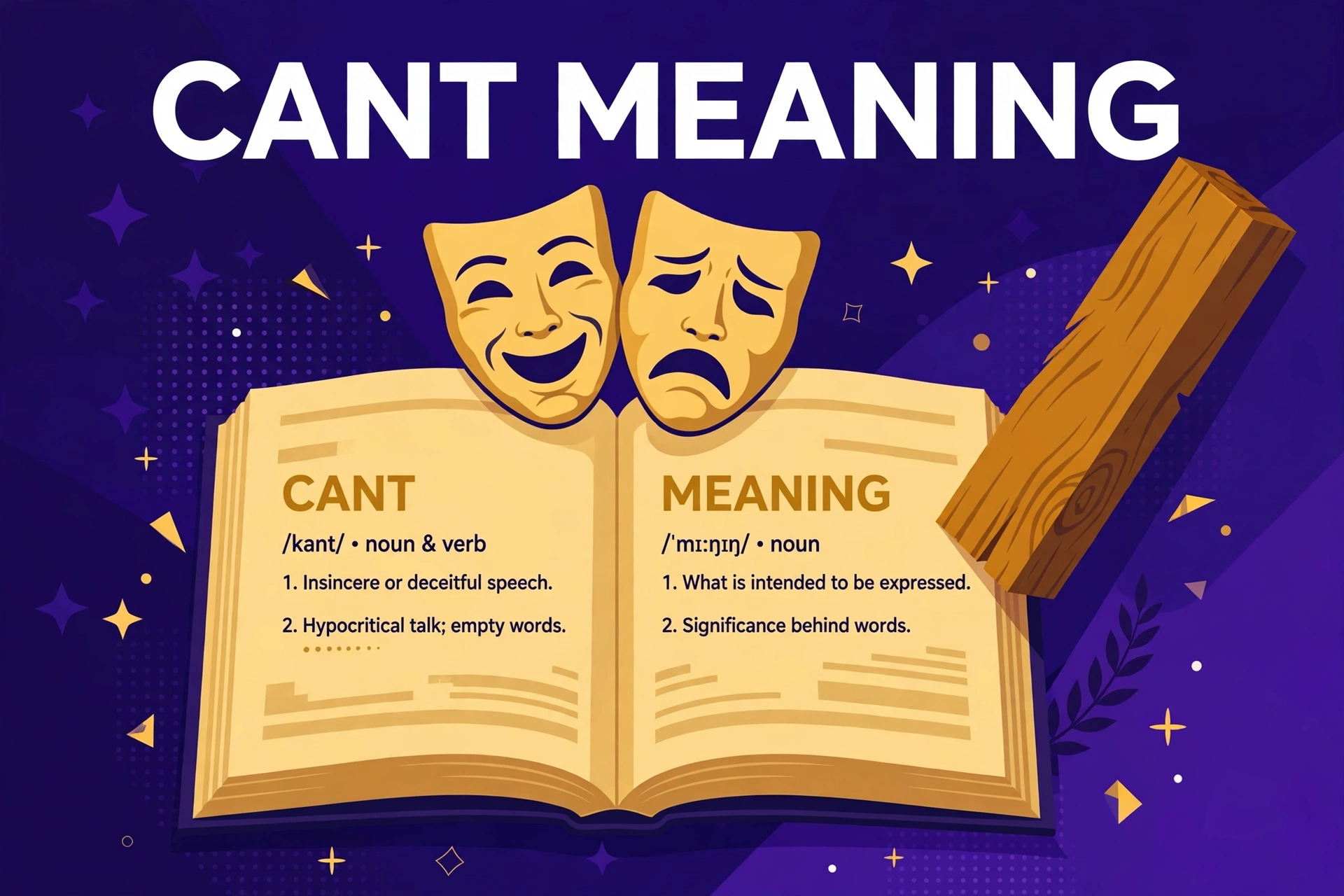
Most people who search for “cant meaning” have just met the word in a sentence where it clearly is not can’t — and yet the two look almost identical. “There was too much cant in his speech about duty.” “The beam was set at a cant.” Neither sentence is about ability, and neither is a typo. Cant is a real, dictionary-listed word with two very different families of meaning: insincere, high-minded talk on the one hand, and a tilt or slant on the other. This guide covers both, and clears up the confusion with can’t first, because that is where nearly everyone starts.
Cant vs Can’t: The Difference at a Glance
| Word | What it is | Meaning | Example |
|---|---|---|---|
| cant | Noun / verb | Insincere, pious-sounding talk; or a tilt/slant | “His speech was full of cant about sacrifice.” |
| can’t | Contraction of cannot | Not able to; not allowed to | “I can’t attend the meeting.” |
The apostrophe does all the work. Can’t is can + not with the o removed and an apostrophe in its place. Cant has no apostrophe, no missing letter, and nothing to do with ability. If you can replace the word with “cannot” and the sentence still works, you want can’t. If you cannot, and the sentence is about hollow talk or a slant, you want cant.
Pronunciation adds a wrinkle worth knowing. In American English the two are homophones: both are pronounced /kænt/. In British English they usually are not — cant is /kænt/ while can’t is /kɑːnt/, with the long “ah” of father. Dictionary.com records exactly this split: cant as /kænt/ in both British and American English, and can’t as /kænt/ or /kɑnt/ in American English but /kɑːnt/ in British English. So an American listener cannot tell them apart by sound alone; only the spelling — and the context — separates them.
What the Dictionaries Say About “Cant”
| Dictionary | Definition of cant |
|---|---|
| Dictionary.com (noun, sense 1) | “Insincere, especially conventional expressions of enthusiasm for high ideals, goodness, or piety.” |
| Dictionary.com (noun, senses 2–3) | “The private language of the underworld”; “the phraseology peculiar to a particular class, party, profession, etc.” |
| Dictionary.com (noun, sense 4) | “Whining or singsong speech, especially of beggars.” |
| Collins COBUILD (noun) | “If you refer to moral or religious statements as cant, you are criticizing them because you think the person making them does not really believe what they are saying.” |
| Dictionary.com (noun, tilt sense) | “A salient angle”; “a sudden movement that tilts or overturns a thing”; “a slanting or tilted position”; “an oblique line or surface, as one formed by cutting off the corner of a square or cube.” |
| Collins (tilt sense, British) | “Inclination from a vertical or horizontal plane; slope; slant”; “a corner or outer angle, esp of a building.” |
Notice that the dictionaries treat cant as two separate headwords with two separate origins — which is why the meanings feel so unrelated. They are, historically, two different words that happen to share a spelling.
Meaning 1: Cant as Insincere, Hypocritical Talk
This is the sense most people meet in books, journalism, and political writing, and it is always critical. To call something cant is to say that the fine words are empty — that the speaker is performing virtue rather than practising it.
- “Strip away the cant about public service and the deal was about money.” (pious talk as cover)
- “He dismissed the whole speech as cant — pretty phrases with nothing behind them.”
- “The editorial was full of the usual cant about family values.”
- “She had no patience for religious cant from people who never gave to charity.”
Collins COBUILD’s definition captures the accusation precisely: the criticism is not that the statements are false in the abstract, but that the person making them does not really believe what they are saying. Cant is therefore close to hypocrisy, but the two are not identical. Hypocrisy is the behaviour — saying one thing and doing another. Cant is the language — the stock phrases and pious formulas themselves. A hypocrite produces cant; cant is what comes out of their mouth.
The word also covers the set phrases of a group. Dictionary.com’s second and third senses — “the private language of the underworld” and “the phraseology peculiar to a particular class, party, profession, etc.” — describe what is often called thieves’ cant: the secret slang of criminals, beggars, and other outsiders, used so that outsiders could not follow the conversation.
As a verb, this sense gives to cant — to talk hypocritically, or to speak in the whining, singsong tone once associated with beggars. It is rare in modern writing, and when it appears it is usually in the participial adjective canting: “a canting preacher,” “canting moralists.”
Meaning 2: Cant as a Tilt, Slant, or Bevelled Edge
The second family of meanings is physical and entirely neutral. A cant is an angle, a slope, or a tilt — and the verb to cant means to put something at an angle or to tip it over.
- “The old wall had developed a slight cant to the left.” (a lean)
- “The boat canted violently in the swell.” (tilted suddenly — WordReference’s example)
- “The carpenter canted the edge of the beam.” (bevelled it, cut it at an angle)
- “Give the picture a slight cant so it lines up with the shelf.” (a tilt)
This sense lives on in technical language. In railway engineering, the cant of a track is the slope given to a curve — the outside rail is raised above the inside one so that trains can take the bend without being thrown outward. In architecture and carpentry, a canted edge is one cut at an angle rather than square, and a cant can be the bevelled corner of a building. The adjective canted means tilted or slanting, and it is the form you will meet most often: “a canted roof,” “canted type” (in printing, type set at a slant).
Where Does “Cant” Come From?
The two senses have two different origins, which is the clearest proof that they are two words wearing one spelling.
The talk sense comes from Latin cantus, “song,” through Old French cant — the same root that gives us chant. Dictionary.com dates its first recorded use in English to 1495–1505 and traces it through Old English cantere, “singer,” and cantic, “song.” The connection is the singsong, whining tone: beggars and street preachers were heard as “singing” their appeals, and the word slid from the sound of the voice to the insincerity of the words. The thieves’-cant sense grew out of the same root — a secret language was a kind of song only insiders could follow.
The tilt sense comes from a completely different root: Middle English and Old French cant, “corner, edge, angle,” from Late Latin cantus, the iron rim of a wheel, and ultimately a Celtic root meaning “rim” or “edge.”
Cant vs Jargon, Slang, and Hypocrisy
| Word | What it means | How it differs from cant |
|---|---|---|
| cant | Insincere, pious-sounding talk; or a group’s private phrases | Always carries a judgement: the words are hollow. |
| jargon | Specialised vocabulary of a profession | Neutral — jargon can be precise and necessary; cant accuses the speaker of not believing it. |
| slang | Informal, often playful language of a group | Slang is casual; cant is either hypocritical or secretive. |
| hypocrisy | Saying one thing and doing another | The behaviour; cant is the language that behaviour produces. |
Common Mistakes and Confusions
Writing “cant” when you mean “can’t”
The most common error, and the reason this article exists. “I cant go” is wrong in any register — the contraction always takes the apostrophe: “I can’t go.” Spellcheckers often miss it because cant is a valid word, so this mistake survives proofreading more often than most typos. If the sentence is about ability or permission, the apostrophe is not optional.
Writing “can’t” when you mean “cant”
The reverse error is rarer but it happens, usually in the tilt sense: “the wall can’ted to the left” is wrong; the verb is canted, with no apostrophe. If you are describing a lean or a bevel, there is no contraction involved.
Confusing “cant” with “chant”
The two share a Latin root (cantus, song), and the confusion is understandable, but they are different words. A chant is a repeated, rhythmic form of singing or speaking — “the crowd’s chant.” Cant is insincere talk or a tilt. A chant can be cant (if the chanters don’t believe the words), but the words are not interchangeable.
FAQs About “Cant”
Is “cant” a real word or a misspelling of “can’t”?
It is a real word, listed in every major dictionary — Cambridge, Collins, Merriam-Webster, and Dictionary.com all carry it as a headword in its own right. It is also genuinely rare in everyday speech, which is why most people only meet it in books. It is not a misspelling, an abbreviation, or a variant of can’t.
What does “cant” mean in simple terms?
Usually, insincere talk — fine-sounding words about goodness, religion, or duty that the speaker doesn’t really mean. Less often, a tilt or slant. Which meaning applies depends entirely on context: speech and morals point to the first, buildings and boats to the second.
How do you pronounce “cant”?
/kænt/ — “kant,” rhyming with ant and plant (in most accents). It is pronounced the same in British and American English. The difference from can’t is a spelling difference in American English (where the two sound identical) and both a spelling and a pronunciation difference in British English, where can’t is /kɑːnt/.
What is “thieves’ cant”?
The secret slang used by criminals, beggars, and other outsiders in the 16th to 18th centuries, so they could talk without being understood by the authorities or their victims. Dictionaries of cant were published at the time, and the phrase survives today as a historical term — and as a model for any group’s private jargon.
Takeaway
Cant is two words in one spelling: insincere, pious-sounding talk (and, by extension, the private jargon of a group), and a tilt, slant, or bevelled edge. Neither has anything to do with can’t, the contraction of cannot — the apostrophe is the whole difference, and in American English the pronunciation is no help at all, since the two sound identical. Remember the test: if “cannot” fits, write can’t; if the sentence is about hollow words or a leaning wall, write cant. Dictionary.com’s entry for cant records both families of meaning, their separate origins, and the pronunciation split that makes this one of English’s quietest traps.