Axle or Axel: Which Is Correct?
Axle and axel look like two spellings of the same word — and because they are pronounced identically, most people assume one of them must be wrong. Neither is. They are two completely different words that happen to sound alike: axle is the bar that holds a vehicle’s wheels, while axel is a jump in figure skating (and a given name). The confusion is understandable, but the answer is firm: they are never interchangeable, and no dictionary lists one as a variant of the other.
This pair is a useful reminder that English spelling is a poor guide to English sound. The letters axl- and ax- plus -el converge on the same pronunciation, /ˈæksəl/, in both British and American English — so the mix-up survives entirely in writing, where spellcheckers rarely flag it because axel is a legitimate word. Below is what the dictionaries actually say, where each word belongs, and how to stop swapping them.
What the Dictionaries Say
Every major dictionary treats these as separate headwords with separate entries — the strongest possible signal that they are distinct words:
| Dictionary | Verdict |
|---|---|
| Cambridge Dictionary | axle /ˈæk.səl/ (UK and US), noun: “a bar connected to the centre of a circular object such as a wheel that allows or causes it to turn, especially one connecting two wheels of a vehicle.” |
| Merriam-Webster | axel, noun: “a jump in figure skating from the outer forward edge of one skate with 1½ turns taken in the air and a return to the outer backward edge of the other skate.” Etymology: named for Axel Paulsen (d. 1938), Norwegian figure skater; first known use 1930. Merriam-Webster adds an explicit warning: you might think axel is related to axle, “but it’s not.” |
| Collins (American English / Webster’s New World) | axel /ˈæksəl/, noun, figure skating: “a jump in which the skater takes off from one skate, does one and a half turns in the air, and lands on the other skate, facing in the opposite direction but moving in the same direction.” Collins also lists Axel as a noun in its own right — the given name. |
Three points to carry away from the table. First, axle is a common noun naming a mechanical part; axel is a common noun naming a sporting move, plus a proper noun naming a person. Second, their pronunciations are effectively identical — /ˈæk.səl/ and /ˈæksəl/ are the same sound written two ways. Third, and most important for writers: the resemblance is a coincidence. The jump is an eponym (a word formed from someone’s name); the vehicle part is not. Merriam-Webster’s explicit “it’s not related” note exists precisely because the dictionaries keep fielding this question.
Axle: The Part That Holds the Wheels
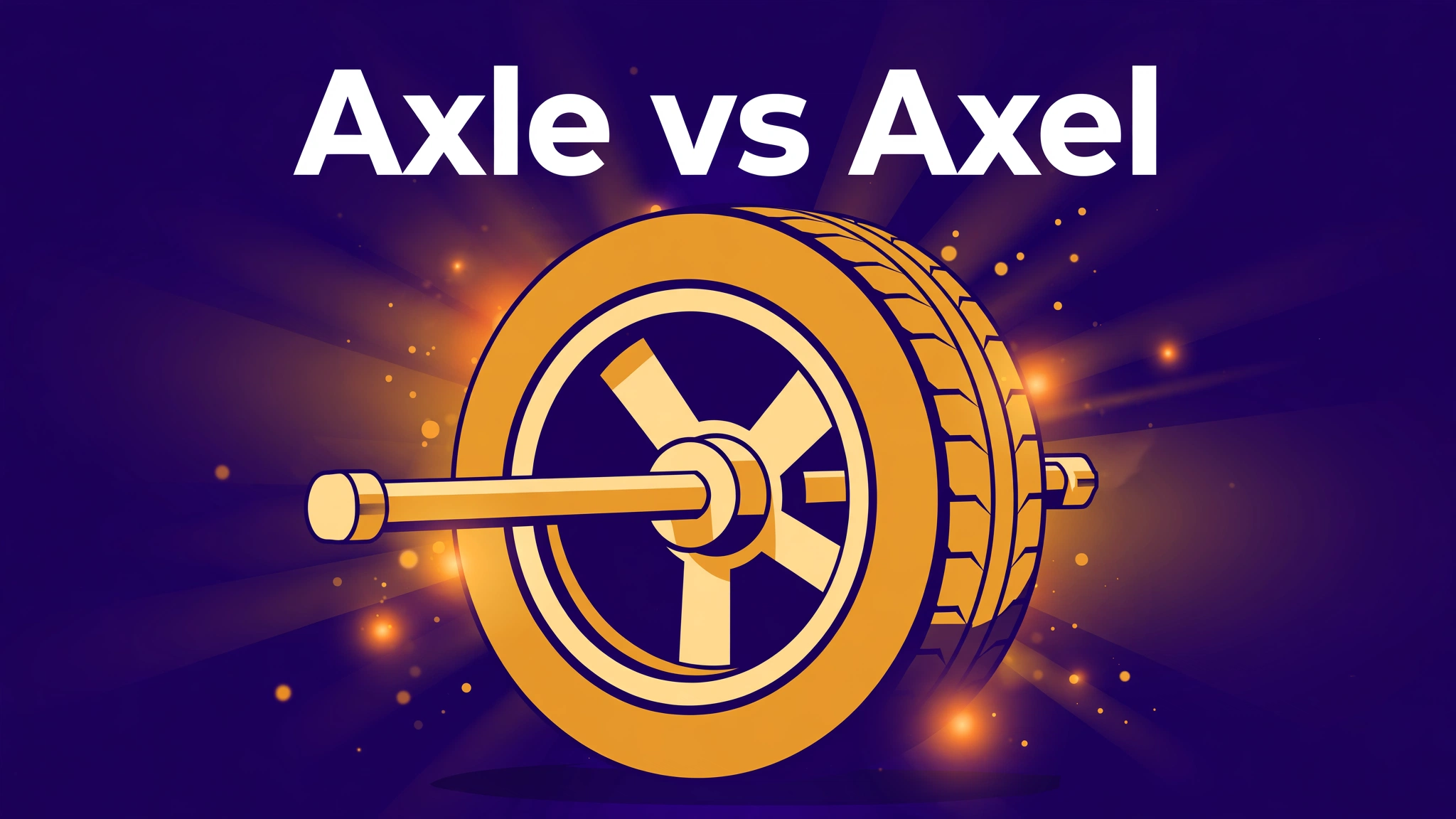
Axle is the everyday engineering word. Whenever wheels need a central shaft — on a car, a truck, a bicycle, a trailer, a train carriage — that shaft is the axle. Cambridge’s definition captures the two arrangements: the axle can run through the centre of a single wheel (the wheel turns around it) or connect two wheels (turning with them). In casual usage, “axle” also stretches to cover the whole assembly, or even just a transverse pair of wheels — “an 18-wheeler has five axles” is counting wheel pairs for toll and tax purposes, not individual shafts.
The word is fully at home in ordinary sentences:
- “The mechanic said the front axle was bent after the collision.”
- “Trucks with more axles pay higher tolls on the motorway.”
- “The trailer’s rear axle seized up halfway through the journey.”
- “He greased the axle bearings before the long drive.” (Note: “axle grease” is also old slang for flattery — buttering someone up — though the mechanical sense is the standard one.)
Grammar notes: axle is a countable noun — one axle, two axles. It pairs naturally with front and rear, and with verbs like bend, break, seize, and grease. It never takes a capital letter unless it starts a sentence, because it is not a name.
Axel: The Jump Named After a Skater
Axel belongs to the ice rink. It names a specific figure-skating jump: the skater takes off from the forward outside edge of one skate, rotates one and a half turns in the air, and lands on the backward outside edge of the other skate. Because it is the only jump that takes off moving forward, it carries an extra half rotation — which is why a “triple axel” actually contains three and a half revolutions, and is among the hardest jumps in the sport. Add rotations and you get the double axel, triple axel, and the notoriously difficult quadruple axel.
- “She landed a clean triple axel in the free skate.”
- “The quadruple axel has only recently been landed in competition.”
- “His axel technique improved once he fixed his take-off edge.”
The name honours Axel Paulsen (1855–1938), the Norwegian skater credited with inventing the jump — Merriam-Webster records the word’s first known use in 1930. This is the whole explanation for the spelling: it is simply Paulsen’s first name, lowercased into a common noun, the same way salchow comes from Ulrich Salchow and lutz from the Lutz family of skaters. Eponyms keep their namesake’s spelling, however odd it looks next to the rest of the vocabulary.
Two usage notes. Capitalisation: dictionaries list the jump in lowercase — axel — though sports writing sometimes capitalises it (“Triple Axel”). Lowercase is the dictionary standard and the safer choice. The given name: Axel is also a common first name (famously borne by the singer Axl Rose, spelled with an i-less variant, and by countless Axels across Scandinavia and Germany). As a name it is always capitalised — and it is never spelled “axle.”
Why They’re Confused — and Why It Matters
The confusion has three ingredients. First, the sound: they are homophones, so the error is invisible in speech and only surfaces in writing. Second, the spelling: the two differ by a single transposed letter pair — xl versus x-e-l — the classic shape of a typo. Third, familiarity: axle is the common word most people meet first (in driving, repairs, tolls), while axel is a specialist sports term, so readers encountering “axel” in a skating report may “correct” it to axle in their heads — and writers may do the same on the page.
But the cost of the mix-up is real in both directions. Writing “triple axle” in a skating report looks like you don’t know the sport; writing “broken rear axel” in a garage invoice looks like you don’t know cars. And because both spellings are real words, spellcheckers will not save you — “axel” passes every dictionary check, so only the writer’s own knowledge catches the error. The check that works: ask what the sentence is about. Wheels and vehicles → axle. Ice, jumps, and skaters → axel. A person’s name → Axel.
Correct vs. Incorrect
- ✓ “The car’s rear axle snapped on the pothole.” (vehicle part)
- ✗ “The car’s rear axel snapped on the pothole.” → ✓ axle
- ✓ “She opened with a double axel.” (figure-skating jump)
- ✗ “She opened with a double axle.” → ✓ axel
- ✓ “My neighbour Axel drives a lorry.” (given name — capitalised, never “axle”)
- ✓ “The truck has three axles.” (plural — axles, never axels, for the vehicle part)
- ✗ “He landed a triple Axle.” → ✓ “triple axel” (lowercase is the dictionary standard for the jump)
Common Mistakes
1. “Correcting” axel to axle in skating contexts. This is the most frequent error, and it runs on a reasonable instinct — axle is the more familiar word. But in a sentence about figure skating, axel is the correct term, eponym and all. Familiarity is not a spelling rule.
2. Typing axel for the car part. The reverse mistake, usually a genuine typo or a phonetic guess. Because both are dictionary words, no red squiggle appears. If you’re writing about vehicles, machinery, or wheels, slow down on this word.
3. Capitalising the jump. “Triple Axel” is common in journalism, but the dictionaries list the jump lowercase. In formal or edited writing, triple axel matches the reference standard.
4. Pluralising the jump as if it were the car part — or vice versa. Both plurals add a plain -s: axles (vehicle parts), axels (jumps: “she landed two clean axels”). Keep the root spelling of whichever word you mean and add -s; don’t let the plural drag you toward the other spelling.
5. Assuming the words are related. They aren’t, and the assumption leads people to “logic” their way to the wrong spelling (“an axel must be a small axle”). Merriam-Webster’s explicit denial exists for a reason: treat the resemblance as coincidence, because it is one.
Frequently Asked Questions
Is “axel” just a misspelling of “axle”?
No. Axel is a fully recorded dictionary word with its own entry, meaning, and etymology — a figure-skating jump named after Axel Paulsen (Merriam-Webster, Collins). It is only a misspelling when it appears where axle belongs, i.e. in a sentence about vehicles or machinery.
Are “axle” and “axel” pronounced the same?
Yes — they are homophones. Cambridge gives axle as /ˈæk.səl/ in both UK and US English; Collins gives axel as /ˈæksəl/. Same stress, same sounds. The difference exists only on the page.
Which is correct: “triple axel” or “triple axle”?
Triple axel. In figure skating, the jump is always spelled axel (usually lowercase). “Triple axle” is a misspelling — it reads as three vehicle shafts, which is not what the skater landed.
Should “axel” be capitalised?
For the jump, dictionaries list it lowercase — axel — so lowercase is the safe standard. The given name Axel is always capitalised. Capitalising the jump (“Triple Axel”) appears in journalism but is not the dictionary form.
Is “Axel” a real name?
Yes — Axel is an established given name, particularly common in Scandinavia and Germany, and it is the source of the skating term (Axel Paulsen, 1855–1938). It is never spelled “axle” as a name.
What’s the plural of “axle”?
Axles — simply add -s: “the truck’s rear axles.” (The jumps pluralise the same way: “two clean axels.” The roots stay distinct; only the -s is shared.)
The Takeaway
Axle is the shaft the wheels turn on; axel is the jump the skater turns in the air — named for Axel Paulsen, unrelated to the vehicle part in both meaning and origin, and identical in sound. The test is the topic: vehicles and machinery take axle; rinks, jumps, and the name take axel/Axel. Spellcheck won’t catch the swap, because both words are real — so this is one pair where the writer, not the software, has to know the difference.