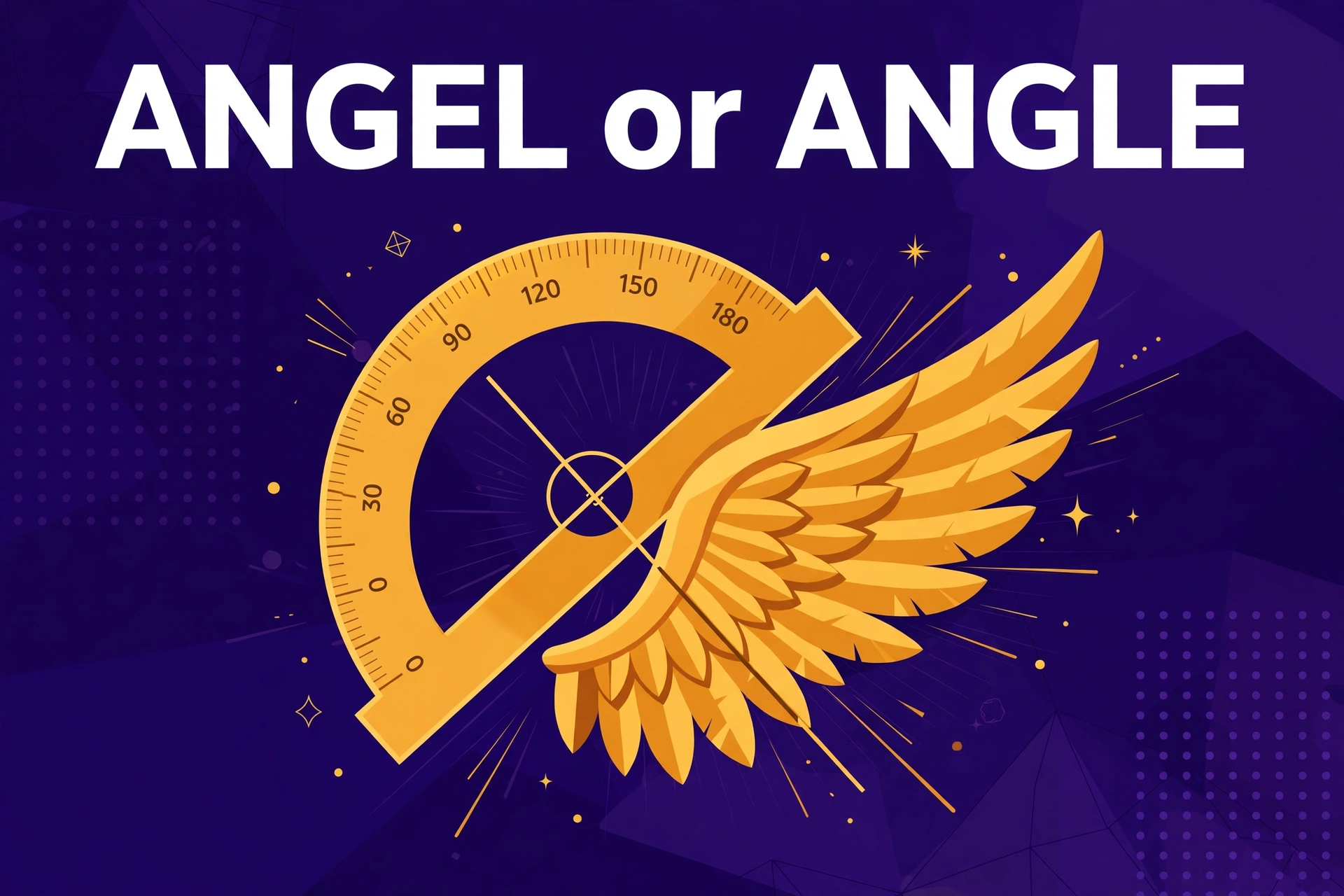
Angel or Angle: What’s the Difference?
If you have ever typed angel when you meant angle — “from a different angel” — or hesitated over which one names the heavenly being, here is the short version: an angel is a messenger of God, or a wonderfully kind person; an angle is a corner between two lines, a viewpoint, or the act of fishing. They sound alike, they look alike, and they have nothing to do with each other — which is exactly why they get mixed up.
This is the classic near-homophone trap. The first vowels differ — angel starts with “AYN”, angle with “ANG” — but in fast speech and faster typing, the words blur. Spellcheckers will not save you, because both are real words. The only defence is knowing what each one means, cold.
What Angel Means
Cambridge Dictionary gives the noun two main senses. The first is the religious one: “a spiritual being in some religions who is believed to be a messenger of God, usually represented as having a human form with wings”. The second is the everyday compliment: “someone who is very good, helpful, or kind” — as in “Be an angel and help me with this.” A child who behaves beautifully is “a little angel”; a stranger who returns your lost wallet is “an absolute angel”.
Two further uses are worth knowing. Angel works as a term of address — “What’s the matter, angel?” — affectionate, usually to someone you know well. And in business English there is the angel investor: a wealthy individual who invests in a new company, “wanting a stake in your business” rather than acting as a lender. None of these senses has anything to do with corners or viewpoints. Angel is always about beings — heavenly or human — who help.
What Angle Means
Angle is the busier word, and Collins gives it a full spread of senses. The core meaning is geometric: “the difference in direction between two lines or surfaces. Angles are measured in degrees” — or, in the shape sense, “the shape that is created where two lines or surfaces join together”. “The boat is now leaning at a 30 degree angle.” “The angle of the blade.”
From the geometry comes the metaphor, and the metaphor is where most real-world uses live:
- A viewpoint. “Thanks to the angle at which he stood, he could just see the sunset.” “His face will be discreetly concealed by camera angles.” “He was considering the idea from all angles.”
- A way of presenting something. “You can refer to a way of presenting something or thinking about it as a particular angle.” Journalists talk about “the angle of a newspaper article” — the slant the story takes.
- A verb: to position. “If you angle something or if it angles in a particular direction, it faces or points in that direction.” “You can open the slats for a bright light or angle them for more shade.”
- A verb: to fish. “To fish with a hook and line” — “he angled for a compliment” extends the fishing metaphor to scheming for praise. This sense comes from Old English angel, “fish-hook” — which, by a wonderful coincidence, is spelled exactly like the heavenly being but is a completely different word with a different history.
And one for the history-minded: the Angles were the Germanic people who settled England in the 5th and 6th centuries — the name England comes from Englaland, “land of the Angles”. Same spelling, capitalised, entirely unrelated to the heavenly host.
| Angel | Angle | |
|---|---|---|
| Pronunciation | AYN-juhl — UK/US /ˈeɪn.dʒəl/ | ANG-guhl — UK/US /ˈæŋɡəl/ |
| Part of speech | noun | noun and verb |
| Core meaning | heavenly being; very kind person | corner between lines; viewpoint |
| Verb? | no verb sense | yes — to position; to fish |
| Typical phrase | “be an angel”, “angel investor” | “from every angle”, “right angle” |
| Origin | religious tradition | Latin angulus, “corner” |
Why They Get Confused
Three forces conspire here. First, the pronunciation: both are two syllables with the stress on the first — AYN-juhl vs ANG-guhl. In rapid speech the first vowels compress toward each other, and many speakers barely separate them. Second, the spelling: swap the e and the g… well, nearly — angel and angle share every letter but one, in almost the same order. Third, autocorrect: phone keyboards suggest angel when you type angl…, because angel is the more common word in everyday texting.
The tell is the first vowel. Angel begins with the “ay” of say: AYN-juhl. Angle begins with the short “a” of cat: ANG-guhl. If you can hear the difference, you can spell the difference. Say them aloud a few times — “AYN-jel, ANG-gul” — and the pair stops being a blur.
Angel and Angle in Real Sentences
- According to the Bible, an angel told Mary she would have a son.
- The two roads meet at a sharp angle.
- Be an angel and pass me that file.
- Let’s look at the problem from a different angle.
- The startup was funded by an angel investor.
- She angled the mirror to catch the light.
- The babysitter said the twins had been little angels.
- The photographer tried several camera angles.
Try swapping any pair and the sentence collapses: “an angle told Mary” is nonsense, and “a sharp angel” is a geometry of the absurd. That instant collapse is your proof that the meanings never overlap — the confusion is purely in the fingers, never in the sense.
Correct vs. Incorrect
| Correct | Incorrect |
|---|---|
| She is an angel for helping us move. | She is an angle for helping us move. |
| Consider it from every angle. | Consider it from every angel. |
| The angel Gabriel appeared in her vision. | The angle Gabriel appeared in her vision. |
| Measure the angle between the walls. | Measure the angel between the walls. |
| He angled for an invitation. | He angeled for an invitation. |
Common Mistakes
Mistake 1: “From a different angel”. The single most common error — the idiom is “from a different angle“, meaning a different point of view. Autocorrect is the usual culprit; reading the sentence back aloud catches it instantly.
Mistake 2: Using “angel” as a verb. There is no verb angel. “He angeled the lamp toward the desk” is wrong — the verb is angle: “He angled the lamp toward the desk.” The fishing sense (“angling for compliments”) belongs to angle too.
Mistake 3: Pronouncing both the same. AYN-juhl vs ANG-guhl. Merging them in speech trains the fingers to merge them in writing.
Mistake 4: “Guardian angle”. It is “guardian angel” — the protective heavenly being. A “guardian angle” would be a very specific piece of geometry.
Frequently Asked Questions
Is it “angel” or “angle” for a viewpoint?
Angle — “from a different angle”, “consider every angle”. Angel never means a viewpoint; it means the heavenly being or a kind person.
Are angel and angle pronounced the same?
No. Angel is AYN-juhl (UK/US /ˈeɪn.dʒəl/); angle is ANG-guhl (UK/US /ˈæŋɡəl/). Both stress the first syllable, but the first vowels differ — “ay” vs short “a”.
What does “angel investor” mean?
A wealthy individual who invests in a new company, typically wanting a stake in the business rather than acting as a lender. Cambridge lists it under the business senses of angel.
Is “angling” related to angels?
Not at all. Angling — fishing with hook and line — comes from Old English angel, “fish-hook”, related to Latin uncus. It is a different word from both the heavenly angel and the geometric angle (from Latin angulus, “corner”), and just happens to share a spelling with the first.
How do I remember which is which?
Angel contains “gel” — think of a gentle being. Angle contains “ang” — think of an angular corner. Or anchor on the phrases: “be an angel” (kindness) vs “a right angle” (geometry).
The Takeaway
Angel (AYN-juhl) is the heavenly being or the wonderfully kind person. Angle (ANG-guhl) is the corner, the viewpoint, or the verb — to position, or to fish. Same letters, nearly; same meanings, never. Hear the first vowel, and the spelling follows.
Sources: Cambridge — angel; Collins — angle.