Costed or Cost: Which Is Correct?
“The repairs costed me £400.” It sounds logical — most English verbs add -ed for the past, so why not cost? Because cost, in its ordinary sense of “have a price” or “cause a loss”, is an irregular verb whose past tense and past participle are simply cost: the repairs cost me £400, and they have cost me more than I budgeted. And yet costed is not a made-up word. Dictionaries record it for a second, narrower sense of the same verb: to estimate or set the cost of something in advance, especially in business and accounting. “We costed the project at £2 million” is correct English — from a project manager, not from a shopper. Choosing between costed and cost is therefore not a spelling preference; it is a meaning test, and this article will give you a reliable way to apply it.
Quick Answer
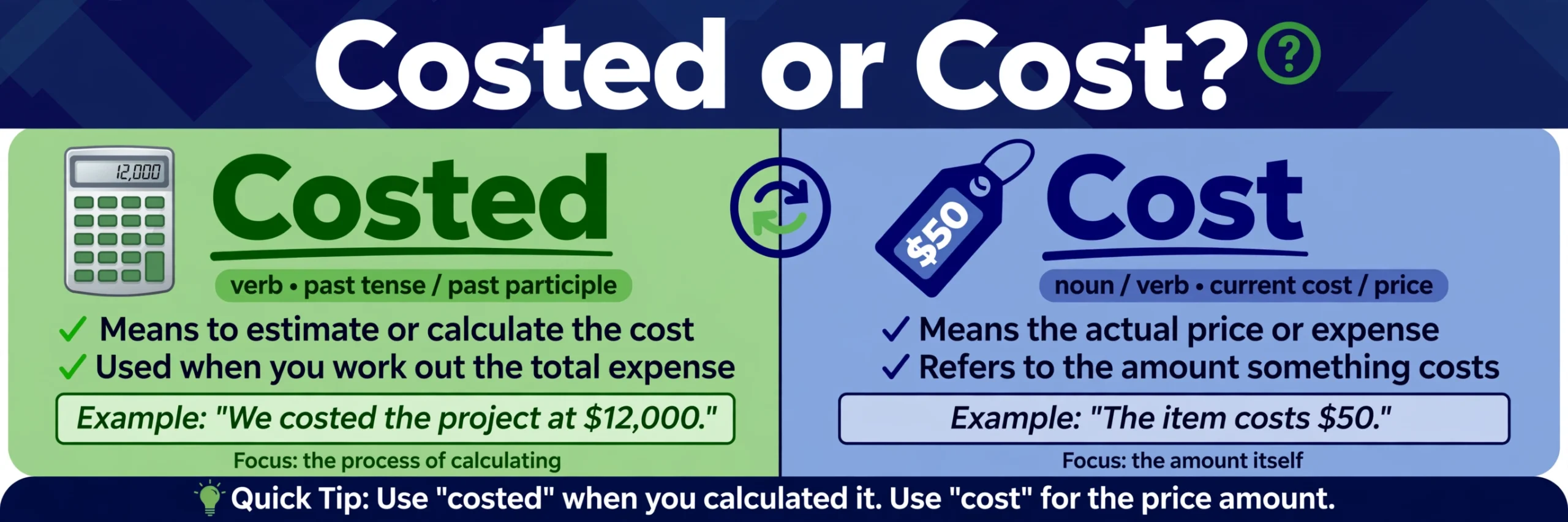
Use cost as the past tense and past participle when you mean that something had a price or caused a loss: “The ticket cost £25”, “The delay has cost us a week.” Use costed only when the verb means to estimate, calculate, or set a price in advance — chiefly in business, finance, and project planning: “The accountants have costed the project at $8.1 million”, “Has the scheme been properly costed?” Oxford Learner’s states the split exactly: past simple and past participle are cost, but “in sense 4 [to estimate] costed is used for the past tense and past participle”.
What the dictionaries record
Start with the main verb, because it accounts for the overwhelming majority of uses. Oxford Advanced Learner’s Dictionary lists the verb cost (UK /kɒst/, US /kɔːst/) with these forms: past simple cost, past participle cost, -ing form costing. The entry then adds a note that many learners miss: in sense 4 — “to estimate how much money will be needed for something or the price that should be charged” — the form costed (/ˈkɒstɪd/, US /ˈkɔːstɪd/) is used for the past tense and past participle. Oxford illustrates that sense with “The project needs to be costed in detail”, “fully costed proposals”, and “Their accountants have costed the project at $8.1 million.”
Cambridge presents the same two-verb picture. The main entry treats cost as the verb of paying and losing: “The trip will cost you $1,000”, with past forms unchanged. Its Business English material then uses costed in the estimating sense — “numerous layouts were planned and costed” — and the Cambridge learner tradition states the contrast plainly: cost, cost when something requires payment; costed, costed when you calculate the future cost of something (“Has your scheme been properly costed?”). Merriam-Webster agrees from the American side, listing as its third transitive sense: “past costed — to estimate or set the cost of, often used with out: ‘The project has yet to be costed out.’”
Collins stresses the same boundary: for the price sense, “the past tense and past participle of cost is cost” (“A two-day stay there cost me $125”). Across all four references the rule is identical in British and American English. There is no regional split. The split is semantic — two senses, each with its own past forms.
The two verbs hiding inside “cost”
Think of cost as two verbs sharing a present tense. The first is the everyday verb: “to have a specified price” (“These phones cost £300”), “to require payment” (“The course cost me a fortune”), or “to cause a loss” (“That mistake cost him his job”). Like cut, put, and set, its base form, past tense, and past participle are identical. It does not accept -ed in standard English.
The second verb is a specialist: “to work out in advance what something will cost or should be charged”. Its habitat is the budget meeting and tender document — costed proposals, a fully costed plan. As a regular verb it takes the regular ending, often in the passive (“The scheme was costed at £4 million”) or with out (“Have you costed out the repairs?”).
Native speakers feel the difference even when they cannot state it, which is why “It costed £10” jars. Conversely, “We have cost the project” sounds unfinished to anyone who works with budgets. English treats the two senses as separate verbs with separate paradigms — a small, learnable system, not random irregularity.
A test you can apply in two seconds
When you hesitate, ask what the sentence is doing. Are you reporting money already involved — a price paid, a bill incurred, a loss suffered? Then the verb is the everyday cost, and its past form is cost. Are you describing the professional act of estimating — someone calculating, pricing up, or producing figures for a plan? Then the verb is the specialist, and its past form is costed.
Two substitution checks make the test concrete. First, replace the verb with “had a price of”. If the sentence survives — “The meal had a price of £40 for us” ≈ “The meal cost us £40” — you need cost. Second, replace it with “estimated the price of”. If that paraphrase works — “The accountants estimated the price of the project at $8.1 million” ≈ “The accountants costed the project at $8.1 million” — you need costed. A sentence will normally pass one test and fail the other, which is what makes the choice dependable.
Grammar gives supporting clues. The estimating verb takes a project, plan, or scheme as its object and favours at (“costed at £2 million”), out, and adverbs like fully and properly. The everyday verb attaches a sum, the payer (“cost me”), or a loss (“cost him his licence”). Together with the meaning test, these clues resolve virtually every real sentence.
Cost vs. costed at a glance
| Feature | cost (past = cost) | costed (past = costed) |
|---|---|---|
| Core meaning | To have a price; to require payment; to cause a loss | To estimate, calculate, or set a price in advance |
| Typical object | A sum of money, the payer, or a loss (“cost me £50”, “cost her the match”) | A project, plan, proposal, or scheme (“costed the expansion”) |
| Past tense | cost — “It cost £20 yesterday” | costed — “We costed it last March” |
| Past participle | cost — “It has cost too much” | costed — “It has been costed at £2m” |
| Common patterns | cost somebody something; cost a fortune | be costed at; cost something out; fully/properly costed |
| Typical context | Everyday speech and writing, all registers | Business, accounting, engineering, public-sector planning |
| Dictionary note | Oxford: past simple cost, past participle cost | Oxford: “In sense 4 costed is used”; Merriam-Webster: “past costed: to estimate or set the cost of” |
Correct vs. incorrect examples
Correct: “How much did it cost?” The paying sense, past tense cost. Adding -ed here (“How much did it costed?”) is the classic learner error.
Correct: “A two-day stay there cost me $125.” (Collins’ example pattern.)
Correct: “His frequent absences cost him his job.” Figurative loss still takes cost, never costed.
Correct: “The project needs to be costed in detail before we apply for funding.” Estimating sense, passive voice — costed is required.
Correct: “Their accountants have costed the project at $8.1 million.” Note the professional subject and the “at + figure” pattern.
Correct: “Have you costed out these proposals yet?” The particle out is a strong signal of the estimating verb.
Incorrect: “The shoes costed £45 in the sale.” Standard English: “The shoes cost £45.”
Incorrect: “It has costed us a lot of time.” Time lost is the everyday verb: “It has cost us a lot of time.”
Incorrect: “We have cost the wedding and it comes to £18,000.” If you performed an estimate, the verb is costed: “We have costed the wedding…”
Common mistakes
Declaring that “costed is not a word”
This is the mirror-image error, and it fails the same dictionary check as overusing costed. Oxford, Cambridge, Collins, and Merriam-Webster all record costed for the estimating sense. The accurate statement is: costed is a real but restricted form. Correcting a finance colleague’s “fully costed proposal” to “fully cost proposal” would introduce an error in the name of removing one.
Using costed for money already spent
Because regular verbs dominate English, learners and hurried native writers alike produce “it costed me…”. In standard British and American English this is not an accepted variant for the price sense; dictionaries give cost as the past form without qualification. In edited writing, always revise costed to cost when a price or loss is meant.
Forgetting the passive clue
Estimates are often reported without naming the estimator: “The bypass was costed at £900 million.” Writers who have learned only “past of cost is cost” sometimes “fix” such sentences into nonsense (“was cost at…”). If the subject is a plan being priced, the passive of the specialist verb — was costed — is the correct form.
Adding “to” after cost
Collins specifically warns against “How much did that haircut cost to you?” The paying verb takes the payer as a direct second object: “cost you £15”, “cost me an hour”. The misplaced to is a frequent transfer error from languages that mark the payer differently, and removing it instantly improves the sentence.
Applying costed to figurative loss
“The scandal costed the minister her career” is wrong. Metaphorical cost — jobs, lives, reputations, matches, sleep — behaves exactly like monetary cost: past form cost. Costed never travels into the figurative sense in standard usage.
FAQs
Is costed a real word?
Yes, but a restricted one. Dictionaries record costed as the past tense and past participle of cost only in the sense “to estimate or set the cost of”, used mainly in business and planning contexts. It is not the past tense for “have a price”.
What is the past tense of cost?
For the ordinary verb, cost: present “it costs £10”, past “it cost £10”, past participle “it has cost £10”. For the estimating verb, costed: “we costed the plan”, “the plan has been costed”.
Can I say “the project was costed at £2 million”?
Yes — that is a standard, correct use. The passive construction with at plus a figure is one of the most common homes for costed in reports and news writing.
Is there a British-American difference?
No. Unlike spiralled/spiraled, this distinction is identical in British and American English. Both varieties use cost for prices and losses and costed for professional estimates.
Why do I hear “costed” in everyday speech?
Regularisation is a permanent pressure in English: speakers extend the -ed pattern to irregular verbs, especially in informal speech and some regional varieties. You will hear “it costed me…” conversationally, but in standard written English — exams, publishing, professional documents — cost remains the required form for the price sense.
Takeaway
Ask what the verb is doing. If something had a price, demanded payment, or caused a loss, the past is cost: “The train ticket cost £38”, “The error has cost us dearly.” If someone professionally estimated a price in advance, the past is costed: “The scheme was fully costed”, “We costed out the repairs.” Both forms are real English; only one of them fits your sentence. Learn the meaning test, and you will never need to guess again.