Aww or Awe: What’s the Difference?
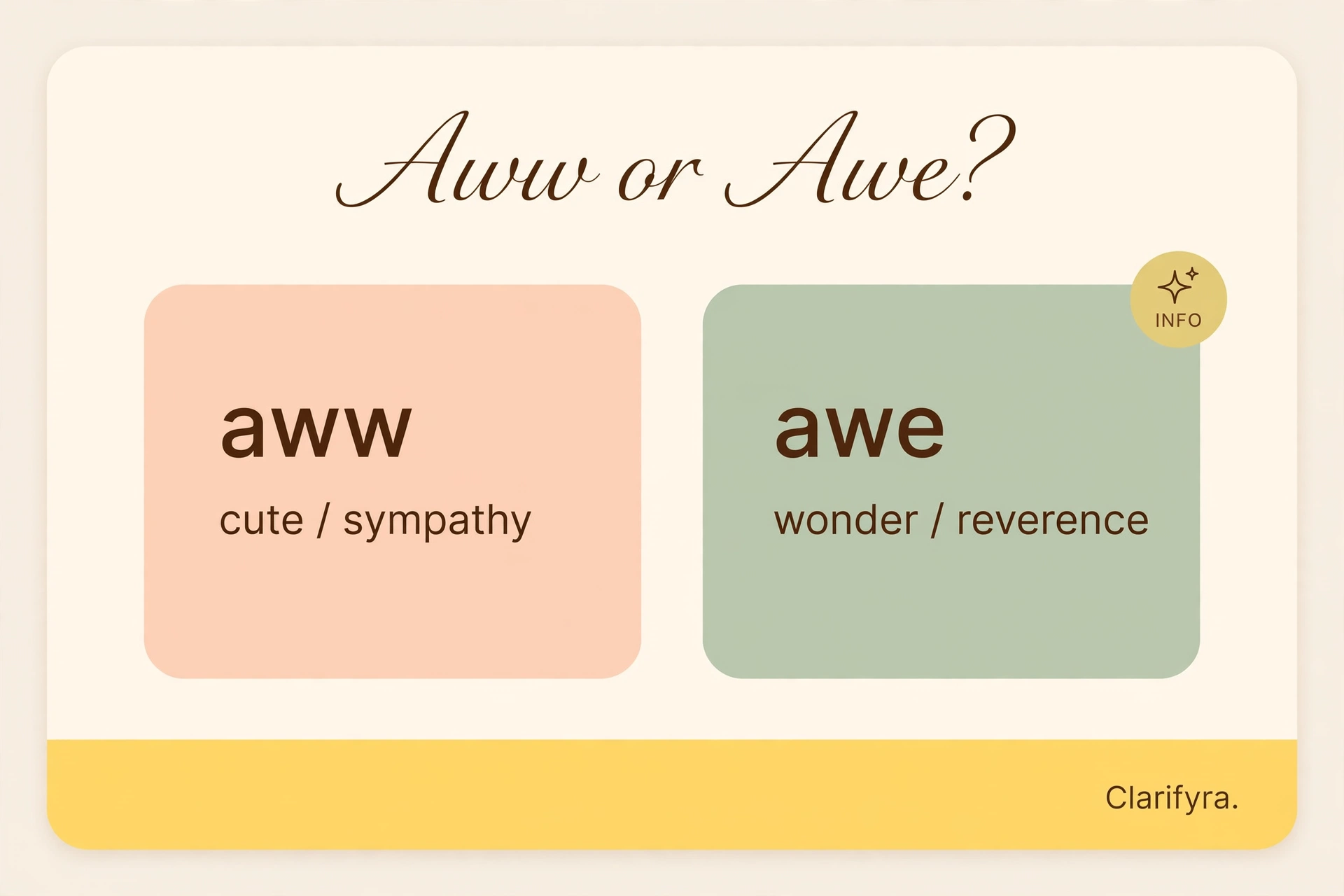
You’ve just seen a photo of a kitten asleep in a teacup and typed “aww” — or was it “awe”? The two words sound almost identical in casual speech, but they do completely different jobs. Aww (often written aw) is the little sound we make when something is cute, sad, or disappointing. Awe is a noun — and a verb — for the overwhelming feeling of wonder and reverence you get in front of something vast or beautiful. One is a reaction noise; the other is a formal, centuries-old emotion word.
Quick Answer
Aww (also aw) is an interjection used to express sympathy, affection, disappointment or disapproval — Cambridge lists both senses under aw: “used to express disappointment or disapproval” and “used to express sympathy or love, especially when you find something or someone cute.” Awe is a noun (and verb) meaning a feeling of great respect, wonder and often a touch of fear — Collins: “the feeling of respect and amazement that you have when you are faced with something wonderful and often rather frightening.” Pronunciation separates them: aw/aww is drawn out in speech, while awe is UK /ɔː/, US /ɑː/ (Cambridge) — a short, single vowel. If you’re reacting to something adorable, you want aww; if you’re describing being overwhelmed by grandeur, you want awe.
“Aww”: The Sound of Cute, Sad, and “Oh No”
Aww belongs to the family of interjections — those short, grammatically loose words like oh, wow, and oops that carry emotion rather than information. Cambridge Dictionary enters the headword as aw and gives it two everyday uses. The first is disappointment or disapproval: “Aw, I thought you were somebody else,” “Aw man, everything’s all wrong,” “Aww, you ruined it!” The second is sympathy or love, “especially when you find something or someone cute (= attractive and pleasant in the way that babies or baby animals are)”: “Aw, that poor guy,” “Aw, isn’t he cute?”
In writing, the single w form aw is the dictionary headword, and aww is the common extended spelling people use online to stretch the sound — aww, awww, and longer runs all signal “hold that vowel a bit longer.” Collins records aww as a “Prolonged form of aw” in its new-word monitoring, which matches how the spelling is actually used: extra letters equal extra feeling, not a different word. You’ll also see aww used as a casual noun or verb in informal writing (“a chorus of awws”), but in edited prose it stays an interjection.
It helps to notice the grammar. Aww almost never slots into the middle of a sentence as a working part of it. It stands alone (“Aww!”), opens a sentence (“Aww, look at that puppy”), or trails off at the end. It can be warm, sarcastic, or disappointed depending on tone — “Aww, you shouldn’t have” said with a smile means the opposite of the same words said flatly — but it never names a thing or an action. That’s the first clue when you’re choosing between the two words.
“Awe”: Wonder Mixed with Reverence
Awe is a full content word with a long history. Merriam-Webster defines the noun as “an emotion variously combining dread, veneration, and wonder that is inspired by overwhelming greatness (as in beauty, power, or size)” — “stood in awe of the king,” “regard nature’s wonders with awe.” Collins gives the learner-friendly version: “the feeling of respect and amazement that you have when you are faced with something wonderful and often rather frightening,” as in “She gazed in awe at the great stones.”
As a verb, awe means to inspire or fill with that feeling: Merriam-Webster’s example is “We were awed by the beauty of the mountains.” The verb is usually passive — people are awed by things more often than things actively awe people in everyday sentences — and it produces the adjectives awed, awesome (in its original sense of “awe-inspiring,” now mostly weakened to “excellent”), awful (originally “full of awe,” now simply “terrible”), and awestruck.
The grammar is the giveaway. You can be in awe of someone, feel awe, stand in awe, or describe something as awe-inspiring. You cannot sensibly do any of those things with aww. Conversely, awe would be a strange thing to type under a photo of a puppy in a birthday hat — unless the puppy is, genuinely, overwhelming in its grandeur.
Pronunciation: Close, But Not Twins
This is where the confusion starts, because in fast speech the two can blur. Cambridge gives awe as UK /ɔː/ and US /ɑː/ — a single long open vowel, the sound in British “law” or American “father” without the following r. Collins records British /ɔː/ and American /ˈɔ/ for the noun. Aw in speech is typically produced with the same vowel quality but stretched and often given a slight w-glide at the end, which is exactly what the spelling aww is trying to capture. In careful speech, awe stays compact and aww lingers.
Regional accents complicate things further. In parts of the US with the cot–caught merger, awe moves toward /ɑː/, bringing it even closer to a short aw. The practical result is that you cannot rely on your ear alone. If the word is doing noun or verb work in the sentence — something you can point to, feel, or be “in” — it’s awe regardless of how it sounded when you said it.
Side-by-Side
| Feature | Aww / Aw | Awe |
|---|---|---|
| Part of speech | Interjection | Noun and verb |
| Core meaning | “That’s cute / sad / disappointing” | Wonder, reverence, and a hint of fear |
| Example | “Aww, look at the puppy!” | “She gazed in awe at the canyon.” |
| Pronunciation | Drawn-out aw | UK /ɔː/, US /ɑː/ |
| Typical setting | Texts, speech, captions | Edited prose, formal description |
| Related forms | awww (emphatic spelling) | awed, awesome, awful, awestruck |
The table compresses the real rule: aww reacts, awe describes. One is a sound you make; the other is an emotion you name.
Correct vs. Incorrect
- ✓ “Aww, that baby donkey is adorable.” (interjection — cute)
- ✗ “Awe, that baby donkey is adorable.” → ✓ “Aww, that baby donkey is adorable.”
- ✓ “They watched the storm roll in with awe.” (noun — wonder and fear)
- ✗ “They watched the storm roll in with aww.” → ✓ “They watched the storm roll in with awe.”
- ✓ “Aw, the shop closed early.” (disappointment — Cambridge’s first sense)
- ✗ “I am in aww of her talent.” → ✓ “I am in awe of her talent.”
- ✓ “The scale of the cathedral awed the visitors.” (verb)
- ✗ “The scale of the cathedral awwed the visitors.” → ✓ “The scale of the cathedral awed the visitors.”
Common Mistakes
1. Using “awe” as a cute reaction. “Awe, how sweet!” is the most frequent mix-up online. If the sentence could end with an exclamation mark and a heart emoji, it wants aww. Awe in that slot reads as a spelling error, not a variant.
2. Using “aww” for genuine wonder. The reverse error drains a serious sentence of its weight: “He stood in aww before the memorial” turns reverence into cooing. When the feeling involves respect, scale, or fear, awe is the only choice.
3. Over-stretching in formal writing. Awww and longer strings are fine in texts and social posts, where they transcribe a drawn-out sound. In anything edited — a report, an essay, a caption for publication — standard aw or aww is enough, and often the interjection can be cut altogether.
4. Confusing “aw” with “awe” in idioms. The fixed phrases all take awe: in awe of, awe-inspiring, awestruck. There is no standard phrase “in aww of,” however common the typo has become.
5. Misreading “awesome” and “awful.” Both words grew out of awe, which is why “an awesome responsibility” once meant a burden that filled people with reverent fear, and “awful” could once describe something majestic. Modern usage has softened awesome and hardened awful, but their root explains why neither word has anything to do with aww.
Frequently Asked Questions
Is it “aw” or “aww”?
Both appear in real usage, and Cambridge’s headword is aw. Aww is the widespread informal spelling that better matches the drawn-out pronunciation, and Collins treats it as the prolonged form of aw. In edited writing, either is defensible; aww is the safer choice when the sense is “cute,” since aw alone more often signals disappointment.
Can “awe” be used like “aww” in texting?
People do type “awe” when they mean the cute reaction, especially in varieties where the words are near-homophones, but in standard edited English it is read as an error. If you mean “that’s adorable,” write aww.
Is “aww” a real word?
It’s a real interjection in everyday use, recorded by Collins as the prolonged form of aw — the word you say when something is cute or when you’re disappointed. It isn’t a noun or verb in standard dictionaries, which is precisely why it can’t replace awe.
Why do “awe” and “aww” sound so similar?
They share the same open vowel. Awe keeps it short (UK /ɔː/, US /ɑː/), while aww stretches it and often adds a slight w glide — the difference between naming a feeling and performing a reaction.
What about “awe” vs. “aww” in “awe-inspiring”?
Always awe: awe-inspiring, awestruck, and in awe of are fixed forms built on the noun. “Aww-inspiring” would describe something that makes people coo — a meaning English expresses with adorable instead.
The Takeaway
Aww is the sound — the interjection for cute, sad, and disappointing moments, listed by Cambridge under aw and lengthened to aww in informal writing. Awe is the emotion — the noun and verb for wonder mixed with reverence and fear, UK /ɔː/, US /ɑː/. If you could replace the word with a sigh, it’s aww; if you could replace it with “wonder,” it’s awe.