Sizeable or Sizable: Which Spelling Is Correct?
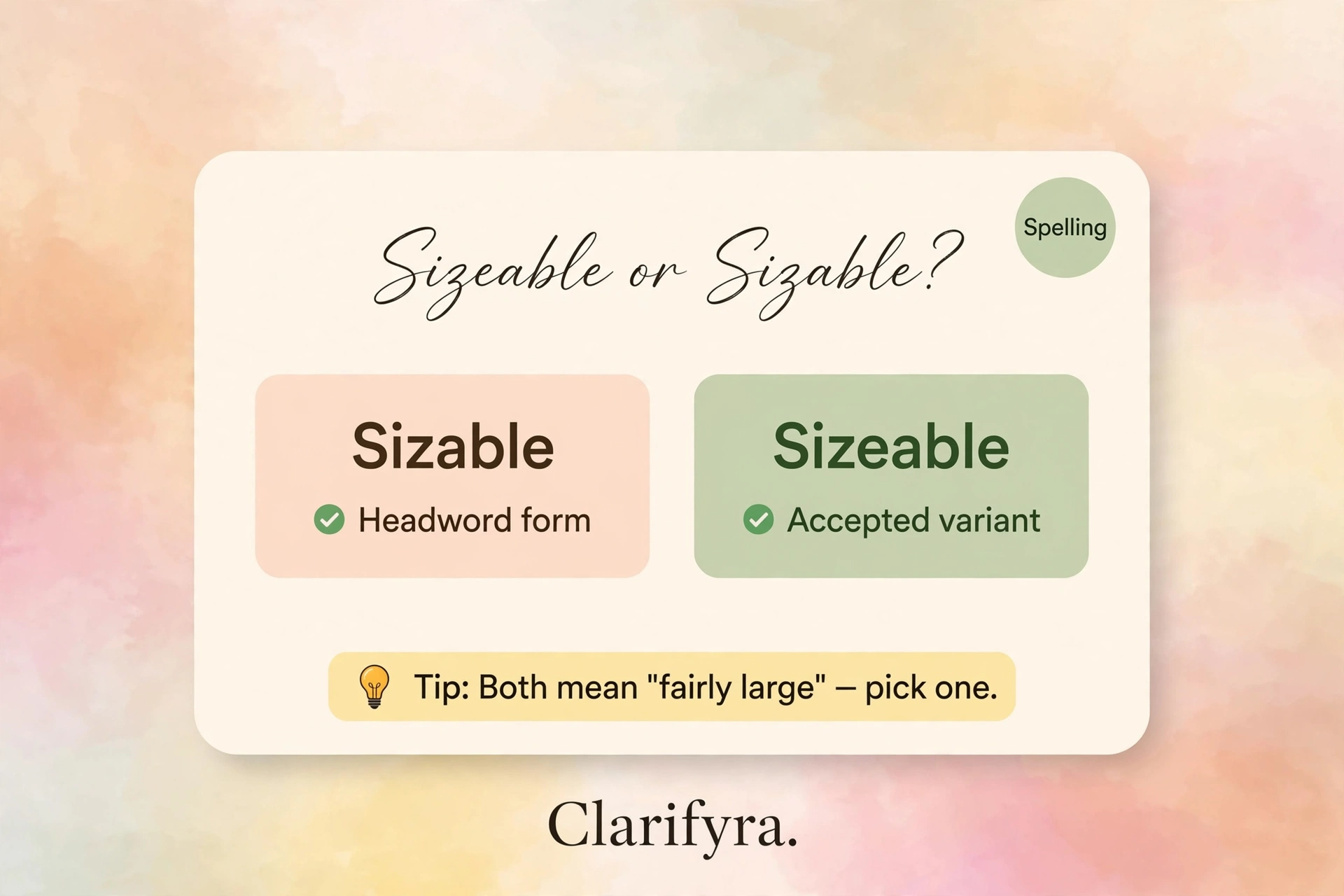
Sizable and sizeable are both correct — this isn’t a right/wrong question but a two-spellings question. Sizable is the headword spelling in Merriam-Webster (“sizable: fairly large”) and in Collins’s American entries; sizeable is listed as a full alternative in Collins (British and American). They mean exactly the same thing and sound exactly the same (/ˈsaɪ.zə.bəl/, “SY-zuh-bul”). Pick one and be consistent.
Quick Answer
Sizable (no e) and sizeable (with e) are both standard spellings of the same adjective, meaning “fairly large” or “of a size greater than average of its kind.” Merriam-Webster headwords sizable /ˈsī-zə-bəl/ (first known use 1613); Collins lists “sizable (also sizeable)” in its British English entry and “also sp.: sizeable” in its American entry, with Random House giving “siz•a•ble or size•a•ble.” Cambridge gives the pronunciation /ˈsaɪ.zə.bəl/ for both spellings, UK and US. Neither spelling is a misspelling, and neither is restricted to one country.
What the Dictionaries Actually Record
Let’s be precise about what the references say, because this word collects a lot of confident-but-wrong advice online (one popular word-tips site even calls sizable incorrect — the dictionaries say the opposite).
Merriam-Webster’s headword is sizable: “sizable adjective: of a size greater than average of its kind.” Its thesaurus entry glosses it as “fairly large” and dates the first known use to 1613. That’s four centuries of sizable without the e.
Collins covers both varieties of English and both spellings in each. The COBUILD entry reads “sizable (also sizeable)”; the American English entry (Webster’s New World) gives “sizable … also sp.: sizeable“; the British English Dictionary gives “sizable or sizeable“; and Random House lists “siz•a•ble or size•a•ble.” In other words: both spellings are fully recognized in both British and American English. This is not a UK/US split — it’s a free variation, like judgment/judgement (though unlike that pair, neither spelling here is regionally marked).
Cambridge’s pronunciation entry confirms what your ear already knows: /ˈsaɪ.zə.bəl/ (“SY-zuh-bul”) for sizable, identical in British and American English — and the e in sizeable changes nothing about the sound. It’s a silent letter either way.
Why the E Exists (and Why It Can Go)
The e in sizeable is the silent e of the root word size. English has a general habit of dropping silent e before suffixes that begin with a vowel — love → lovable, move → movable — because the e isn’t doing any pronunciation work. Sizable follows that streamlined pattern: size + -able → sizable.
Sizeable keeps the e to preserve the visual link to size — the reader sees the root word intact. Neither instinct is wrong; English tolerates both, which is exactly why the dictionaries list both. The same tension produced pairs like likeable/likable, and the same advice applies: both fine, pick one.
If you’re looking for a tiebreaker rather than a rule: sizable is the headword form in Merriam-Webster and in Collins’s American entries, which makes it the marginally safer default in edited writing — it’s the spelling a copyeditor is least likely to query. But no dictionary checked marks sizeable as wrong, nonstandard, or even “chiefly British,” so there’s no correctness cost to keeping the e.
How “Sizable” Is Used
Sizable/sizeable means “fairly large” — noticeably bigger than average, but not enormous. It’s the word for the middle of the scale:
- “They donated a sizable sum to the charity.” (a large amount, not a record-breaking one)
- “A sizable crowd gathered outside.” (bigger than expected)
- “She inherited a sizable estate.” (substantial, not vast)
- “The project faces sizable challenges.” (significant, not insurmountable)
It’s a slightly formal, measured word — the kind of adjective that appears in financial reporting (“a sizable quarterly profit”) and news writing (“a sizable majority”). In casual speech, “pretty big” or “decent-sized” usually does the same job.
Sizable in Context: Typical Collocations
Sizable/sizeable has favorite company — the nouns it most often modifies tell you its register. In news and business writing, it’s sums, amounts, investments, stakes, majorities, and profits: “a sizable investment,” “a sizable majority.” In general prose, it’s crowds, portions, chunks, collections, and gardens: “a sizable chunk of the budget,” “a sizable collection of first editions.”
Notice what’s missing: physical size. You rarely read “a sizable elephant” — for literal dimensions, large, big, or huge do the work. Sizable quantifies amounts, groups, and abstractions more naturally than objects. And it’s comparative by nature: “sizable” always means “sizable for its kind” (Merriam-Webster’s “of a size greater than average of its kind”). A sizable donation from a student and a sizable donation from a foundation are different sums — the word measures against expectations, not against an absolute scale.
Correct vs. Incorrect
- ✓ “They raised a sizable amount.” / ✓ “They raised a sizeable amount.” (both correct)
- ✗ “They raised a sizeable amount and a sizable crowd attended.” → pick one spelling per document
- ✗ “They raised a sizible amount.” → ✓ “…a sizable amount.” (-able, not -ible)
- ✗ “They raised a sizeabel amount.” → ✓ “…a sizeable amount.” (no such form)
- ✓ “a sizable portion” (not “a sized portion” — different word)
Common Mistakes
1. “Correcting” one spelling to the other. As with duffel/duffle, the classic error here is the unnecessary correction. Neither sizable nor sizeable needs fixing; “fixing” one to the other just introduces inconsistency with the rest of the document.
2. Inconsistency within a document. The one genuinely sloppy move: sizable in the introduction and sizeable in the conclusion. Settle it once — many writers just follow their spellchecker’s default — and keep it.
3. Assuming it’s a UK/US split. It’s tempting to file this with color/colour, but the dictionaries don’t support it: Collins lists both spellings in both its British and American entries. An American writer using sizeable and a British writer using sizable are both within standard usage.
4. Writing “sizible.” The suffix here is -able (as in capable, readable), not -ible (as in visible, terrible). The root size takes -able; “sizible” is simply wrong.
5. Using “sizable” to mean “enormous.” Sizable means “fairly large” — substantial, above average. For truly huge, use enormous, vast, or immense. “A sizable mountain” undersells Everest; “a sizable donation” correctly suggests generous but not staggering.
Frequently Asked Questions
Is “sizable” or “sizeable” correct?
Both. Every dictionary checked — Merriam-Webster, Collins (British and American), Cambridge — recognizes both spellings as standard. Sizable is the headword form in Merriam-Webster and Collins’s American entries, making it the slightly safer default, but sizeable is equally correct.
Is one spelling American and the other British?
No — that’s a common misconception. Collins lists both spellings in both its British and American entries. Unlike color/colour or vise/vice, this pair isn’t regionally divided; it’s free variation on both sides of the Atlantic.
How do you pronounce “sizable”?
/ˈsaɪ.zə.bəl/ (“SY-zuh-bul”) — Cambridge gives the same pronunciation for British and American English, and it’s identical for sizeable. The e is silent in both spellings.
What’s the difference in meaning between “sizable” and “sizeable”?
None whatsoever. They’re the same word with two accepted spellings — “fairly large; of a size greater than average of its kind.” The choice is purely orthographic.
Why do some sites say “sizable” is wrong?
Because spelling advice on the open web is uneven. Some sites assert a single “correct” form without checking dictionaries. The references that lexicographers actually compile — Merriam-Webster, Collins, Cambridge — all list both. When in doubt, trust the dictionaries over the tip sites.
The Takeaway
Sizable and sizeable are both correct, both standard, and both used on both sides of the Atlantic — “fairly large,” pronounced “SY-zuh-bul” either way. Sizable has a slight edge as the headword spelling in Merriam-Webster and Collins’s American entries, so it’s the default I’d recommend. But the real rule is consistency: pick a spelling, use it throughout, and never “correct” the other one.