Embassador or Ambassador: Which Is Correct?
Ambassador is the correct modern spelling — it’s the headword in every dictionary checked. Embassador is not simply a typo, though: Merriam-Webster gives it its own entry as a “variant spelling of ambassador,” and it was a fully standard spelling centuries ago (Chaucer wrote “embassadour,” Dryden “embassador”). In modern writing, use ambassador; reserve embassador for historical quotations.
Quick Answer
Ambassador is the standard modern spelling: an official envoy, an authorized representative, or an unofficial goodwill representative (“brand ambassadors”). Embassador is a genuine historical spelling — Webster’s 1913 and 1828 dictionaries listed it as a full headword (“Same as Ambassador”), and Merriam-Webster still gives it its own entry as a “variant spelling of ambassador.” But no modern dictionary checked headwords embassador for current use. In contemporary writing, always use ambassador. The e spelling likely persists because of embassy, which does start with e.
Why “Embassador” Feels Plausible
Before the verdict, it’s worth saying why so many people write embassador — because the instinct behind it is reasonable. The related word embassy (the diplomatic mission, or the building that houses it) starts with e. If the embassy is where diplomats work, then the person working there should be an embassador — right?
Wrong, but understandably so. English is full of these near-miss pairs where related words diverge in spelling. And history is on the misspeller’s side: embassador wasn’t invented by confused modern writers. Webster’s 1913 dictionary listed “Em*bas’sa*dor” as a full headword, defined simply as “Same as Ambassador,” with literary citations — Chaucer’s “embassadour” and Dryden’s “My king’s embassador.” The 1828 Webster’s did the same. For centuries, embassador was not a mistake; it was the spelling.
What changed is standardization. As dictionaries and style guides converged in the 19th and 20th centuries, ambassador won decisively. Merriam-Webster’s current treatment tells the whole story in miniature: ambassador gets the full entry, and embassador gets a one-line cross-reference — “variant spelling of ambassador.” It’s recorded, not recommended.
What “Ambassador” Means
Merriam-Webster’s entry for ambassador gives three senses, and the word’s range is wider than just diplomacy:
1. The official envoy. “An official envoy; especially: a diplomatic agent of the highest rank accredited to a foreign government or sovereign as the resident representative of his or her own government.” The Ambassador to France, the UN ambassador. This is the capitalized-title sense.
2. The authorized representative. “An authorized representative or messenger” — broader than diplomacy. A company sending an ambassador to a trade summit, a university’s alumni ambassadors.
3. The unofficial representative. “An unofficial representative” — the sense that exploded in modern marketing: “brand ambassadors,” “goodwill ambassadors,” celebrity ambassadors for charities. No diplomatic credentials required, just a public association.
Related forms all keep the a: ambassadorial (the adjective — “ambassadorial duties”), ambassadorship (the office or term — “during her ambassadorship”), and ambassadress (the older feminine form, now largely replaced by ambassador for everyone). Note that embassy — the e word — refers to the mission or building, never the person.
Ambassador-at-Large and Other Formal Titles
Diplomacy gives ambassador a few fixed titles worth knowing, all spelled with the a:
- Ambassador-at-large — a diplomat with a roving remit rather than a single posting (“ambassador-at-large for climate affairs”). Note the hyphens.
- Ambassador Extraordinary and Plenipotentiary — the full formal title of a top-rank ambassador (“invested with full power”). You’ll see it on credentials and in very formal protocol; in ordinary writing, “ambassador” suffices.
- Goodwill ambassador — the unofficial sense: celebrities and public figures appointed by organizations (often the UN) to promote a cause. No diplomatic rank, but the title is real.
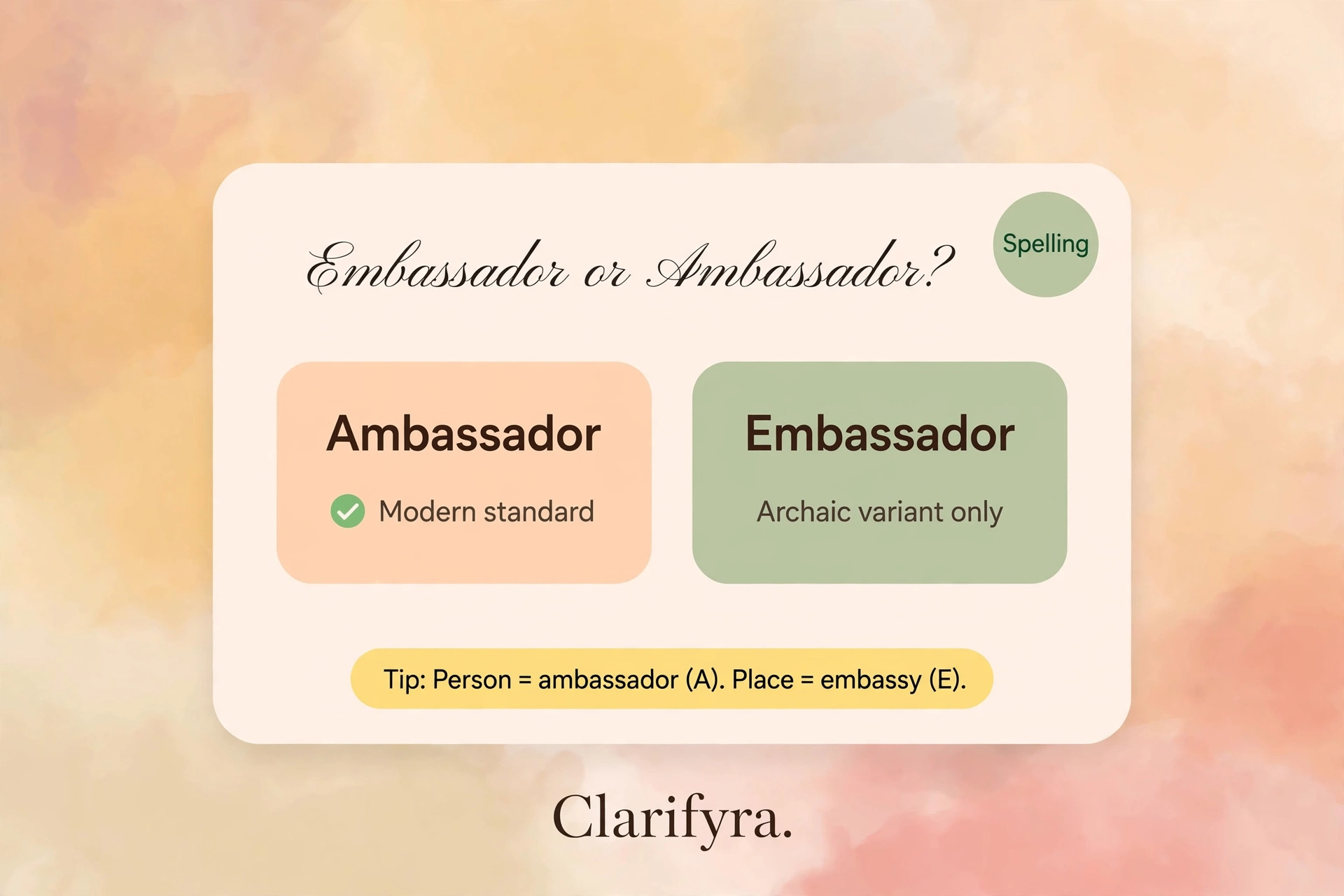
Two related words round out the family. An embassy is the mission itself — the staff, the function, or the building (“the embassy on Grosvenor Square”). A consulate is the smaller office handling visas and citizen services, headed by a consul, not an ambassador. So the hierarchy runs: ambassador (the person, top rank) → embassy (their mission and building) → consulate (the smaller outpost). Person with a, place with e — the mnemonic holds all the way up.
Correct vs. Incorrect (Modern Writing)
- ✓ “She was appointed ambassador to Japan.” (modern standard)
- ✗ “She was appointed embassador to Japan.” → ✓ “…appointed ambassador…” (not current standard)
- ✓ “The brand signed three new ambassadors.” (unofficial representatives)
- ✓ “He served as ambassador-at-large.” (note the hyphens in this fixed title)
- ✓ “Dryden wrote of ‘my king’s embassador‘.” (historical quotation — keep the original spelling)
- ✓ “The embassy issued a statement.” (the mission/building — always with e)
- ✗ “The embassy sent its embassador.” → ✓ “…sent its ambassador.” (person = a, place = e)
- ✓ “During her ambassadorship, trade doubled.” (the office — with a)
Common Mistakes
1. Writing “embassador” under the influence of “embassy.” This is the number-one cause. The mental logic — embassy → embassador — is tidy but wrong for modern English. Drill the split: the place starts with e (embassy), the person starts with a (ambassador).
2. Assuming “embassador” is always a typo. The subtler error, usually made by overzealous correctors: embassador appears in historical texts and quotations (Chaucer, Dryden, early American documents). If you’re quoting a 17th-century source that says “embassador,” modernizing it to “ambassador” without brackets misrepresents the source. Keep historical spellings in historical quotes.
3. “Ambassadore” and other invented endings. The -or ending sometimes tempts writers toward -ore by analogy with words like “sophomore.” The ending is -dor: am-bass-a-dor.
4. Capitalization confusion. “Ambassador” is capitalized when it’s part of a formal title (“Ambassador Smith,” “the British Ambassador to Washington”) but lowercase as a common noun (“she works as an ambassador for the charity,” “brand ambassadors”). The spelling doesn’t change; only the capital does.
5. Mixing up “ambassador” and “emissary.” An emissary is a messenger sent on a specific mission, often secret; an ambassador is a standing representative. Related jobs, different words — and note that emissary genuinely does start with e, which may feed the embassador confusion.
Frequently Asked Questions
Is “embassador” a word at all?
Yes — it’s a real historical spelling, not an invention. Webster’s 1828 and 1913 dictionaries listed it as a full headword, and Merriam-Webster still gives it its own entry today as a “variant spelling of ambassador.” But it’s not the current standard: no modern dictionary checked headwords it for present-day use. Use ambassador in your own writing.
Why do “embassy” and “ambassador” start with different letters?
Historical accident. Both come from the same root (through Old French ambassade), but embassy passed through forms that favored the e while ambassador standardized on the a. English kept both, and now the split is fixed: e for the mission, a for the person.
When is it okay to write “embassador”?
When you’re quoting or transcribing historical text that uses it — Chaucer, Dryden, early American documents — or discussing the word’s history itself. In those contexts, “correcting” it would be the error. Everywhere else, write ambassador.
What’s the adjective form — “ambassadorial” or “embassadorial”?
Ambassadorial, with an a: “ambassadorial duties,” “an ambassadorial residence.” Like the noun it comes from, it follows the modern a spelling. The noun for the office is ambassadorship.
Is “ambassadress” still used?
Rarely. It was the traditional feminine form (“she was appointed ambassadress”), but modern usage overwhelmingly prefers ambassador for everyone, parallel to how “authoress” and “poetess” have faded. You’ll still meet ambassadress in older texts.
The Takeaway
Ambassador is the only correct spelling in modern writing — the envoy, the representative, the brand face. Embassador deserves more respect than a red squiggle: it was standard English for centuries and Merriam-Webster still records it as a variant. But its time has passed; today it belongs in historical quotations, not in your emails. Remember the split that explains all the confusion: the embassy is the place, the ambassador is the person.