Judgmental or Judgemental: Which Is Correct?
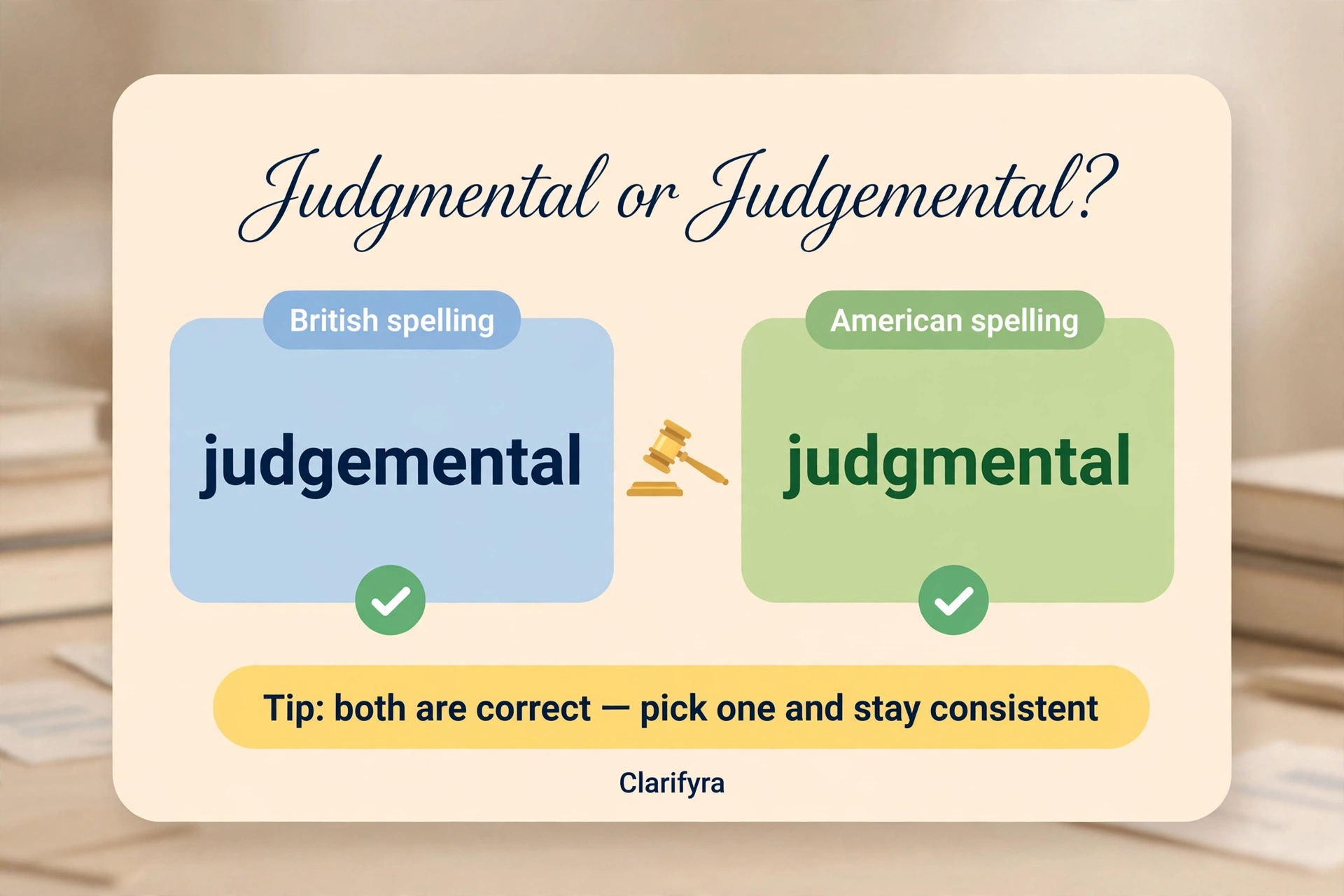
If you’ve typed “judgmental” and then stared at it, wondering whether the missing e is a mistake, you’re in good company — this is one of English’s genuinely unsettled spellings. The short answer: both “judgmental” and “judgemental” are correct. Judgmental is the standard spelling in American English, while judgemental is standard in British English. But the real story is more interesting than a tidy UK/US split — the dictionaries themselves can’t quite agree on which spelling is the headword, and both senses of the word deserve a look before you choose.
Quick Answer
Judgmental ✅ — the standard American spelling (Merriam-Webster and Collins’s American entries list it as the headword).
Judgemental ✅ — the standard British spelling (Oxford Learner’s lists it as its headword, marked “especially British English”).
They sound identical (/dʒʌdʒˈmentəl/), mean the same two things — (1) disapproving: judging people and criticizing them too quickly, and (2) formal: relating to the act of judging — and neither is a misspelling. Pick the spelling that matches your audience and use it consistently.
Why There Are Two Spellings
The adjective inherits its split from the noun it was built on. Both forms come from judgment (Merriam-Webster’s headword for the noun) or judgement — the British spelling of the same noun — plus the suffix -al. (Collins dates the adjective’s formation to “judgment + -al,” first recorded in 1905–10.)
The usual rule for the silent e is simple: drop it before a suffix that starts with a consonant. Judge + -ment should give judgment, just as manage + -ment gives management. American English follows that rule here; British English kept the e. So the two adjectives are really the same word built on the two regional spellings of the same noun:
- judgment + -al → judgmental (American standard)
- judgement + -al → judgemental (British standard)
This is also why the word feels slightly odd to look at either way: it’s one of the rare cases where English visibly branches off from the same root in two directions at once.
What the Dictionaries Actually Record
Here’s where it gets interesting — and why you shouldn’t trust any source that declares one spelling “correct” and the other a mistake. Each major dictionary verified below treats both spellings as legitimate; they differ only on which one gets the headword:
- Merriam-Webster (American): headword “judgmental”, with two senses — (1) “of, relating to, or involving judgment,” as in “a judgmental error”; and (2) “characterized by a tendency to judge harshly,” as in “judgmental prigs”. First known use: 1834.
- Oxford Learner’s: headword “judgemental,” marked “(especially British English),” with “(also judgmental especially in North American English).” Sense 1 is disapproving: “judging people and criticizing them too quickly” — “Stop always being so judgemental!” Sense 2 is formal: “relating to the process of judging things” — “the judgemental process.”
- Cambridge: headword “judgmental,” marked “(also UK judgemental).” British and American pronunciation are the same: /dʒʌdʒˈmentəl/.
Notice the disagreement: Oxford puts the e first, Merriam-Webster and Collins put the e-less form first, and Cambridge hedges with “also UK.” The takeaway isn’t that one dictionary is right — it’s that the spelling is genuinely regional, and every dictionary accepts both. No dictionary lists either form as an error.
The UK/US Split Is a Tendency, Not a Law
The clean rule — “judgmental” in America, “judgemental” in Britain — is mostly true in practice, which makes it useful advice and a bad slogan. In practice:
- In the United States, judgmental is overwhelmingly the spelling you’ll see in print, from Merriam-Webster’s entry to everyday usage. “Judgemental” in an American document will read as a Britishism or a typo, depending on the reader.
- In Britain, both spellings circulate. Oxford Learner’s makes judgemental its headword (marked “especially British English”), while Collins makes judgmental its headword with a British regional note accepting judgemental. In other words, a British reader will find either spelling unremarkable.
- For legal writing, American convention is decisive: it’s “judgment” and “judgmental” throughout (“The court issued a judgment against the defendant”). British legal writing tends toward “judgement.”
The practical rule: match the spelling to your audience, and never mix both in one document. An American writing for an American audience should use “judgmental”; a British writer can safely use “judgemental” (or “judgmental” — both will pass). What reads as a mistake is the sentence that contains both.
Examples: Correct vs. Incorrect
All three correct versions below mean the same thing; only the spelling — and the consistency — differs.
✅ “Try not to be so judgmental about people’s life choices.” — standard American spelling, disapproving sense.
✅ “Try not to be so judgemental about people’s life choices.” — standard British spelling, same meaning.
✅ “There was a judgmental error in the figures.” — Merriam-Webster’s sense 1: “of, relating to, or involving judgment.” This is not about anyone being harsh; it means the error happened in the act of judging (estimating) the numbers.
And the real mistakes:
❌ “He was judgemental, but she tried not to be judgmental.” — both spellings are fine individually; switching mid-document is the error.
❌ “Don’t be so judmental about it.” — neither spelling; the e (or its absence) belongs between the g and the m.
❌ “She’s a very judgmental manager — I trust her decisions.” — wrong word, not wrong spelling. “Judgmental” never means “having good judgment”; the word for that is judicious.
One more note on usage: both prepositions work — “judgmental of” (as in “judgmental of young people”) and “judgmental about” (as in “judgmental about people’s choices”). Collins’s own example uses about: “You should not be judgemental about people.”
Common Mistakes to Avoid
- Calling “judgemental” a misspelling. This is a common error — correcting someone’s “judgemental” to “judgmental” in British English is correcting a correct spelling. Oxford Learner’s lists it as the headword, marked “especially British English.” No dictionary treats it as an error.
- Assuming “judgmental” always means “harshly critical.” That’s the everyday, disapproving sense (“He’s judgmental about everyone except himself”), but Merriam-Webster’s first sense is neutral: “of, relating to, or involving judgment” — “a judgmental error,” “the judgmental process.” Read the sentence before you assume the tone.
- Mixing the two spellings. Spellcheckers are often set to one variety of English; a mixed document flags one of your two spellings as wrong no matter which you pick. Choose once, at the start.
- Confusing “judgmental” with “judicious.” “Judicious” means showing good, careful judgment — a compliment. “Judgmental” (disapproving sense) means forming harsh opinions too quickly — a criticism. Praising a colleague as “judgmental” when you mean “judicious” sends the opposite of your intended message.
- Splitting it into two words. Search engines see plenty of “judge mental” — but in standard writing it’s always one word, whichever spelling you use.
The Base Noun: “Judgment” vs. “Judgement”
Since the adjective derives from the noun, it’s worth knowing the noun’s own split: the noun is spelled judgment in American English (Merriam-Webster’s headword) and judgement in British English. The adjective simply follows the noun of its region: judgment → judgmental; judgement → judgemental. Keep the pair consistent in your writing — an American text should use “judgment” and “judgmental,” a British text “judgement” and “judgemental” (or “judgment” and “judgmental,” which British readers also accept, per Collins’s regional note).
FAQs
Is “judgemental” actually a word, or just a common misspelling?
It’s a real word. Oxford Learner’s lists “judgemental” as its headword, marked “(especially British English),” and Collins gives “in BRIT, also use judgemental.” No major dictionary treats it as an error. The idea that it’s a misspelling comes from American spellcheckers, which default to “judgmental.”
Which spelling should I use on my CV or in a job application?
Match the employer’s variety of English. An American employer expects “judgmental” (this applies to legal writing especially — American courts write “judgment”). A British employer will accept “judgemental” and, per Collins, “judgmental” too. In international writing, “judgmental” is the slightly safer global choice.
One caveat: the adjective rarely belongs on a CV either way. If you’re describing people skills, “non-judgmental” (Oxford Learner’s cross-references “non-judgemental”) is the form that actually appears in hiring language — and it follows the same spelling rule as its root.
Do the two spellings sound different?
No. Both are pronounced /dʒʌdʒˈmentəl/ in British and American English (Cambridge). The extra e is silent — it’s purely a spelling difference.
Can I use “judgmental” to describe a thing, not a person?
Yes — that’s Merriam-Webster’s first sense, “of, relating to, or involving judgment”: “a judgmental error,” “the judgmental process” (Oxford Learner’s formal sense). In this use there’s no disapproval involved; it just means “having to do with the act of judging or estimating.”
Does it matter which I use in academic writing?
Consistency matters more than the choice. Pick the spelling that matches your institution’s style guide (most American universities: “judgmental”; most British: “judgemental”), and apply it to the noun too (“judgment”/”judgement”). The formal sense (“relating to the process of judging things”) is the one you’ll use most in academic prose.
The Takeaway
Judgmental and judgemental are the same word in two regional spellings — “judgmental” standard in American English, “judgemental” standard in British English — and every major dictionary accepts both. They share one pronunciation and two senses: the disapproving everyday one (quick to criticize people) and the formal one (relating to the act of judging). Match your spelling to your audience, keep the noun and adjective consistent (“judgment”/”judgmental” or “judgement”/”judgemental”), and never mix the two forms in one document.