Sofa or Couch: What’s the Difference?
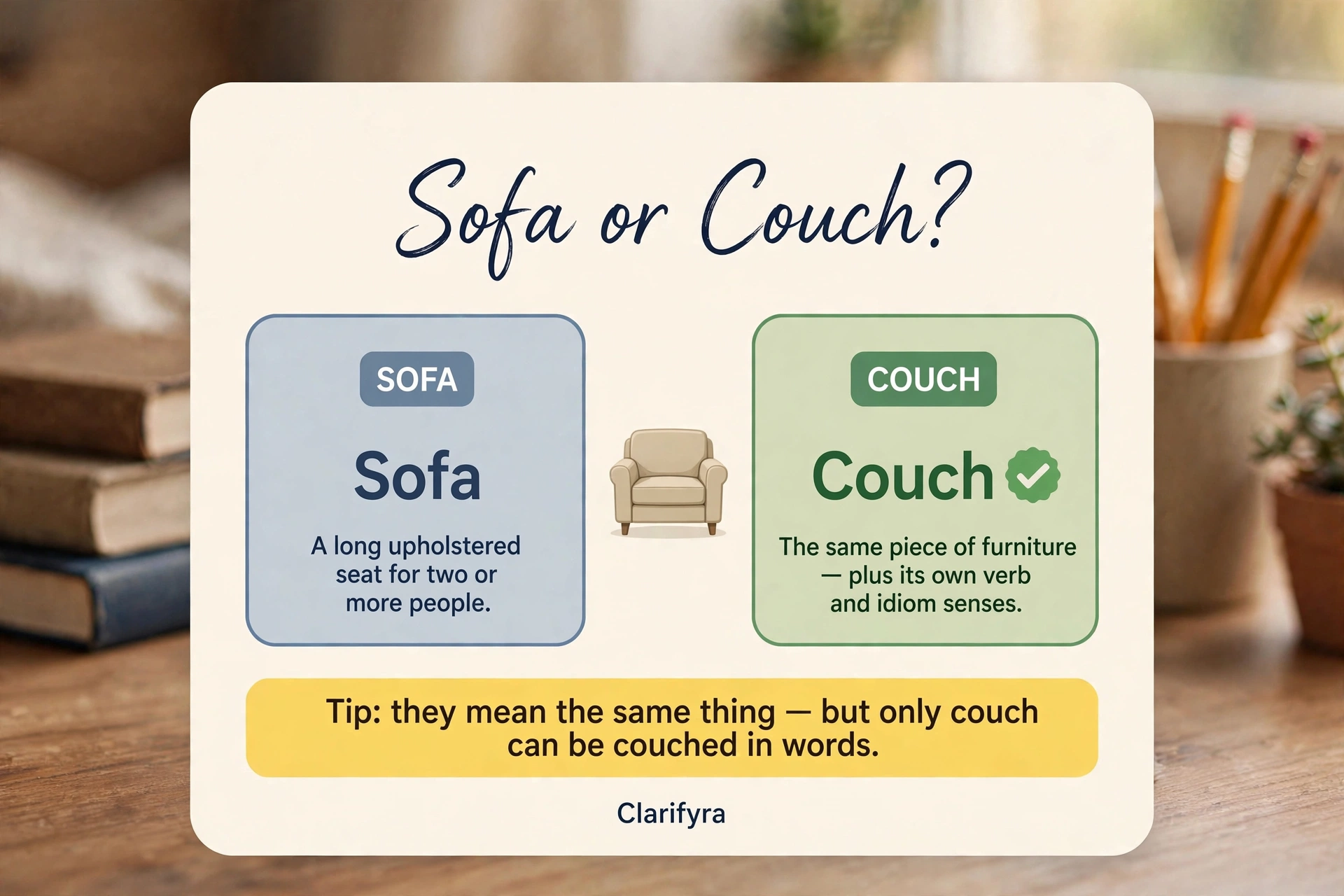
Sofa and couch are synonyms: both name the same long, upholstered piece of furniture you sit or recline on in a living room. No dictionary divides them by region or formality, so you can use whichever word feels natural. The real difference lies elsewhere — couch has extra senses that sofa doesn’t share, and that’s where people go wrong.
Quick Answer
Sofa and couch mean the same thing: a long, comfortable seat for two or more people. The difference is not in the furniture — it’s in the extra jobs the word couch does. Only couch can be a verb (couched in polite terms) and only couch names the doctor’s or therapist’s narrow bed. Use either word for the living-room furniture; just don’t swap them in those fixed expressions.
The Short Answer: They’re Synonyms
If you type “sofa” and “couch” into the major dictionaries, you get essentially the same definition. Collins COBUILD defines a sofa as “a long, comfortable seat with a back and usually with arms, which two or three people can sit on,” and couch as “a long, comfortable seat for two or three people.” Merriam-Webster calls a sofa “a long upholstered seat usually with arms and a back and often convertible into a bed,” and a couch “an article of furniture for sitting or reclining.” Oxford Learner’s lists “sofa” directly as a synonym of “couch.”
Note what none of them do: none of the four dictionaries tags either word as British, American, formal, or informal for the furniture sense. So if you’ve been told “sofa is British and couch is American,” or “sofa is posh and couch is casual,” know that the dictionaries themselves record no such division. In ordinary use, many speakers simply use the word they grew up with, and there’s nothing wrong with that.
What the Dictionaries Say
Sofa
Merriam-Webster defines sofa as “a long upholstered seat usually with arms and a back and often convertible into a bed.” Collins agrees: “a long, comfortable seat with a back and usually with arms, which two or three people can sit on.” The plural is sofas.
The word has travelled a long way. Collins traces it to the 17th century, when it meant a dais upholstered as a seat, from the Arabic suffah. Merriam-Webster gives the fuller route: earlier, a “raised carpeted floor,” from Italian sofà, from Turkish sofa, from Arabic ṣuffa, meaning a carpet or divan. The first recorded use in the modern sense of “long stuffed seat” dates to 1717.
Pronunciation splits cleanly between the two main varieties of English: UK /ˈsəʊfə/, US /ˈsoʊfə/ (Collins).
Couch
Merriam-Webster defines couch (noun) as “an article of furniture for sitting or reclining.” Oxford Learner’s is nearly identical: “a long comfortable seat for two or more people to sit on,” and it lists sofa and settee as synonyms. The plural is couches.
Unlike sofa, couch also carries senses that have nothing to do with the living room — more on those below. Its history is older: Collins traces it to the 14th century, from Old French couche (a bed, a lair), from coucher “to lay down,” itself from Latin collocāre “to arrange, to place.” Merriam-Webster agrees on a 14th-century first known use. Pronunciation is the same on both sides of the Atlantic: /kaʊtʃ/ (Oxford).
Where They’re NOT Interchangeable
For the furniture, swap freely. For everything else, couch walks off on its own. Here are the senses that belong to couch alone:
Couch as a verb
Couch is also a verb meaning to express something in particular words. Oxford Learner’s labels it formal and notes it’s usually used in the passive: “The letter was deliberately couched in very vague terms.” Collins COBUILD gives the same sense with a [written] label: “The new centre-right government’s radical objectives are often couched in moderate terms.”
Sofa is never a verb. There is no “sofaed,” no “sofing,” no “couched in” counterpart built on sofa.
The therapist’s couch
Both Oxford and Collins give couch a second noun sense: the narrow bed-like piece of furniture a patient lies on in a doctor’s office or during psychoanalysis. Oxford’s example: “He spends several hours a week on the therapist’s couch.” This is a fixed expression — you wouldn’t talk about “the therapist’s sofa.”
Fixed compounds
Oxford’s collocations for couch include “couch cushion,” “couch pillow,” and “couch potato” — the familiar term for someone who watches a great deal of television. These compounds are built on couch; there is no “sofa potato.” (Merriam-Webster, by contrast, does record “sofa bed,” a compound built on sofa.)
Regional and Register Differences: An Honest Answer
Here’s where many articles invent statistics, so let’s be careful. What the dictionaries actually tell us:
- Oxford, Cambridge, Collins, and Merriam-Webster treat the furniture senses of sofa and couch as synonyms, with no regional or register labels attached to either word.
- Cambridge’s entry for settee — “a large, comfortable seat for more than one person” — is explicitly labelled UK, and cross-references it to “(UK/US sofa)”. So settee is the one in this family with a verified regional label, and it’s British. Collins and Oxford both list settee as a synonym of sofa and couch.
- Both Oxford and Collins publish American editions that include both words without marking either as the “American” one, which at minimum shows both are in active use in American English.
Some speakers feel sofa sounds a touch more formal than couch, but that’s personal impression, not something any dictionary records. The safest, most honest guidance: pick the word that sounds natural in your own variety of English, use it consistently in a piece of writing, and you will not be wrong.
Side-by-Side Comparison
| Aspect | Sofa | Couch |
|---|---|---|
| Furniture meaning | Long upholstered seat for two or more people | Long comfortable seat for two or more people — same thing |
| Verb use | None — sofa is noun-only | Yes — couched in polite terms (formal, usually passive) |
| Doctor’s/therapist’s sense | Not recorded | Yes — the therapist’s couch (Oxford, Collins, Merriam-Webster) |
| Fixed compounds | sofa bed | couch potato, couch cushion |
| Plural | sofas | couches |
| Pronunciation | UK /ˈsəʊfə/, US /ˈsoʊfə/ | /kaʊtʃ/ (both UK and US) |
| Etymology | Turkish ← Arabic ṣuffa, via Italian; 17th–18th century | Old French couche “bed, lair” ← Latin collocāre; 14th century |
| Regional label | None in the dictionaries | None in the dictionaries |
Common Mistakes
1. Using couch as a verb meaning “to sit down.”
✗ “She couched on the sofa to watch TV.”
✓ “She curled up on the sofa to watch TV.”
The verb couch means to phrase or express something (“couched in vague terms”) — it never means sitting. Don’t mix up the noun and verb jobs.
2. Saying “the therapist’s sofa.”
✗ “He told his analyst everything on the therapist’s sofa.”
✓ “He spends several hours a week on the therapist’s couch.”
The fixed expression, recorded by Oxford, Collins, and Merriam-Webster, is the therapist’s couch.
3. Inventing “sofa potato.”
✗ “He’s a real sofa potato.”
✓ “He’s a real couch potato.”
The compound for a TV-watching idler is built on couch (Oxford’s collocations confirm “couch potato”); there is no sofa-based equivalent.
4. Assuming one word means arms and the other doesn’t.
✗ “A sofa always has arms; a couch doesn’t.”
No dictionary draws that line. Collins describes a sofa as having “a back and usually with arms” — “usually” is doing the work there. Buy the furniture by its shape, not by its name.
5. Correcting someone for “the wrong” word.
✗ “Actually, it’s called a sofa.”
For the furniture, neither word is more correct. The dictionaries treat them as full synonyms, and both appear without regional labels in both British and American editions.
Choosing Between Them
In practice, the choice comes down to your ear and your audience. Match the word your readers already use, and keep it consistent within one piece of writing — switching between sofa and couch in the same article reads as sloppy, even though either word alone is fine.
Two situations where the choice is made for you: use couch in the fixed expressions the therapist’s couch and couch potato, and reach for sofa bed when you mean the convertible kind. Everywhere else, it’s simply preference.
English is full of word pairs that look interchangeable but hide a trapdoor — if you enjoy untangling them, our guide to invoke vs evoke takes on another famous one.
Frequently Asked Questions
Is “sofa” British and “couch” American?
No dictionary records that division. Oxford, Cambridge, Collins, and Merriam-Webster all define both words for the same furniture without attaching US or UK labels, and both appear in American and British editions. The word with a verified regional label in this family is settee, which Cambridge marks as UK.
Is “sofa” more formal than “couch”?
Not according to the dictionaries — none of them carries a formality label for either word. Some speakers feel sofa sounds slightly smarter, but that’s personal impression, not a recorded distinction. In writing, either is acceptable.
Can I use “sofa” for the therapist’s couch?
Stick with couch. The doctor’s-office sense is recorded only for couch (Oxford, Collins, Merriam-Webster), and “the therapist’s couch” is the fixed expression. Saying “the therapist’s sofa” would sound odd to most readers.
What’s the difference between a sofa and a settee?
By the dictionaries’ definitions, there isn’t one worth worrying about: Collins and Oxford list settee as a synonym of both sofa and couch. The one verifiable difference is regional — Cambridge labels settee as UK, while sofa and couch carry no regional label.
Is “couch” short for something?
No. It comes from Old French couche, meaning a bed or lair, from coucher “to lay down” (Collins, Merriam-Webster), with first recorded use in the 14th century — roughly four hundred years before sofa entered English in its modern sense in 1717.
Final Takeaway
Sofa and couch name the same piece of furniture, and the dictionaries treat them as plain synonyms — no regional labels, no formality gap, no difference in what they refer to. The only real work of choosing comes at the edges: couch doubles as a verb (“couched in vague terms”), names the therapist’s narrow bed, and anchors the compound couch potato, while sofa stays a noun and gives us sofa bed. Get those few fixed expressions right, and you can sit — or recline — on either word with complete confidence.