Throught or Through: Which Is Correct?
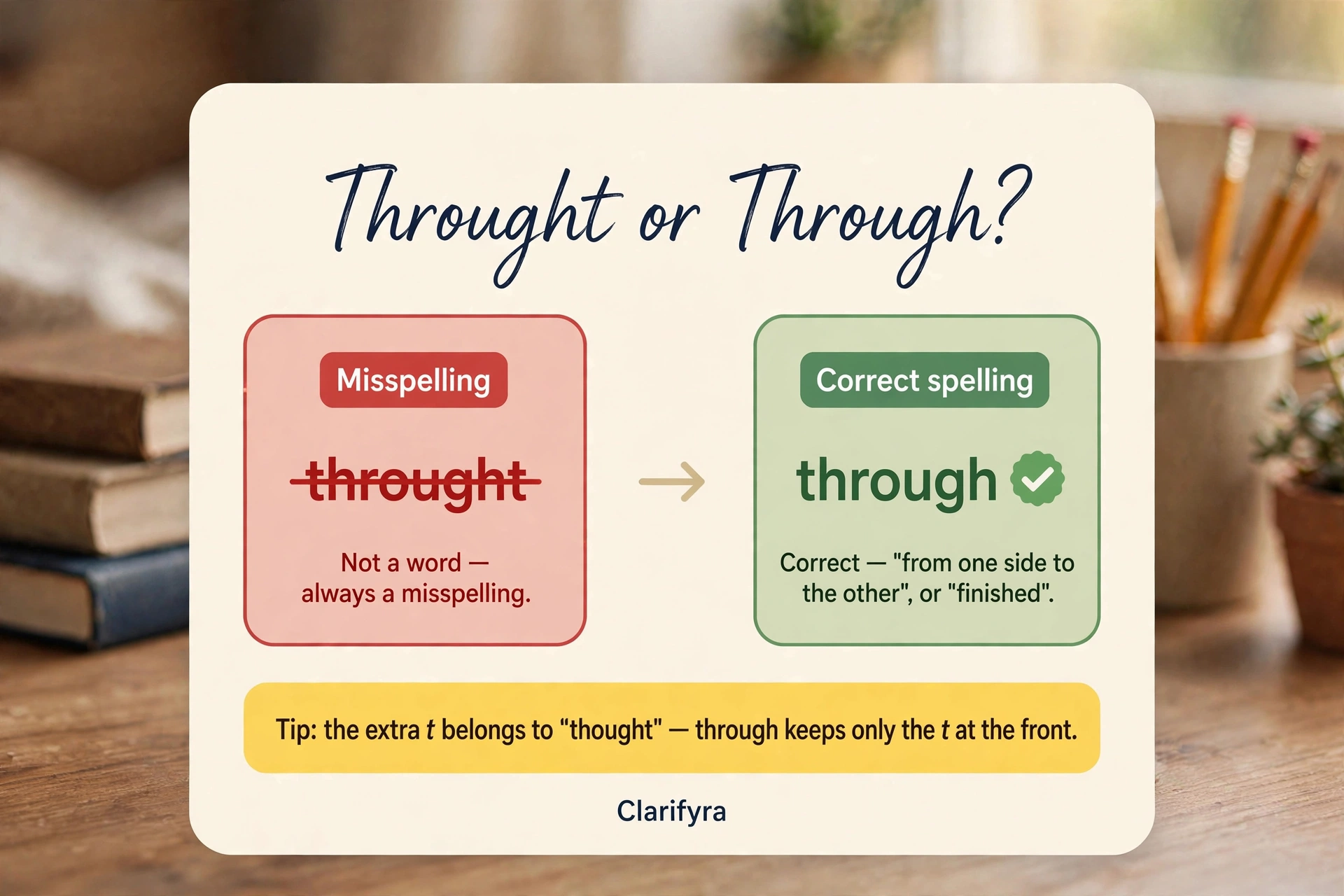
Through is the correct spelling. Throught is a misspelling — it is listed in no major dictionary, it has no meaning of its own, and it is never the right choice in any sentence. If you have typed “throught,” delete the final t and you will land on the correct word.
Quick Answer
Use through, never throught. “Through” (UK /θruː/, US /θruː/) means “from one side or end of something to the other,” and it can also mean “finished” or “completed.” “Throught” is simply a misspelling — it has no entry in Cambridge, Oxford Learner’s, or Merriam-Webster.
Why the Extra “t” Sneaks In
Nobody invents “throught” on purpose. It appears through a very ordinary error pattern: your brain borrows the ending of a far more common word, thought. The two words share the opening “thro-” and the silent “gh,” and thought — one of the most frequent words in English — ends in t. When you are writing quickly, your fingers finish the familiar shape instead of the correct one.
There are two more forces pushing that stray t into place. The first is typing speed: “through” already ends in the unusual letter cluster “-ough,” and the hand reaches for a familiar keystroke to complete it. The second is the real word throughout, which genuinely ends in t — the brain half-remembers that t and plants it in the wrong word.
This borrowed-letter slip is common. It is the same kind of extra-letter error that produces other familiar typos — for example, the stray l in the misspelling discussed in our guide to collum vs column. The defense is simple once you see the pattern: know which letter each word actually owns.
What the Dictionaries Say
The dictionaries agree with each other on this one, which is convenient. Through is a fully established word with three different jobs:
- Preposition: “from one end or side of something to the other” — They walked slowly through the woods.
- Adverb: “from the beginning to the end” or “from one side to the other” — Have you read the report all the way through?
- Adjective: “finished” or “completed” — Are you through with that book? (Cambridge also lists the “direct” sense: a through train goes from one place to another without passengers changing.)
Cambridge lists “through” as a preposition and adverb across several senses (place, time, result, and “by/using”), plus the adjective senses above. Merriam-Webster likewise gives it three numbered entries — preposition, adverb, and adjective — so the word’s credentials are not in doubt. Oxford Learner’s transcribes the pronunciation as UK /θruː/, and the Oxford Advanced American Dictionary gives the US pronunciation as NAmE /θruː/.
One related spelling is worth clearing up: thru. Cambridge marks it “(also US not standard thru)” — it is an acknowledged informal American spelling, but it is not standard English. Keep it out of anything formal, academic, or published.
As for throught: it has no entry anywhere. A search of Cambridge returned no headword at all; Oxford Learner’s and Merriam-Webster both returned no page for the spelling; and Wordnik, an aggregator that pulls from multiple dictionaries, reports “no definitions found.” It is not a variant, not an archaic form, and not a regional spelling. It is simply a mistake.
Through vs Thorough vs Thought vs Though
Part of the confusion is that “throught” sits in a crowded neighborhood of lookalike words. Here is how the genuine members of the family differ, with meanings checked against Cambridge:
| Word | Part of speech | Meaning (Cambridge) | Example |
|---|---|---|---|
| through | preposition, adverb, adjective | from one side or end of something to the other; also “finished” | We drove through the tunnel. |
| thorough | adjective | paying close attention to detail; complete, with nothing left out | They did a thorough search of the area. |
| thought | noun; past tense of think | an idea or opinion; the act of thinking | You will need to give the matter some thought. |
| though | conjunction | despite the fact that; also “but” or “however” | Even though it rained, the match continued. |
Notice that every one of these is a real word with its own entry, its own pronunciation, and its own job in a sentence. “Throught” is the only one in the lineup that fails all three tests.
Verdict: Throught or Through?
| Spelling | Status | Use it? |
|---|---|---|
| through | Correct in all varieties of English; preposition, adverb, and adjective | Always |
| throught | Misspelling; no dictionary entry in Cambridge, Oxford Learner’s, or Merriam-Webster | Never |
| thru | US, non-standard variant (per Cambridge); informal only | Only in informal American writing |
Common Mistakes
These are the errors writers actually make with this word family, numbered so you can spot your own habits:
-
The plain extra t.
✗ She walked throught the park to get home.
✓ She walked through the park to get home. -
Borrowing the ending of “thought.”
✗ I need to think this throught.
✓ I need to think this through. -
Mixing “through” with “thorough.”
✗ They did a through search of the building.
✓ They did a thorough search of the building.
(“Thorough” is the adjective meaning careful and complete; “through” never does this job.) -
Borrowing the extra t into “though.”
✗ Even throught it rained, we stayed.
✓ Even though it rained, we stayed. -
Using “thru” in formal writing.
✗ Please proceed thru the checkpoint. (in an official notice)
✓ Please proceed through the checkpoint.
(“Thru” is fine in a casual text; it does not belong in published or professional writing.)
Memory Tricks
- One t only, and it comes first. “Through” starts with t — that is the word’s entire supply. The final t of “thought” belongs to “thought”; it cannot be borrowed.
- The “gh” is doing the work. In “through,” the letters “gh” are silent and the word ends on the “oo” sound (UK /θruː/, US /θruː/). There is no “t” sound to account for, and no “t” to spell.
- Check the -ght list. English words that end in “-ght” — thought, brought, fought, throughout — are a closed, familiar set. “Throught” is not in it. If a word isn’t on that list, it doesn’t get the final t.
- The “via” test. If you can replace the word with “via” and the sentence still makes sense (we drove via the tunnel), the word you want is “through” — spelled t-h-r-o-u-g-h, full stop.
- Proofread by searching. Before you submit anything, search your document for “throught.” The typo is easy to make and easy to catch once you look for it deliberately.
Frequently Asked Questions
Is “throught” a word?
No. It has no entry in Cambridge, Oxford Learner’s, or Merriam-Webster, and no meaning of its own. It is always a misspelling of “through” (or occasionally of “throughout”).
Is “throught” ever an acceptable variant of “through”?
No. Unlike “thru,” which Cambridge acknowledges as a US non-standard spelling, “throught” has no recorded variant status anywhere. There is no context — formal or informal, British or American — in which it is correct.
Why do I keep typing “throught”?
Because the error is structural, not careless. “Thought” is far more frequent than “through,” it ends in t, and it shares the “thro-” opening and silent “gh.” Your brain completes the familiar pattern automatically. The fix is mechanical: check every “-ght” ending and confirm it belongs to a genuine “-ght” word.
What is the difference between “through” and “thorough”?
They are different words entirely. “Through” (UK /θruː/, US /θruː/) is about movement from one side to the other or about being finished. “Thorough” (adjective, UK /ˈθʌr.ə/, US /ˈθɝː.ə/) means careful, detailed, and complete — as in “a thorough investigation.” They sound alike but share nothing else.
Should I use “through” or “thru”?
Use “through” everywhere it matters. “Thru” is marked as non-standard by Cambridge even in American English; it is acceptable only in deliberately informal writing (texts, signs, brand names). In anything published, “through” is the safe and correct choice.
Is “through” a preposition, an adverb, or an adjective?
All three, depending on the sentence. It is a preposition in “we walked through the woods,” an adverb in “read it all the way through,” and an adjective meaning “finished” in “are you through with that book?” Cambridge and Merriam-Webster both list all three uses, so none of them is a mistake.
Final Takeaway
The verdict is as short as it gets: through is the word; throught is the typo. The extra t arrives courtesy of “thought,” a lookalike that earns its final letter honestly. “Through” does not need one — it owns only the t at the front, and every dictionary consulted agrees. Memorize that single fact and this error disappears for good.