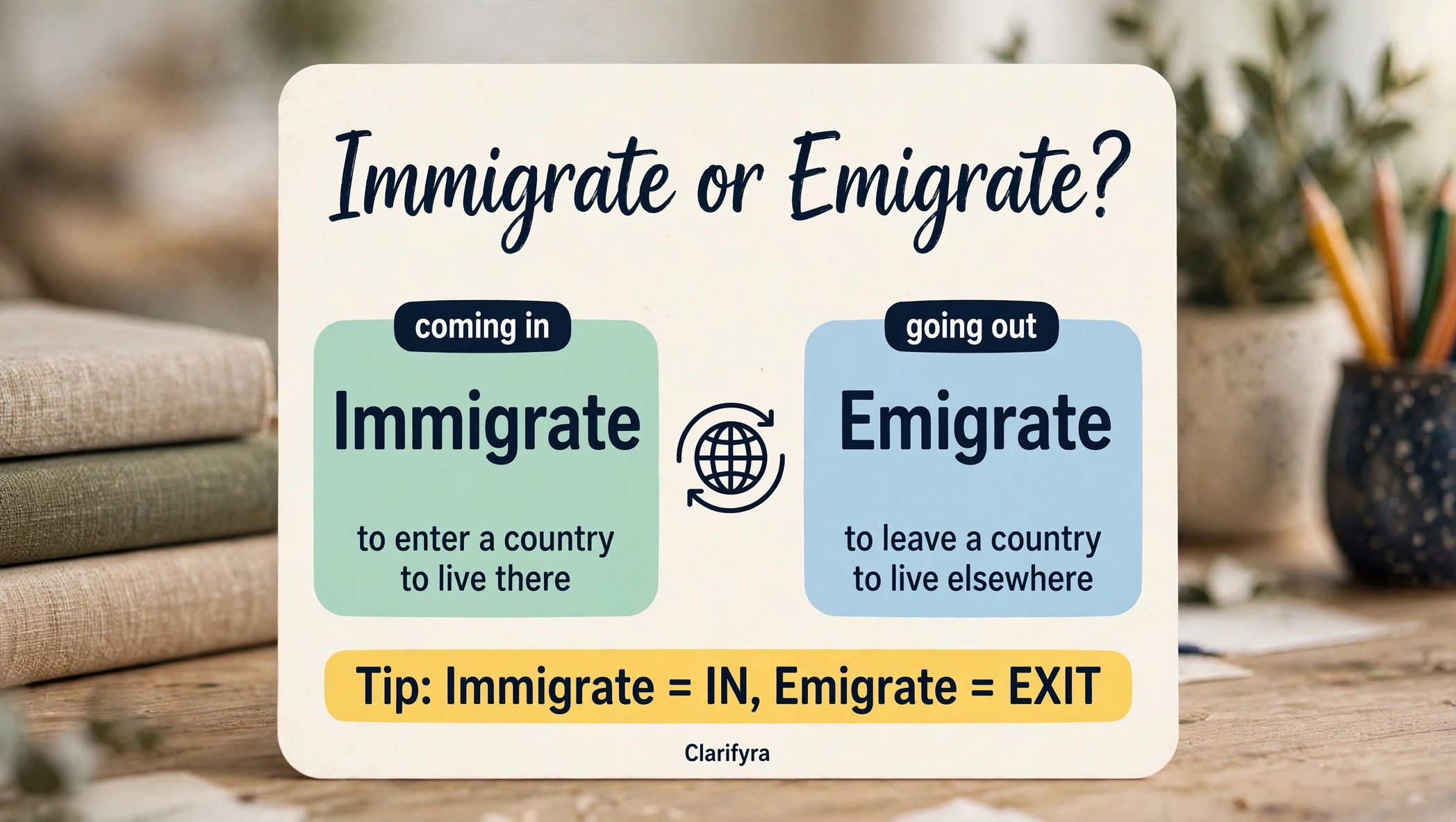
Immigrate or Emigrate: What’s the Difference?
Immigrate and emigrate describe the same move from opposite ends of the journey. To immigrate is to move into a country to live there; to emigrate is to move out of a country to live elsewhere. The prefixes do the work: im- (in/into) versus e-/ex- (out of). One person, one move, two words — the choice depends entirely on which side of the border you’re standing on when you describe it.
Quick Answer
Immigrate = move into a country (“She immigrated to Canada in 2019″). Emigrate = move out of a country (“He emigrated from Spain in 2019″). Same journey, opposite perspectives: the destination country’s view is immigration; the origin country’s view is emigration. Both are intransitive verbs — you immigrate to somewhere, you emigrate from somewhere, never with a direct object. Pronunciation: immigrate /ˈɪmɪɡreɪt/, emigrate /ˈemɪɡreɪt/ — the first syllable carries the whole distinction.
The One Rule: Direction
Everything about this pair reduces to a single question: which border is being crossed, and in which direction?
- Moving into a new country to settle → immigrate (destination’s perspective). Preposition: to.
- Moving out of your country to settle elsewhere → emigrate (origin’s perspective). Preposition: from.
Take one journey — a family leaves Portugal and settles in Brazil. From Portugal’s point of view, they emigrated from Portugal. From Brazil’s point of view, they immigrated to Brazil. The family did one thing; the language gives you two words for it because countries count arrivals and departures separately. (Governments literally do: immigration statistics and emigration statistics are different datasets.)
What the Dictionaries Actually Say
All four references draw the line in the same place — into versus out of:
- Cambridge: immigrate — “to come to live in a different country”; emigrate — “to leave a country permanently and go to live in another one.”
- Oxford Learner’s Dictionaries: immigrate — “to come into a country in order to live there permanently”; emigrate — “to leave your own country in order to live in another country.” Oxford adds the usage warning explicitly: “Emigrate is used of leaving a country; immigrate of entering.”
- Merriam-Webster: immigrate — “to enter and usually become established; especially: to come into a country of which one is not a native for permanent residence”; emigrate — “to leave one’s place of residence or country to live elsewhere.”
- Collins: immigrate — “to come into a country of which one is not a native, for permanent residence”; emigrate — “to leave one country or region to settle in another.” Collins adds the etymology that explains the prefixes: immigrate from Latin immigrāre, from im- (“into”) + migrāre (“to move”); emigrate from Latin ēmigrāre, from ex- (“out of”) + migrāre.
The etymology is the memory aid built into the words: im- = into, e-/ex- = out of. The same directional prefixes appear all over English — which is why confusing them here is worth fixing properly. (The im-/em- prefix pair causes trouble elsewhere too: invoke vs evoke is another case where the opening syllable changes everything.)
Grammar: Prepositions and Verb Patterns
Both verbs are intransitive — they don’t take a direct object. The error ✗ “They immigrated Canada” fails the same way ✗ “They emigrated Portugal” does: each verb needs its preposition to point at the border being crossed.
| Immigrate | Emigrate | |
|---|---|---|
| Direction | Into | Out of |
| Preposition | to (“immigrated to Canada”) | from (“emigrated from Spain”) |
| Perspective | Destination country’s view | Origin country’s view |
| Noun | immigration | emigration |
| Person | immigrant | emigrant |
| Adjective | immigrant (attributive) | emigrant (attributive) |
The whole word family follows the verb: immigration/emigration, immigrant/emigrant. Learn the verb pair and the nouns come free. Note the adjective use too: “immigrant communities” (communities of people who immigrated), “emigrant remittances” (money sent home by people who emigrated).
Examples in Real Sentences
“Her grandparents immigrated to the United States from Italy in the 1950s.”
“He emigrated from Ireland during the famine, seeking work in Liverpool.”
“After the war, thousands emigrated from Europe and immigrated to Australia under assisted-passage schemes.”
“She immigrated to Toronto, where she joined a large diaspora community.”
Notice the third example: both verbs in one sentence, each with its own preposition, describing one historical movement from two perspectives. That’s the pair working as designed.
Migrant vs Immigrant vs Emigrant
The family has a third member that confuses things: migrant. Unlike its two siblings, migrant is direction-neutral — it describes movement without specifying into or out of:
- Migrant: a person who moves, generally or temporarily — “migrant workers,” “rural-to-urban migrants.” No direction implied; often suggests movement that may not be permanent.
- Immigrant: someone who has moved into a country to settle — the destination’s word for the same person.
- Emigrant: someone who has moved out of a country to settle elsewhere — the origin’s word.
So in news writing, “migrants crossed the Mediterranean” is deliberately neutral about origin and destination; “immigrants arrived in Lampedusa” takes the destination’s view; “emigrants left Tunisia” takes the origin’s. The three words are a toolkit, not synonyms — pick the one whose perspective matches your sentence.
Common Mistakes
1. Swapping the direction. ✗ “They emigrated to Canada.” → ✓ “They immigrated to Canada.” / “They emigrated from Poland.” The preposition is the giveaway: to pairs with im-, from pairs with em-.
2. Using a direct object. ✗ “She immigrated Australia.” → ✓ “She immigrated to Australia.” Both verbs are intransitive — the preposition is mandatory.
3. “Emigrate” for internal moves. ✗ “He emigrated from Texas to California.” → ✓ “He moved from Texas to California.” Emigrate/immigrate are for crossing national borders to settle. Within a country, it’s migrate (or just “move”).
4. Mixing up the nouns. ✗ “The country’s immigration rate is rising” (when describing departures). → ✓ “The country’s emigration rate is rising.” Match the noun to the direction: arrivals = immigration, departures = emigration.
5. “Immigrate” as a transitive verb. ✗ “The policy immigrated thousands of workers.” Policies don’t immigrate people — people immigrate. The causative idea needs different wording: “The policy brought in thousands of workers” or “allowed thousands to immigrate.”
How to Remember the Difference
1. The preposition trick. Immigrate → to. Emigrate → from. The vowel sounds even echo each other: im-to, em-from.
2. “In” vs “exit.” Immigrate starts like “in” — moving in. Emigrate starts like “exit” — moving out. In/exit: the two most basic directional words in English, sitting right at the front of each verb.
3. Think like a border official. Immigration control is the desk you meet when you arrive — passports stamped in. Nobody says “emigration control” at arrivals. The institution’s name tells you which verb belongs to the destination.
Frequently Asked Questions
What’s the difference between immigrate and emigrate?
Immigrate means to move into a country to live there (“She immigrated to Canada”); emigrate means to move out of a country (“He emigrated from Spain”). One journey, two perspectives: the destination sees immigration, the origin sees emigration.
Is it “immigrate to” or “immigrate from”?
“Immigrate to.” The preposition follows the prefix: im- (into) takes to. “Emigrate” takes from: “emigrated from Portugal.” Getting the preposition right is half of getting the verb right.
Can you emigrate within your own country?
No. Emigrate/immigrate describe crossing national borders to settle permanently. Moving from Texas to California is migrating (internal migration) — or simply moving.
What’s the difference between a migrant, an immigrant, and an emigrant?
A migrant is direction-neutral (someone who moves, often temporarily). An immigrant is someone viewed from the destination country (moved in). An emigrant is the same person viewed from the origin country (moved out).
Do you say “immigrate” or “emigrate” when leaving a country?
Emigrate — with from: “They emigrated from Lebanon in 2010.” Reserve “immigrate” (with to) for the arrival end of the journey.
Is “immigrate” transitive or intransitive?
Intransitive. You can’t “immigrate a country” or “immigrate someone” — the verb needs its preposition: “immigrate to Canada,” “emigrate from Spain.”
Final Takeaway
Immigrate is the arrival word, emigrate the departure word — im- for in, em- for exit. One journey, two perspectives, and the preposition tells you which you’re using: to with immigrate, from with emigrate. Get the direction right and the whole family — immigration/emigration, immigrant/emigrant — falls into place.