Matrixes or Matrices: Which Is Correct?
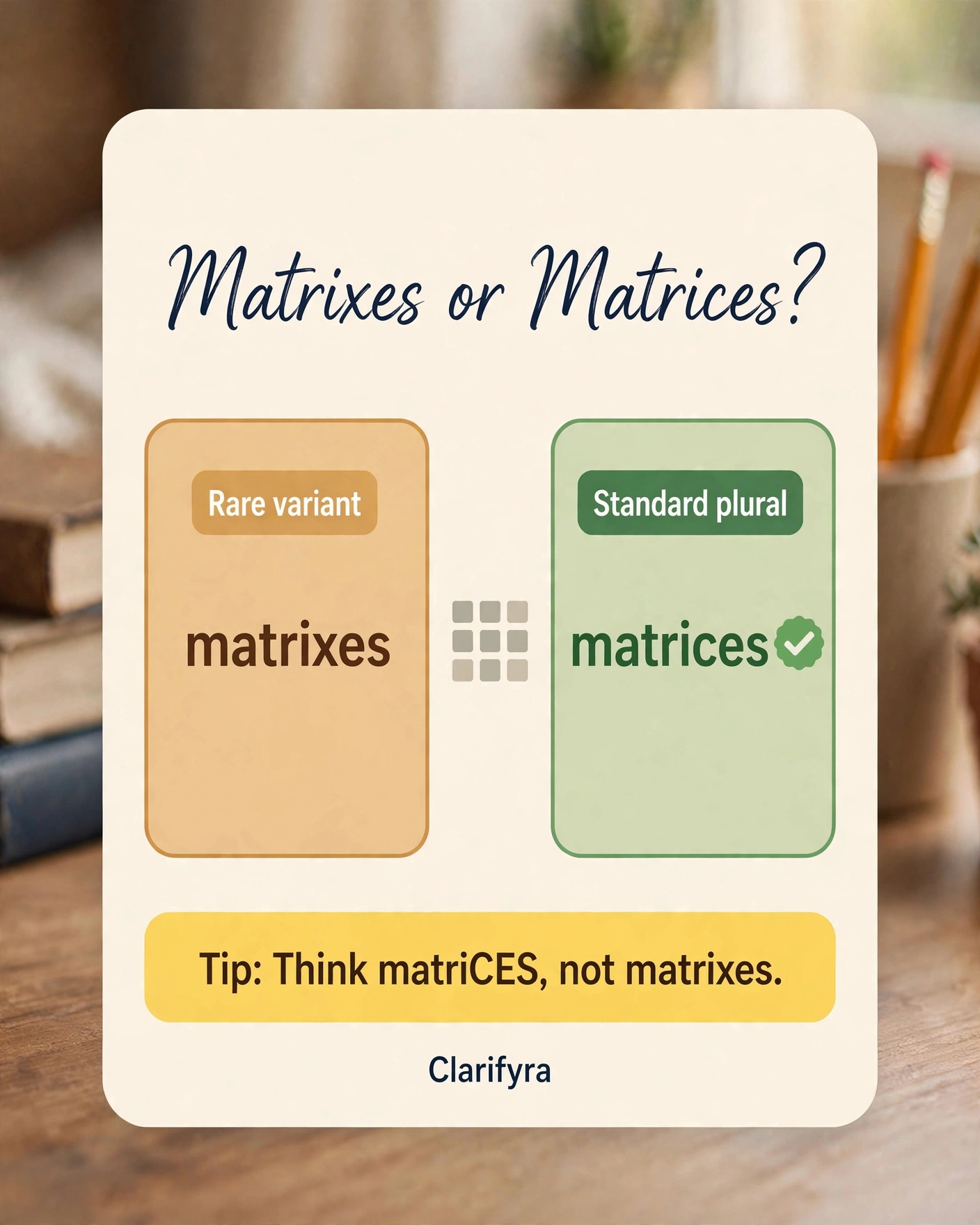
Both matrixes and matrices are plural forms of the noun matrix, but they are not equal. Matrices (pronounced /ˈmeɪtrɪsiːz/) is the standard, dictionary-listed plural in both British and American English; matrixes (pronounced /ˈmeɪtrɪksɪz/) is a rare, heavily discouraged variant that no major dictionary gives a headword entry. In published writing, academia, and every professional context, the plural is matrices — full stop.
Quick Answer
Matrices is the standard plural of matrix — use it in all writing. Matrixes is listed by Merriam-Webster as a less common variant, but Oxford Learner’s and Cambridge give only matrices, and Collins marks it “rare.” When in doubt, matrices is never wrong. Singular pronunciation: UK /ˈmeɪ.trɪks/, US /ˈmeɪ.trɪks/; plural matrices: /ˈmeɪtrɪsiːz/.
What the Dictionaries Actually Say
The references agree with unusual force — they don’t just prefer matrices, most of them refuse to acknowledge matrixes at all:
- Oxford Learner’s Dictionaries: headword matrix — “plural matrices” — and nothing else. No variant listed.
- Cambridge Dictionary: “matrix noun [ C ] plural matrices” — defined in mathematics as “a group of numbers arranged in a rectangle, especially in rows and columns.” No variant listed.
- Collins English Dictionary: “plural matrices (ˈmeɪtrɪˌsiːz)” — and on its separate form entry for “matrixes,” the one-word label “rare.”
- Merriam-Webster (American): “plural matrices ˈmā-trə-ˌsēz also matrixes ˈmā-trik-səz.” The most permissive of the four — and even here, “also” marks the second form as the lesser alternative.
The verdict: matrices is the headword plural everywhere; matrixes scrapes by as a recorded-but-rare variant in two American-leaning sources and is invisible in the British ones. A spellchecker accepting “matrixes” tells you only that the form exists somewhere — not that any editor would let it through.
Why “Matrices”? The Latin -ix → -ices Rule
Matrix comes from Latin mātrīx (“womb,” from māter, “mother”), and it kept the Latin plural pattern that English inherited with it: -ix → -ices. The same machinery produces a small, learnable family of plurals — and once you see the family, “matrixes” starts looking like an outsider:
| Singular | Standard plural | The -es variant |
|---|---|---|
| matrix | matrices | matrixes (rare) |
| index | indices | indexes (common) |
| appendix | appendices | appendixes (acceptable) |
| vortex | vortices | vortexes (acceptable) |
| apex | apices | apexes (acceptable) |
Notice the spectrum: for index, both plurals are fully standard — and usefully different (“indices” in mathematics, “indexes” for books). For matrix, the spectrum collapses: the -ices form won so completely that the -es form barely registers. Why the difference? Frequency and register. “Matrix” lives overwhelmingly in mathematics, science, and computing — high-formality fields that preserve the classical plural. Words that escaped into everyday use (indexes in books, appendixes in reports) earned their -es forms through sheer volume of ordinary use. “Matrixes” never got that volume.
Pronunciation: UK and US
- Singular — matrix: /ˈmeɪ.trɪks/ (“MAY-triks”) in both British and American English (Oxford Learner’s, Cambridge). Stress on the first syllable.
- Plural — matrices: /ˈmeɪ.trɪ.siːz/ (“may-TRISS-eez” — Oxford Learner’s) or /ˈmeɪtrɪˌsiːz/ (Collins). The -ix ending becomes -ices, and the “c” softens to an /s/ sound: MAY-tri-seez, rhyming loosely with “crises.”
- The variant — matrixes: /ˈmeɪ.trɪk.sɪz/ (“MAY-trik-siz”) — pronounced exactly as spelled, keeping the hard /ks/. If you hear someone say “MAY-trik-siz,” they’re saying “matrixes.”
The practical tip: if you can say crises (the plural of crisis), you can say matrices — same -es → -eez machinery, same rhythm.
What “Matrix” Means: The Main Senses
The word’s senses all grow out of the Latin root māter — “mother,” i.e., something that contains, produces, or gives form to something else:
1. Mathematics. The dominant modern sense: a rectangular array of numbers (or symbols) in rows and columns, used in linear algebra, computer graphics, and statistics. “To solve the system, we inverted the coefficient matrix.” / “The two matrices cannot be multiplied — their dimensions don’t agree.” This is the sense where the plural matrices appears most often by far.
2. An enclosing or embedding structure. Geology: the rock or sediment surrounding fossils or crystals (“fossils embedded in a limestone matrix“). Biology: the substance between cells, or the material in which something develops. Manufacturing: a mold or die that shapes material — Collins lists “a metal block used as a die in cutting, stamping, or shaping.” All share the “container that gives form” idea.
3. A surrounding situation or environment. The figurative extension: “the social matrix of the city,” “the cultural matrix in which the novel was written.” Here the word means the conditions that produce or shape something — closest to the original “womb” sense.
4. Computing and electronics. A grid arrangement — a “matrix display,” a “matrix printer” (the old dot-matrix workhorse), a “switching matrix.” The math sense applied to hardware.
5. The film (capital M). The Matrix (1999) uses the word in senses 3 and 4 at once: the simulated reality as both an enclosing environment and a computational grid. The title is always capitalized and singular.
Correct vs Incorrect: The Plurals Compared
| Form | Verdict | Why |
|---|---|---|
| matrices | ✓ Standard | Headword plural in Oxford, Cambridge, Collins, and Merriam-Webster |
| matrixes | ⚠ Rare variant | Recorded by Merriam-Webster (“also”), marked “rare” by Collins; absent from Oxford and Cambridge |
| matrix (as plural) | ✗ Wrong | The singular cannot do plural duty: ✗ “two matrix” → ✓ “two matrices“ |
| matrice | ✗ Wrong | A back-formation some writers invent by analogy with “crisis → crises”; no dictionary lists it |
Common Mistakes
1. Writing “matrixes” in formal or academic work. ✗ “The matrixes were multiplied in parallel.” → ✓ “The matrices were multiplied in parallel.” Even though a spellchecker may accept “matrixes,” reviewers and editors in math, science, and computing expect the -ices form.
2. Using the singular where the plural belongs. ✗ “We compared three matrix.” → ✓ “We compared three matrices.” Countable noun, regular agreement — no exceptions.
3. Inventing “matrice” as a singular. ✗ “Each matrice represents a transformation.” → ✓ “Each matrix represents a transformation.” The singular is “matrix”; “matrice” is not a word (though French uses matrice — a false-friend trap for bilingual writers).
4. Pronouncing “matrices” as “MAY-trik-seez.” The -ices ending is /siːz/, not /ksɪz/: “may-TRISS-eez.” Keep the hard /ks/ for the singular only.
5. Assuming “indexes” logic transfers. ✗ “If ‘indexes’ is fine, ‘matrixes’ must be fine too.” The -ix family isn’t uniform — “index” earned two standard plurals through centuries of everyday use in publishing; “matrix” stayed in formal registers and kept one. Judge each word by its own dictionary entry.
How to Remember the Plural
1. Pair it with “crises.” Crisis → crises and matrix → matrices run on the same machinery: the -is/-ix ending becomes -es/-ices, pronounced “-eez.” If “crises” feels natural, “matrices” should too.
2. Think Latin. The word came from Latin mātrīx, and Latin -ix nouns pluralize to -ices. “Matrixes” is what you’d get by applying the English rule to a Latin word — like putting ketchup on a dish that already has its own sauce.
3. Remember the register. “Matrix” lives in mathematics, science, and computing — fields that preserve classical plurals (phenomena, criteria, data). The company it keeps all uses -a/-ae/-ices plurals; “matrixes” would be the odd one out at the table.
Frequently Asked Questions
Is “matrixes” wrong?
Not exactly — it’s a recorded variant, but a rare and discouraged one. Merriam-Webster lists it as an “also” form and Collins marks it “rare”; Oxford Learner’s and Cambridge don’t list it at all. In practice, treat it as wrong for anything published: use matrices.
What’s the plural of matrix?
Matrices — pronounced /ˈmeɪtrɪsiːz/ (“may-TRISS-eez”). It’s the headword plural in all four major dictionaries we checked.
Why is it “matrices” and not “matrixes”?
Because “matrix” is a Latin borrowing, and Latin -ix nouns form their plural as -ices (like “index → indices” and “apex → apices”). English kept the classical pattern for this word because it lives mostly in formal, technical registers.
Is it “indexes” or “indices” — and does the same logic apply?
Both are standard for “index,” with a useful split: “indices” in mathematics and science, “indexes” for books and databases. “Matrix” never developed that split — “matrices” covers all senses, and “matrixes” stayed rare.
How do you pronounce “matrices”?
/ˈmeɪtrɪsiːz/ — “may-TRISS-eez,” with the stress on the first syllable and the ending rhyming with “crises.” The singular “matrix” is /ˈmeɪtrɪks/ (“MAY-triks”).
Is “matrice” a word?
Not in English. Some writers back-form it by analogy with “crisis → crises,” but no English dictionary lists “matrice” as the singular of “matrices.” (French does use matrice — so francophone writers should beware the false friend.)
Final Takeaway
The plural of matrix is matrices — the dictionary headword in British and American English alike, the form every mathematician, scientist, and editor expects. Matrixes exists on the margins (Merriam-Webster’s “also,” Collins’s “rare”), but a recorded variant is not a recommended one. Pair it with crises, think Latin -ix → -ices, and the classical plural will come naturally.