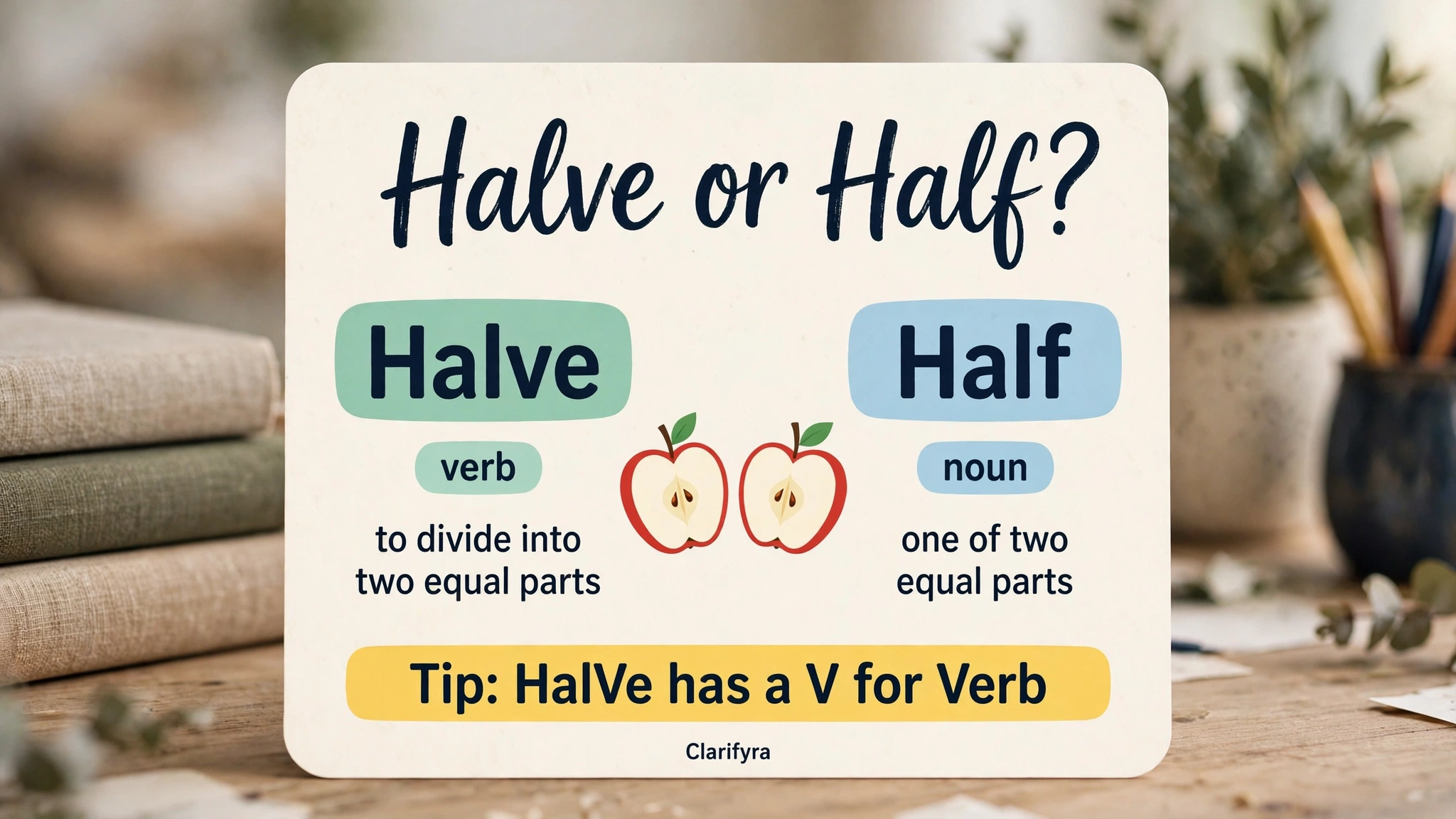
Halve or Half: What’s the Difference?
Half names a portion. Halve describes the act of creating one. That single-letter difference — an f versus a v — is the whole story: half is the word for “one of two equal parts” (working as a noun, adjective, or adverb), while halve is the verb meaning “to divide into halves” or “to reduce by half.” They don’t even sound the same: half ends in an /f/ sound, halve in a /v/ sound. Once you hear that difference, you’ll never confuse them again.
Quick Answer
Half = the portion (noun/adjective/adverb): “half an hour,” “half asleep.” Halve = the action (verb): “halve the recipe,” “they halved the budget.” Pronunciation: half is UK /hɑːf/, US /hæf/; halve is UK /hɑːv/, US /hæv/.
Half: The Portion Word
Half is one of the hardest-working small words in English. Dictionaries record it as a noun, a predeterminer, an adjective, and an adverb — which is why it shows up in so many different-looking sentences. In every role, though, it does the same conceptual job: it points to a portion, never an action.
As a noun: one of two equal parts
“Would you like half of my sandwich?”
“The melon slipped and broke into two halves.”
“Only half the guests had arrived when the speeches started.”
The plural is halves — never “halfs.” Half also has a few specialized noun senses worth knowing: in sport, a match divided into two periods (“the second half“), and in British English, “a half” on its own can mean half a pint (“a half of lager and a sandwich”).
As a predeterminer: sitting before articles and possessives
This is the use most people never notice they know. In “half an hour,” “half the money,” or “half his age,” half sits in front of a/an, the, or a possessive — a slot grammarians call a predeterminer:
“We talked for half an hour.”
“They’d only received half the money they were promised.”
“She’s half his age.”
Note the word order: it’s “half an hour,” not “a half an hour.” (American speakers do sometimes say “a half hour” informally — “the film lasts a half hour” — but “half an hour” is the standard form everywhere.)
As an adjective: describing a partial thing
“I took a half day off work.”
“He gave a half smile and said nothing.”
“Half measures won’t fix this — we need a proper plan.”
As an adverb: meaning “partly”
“The shutters were half closed against the sun.”
“She half expected him to cancel.”
“I was half asleep through the entire lecture.”
In all of these, half names or modifies — it never does anything. The moment your sentence needs an action, you need the verb: halve.
Halve: The Action Word
Halve is a regular verb with two closely related meanings: to divide something into two equal parts, and to reduce something by half. Collins lists its forms as halves (third-person singular), halving (present participle), and halved (past tense and past participle):
“Halve the potatoes before roasting them.” (divide)
“The shop halved its prices for the January sale.” (reduced)
“She is halving the recipe so it serves two.” (dividing)
“He halves every portion out of habit.” (third-person singular)
Notice that halve works both transitively (you halve something) and intransitively (something halves on its own): “Oil prices halved in a year.” And if you ever watch golf, you’ll meet a third, specialized sense — in match play, “to halve a hole” means to tie it, each player taking the same number of strokes.
Pronunciation: don’t merge it with “half”
Say halve with a voiced /v/ at the end, not an /f/: UK /hɑːv/ (rhyming with “carve”), US /hæv/. The vowel follows the same British/American split as “half” itself — long “ah” in British English (/hɑːv/), short “a” in American English (/hæv/). If you pronounce it “haff,” you’ve collapsed the one sound that marks it as the verb.
All Four Forms at a Glance
| Word | Part of Speech | Meaning | Example |
|---|---|---|---|
| half | noun / predeterminer / adjective / adverb | one of two equal parts; partly | “half the class stayed late”; “she was half joking” |
| halve | verb (base form) | to divide into halves; to reduce by half | “Halve the cherry tomatoes” |
| halves | plural noun or 3rd-person singular verb | (noun) more than one half; (verb) he/she/it divides | “two halves“; “she halves the recipe” |
| halved | past tense & past participle | divided; reduced by half | “they halved the budget” |
Why “Halves” Causes the Most Trouble
Halves is the only form doing double duty, and it gives you no phonetic clue about which job it’s doing — the noun plural and the verb form are spelled and pronounced identically (UK /hɑːvz/, US /hævz/). Only the sentence tells you:
“Cut the apple into halves.” — noun (things you can count)
“She halves the apple with one cut.” — verb (something she does)
Try the substitution test: if you can replace it with “parts,” it’s the noun (“cut it into parts” works); if you can replace it with “divides,” it’s the verb (“she divides the apple” works). And whatever you do, don’t write “halfs” — that spelling doesn’t exist in standard English for either meaning.
The F-to-V Pattern (It’s Not Random)
There’s a reason the verb ends in v while the noun ends in f. English has a long-standing habit of voicing /f/ to /v/ when a word shifts into verb or plural territory: half/halves, belief/believe, shelf/shelve, knife/knives. So “halve” isn’t an odd exception — it’s the verb behaving exactly the way English verbs of this family behave. Once you see the pattern, the spelling starts to feel inevitable rather than arbitrary.
In the Kitchen: Where This Confusion Lives
Recipes are the number-one place people meet this pair, because recipe instructions are almost all verbs — and the verb is the one people forget:
“Halve the recipe to serve two instead of four.”
“Halve the cherry tomatoes and scatter them over the salad.”
“Use half the sugar the recipe calls for.”
“Reduce all quantities by half.”
Notice the logic: whenever the sentence tells you to do something — halve the dough, halve the portions — it’s the verb with a v. When it names an amount — half the flour, half the time — it’s the noun with an f. The most common kitchen error, “Half the onions and fry them,” fails exactly this test: it’s an instruction, so it needs the verb.
Numbers, Money, and Percentages
Outside the kitchen, halve is the business and news verb for a 50% reduction:
“The company halved its workforce in two years.”
“They’ve halved the deficit since 2020.”
“Regular exercise can halve your risk, researchers say.”
With quantities, both words get used but in different slots: “Tickets are half price” (adjective), “She owns half the company” (noun), “Cut spending by half” (noun phrase). One redundancy to watch: because halve already means “reduce by half,” writing “they halved prices by half” says the same thing twice — “they halved prices” is complete on its own.
Common Mistakes
1. Using “half” as a verb. ✗ “Half the onions and fry them.” → ✓ “Halve the onions and fry them.” Interestingly, this error has deep roots: older dictionaries record an obsolete verb sense of “half” meaning “to halve,” so the mistake feels almost right because, centuries ago, it was. In modern English that verb is dead — the living verb is halve. (Verb forms are a minefield generally; lyed vs lied untangles another one that looks almost plausible.)
2. Using “halve” as a noun. ✗ “I’ll take a halve of that cake.” → ✓ “I’ll take half of that cake.” If there’s no action, there’s no v.
3. Writing “halfs.” ✗ “Cut it into halfs.” → ✓ “Cut it into halves.” This applies whether you mean the plural noun or the verb — “halfs” is never standard.
4. Misplacing the article with time. ✗ “a half an hour” → ✓ “half an hour.” Half comes before the article, not after it. (Informal American “a half hour” exists, but “half an hour” is standard everywhere.)
5. Tense mismatch with “halves.” ✗ “She halves the apple yesterday.” → ✓ “She halved the apple yesterday.” Halves is present tense only; the past is always halved.
6. Pronouncing “halve” with an /f/. Saying “haff” wipes out the verb’s signature sound. Keep the /v/: UK /hɑːv/, US /hæv/.
How to Remember It
HalVe has a V for Verb — and that v is voiced, so you can hear it too. No action in the sentence? No v in the spelling: half. It’s a small trick, but it encodes the real grammar: the v is the verb marker, the same f-to-v voicing you see in believe, shelve, and knives.
Frequently Asked Questions
Is “halve” a real word?
Yes — it’s a standard English verb meaning to divide into halves or reduce by half, recorded in every major dictionary (Cambridge, Collins, Merriam-Webster, Oxford). “Halve the ingredients” is perfectly correct.
How do you pronounce “halve”?
With a /v/ sound at the end: UK /hɑːv/ (rhymes with “carve”), US /hæv/. Don’t pronounce it like “half” (/hɑːf/ /hæf/) — the f/v difference is what separates the verb from the noun.
What is the past tense of “halve”?
Halved — “She halved the recipe and it still served four.” The -ed ending is pronounced /d/ (UK /hɑːvd/, US /hævd/) because it follows the voiced /v/.
Can “half” be used as a verb?
Not in modern English. Older dictionaries do record an obsolete verb sense of “half” meaning “to halve,” which is probably why “Half the onions” feels almost acceptable — but no current dictionary lists it as a living verb. Use halve.
Should I write “halve the recipe” or “half the recipe”?
“Halve the recipe” — you’re describing the action of dividing the quantities, so you need the verb. “Half the recipe” would only work as a noun phrase naming an amount, as in “use half the recipe’s sugar.”
What’s the plural of “half”?
Halves — “Cut the paper into two halves.”
How can I tell whether “halves” is a noun or a verb?
By context alone — they’re identical in spelling and pronunciation. Try substituting: if “parts” fits, it’s the noun (“cut it into parts”); if “divides” fits, it’s the verb (“she divides the apple”).
Is it “cut in half” or “cut in halves”?
“Cut in half” is the idiomatic standard when dividing something into two. “Cut into halves” also works and emphasizes the resulting pieces. Both are correct; “in half” is more common.
Is it “half of the cake” or “half the cake”?
Both are fine before nouns: “half the cake,” “half of the cake.” But before a pronoun, “of” is required: “half of it,” “half of them” — never “half it.”
Final Takeaway
Half names the portion; halve performs the action. They’re separated by one letter, one sound, and one part of speech — and by a pattern (f-to-v voicing) that runs through the whole language. Keep the V for the verb, listen for the /v/, and the rest takes care of itself.