Bit or Bite: What’s the Difference?
It can be confusing to choose between bit and bite, especially because they are forms of the same irregular verb. Both words are correct, but they do different grammatical jobs. Bite is the base form of the verb, while bit is its simple past form. There is also a third form worth knowing: bitten, which is the standard past participle. Understanding these three forms makes it much easier to know which one belongs in a sentence.
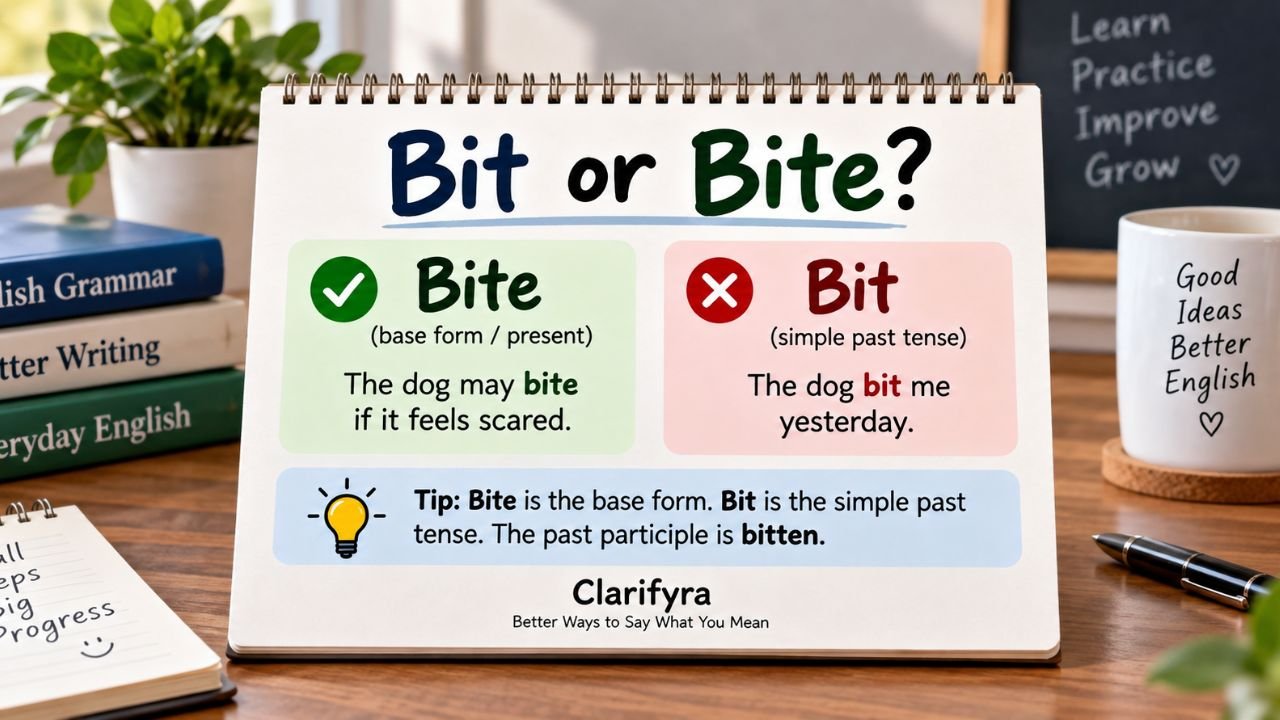
Bite and bit are both correct, but they are different forms of the verb. Bite is the base form, while bit is the simple past tense. The standard past participle is bitten: bite → bit → bitten.
Bit or Bite: The Basic Difference
The easiest way to understand the difference is to look at the verb forms:
| Form | Word | Main use | Example |
|---|---|---|---|
| Base form | bite | Present, infinitive, after modal verbs | Dogs can bite. |
| Simple present | bite / bites | Present actions or habits | Some dogs bite. |
| Simple past | bit | Completed past actions | The dog bit me. |
| Past participle | bitten | Perfect and many passive constructions | The dog has bitten me. |
| Present participle | biting | Continuous forms | The dog is biting the toy. |
So, the main pattern to remember is:
bite → bit → bitten
This is an irregular verb, which means its past forms do not follow the regular -ed pattern.
For example:
- I bite my nails.
- I bit my tongue.
- I have bitten my tongue before.
What Does “Bite” Mean?
Bite is the base form of the verb. It means to use the teeth to cut, grip, hold, or injure something. It can describe the action of a person, animal, or sometimes an insect.
Examples:
- Be careful; the dog may bite.
- Some insects bite humans.
- Try not to bite your tongue.
- The puppy likes to bite its toys.
Bite can also be a noun:
- Take a bite of the apple.
- He took a bite of his sandwich.
- The dog gave him a nasty bite.
The noun and verb are related, but in a sentence you can usually identify the verb when it describes an action.
“Bite” in the Present
Use bite when talking about something that happens now, happens regularly, or is generally possible.
Some dogs bite when they are frightened.
I sometimes bite my nails.
With he, she, or it, the present-tense form becomes bites:
The dog bites when it feels threatened.
What Does “Bit” Mean?
Bit is the simple past tense of bite.
Use it when the biting action happened in the past.
Examples:
- The dog bit my shoe.
- A mosquito bit me last night.
- She bit into the apple.
- He accidentally bit his tongue.
- The puppy bit the toy and ran away.
Notice that bit tells us that the action has already happened.
Compare:
The dog may bite me.
Here, the action is possible in the present or future.
The dog bit me yesterday.
Here, the action happened in the past.
Is “Bit” the Past Tense of “Bite”?
Yes. Bit is the simple past tense of bite.
The correct forms are:
Present/base: bite
Past: bit
Past participle: bitten
For example:
I bite my nails when I am nervous.
I bit my tongue while eating.
I have bitten my tongue before.
A common mistake is to form the past tense as bited. That is not the standard form of the verb.
Correct: The dog bit him.
Incorrect: The dog bited him.
Because bite is irregular, its past tense changes to bit rather than taking -ed.
Bite Past Tense and Past Participle
One of the most useful things to remember is that the simple past and past participle are not the same.
Simple past: Bit
Use bit when describing a completed action in the past.
The dog bit the ball.
She bit her lip.
A mosquito bit me yesterday.
Past participle: Bitten
Use bitten with auxiliary verbs in perfect constructions and in standard passive constructions.
The dog has bitten the ball.
She had bitten her lip.
I have been bitten by mosquitoes.
He was bitten by a dog.
This gives us the complete pattern:
Bite — Bit — Bitten
Learning these three forms together is much more useful than memorizing bit and bite separately.
Bit vs. Bitten: An Important Related Difference
Although bit and bitten are not the same form, they come from the same verb.
Use bit as the simple past:
The dog bit me yesterday.
Use bitten as the past participle:
The dog has bitten me before.
The difference becomes particularly clear when you compare active and perfect constructions:
The dog bit the boy.
The dog has bitten the boy before.
In the first sentence, bit is the simple past. In the second, bitten follows has and functions as the past participle.
“Did You Bite” or “Did You Bit”?
The correct expression is:
Did you bite me?
Not:
Did you bit me?
After did, English uses the base form of the verb. Since the base form is bite, the correct structure is:
did + bite
Examples:
- Did the dog bite you?
- Did you bite your tongue?
- Did she bite the apple?
- Did he bite the sandwich?
The past meaning is already supplied by did, so you do not need to use the past form bit after it.
This same rule applies to other irregular verbs:
- Did you go? — not Did you went?
- Did she eat? — not Did she ate?
- Did he see it? — not Did he saw it?
“Was Bit” or “Was Bitten”?
For standard English, bitten is normally used in passive constructions.
The child was bitten by the dog.
She was bitten by a mosquito.
He had been bitten by an insect.
The active equivalent uses bit:
The dog bit the child.
The difference is grammatical:
Active:
The dog bit the child.
Passive:
The child was bitten by the dog.
In some varieties of English, particularly in certain American usages, bit can occasionally occur as a past participle. However, bitten is the standard and clearest form for formal writing and for learners to use when the past participle is required.
Correct Usage in Sentences
Here are some examples showing how the forms work in different contexts.
Use “bite”
Don’t bite the pencil.
The puppy likes to bite its toys.
Some insects bite at night.
Be careful—the dog might bite.
Use “bit”
The dog bit my hand.
She bit into a fresh apple.
He bit his lip during the game.
A mosquito bit me while I was outside.
Use “bitten”
I have been bitten by mosquitoes before.
The dog has bitten someone before.
She had bitten into the apple before realizing it was sour.
He was bitten by a dog when he was younger.
Why Are Bit and Bite Confused?
The confusion is understandable because bit and bite are simply different forms of the same irregular verb.
The spelling changes in a way that does not follow the regular pattern:
- walk → walked
- jump → jumped
- talk → talked
But:
- bite → bit
- write → wrote
- speak → spoke
The pronunciation also changes:
- bite has a long vowel sound, as in light.
- bit has the short vowel sound found in sit.
The key issue, however, is grammar rather than pronunciation. If you know whether the sentence refers to the base/present form or a completed past action, choosing between them becomes straightforward.
A Simple Way to Remember the Forms
Remember the three principal forms as a sequence:
BITE → BIT → BITTEN
Think of them as:
- bite = basic form
- bit = past action
- bitten = past participle
For example:
I bite.
I bit.
I have bitten.
A particularly useful rule is:
If “did” comes before the verb, use “bite,” not “bit.”
Did you bite it?
But without did, a completed past action takes bit:
You bit it.
Common Mistakes to Avoid
1. Using “bited” as the past tense
Incorrect:
The dog bited him.
Correct:
The dog bit him.
2. Using “bit” after “did”
Incorrect:
Did the dog bit you?
Correct:
Did the dog bite you?
3. Using “bit” where a past participle is needed
Less standard:
He has bit me before.
Standard:
He has bitten me before.
4. Confusing the noun “bit” with the verb
Bit can also mean a small amount or piece:
I need a bit of time.
That use has nothing to do with the past tense of bite.
Bit or Bite: A Quick Grammar Guide
If you’re unsure which form to choose, ask what the sentence is doing.
Use bite when it is the base form:
I don’t want to bite it.
Use bit for a simple past action:
She bit it yesterday.
Use bitten after auxiliary verbs when the past participle is required:
She has bitten it before.
The most useful formula is:
bite → bit → bitten
Once this pattern is familiar, most questions about the three forms become much easier.
FAQs
Is “bit” the past tense of “bite”?
Yes. Bit is the simple past tense of bite. For example, “The dog bit me yesterday.” The standard past participle is bitten, as in “The dog has bitten me before.”
What is the past tense of bite?
The simple past tense is bit. For example: “She bit into the apple.” The verb is irregular, so bited is not the standard past-tense form.
What is the past participle of bite?
The standard past participle is bitten. It appears in constructions such as “has bitten,” “had bitten,” and “was bitten.”
Is it “Did you bite” or “Did you bit”?
The correct form is “Did you bite?” After did, use the base form of the verb. Therefore, “Did you bite your tongue?” is correct, while “Did you bit your tongue?” is not standard English.
Is “bited” a correct word?
Bited is not the standard past tense of bite. The correct simple past is bit, and the standard past participle is bitten.
What are the three forms of “bite”?
The three principal forms are bite, bit, bitten. Bite is the base form, bit is the simple past, and bitten is the past participle.
The Bottom Line
Bite is the base form, bit is the simple past, and bitten is the standard past participle: bite → bit → bitten. Use bite in sentences such as “Did you bite it?” and bit for completed past actions such as “The dog bit me.” Once you remember this three-form pattern, the distinction becomes simple. Clarifyra is here to make confusing English choices clearer and easier to use.