Active or Passive: How to Tell the Difference
The terms active and passive can describe several different things, but in English grammar they usually refer to active voice and passive voice. The difference is mainly about who performs an action and who receives it. For example, “The teacher praised the student” is active, while “The student was praised by the teacher” is passive.
The same words also appear in biology and investing, where they have completely different meanings. Understanding the context is therefore important. This guide explains active and passive voice first, then briefly covers questions such as whether diffusion is active or passive and whether ETFs can be active or passive.
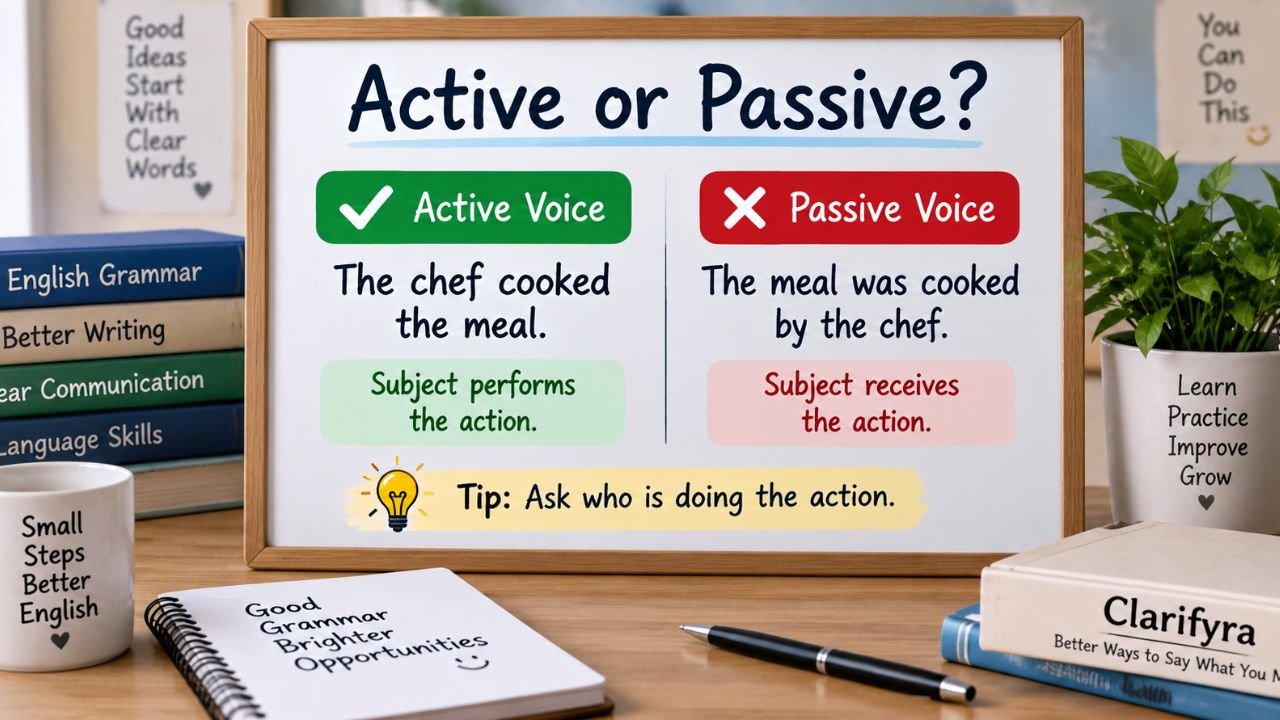
Active voice is used when the subject performs the action, while passive voice is used when the subject receives the action. For example, “The chef cooked the meal” is active, while “The meal was cooked by the chef” is passive. The terms can also have different meanings in biology and investing, so context matters.
Active vs. Passive: What’s the Difference?
The simplest way to distinguish the two grammatical forms is to ask:
Who is doing the action?
If the subject performs the action, the sentence is in active voice.
The student answered the question.
The student performs the action of answering.
If the subject receives the action, the sentence is in passive voice.
The question was answered by the student.
The question receives the action.
The British Council describes the same basic distinction and notes that passive forms are generally built with a form of be + past participle.
Quick comparison
| Feature | Active Voice | Passive Voice |
|---|---|---|
| Focus | Doer of the action | Receiver of the action |
| Typical structure | Subject + verb + object | Subject + be + past participle |
| Example | The chef cooked dinner. | Dinner was cooked by the chef. |
| Agent | Usually clear | May be included or omitted |
| Style | Often direct and concise | Useful when the receiver is more important |
Both forms are grammatically valid. Choosing between them depends on what you want the sentence to emphasize.
What Is Active Voice?
In an active sentence, the grammatical subject performs the action expressed by the verb.
For example:
Maria opened the window.
Maria is the subject, and she performs the action of opening.
Other examples include:
- The dog chased the cat.
- The mechanic repaired the car.
- The children planted the flowers.
- The researcher analyzed the results.
A common basic pattern is:
Subject + verb + object
For example:
The teacher + explained + the lesson.
Active voice often makes it immediately clear who did what. The British Council uses examples such as “The hunter killed the lion” to illustrate this structure.
What Is Passive Voice?
In passive voice, the grammatical subject receives the action rather than performing it.
Compare:
Active: The chef cooked the meal.
Passive: The meal was cooked by the chef.
In the first sentence, the chef is the subject and performs the action. In the second, the meal becomes the subject and receives the action.
Passive constructions commonly contain a form of be followed by a past participle:
- is written
- was completed
- were invited
- has been repaired
- will be finished
For example:
The report was completed yesterday.
The person who completed it does not have to be mentioned.
Why use passive voice?
Passive voice can be useful when the person performing an action is:
- unknown
- obvious from context
- unimportant
- deliberately left unspecified
For example:
The window was broken.
The sentence does not tell us who broke it because the identity of the person may not matter.
You can include the performer with by:
The window was broken by the children.
However, the “by” phrase is optional.
Active or Passive Sentence: How Can You Tell?
Look at the relationship between the subject and the verb.
Active
The gardener watered the plants.
The gardener performs the action.
Passive
The plants were watered by the gardener.
The plants receive the action.
A useful test is:
Is the subject doing something, or is something being done to the subject?
This works for many ordinary sentences.
| Sentence | Voice | Explanation |
|---|---|---|
| The boy kicked the ball. | Active | The boy performs the action. |
| The ball was kicked by the boy. | Passive | The ball receives the action. |
| Sarah wrote the letter. | Active | Sarah performs the action. |
| The letter was written by Sarah. | Passive | The letter receives the action. |
| The company announced the results. | Active | The company performs the action. |
| The results were announced by the company. | Passive | The results receive the action. |
Are Water Sprinklers Active or Passive?
The answer depends on the sentence, not the sprinkler itself.
Consider:
The water sprinklers watered the garden.
This is active voice because the sprinklers are the grammatical subject performing the action.
Now compare it with:
The garden was watered by the sprinklers.
This is passive voice because the garden is the subject receiving the action.
So, if you see a question such as “Are water sprinklers active or passive?”, look at how the noun is being used in the sentence.
More examples
Active:
The sprinklers watered the lawn.
Passive:
The lawn was watered by the sprinklers.
Active:
The sprinklers are watering the flowers.
Passive:
The flowers are being watered by the sprinklers.
The word sprinklers does not automatically make a sentence active. Voice is determined by the grammatical structure of the sentence.
Is Diffusion Active or Passive?
Here, active and passive have a biological meaning rather than a grammatical one.
In biology, diffusion is passive transport. Substances move down their concentration gradient, generally from an area of higher concentration toward an area of lower concentration, without the cell using energy for that transport process. OpenStax describes diffusion as a passive process that does not require cellular energy.
So:
Diffusion = passive transport
This meaning has nothing to do with active or passive voice.
Is Facilitated Diffusion Active or Passive?
Facilitated diffusion is also passive.
The important detail is that facilitated diffusion uses membrane proteins, such as channels or carrier proteins, to help substances cross a cell membrane. The substances still move down their concentration gradient without requiring cellular energy for the transport step. Khan Academy and OpenStax both classify facilitated diffusion as passive transport.
For example, a charged or polar molecule may have difficulty crossing the membrane directly. A channel or carrier protein can provide a pathway, but using that pathway does not make the process active.
A simple comparison is:
| Biological process | Active or passive? |
|---|---|
| Simple diffusion | Passive |
| Facilitated diffusion | Passive |
| Active transport | Active |
The key distinction is energy use and direction relative to the concentration gradient, not simply whether a protein is involved.
Are ETFs Active or Passive?
In investing, an ETF can be either active or passive.
ETF stands for exchange-traded fund, but the term ETF describes the fund structure rather than automatically determining its management strategy. Investor.gov explains that both mutual funds and ETFs can follow either passive or active strategies.
Passive ETFs
A passive ETF generally seeks to track an index or another predetermined benchmark.
For example, a fund may be designed to follow the performance of a particular stock-market index.
Active ETFs
An actively managed ETF gives its investment manager more discretion to select and change investments according to the fund’s objectives rather than simply replicating an index.
J.P. Morgan’s current ETF guide likewise identifies passive and active management as two main ETF management styles.
Therefore:
ETFs can be active or passive.
The word “ETF” alone does not tell you which management approach a fund uses.
Active or Passive Funds: What’s the Difference?
The same distinction applies to investment funds generally.
A passive fund typically attempts to track an index or benchmark. An active fund relies on investment management decisions to build and adjust its portfolio according to its stated objective. Investor.gov describes these two approaches in those terms.
Simple comparison
| Active funds | Passive funds |
|---|---|
| Managed according to an investment strategy | Usually designed to track an index |
| Manager makes portfolio decisions | Portfolio follows predetermined rules or a benchmark |
| May buy and sell based on management decisions | Generally changes as the tracked index or rules change |
| Goal can include outperforming a benchmark | Goal is generally to approximate benchmark performance |
Which Is Better: Active or Passive Funds?
There is no universal answer that makes one approach better for every investor.
The comparison depends on factors such as the fund’s objectives, costs, strategy, risk, benchmark, and the investor’s circumstances. FINRA notes that investing is not a one-size-fits-all decision and distinguishes active strategies from the more hands-off approach associated with passive investing.
Morningstar also notes that the boundary between active and passive investing can be more nuanced than a simple either/or distinction.
For this reason, “active” and “passive” should be understood as descriptions of an investment approach rather than automatic judgments about quality.
Common Mistakes With Active and Passive Voice
1. Assuming passive voice is always wrong
Passive voice is not grammatically incorrect. It has legitimate uses.
The documents were signed yesterday.
This is a perfectly grammatical passive sentence.
2. Assuming every sentence containing “was” is passive
A form of be can appear in sentences that are not passive.
For example:
She was tired.
Here, “was” links the subject to an adjective. It is not the same construction as:
The report was completed.
The second sentence contains a passive construction.
3. Looking only at the first noun
The first noun is not automatically the person doing the action.
The car was repaired by James.
“The car” comes first, but James performs the repairing.
4. Thinking the word “by” is always required
Passive sentences do not have to identify the person who performed the action.
The building was damaged.
This is passive even though no “by” phrase appears.
5. Confusing grammatical voice with scientific or financial terminology
“Passive transport,” “passive voice,” and “passive investing” use the same adjective, but they describe different concepts.
Always consider the context.
An Easy Way to Remember the Difference
For grammar, remember:
Active = the subject acts.
Passive = the subject receives the action.
Try turning the sentence around.
The chef prepared the meal.
The chef does the action → active.
The meal was prepared by the chef.
The meal receives the action → passive.
For biology, remember:
Diffusion moves down a concentration gradient without cellular energy → passive.
For investing:
Passive usually follows an index or predetermined strategy; active involves management decisions.
These three rules cover the most important meanings of the terms.
FAQ
Is active voice better than passive voice?
Neither is universally better. Active voice is often direct and makes the performer clear, while passive voice is useful when the receiver of the action is more important or the performer is unknown or irrelevant.
How do I know if a sentence is passive?
Look for a construction involving a form of be + past participle, then ask whether the subject receives the action. For example, “The package was delivered” is passive because the package receives the action.
Are sprinklers active or passive?
A sprinkler is not inherently active or passive in grammar. The sentence determines the voice. “The sprinklers watered the lawn” is active, while “The lawn was watered by the sprinklers” is passive.
Is facilitated diffusion active or passive?
Facilitated diffusion is passive transport. It uses membrane proteins to help substances cross the membrane, but the substances move down their concentration gradient without cellular energy being used for the transport process.
Are ETFs active or passive?
They can be either. Some ETFs passively track an index, while actively managed ETFs use an investment management strategy rather than simply replicating an index.
Which is better, active or passive funds?
There is no single answer for every investor. Active and passive strategies have different objectives and methods, so they should be compared based on factors such as costs, strategy, risk, and investment goals rather than treated as universally superior or inferior.
The Bottom Line
In English grammar, active voice means the subject performs the action, while passive voice means the subject receives it. “The sprinklers watered the garden” is active, whereas “The garden was watered by the sprinklers” is passive. In other fields, the terminology changes: diffusion and facilitated diffusion are passive biological processes, while ETFs and investment funds can use either active or passive strategies. For clear explanations of confusing English terms and usage, Clarifyra helps you choose the form that best communicates what you mean.