Aisle vs Isle: What’s the Difference and Which Word Is Correct?
Aisle and isle are both correct English words, but they mean very different things. The confusion comes from their almost identical spelling and the fact that they are pronounced the same way. An aisle is a passage between rows of seats, shelves, or other objects, while an isle is an island, usually a small one. Knowing whether you are talking about a walkway or a piece of land surrounded by water makes choosing the correct word easy.
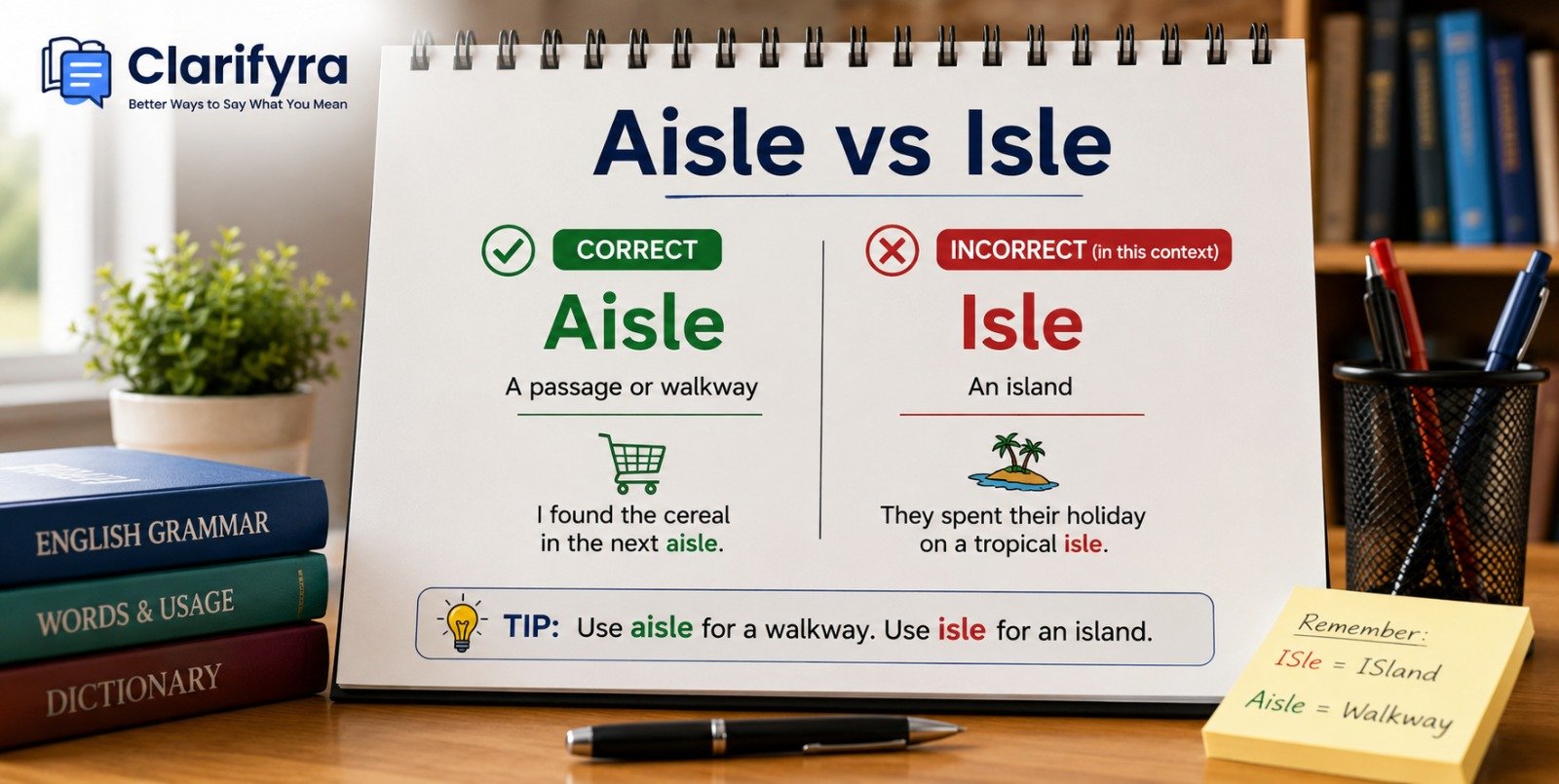
Both aisle and isle are correct. Use aisle for a passage or walkway, such as one in a supermarket, airplane, church, or wedding venue. Use isle for an island, especially a small one.
Aisle vs Isle: What’s the Difference?
The basic aisle vs isle difference is their meaning.
An aisle is an open passage that allows people to move between rows of seats, shelves, displays, or similar objects.
An isle is an island or a piece of land surrounded by water.
Consider these examples:
- We walked down the grocery aisle.
- They spent their holiday on a tropical isle.
Using one in place of the other can completely change the meaning of a sentence.
Quick Comparison
| Feature | Aisle | Isle |
|---|---|---|
| Correct English word? | Yes | Yes |
| Part of speech | Noun | Noun |
| Meaning | A passage or walkway | An island |
| Pronunciation | /aɪl/ | /aɪl/ |
| Common context | Stores, airplanes, churches, weddings | Geography, travel, literature |
| Example | She walked down the aisle. | They sailed toward the isle. |
The most important point in the aisle vs isle definition is that neither word is a misspelling. They simply refer to different things.
You May Also Read | Synch vs Sync: What’s the Difference and Which Is Correct?
What Is Aisle?
Aisle is a noun referring to a passage between rows of seats, shelves, counters, or other objects.
You are likely to encounter aisles in places such as supermarkets, airplanes, theaters, churches, libraries, and auditoriums.
Examples:
- The cereal is in the next aisle.
- Please keep the airplane aisle clear.
- We booked an aisle seat for the flight.
- The guests stood as the bride entered the aisle.
The word can also appear in expressions such as “across the aisle,” particularly when talking about opposing political groups or sides.
What Is Isle?
Isle is also a noun, but it means an island, especially a relatively small one.
It frequently appears in geographical names and in literary or descriptive writing.
Examples:
- They discovered a small isle off the coast.
- A lighthouse stood on the distant isle.
- The family spent the summer on a peaceful tropical isle.
- The Isle of Wight lies off the southern coast of England.
In ordinary conversation, island is often more common than isle, but isle remains a standard English word.
Aisle or Isle in a Store?
When talking about a supermarket, grocery store, department store, or another shop, the correct word is aisle.
Correct: The pasta is in aisle seven.
Correct: She pushed her shopping cart down the aisle.
Incorrect: She pushed her shopping cart down the isle.
A store has aisles because shoppers walk through passages between shelves or displays.
An isle, by contrast, would be a piece of land surrounded by water.
So if you are wondering whether it is aisle or isle in a store, choose aisle.
Aisle or Isle for a Wedding?
The correct word for a wedding is also aisle.
A wedding aisle is the passage between rows of chairs or pews that leads toward the ceremony area.
For example:
Correct: The bride walked down the aisle.
Incorrect: The bride walked down the isle.
The expression “walk down the aisle” is also commonly associated with getting married.
Using isle would create a humorous image of someone walking across an island instead of through a wedding venue.
Aisle vs Isle Pronunciation
One reason these words are easy to confuse is their pronunciation.
Both aisle and isle are commonly pronounced:
/aɪl/
They sound like the word “I’ll” and rhyme with words such as:
- mile
- file
- while
- style
The s is silent in both words.
Because they sound the same but have different meanings and spellings, aisle and isle are homophones.
Aisle vs Isle vs I’ll
The comparison becomes even more confusing when I’ll is included.
Aisle, isle, and I’ll are normally pronounced alike, but each serves a different purpose.
Aisle
Means a passage or walkway.
Example: I found the coffee in the next aisle.
Isle
Means an island.
Example: The boat approached a rocky isle.
I’ll
Is a contraction of I will or, in some contexts, I shall.
Example: I’ll call you after work.
A simple comparison is:
Aisle = passage
Isle = island
I’ll = I will
Pronunciation alone will not tell you which spelling is correct, so you need to look at the sentence’s meaning.
Why Are Aisle and Isle Confused?
The main reason is that they are homophones. They sound identical in normal speech, and their spellings differ by only one letter at the beginning.
Someone who hears a sentence such as:
“Meet me at the end of the aisle.”
must rely on context to know whether the speaker means aisle, isle, or even I’ll in another sentence.
The similarity becomes especially noticeable in phrases such as “walk down the aisle.” Writing isle accidentally produces a grammatically possible word, which means the mistake may not look as obvious as an ordinary spelling error.
Aisle vs Isle Etymology
Although the two words look closely related today, their histories are different.
Aisle developed from earlier words connected with the idea of a wing or side part of a building. Its modern spelling was later influenced by the spelling of isle.
Isle came through French from a Latin word associated with an island.
This helps explain why two words with different meanings ended up looking and sounding so similar.
Their modern similarity does not mean that an aisle is a type of isle or that the words can be used interchangeably.
Aisle vs Isle Examples
Seeing both words in context is one of the easiest ways to learn their correct usage.
Examples With Aisle
- Our seats were near the center aisle.
- An employee was restocking shelves in the next aisle.
- He prefers an aisle seat rather than a window seat.
- Everyone turned toward the aisle when the ceremony began.
- Boxes should not be left blocking the aisle.
Examples With Isle
- The fishermen stopped beside a tiny isle.
- The novel is set on a mysterious isle.
- Palm trees covered much of the tropical isle.
- They could see the isle from the mainland.
- A small community lives on the remote isle.
Side-by-Side Examples
Aisle: We walked down the aisle between the shelves.
Isle: We sailed around the isle before sunset.
Aisle: Her seat was beside the aisle.
Isle: Her hotel was located on a quiet isle.
Why “Aisle vs Isle” Can Become a Meme
An aisle vs isle meme usually works because using the wrong word creates an unintentionally funny mental image.
For instance:
“The bride walked down the isle.”
Because isle means island, the sentence may make someone imagine a bride walking across a tropical island rather than walking through a wedding ceremony.
The humor comes from the fact that both spellings are real words. The sentence may look properly spelled even though the writer selected the wrong homophone.
An Easy Way to Remember the Difference
A simple trick is to connect isle with island.
Both begin with:
IS
Think:
ISle = ISland
If you are talking about land surrounded by water, use isle.
For aisle, remember that it refers to somewhere you can walk:
Aisle = walkway
You can walk through a supermarket aisle, an airplane aisle, or a wedding aisle.
Common Mistakes to Avoid
Using Isle for a Shopping Passage
Incorrect: Meet me in the cereal isle.
Correct: Meet me in the cereal aisle.
A supermarket passage is always an aisle.
Writing “Wedding Isle”
Incorrect: They decorated the wedding isle with flowers.
Correct: They decorated the wedding aisle with flowers.
Unless the wedding is literally taking place on an island, aisle is the word you need.
Confusing Isle With I’ll
Incorrect: Isle call you tomorrow.
Correct: I’ll call you tomorrow.
Here, I’ll means I will.
Assuming One Word Is a Misspelling
Neither word is incorrect. Aisle and isle are separate standard English nouns with different meanings.
Final Verdict: Aisle or Isle?
Use aisle when you mean a walkway or passage between rows of seats, shelves, or other objects. Use isle when you mean an island.
A grocery store has an aisle, a bride walks down an aisle, and a passenger can choose an aisle seat. A small island can be called an isle.
Remembering “isle = island” is usually enough to keep the two words straight.
Frequently Asked Questions
Is aisle or isle correct?
Both are correct English words. Aisle means a walkway or passage, while isle means an island. The correct choice depends on what you are describing.
Do aisle and isle have the same pronunciation?
Yes. Both are normally pronounced /aɪl/, sounding like “I’ll.” This makes them homophones: words with the same pronunciation but different spellings and meanings.
Is it aisle or isle on an airplane?
Use aisle. The passage running between rows of airplane seats is an aisle, and a seat beside that passage is called an aisle seat.
Is isle just another word for island?
Yes. Isle means island and is particularly common in geographical names or more literary descriptions. In everyday speech, island is often more common.
Is it “walk down the aisle” or “walk down the isle”?
Walk down the aisle is correct when referring to a wedding. An aisle is the passage between the rows of seats. An isle is an island.
How can I remember aisle vs isle?
Associate isle with island because both begin with “is.” Then remember that an aisle is a walkway. For more clear explanations of easily confused English words, Clarifyra helps you find better ways to say what you mean.
You May Also Read | Tear vs Tare: What’s the Difference and Which Is Correct?