Another Way to Say “Sounds Good”: 25 Professional, Formal & Casual Alternatives
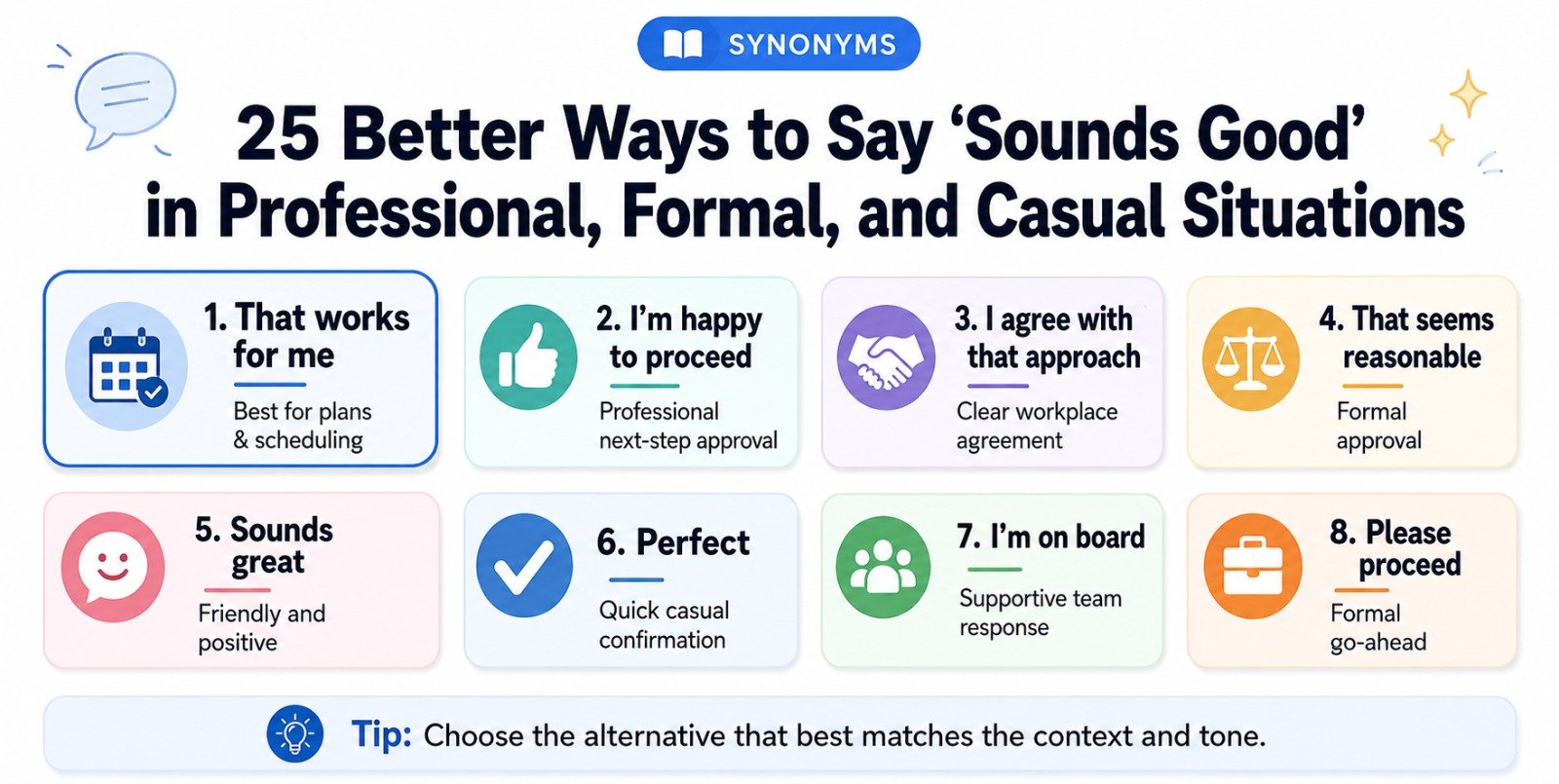
“Sounds good” is one of the easiest ways to show agreement with a plan, suggestion, meeting time, or idea. It works naturally in everyday conversation, but using it repeatedly can make your replies feel vague or repetitive. If you’re looking for another way to say sounds good, options such as “that works for me,” “I’m happy to proceed,” “that sounds great,” and “I agree with that approach” can help you match the tone of the situation more precisely.
Alternatives to “Sounds Good” at a Glance
Not every alternative carries exactly the same meaning. Some confirm that a plan is convenient, while others express approval, enthusiasm, or formal authorization.
| Alternative | Tone | Best Used For |
|---|---|---|
| That works for me | Neutral/Professional | Scheduling and plans |
| Works for me | Casual/Professional | Coworker conversations |
| I’m happy to proceed | Professional | Emails, proposals, projects |
| That sounds great | Friendly | Positive responses |
| I agree with that approach | Professional/Formal | Decisions and strategies |
| That seems reasonable | Formal/Neutral | Proposals and arrangements |
| Perfect | Casual/Friendly | Quick confirmations |
| Absolutely | Positive/Direct | Strong agreement |
| I’m on board | Friendly/Professional | Team plans and ideas |
| Please proceed | Formal | Giving approval |
| That should work | Neutral | Tentative agreement |
| I’m comfortable with that | Professional | Decisions and arrangements |
| Excellent | Positive/Professional | Approval and enthusiasm |
| Let’s do that | Conversational | Plans and next steps |
| Count me in | Casual | Invitations and group plans |
What Does “Sounds Good” Actually Mean?
“Sounds good” usually means that you agree with, approve of, or accept what someone has suggested.
For example:
“Can we meet at 3 p.m. tomorrow?”
“Sounds good.”
Here, the phrase essentially means, “Yes, that time works for me.”
But the meaning changes slightly depending on the conversation. If someone presents an idea, “sounds good” can mean that you approve of it. If someone suggests going somewhere, it may show enthusiasm. In a work email, it may simply confirm that you’re ready to move forward.
That’s why choosing a more specific alternative can sometimes make your response clearer.
Professional Ways to Say “Sounds Good”
In professional communication, clarity matters more than creativity. A good replacement should tell the other person whether you’re agreeing with a time, approving an approach, or confirming the next step.
Other Ways to Say “Sounds Good” Professionally
1. That works for me
This is one of the most natural professional alternatives when confirming a meeting, deadline, or arrangement.
Example:
“Thursday at 10 a.m. works for me. I’ll send the calendar invite.”
2. I’m happy to proceed
Use this when you want to confirm that you’re ready for a project, decision, or agreed next step to move forward.
Example:
“I’ve reviewed the proposal and I’m happy to proceed with the revised plan.”
3. I agree with that approach
This is more specific than “sounds good” because it clearly communicates approval of a method or strategy.
Example:
“I agree with that approach. Let’s prioritize the client feedback first.”
4. That works well
This is useful when the suggested arrangement suits your needs.
Example:
“Sending the report on Friday works well for our schedule.”
5. I’m on board
“I’m on board” is professional enough for many modern workplaces, although it has a friendlier and less formal tone.
Example:
“I’m on board with the new launch schedule.”
Other Ways to Say “Sounds Good” in a Work Email
Email often benefits from slightly more specific wording. Instead of replying with only “sounds good,” you can connect your response to the action being discussed.
Consider:
- “That works for me.”
- “I’m happy to move forward with this.”
- “That plan works well from my side.”
- “I agree with the proposed approach.”
- “I’m comfortable proceeding on that basis.”
- “Thanks for confirming. That timing works for me.”
For example:
“Could we move our meeting to Wednesday morning?”
A stronger email response would be:
“Wednesday morning works for me. Thanks for checking.”
It confirms both your agreement and the exact arrangement, reducing the chance of confusion.
Formal Ways to Say “Sounds Good”
A formal way to say sounds good is useful when communicating with clients, senior professionals, external organizations, or in situations where casual language may feel too relaxed.
Other Ways to Say “Sounds Good” Formally
6. That seems reasonable
This expresses measured approval without sounding overly enthusiastic.
Example:
“The proposed timeline seems reasonable based on the current scope.”
7. That would be acceptable
This is considerably more formal and can sound somewhat reserved. It works best when confirming terms, conditions, arrangements, or requirements.
Example:
“A delivery date of September 15 would be acceptable.”
8. I agree with the proposed plan
This clearly records your agreement and is useful when the decision itself matters.
Example:
“I agree with the proposed plan and support moving to the next stage.”
9. Please proceed
This phrase does more than say something “sounds good.” It gives clear authorization to continue.
Example:
“The final version looks appropriate. Please proceed with publication.”
10. I have no objections to this approach
This is formal and neutral rather than enthusiastic. It is useful when your main purpose is to indicate that you do not oppose a decision.
Example:
“I have no objections to this approach, provided the budget remains unchanged.”
These expressions are not interchangeable. “Please proceed” gives permission, while “that seems reasonable” merely expresses approval. Choosing the right one depends on what you actually want the recipient to understand.
Friendly and Casual Alternatives to “Sounds Good”
With friends, coworkers, family members, or people you know well, shorter and warmer phrases often feel more natural.
Other Ways to Say “Sounds Good” Casually
11. Sounds great
This is a little more enthusiastic than “sounds good.”
Example:
“Dinner at seven sounds great!”
12. Perfect
A short and natural response when you’re completely satisfied with a plan.
Example:
“I’ll pick you up around six.”
“Perfect!”
13. Absolutely
Use this when you want to express strong agreement.
Example:
“Should we order everything today?”
“Absolutely.”
14. Works for me
This is the more relaxed version of “that works for me.”
Example:
“Let’s start at nine tomorrow.”
“Works for me.”
15. Let’s do it
This moves beyond approval and shows that you’re ready to take action.
Example:
“Want to book the tickets tonight?”
“Let’s do it.”
16. I’m in
A casual way to accept an invitation or agree to participate.
Example:
“We’re going hiking Saturday morning.”
“I’m in.”
17. Count me in
This is another enthusiastic choice for joining a plan or activity.
Example:
“We’re putting together a team for trivia night.”
“Count me in!”
Better Alternatives When Confirming a Plan
Sometimes “sounds good” is too general because the other person needs clear confirmation.
Other Ways to Say “Sounds Good” When Making Plans
18. That time works for me
Best when confirming an appointment or meeting.
“Would 2:30 work?”
“That time works for me.”
19. That plan works for me
Use this when agreeing to a proposed sequence of actions.
“Let’s finish the draft today and review it tomorrow.”
“That plan works for me.”
20. I can make that work
This suggests that the arrangement may require some adjustment on your part, but you can accommodate it.
“Could you join us at eight instead?”
“I can make that work.”
21. That should work
This is slightly less definite than “that works for me.” It can imply that you expect the plan to be fine, although there is still a small amount of uncertainty.
“Can you have the file ready by Monday?”
“That should work.”
If you need to give a firm commitment, “that works for me” is usually clearer.
Alternatives That Show Enthusiasm
Sometimes you don’t simply agree—you genuinely like the idea.
Other Ways to Say “Sounds Good” When You’re Excited
22. That sounds excellent
A positive choice that can work in both friendly and professional settings.
Example:
“Your team can handle the launch while we manage promotion.”
“That sounds excellent.”
23. I love that idea
Use this when responding positively to an idea rather than confirming logistics.
Example:
“What if we include customer examples in the presentation?”
“I love that idea.”
24. That sounds like a great plan
This combines agreement with enthusiasm.
Example:
“Let’s finish early and grab lunch afterward.”
“That sounds like a great plan.”
25. I’m all for it
This expresses strong support but is more conversational than formal.
Example:
“We could simplify the process instead of adding another approval step.”
“I’m all for it.”
“Sounds Good” vs. Similar Expressions
Small wording changes can communicate noticeably different intentions.
“That works for me” focuses on practicality. You’re saying the suggested arrangement suits you.
“Sounds great” shows more enthusiasm than simple agreement.
“I agree” is direct and works especially well when discussing opinions or decisions.
“Please proceed” is not just agreement; it instructs or authorizes someone to continue.
“That seems reasonable” communicates cautious approval rather than excitement.
“I’m on board” indicates support for an idea or plan, particularly in a team environment.
These distinctions matter because saying “sounds good” when you actually mean “I formally approve this” can sometimes leave the next step unclear.
How to Say “Sounds Good” Professionally to Different People
The best wording may also depend on who you’re speaking to.
To a Coworker
A relaxed professional phrase usually works well:
“That works for me.”
“Perfect, I’ll take care of my part.”
“I’m on board with that.”
To a Manager
Aim for clarity while keeping the tone natural:
“I agree with that approach.”
“That timeline works for me.”
“I’m happy to move forward with those priorities.”
To a Client
Client communication benefits from wording that confirms exactly what has been agreed.
“Thank you for confirming. That schedule works well for us.”
“We’re happy to proceed with the proposed timeline.”
“That approach sounds appropriate. We’ll move ahead accordingly.”
When Approving Someone’s Work
If approval itself is important, avoid a vague response.
Instead of:
“Sounds good.”
Try:
“The revised version looks good to me. Please proceed.”
That makes it clear that you have reviewed the work and are authorizing the next step.
Is “Sounds Good” Professional?
Yes, “sounds good” can be professional, especially in everyday communication with coworkers, familiar clients, or team members.
For example:
“Let’s meet at 11 tomorrow.”
“Sounds good. See you then.”
There is nothing inappropriate about that exchange.
However, the phrase can feel too casual or vague when you’re:
- formally approving a proposal
- accepting important terms
- communicating with an unfamiliar client
- documenting a decision
- authorizing someone to proceed
- responding in a particularly formal setting
In those situations, wording such as “I agree with the proposed approach,” “that works for me,” or “please proceed” makes your intention clearer.
How to Choose the Best Alternative
Start by thinking about what you actually mean.
If you’re confirming a meeting, say:
“That works for me.”
If you’re approving an idea, say:
“I agree with that approach.”
If you’re giving authorization, say:
“Please proceed.”
If you’re showing enthusiasm, say:
“That sounds great.”
If you’re accepting a casual invitation, say:
“Count me in.”
If you’re agreeing while remaining formal, say:
“That seems reasonable.”
The best alternative isn’t necessarily the fanciest phrase. It’s the one that makes your response clear while fitting the relationship and setting.
Frequently Asked Questions
What’s Another Way to Say “Sounds Good”?
Natural alternatives include “that works for me,” “sounds great,” “perfect,” “I agree,” “I’m on board,” and “that sounds like a good plan.” The right choice depends on whether you’re confirming, approving, or expressing enthusiasm.
What Is a Professional Way to Say “Sounds Good”?
“That works for me” is one of the safest professional choices. Other options include “I’m happy to proceed,” “I agree with that approach,” and “that works well from my side.”
What Is Another Way to Say “Sounds Good” Professionally in an Email?
You can write “That works for me,” “I’m happy to move forward,” or “I agree with the proposed plan.” If you’re confirming a schedule, mention the specific time or date for greater clarity.
What Is a Formal Way to Say “Sounds Good”?
Formal options include “that seems reasonable,” “that would be acceptable,” “I agree with the proposed approach,” and “please proceed.” Remember that “please proceed” also gives permission to take action.
Can I Say “Sounds Good” to My Boss?
Yes. “Sounds good” is normal in many workplaces, particularly where communication is relaxed. For important decisions or more formal exchanges, “that works for me” or “I agree with that approach” may sound more precise.
Is “Sounds Great” More Professional Than “Sounds Good”?
Not necessarily. “Sounds great” is more enthusiastic, but both expressions are conversational. For formal professional communication, a specific response such as “that schedule works for me” is often clearer.
What Can I Say Instead of “Sounds Good” in a Meeting?
Try “I agree,” “that makes sense,” “I support that approach,” “that works for me,” or “I’m on board.” Choose according to whether you’re agreeing with an opinion, strategy, or practical arrangement.
Conclusion
There’s no single replacement for “sounds good” that works in every conversation. “That works for me” is ideal for arrangements, “I’m happy to proceed” fits professional next steps, “sounds great” adds enthusiasm, and “please proceed” provides clear authorization.
Pay attention to what you’re agreeing to, who you’re speaking with, and how formal the conversation needs to be. Clarifyra makes these subtle wording choices easier to understand, helping you choose expressions that communicate exactly the level of agreement, approval, or enthusiasm you intend.
You May Also Read | 30 Other Ways to Say “Good Luck in Your Future Endeavors” Naturally