Cycle Meaning: Definition, Uses, and Examples
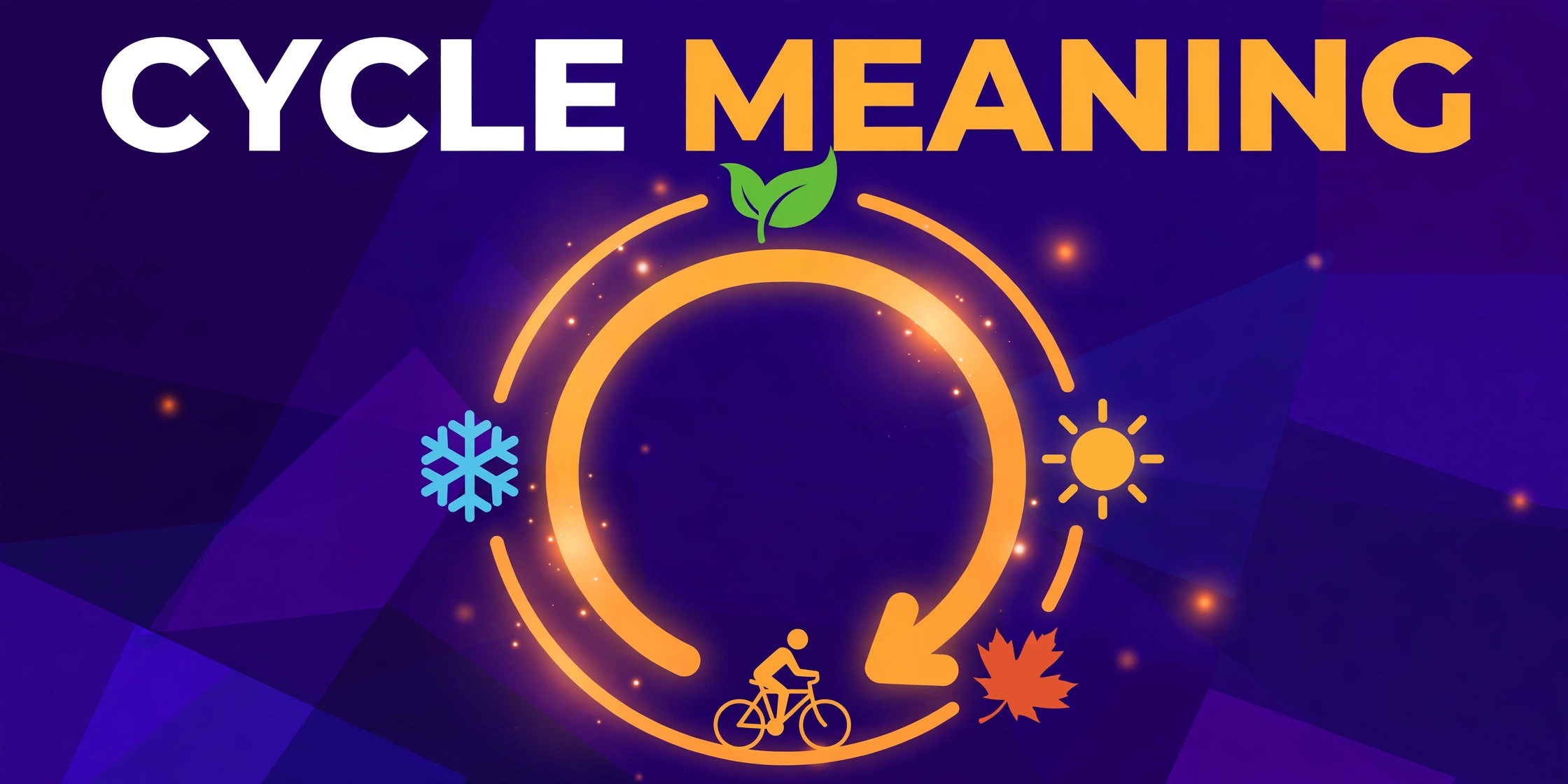
Seasons turn, washing machines hum through their rinse cycle, and economists warn about the business cycle. One small word covers all three, and it also names the bicycle you ride to work. Cycle is one of the busiest words in English: a noun and a verb, a piece of everyday vocabulary and a technical term, and a word whose senses all trace back to a single image, the circle.
This article explains what cycle means, how the dictionaries define it, how to pronounce it, and how its senses fit together, from the cycle of the seasons to the rinse cycle, the life cycle, and the verb meaning to ride a bicycle.
Quick Answer: Cycle is a noun meaning a series of events that happen repeatedly in the same order, a complete set of movements in a machine, or, in British English, a bicycle. As a verb it means to ride a bicycle or to pass through a repeating series. Pronounced /ˈsaɪkl/ in both British and American English, it comes from Greek kyklos, meaning circle.
What Does “Cycle” Mean?
Oxford Advanced Learner’s Dictionary gives three main noun senses. The first, in British English, is a bicycle or motorcycle: “We went for a cycle ride on Sunday.” The second is the sense most people reach for first: “the fact of a series of events being repeated many times, always in the same order”, as in “the cycle of the seasons”. The third is “a complete set or series, for example of movements in a machine”, as in “the rinse cycle”.
Cambridge gives the same picture in slightly different words. Its series sense is “a group of events that happen in a particular order, one following the other, and are often repeated”, again with “the life cycle of a moth” as the example. It adds a literary sense: a group of plays, poems, or songs “written by one person and connected with each other by dealing with the same characters or ideas”.
Merriam-Webster, which has the longest entry of the three, starts with “an interval of time during which a sequence of a recurring succession of events or phenomena is completed”, with the example “a 4-year cycle of growth and development”. It then lists a course of events “that recur regularly and usually lead back to the starting point”, a group of creative works on the same theme, a series of narratives such as the Arthurian cycle, and, in baseball, the series of a single, double, triple, and home run hit by one player in one game.
What holds all of these together is the idea of return. A cycle is not just a list of events; it is a list that comes back to where it started and can begin again. That is the difference between a cycle and a sequence. A sequence runs once, from beginning to end. A cycle runs, returns, and repeats, which is why the word so often appears with verbs such as go through, complete, and break.
How to Pronounce “Cycle”
The pronunciation is the same on both sides of the Atlantic. Oxford gives /ˈsaɪkl/ for British and American English alike, and Cambridge gives UK /ˈsaɪ.kəl/ and US /ˈsaɪ.kəl/. Say it as “SY-kul”, rhyming the first syllable with my and sky, with the stress on the first syllable.
The spelling is the part that catches people out. The word begins with a c pronounced /s/, not /k/, and the y in the middle is pronounced as the vowel /aɪ/. The ending -cle is the unstressed syllable /kəl/, the same ending as in bicycle and article. The most common misspelling is “cicle”, which drops the y.
| Variety | Pronunciation | Stress |
|---|---|---|
| British English | /ˈsaɪkl/ | First syllable: SY-kul |
| American English | /ˈsaɪkl/ | First syllable: SY-kul |
The word is old in English. Merriam-Webster dates the noun to the fourteenth century, and Oxford traces it to late Middle English, from Old French, from late Latin cyclus, from Greek kyklos, meaning circle or wheel. That Greek root is also behind cyclone and bicycle, itself a compound of bi-, two, and cycle.
The Noun: Repeating Series, Machines, and Bicycles
The repeating-series sense is the most important, and it is the one that generates the most phrases. A life cycle is the series of changes a living thing goes through, from birth to reproduction to death. A business cycle is the repeating pattern of expansion and contraction in an economy.
The machine sense is a smaller version of the same idea. A washing machine’s rinse cycle is one complete run through a set of movements, and the machine then starts the next one. An engine’s cycle is one complete set of movements of its parts.
The bicycle sense is the most concrete of all, and the most regionally marked. In British English, cycle is a standard, slightly formal word for a bicycle, and also for a motorcycle: “a cycle ride”, “a cycle lane”, “a cycle helmet”. In American English, the word is understood but rarely used in this sense; Americans say bike. If you write “cycle” meaning a bicycle for an American audience, it will be understood, but it will sound British.
The Verb: To Cycle
As a verb, cycle has two main senses, dividing neatly along the same lines as the noun. The first is to pass through a cycle, or to recur in cycles: “The menu cycles through all the options”, “Temperatures cycle between freezing and thaw”. The second is to ride a bicycle: “She cycles to work”, “Most of the kids cycle or walk to school”. Cambridge labels the bicycle verb B1 and mainly UK, and the same regional note applies: Americans are more likely to say “bike to work” than “cycle to work”.
The verb is regular: cycles, cycled, cycling. Merriam-Webster dates the verb to 1842, five centuries after the noun, which makes sense: the verb meaning “to pass through a cycle” could only appear once the noun was established, and the bicycle sense had to wait for the bicycle itself.
The phrasal verb cycle through is worth learning whole. It means to go through a series of things in turn, returning to the start when the series is complete: a television cycles through its channels, a playlist cycles through its songs.
Cycle in Real Sentences
- “The cycle of the seasons shapes everything on the farm.”
- “They could not break the cycle of harvest failure, food shortage, price increase and misery.” (Oxford American Dictionary.)
- “She cycles to work every day.” (Merriam-Webster’s example.)
- “The washing machine was stuck on the rinse cycle.”
- “Breaking the cycle of poverty was the charity’s stated aim.”
Notice the verbs that travel with the noun: go through a cycle, complete a cycle, break a cycle, repeat a cycle. A vicious cycle is a repeating pattern in which each problem makes the next one worse, while a virtuous cycle is the opposite: a pattern in which each good result makes the next one more likely.
Cycle vs Circle, Round, and Period
Several words sit close to cycle, and the differences are about shape, time, and repetition.
| Word | Core meaning | Difference from cycle |
|---|---|---|
| Cycle | A series of events that repeats in the same order | The reference point: repetition in time |
| Circle | A round shape, or a group of people | A shape or a group, not a repeating series |
| Round | One complete turn, or one stage of a contest | One occurrence, not a repeating pattern |
| Period | A length of time | A stretch of time, without the idea of return |
| Phase | One stage in a process | A single stage, not the whole repeating series |
Circle is the word for the shape and for a group of people, and it is the word to use when there is no repetition: a circle of friends, a circle drawn on paper. Round names one complete turn or one stage, as in a round of golf, but it does not imply that the turn will repeat. Period names a length of time without saying anything about what happens inside it.
The related adjectives are also worth sorting out. Cyclical means happening in cycles, and it is the standard word in economics and general writing: “cyclical unemployment”. Cyclic means the same thing in most contexts, but it is more common in chemistry and mathematics. For ordinary writing, cyclical is the safe choice.
Common Mistakes With “Cycle”
The most frequent mistake is using cycle for any repetition, when the dictionaries require the events to repeat in the same order. A series of random events is not a cycle, however often it happens. The seasons are a cycle because spring always follows winter; a run of bad luck is not a cycle unless the same misfortunes keep recurring in the same sequence.
A second mistake is confusing cycle with circle. The two are related by history, since both come from the Greek word for a round shape, but they are not interchangeable in modern English. You ride a cycle, you draw a circle, and you go through a cycle, not a circle, of events. The standard idiom is “vicious cycle”, not “vicious circle”.
A third mistake is the bicycle sense in the wrong variety of English. Using cycle for a bicycle is natural in British English and will be understood in American English, but an American reader will expect bike, and the verb cycle for riding is marked mainly UK by Cambridge. In international writing, bike is the safer choice for the vehicle.
A fourth mistake is spelling the verb forms. The verb is cycle, the third person singular is cycles, the past tense is cycled, and the -ing form is cycling, with the e dropped before -ing. The form “cycleing” is a common error, and so is “cyling”, which drops the e from the stem as well.
Frequently Asked Questions
What is the difference between a cycle and a circle?
A circle is a round shape, or a group of people. A cycle is a series of events that repeats in the same order over time. The two share a Greek root, kyklos, meaning circle, but they are not interchangeable.
What does “life cycle” mean?
The series of changes a living thing goes through, from birth or germination, through growth and reproduction, to death. Cambridge’s example is “the life cycle of a moth”.
What does “hit for the cycle” mean in baseball?
It means one player hits a single, a double, a triple, and a home run in the same game, in any order. Merriam-Webster lists it as a noun sense.
What is the difference between “cyclical” and “cyclic”?
Both mean happening in cycles. Cyclical is the standard word in general and economic writing, while cyclic is more common in chemistry and mathematics. For ordinary writing, use cyclical.
The Takeaway
Cycle is a noun and a verb built on a single image: the circle that returns to where it started. As a noun it names a repeating series of events, a complete set of machine movements, or, in British English, a bicycle. As a verb it means to pass through such a series or to ride a bicycle. Pronounced /ˈsaɪkl/ in both varieties, it is one of the most useful words in English, so keep the idea of return at the centre of it.
Sources: Oxford Advanced Learner’s Dictionary (cycle, /ˈsaɪkl/, word origin late Middle English from Greek kuklos ‘circle’); Cambridge Dictionary (cycle, B2 noun and B1 verb, UK and US /ˈsaɪ.kəl/); Merriam-Webster (cycle, noun 14th century, verb 1842).