Provenance Meaning: What It Means and How to Use It
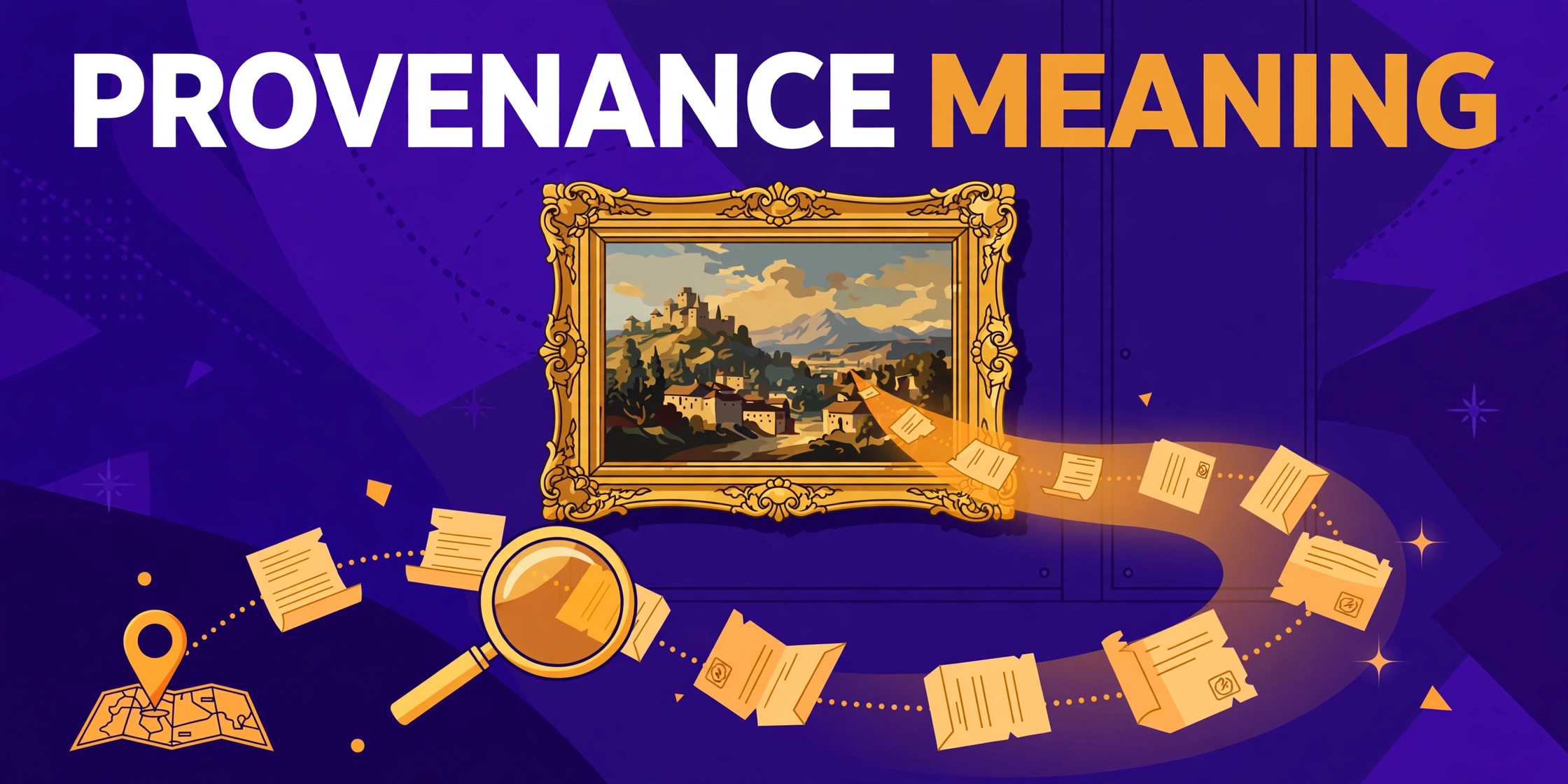
A painting sells for millions, and the first question a buyer asks is not about the paint. It is about the paper trail: who owned it, where it has been, and whether that chain of ownership can be proved. That paper trail has a single-word name, and it is provenance.
This article explains what provenance means, how the dictionaries define it, how to pronounce it in British and American English, and where the word belongs, from museum catalogues and auction houses to archaeology and computing.
Quick Answer: Provenance is a formal noun meaning the place something originally came from, or the history of ownership of a valued object, especially a work of art. Pronounced UK /ˈprɒvənəns/ and US /ˈprɑːvənəns/, it is used of paintings, antiques, manuscripts, and artefacts, where a documented provenance proves authenticity and affects value.
What Does “Provenance” Mean?
Oxford Advanced Learner’s Dictionary defines provenance as “the place that something originally came from”, gives origin as its synonym, and labels it specialist, uncountable or countable. Its two example sentences show both halves of the meaning: “All the furniture is of English provenance” uses the place-of-origin sense, while “There’s no proof about the provenance of the painting (= whether it is genuine or not)” uses the ownership-history sense, where provenance is evidence of authenticity.
Merriam-Webster splits the meaning into two numbered senses. Sense 1 is “origin, source”. Sense 2 is “the history of ownership of a valued object or work of art or literature”. Its examples are the standard ones: “Has anyone traced the provenances of these paintings?” and “The artifact is of unknown provenance.” Collins agrees, defining it as “the place that it comes from or that it originally came from”, and the Britannica Dictionary calls it formal and defines it as “the origin or source of something”.
The two senses are really one idea seen from two angles. The place of origin is where the story starts, and the history of ownership is the story itself: who made it, who bought it, who inherited it, and where it was kept. For an ordinary object, only the first half matters. For a painting or a manuscript, the second half is what gives the word its work to do, because a complete chain of ownership is the best evidence that the object is genuine and lawfully held.
How to Pronounce “Provenance”
British and American pronunciations differ in the first vowel, so this is one of the words where the two varieties genuinely part company. In British English, Oxford gives /ˈprɒvənəns/, with the short o sound of lot and hot: “PROV-uh-nuhnss”. In American English, Oxford gives /ˈprɑːvənəns/, with the broader ah sound of father: “PRAH-vuh-nuhnss”. The American dictionary also records a second American form, /ˈprɑvəˌnɑns/, with a secondary stress on the last syllable.
The stress is always on the first syllable, in both varieties, and the word has three syllables: prov-e-nance. The most common error is to stress the second syllable, “prov-EN-ance”, which no dictionary records.
| Variety | Pronunciation | First vowel |
|---|---|---|
| British English | /ˈprɒvənəns/ | Short o, as in “lot” |
| American English | /ˈprɑːvənəns/ | Broad ah, as in “father” |
| American English (also heard) | /ˈprɑvəˌnɑns/ | Secondary stress on the last syllable |
Spelling is straightforward once the pronunciation is settled: p-r-o-v-e-n-a-n-c-e. The tricky letters are the single v after pro, which tempts writers to double it, and the -ance ending, sometimes misspelled -ence. The plural is regular: provenances, as in Merriam-Webster’s example, “Has anyone traced the provenances of these paintings?”
Provenance in Real Sentences
The word appears most often with of, in the pattern “the provenance of” something.
- “All the furniture is of English provenance.” (Oxford’s example sentence.)
- “There’s no proof about the provenance of the painting.” (Oxford’s example sentence.)
- “Has anyone traced the provenances of these paintings?” (Merriam-Webster’s example sentence.)
- “The museum refused to buy the sculpture because its provenance could not be documented before 1945.”
- “A clear provenance can double the value of an antique; a gap in the record can halve it.”
- “Provenance research is now a standard part of preparing any major auction catalogue.”
Two phrases are worth learning whole. The first is “of unknown provenance”, the standard formula for an object whose history cannot be traced, and a quiet warning to any buyer. The second is “to establish the provenance of” something, the phrase curators use for tracing ownership through documents and sale records.
Why Provenance Matters: Art, Antiques, and Authenticity
Provenance matters because it answers three questions that money depends on. Is the object genuine? Was it obtained lawfully? And does the seller actually own it? A painting with a complete provenance is far easier to sell, insure, and exhibit than the same painting with a gap in its record, because every gap is a place where a forgery, a theft, or a disputed claim could hide.
The clearest example is the period 1933 to 1945. Provenance research on paintings that changed hands in Europe during those years can determine whether a work was looted or sold under pressure, and museums now put considerable effort into researching works in their collections with no firm record for that period. A documented provenance can resolve an ownership dispute; an undocumented one can keep it open for decades.
Value follows the paper trail. A good provenance increases the value of a painting, and establishing it may help confirm the date, the artist, and, for portraits, the subject. What matters is not the length of the record but its continuity: a chain with no missing links, supported by bills of sale, exhibition catalogues, photographs, and inscriptions on the back of the frame.
The word has also spread beyond art. In archaeology, the related term provenience is used for the precise place where an artefact was found, while provenance covers its complete documented history. In computing, data provenance means the record of where a piece of data came from and how it was produced, serving the same purpose as the art-world sense: proving that something is what it claims to be.
Provenance vs Origin, Source, Pedigree, and History
Several words overlap with provenance, and the choice between them depends on what you are describing and how formal you want to sound.
| Word | Core meaning | When to use it |
|---|---|---|
| Provenance | Place of origin, or the documented history of ownership | Art, antiques, manuscripts, artefacts; formal and specialist |
| Origin | Where something began or came from | General use; the everyday word for the same idea |
| Source | Where something was obtained | General use; often used for information and materials |
| Pedigree | Recorded ancestry or background | Animals, families, and, by extension, objects with a notable line |
| History | What happened to something over time | General use; broader and less precise than provenance |
Origin is the word to use in ordinary writing. Oxford lists it as the synonym of provenance, and for most sentences it says everything needed: “the origin of the custom”, “the origin of the word”. Provenance earns its place only when the documented chain of ownership is part of the point, which is why it belongs to art, antiques, and archives. Using it for everyday things sounds pretentious: nobody needs “the provenance of my sandwich” when “where my sandwich came from” will do.
Source is the better word when the question is where something was obtained rather than where it began: the source of a quotation, the source of a river, the source of a rumour. Pedigree overlaps with provenance when the emphasis is on a distinguished line, and it is the standard word for animals, but it sounds odd applied to a painting.
Word Forms and Grammar
Provenance is a noun only. There is no verb “to provenance” and no adjective in general use, although the noun is often used attributively, directly before another noun: “provenance research”, “provenance documents”, “provenance gaps”. This is the normal pattern for specialist nouns in English, and it is how curators and auction houses use the word most often.
It is countable when it refers to a particular history and uncountable when it refers to the idea in general. “The provenance of the painting is unclear” treats it as one history; “Has anyone traced the provenances of these paintings?” counts them one by one.
The word entered English in the late eighteenth century, with Merriam-Webster recording its first known use in 1785. Oxford gives the same date: “late 18th cent.: from French, from the verb provenir ‘come or stem from’, from Latin provenire, from pro- ‘forth’ + venire ‘come’.” The French verb provenir still means “to come from”, and the Latin roots are the same ones behind the English words convene and intervene.
Common Mistakes With “Provenance”
The most common mistake is using the word where origin would do. Provenance is labelled specialist by Oxford and formal by Britannica, and those labels are instructions, not decoration. In everyday writing about where things come from, origin is the natural word, and provenance will sound as if it has wandered in from an auction catalogue.
A second mistake is confusing provenance with provenience. In archaeology and palaeontology, provenience means the precise location where an object was found, while provenance means its complete documented history. Outside those fields, provenience is rare, so the distinction matters mainly in specialist writing.
A third mistake is pronunciation. Stress the first syllable, and remember that the British first vowel is the short o of lot while the American first vowel is the broad ah of father. Stressing the second syllable is the error most often heard, and it marks the speaker out immediately in a museum or an auction room.
A fourth mistake is treating provenance as a guarantee. A documented provenance is strong evidence that an object is genuine and lawfully held, but it is evidence, not proof in itself. Documents can be forged, and a chain of ownership can contain an error.
Frequently Asked Questions
What does provenance mean in simple terms?
It means where something came from, and, for a valuable object, the recorded history of who owned it. For a painting, the provenance is the chain of owners from the artist’s studio to the present day.
Is provenance the same as origin?
Nearly, but not quite. Origin is the general word for where something began. Provenance is the formal, specialist word, and it usually adds the idea of a documented history of ownership, which origin does not.
What is the plural of provenance?
Provenances. Merriam-Webster’s example sentence uses it: “Has anyone traced the provenances of these paintings?”
What is the difference between provenance and provenience?
In archaeology, provenience is the precise place where an artefact was found, while provenance is the object’s complete documented history. An artefact can have both. Outside archaeology, provenience is rarely used.
Why do auction houses care about provenance?
Because a complete, documented provenance supports authenticity, shows the work was obtained lawfully, and confirms the seller’s right to sell. It also affects value: a good provenance increases a painting’s price, and a gap in the record lowers it.
The Takeaway
Provenance is a formal noun for where something came from and, for valuable objects, the documented history of who owned it. Pronounced /ˈprɒvənəns/ in British English and /ˈprɑːvənəns/ in American English, it belongs to art, antiques, archives, and archaeology, where a complete provenance proves authenticity and protects value. Everywhere else, the plain word origin will usually serve better.
Sources: Oxford Advanced Learner’s Dictionary (provenance, specialist, UK /ˈprɒvənəns/, US /ˈprɑːvənəns/, word origin late 18th century from French provenir, from Latin provenire); Merriam-Webster (provenance, senses 1–2, first known use 1785); Collins English Dictionary (provenance, variable noun; provenience); Britannica Dictionary (provenance, formal).