Sleave or Sleeve: Which Is Correct?
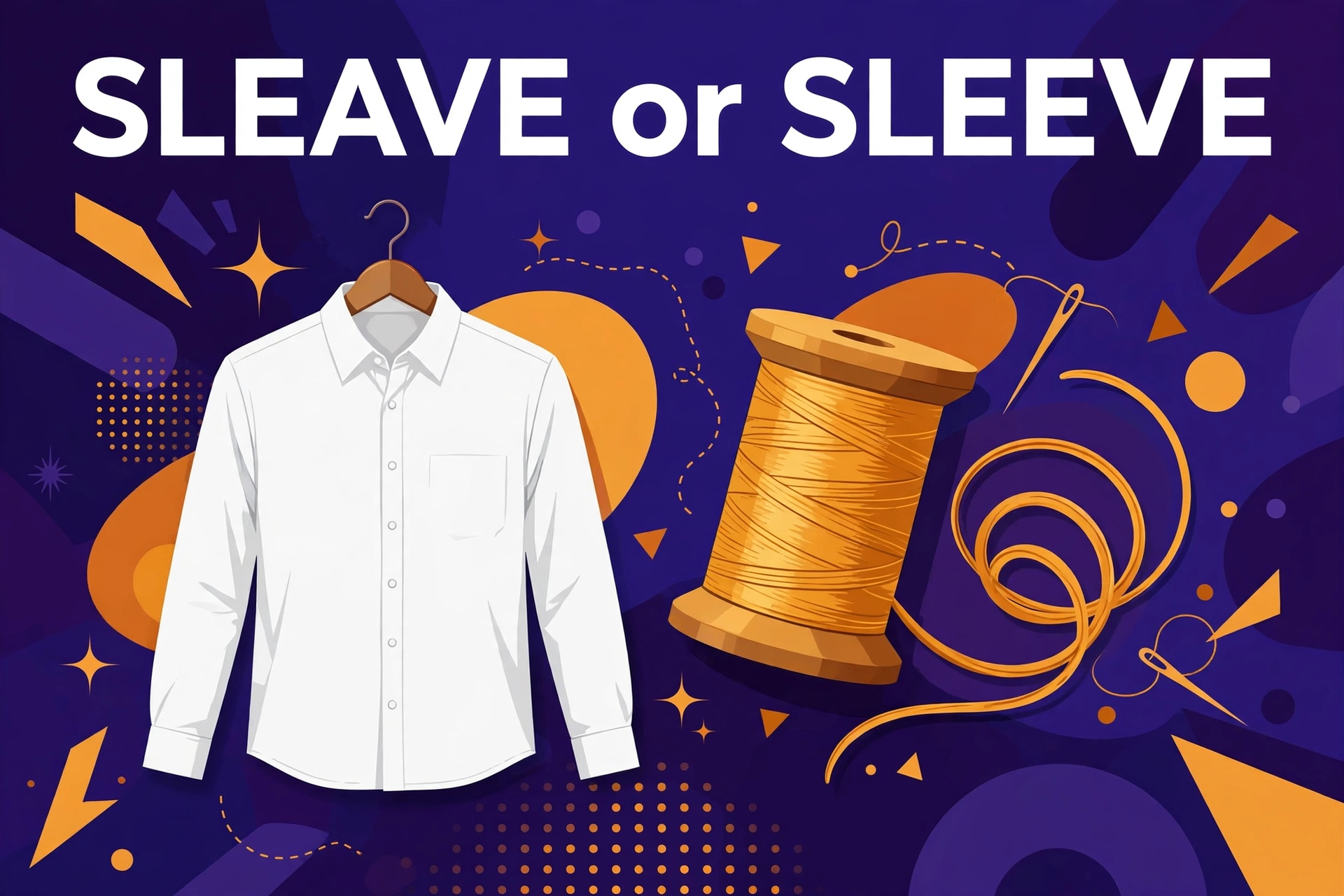
Sleeve is the correct spelling for the part of a garment that covers the arm. Sleave is not a spelling of that word: it is a different, very old word, meaning untwisted silk thread, that has not been in ordinary use for centuries. If you are writing about a shirt, a jacket, a dress, or a tattoo, the word is sleeve, spelled s-l-e-e-v-e. The confusion is easy to understand — the two words sound identical, and English spells the long “ee” sound in several different ways — but the dictionaries are clear. For clothing, there is only one spelling, and it has two es in the middle.
Quick Answer: Use sleeve for the part of a garment that covers the arm — “long sleeves,” “a sleeveless dress,” “roll up your sleeves.” Sleave is a rare, obsolete word for untwisted silk thread, recorded in older dictionaries and in Shakespeare, but it is not a spelling of the clothing word and it is not listed as a headword in the modern Cambridge, Oxford Learner’s, or Merriam-Webster dictionaries. The two are homophones, both pronounced /sliːv/.
What the Dictionaries Say
Merriam-Webster defines sleeve as a noun with several senses. The first, and the one everyone knows, is “a part of a garment covering an arm”: “a shirt with long sleeves.” The second is a tubular part designed to fit over another part, such as a hollow axle or a bushing: “The joint is covered with a metal sleeve.” The third is an open-ended flat or tubular packaging or cover — the sense behind “a record sleeve.” And the fourth, the newest, is a collection of tattoos, or one large tattoo, that covers the arm or leg: “a sleeve of tattoos on one arm.” The dictionary gives the first known use as before the twelfth century, which makes sleeve one of the oldest clothing words in English.
Cambridge Dictionary gives the same core definition — “the part of a piece of clothing that covers the arm” — and records the pronunciation as /sliːv/ in both British and American English. Oxford Learner’s Dictionaries agrees, and adds the related forms: sleeved as an adjective (“long-sleeved”), and sleeveless as an adjective for a garment with no sleeves at all. The word is a straightforward noun, and its plural is sleeves, formed by adding -s to the singular.
Sleave has no headword in the modern Cambridge, Oxford Learner’s, or Merriam-Webster dictionaries. What it has is an entry in older and historical sources. Webster’s Revised Unabridged Dictionary of 1913 defines it as a noun meaning “the knotted or entangled part of silk or thread” and “silk not yet twisted; floss,” and as a verb, in weaving, meaning “to separate, as threads; to divide, as a collection of threads.” Wiktionary records the same senses, and adds the most famous use of the word in English literature: Shakespeare’s Macbeth, where sleep “knits up the ravell’d sleave of care.” The word is real, but it belongs to the history of textiles, not to modern English. Nobody buys a shirt with sleaves.
Sleeve: The Garment, the Tube, and the Tattoo
The clothing sense of sleeve is the one that matters, and it covers more than shirts. Sleeves come in lengths — short, long, three-quarter — and in shapes: cap sleeves that barely cover the shoulder, bell sleeves that flare at the wrist, raglan sleeves that extend in one piece to the collar, bishop sleeves that gather into a cuff. The word is used for any garment with an arm covering: a shirt sleeve, a jacket sleeve, a dress sleeve, a coat sleeve. The plural is sleeves, and the common collocations are worth learning: “long sleeves,” “short sleeves,” “a sleeveless top,” “to roll up one’s sleeves,” “to wear one’s heart on one’s sleeve.”
Sleave: Silk Thread, and a Line in Macbeth
Sleave deserves a fair hearing, because it is a real word, and the article would be dishonest if it called it a non-word. In the textile trade of the seventeenth and eighteenth centuries, sleave — also spelled sleave silk — meant silk in its raw, unspun state: fine, untwisted thread, or floss, before it was twisted into yarn. As a verb it meant to separate or untangle threads, the work a weaver does before spinning. The word appears in the 1913 Webster’s dictionary with both senses, and in Wiktionary with the same definitions and the same Shakespeare quotation.
The quotation is the reason the word survives at all. In Macbeth, Macbeth calls sleep “the death of each day’s life, sore labour’s bath, balm of hurt minds, great nature’s second course, chief nourisher in life’s feast,” and then says that sleep “knits up the ravell’d sleave of care.” The image is of tangled silk thread — the “ravell’d sleave,” the knotted, tangled cares of the day — being knitted up, smoothed out, by sleep. It is a beautiful line, and it is the only place most readers will ever meet the word. It is also a reminder of how the word worked: a sleave is something tangled that needs to be separated and smoothed, and sleep does the smoothing.
Pronunciation: Identical, in Both Varieties of English
Sleeve is pronounced /sliːv/ in British English and /sliːv/ in American English: a single syllable, rhyming with leave, weave, grieve, and believe. There is no difference between the two varieties of English, and there is no difference between sleeve and sleave: the two words are exact homophones. The ea in sleave and the ee in sleeve represent the same long vowel sound, which is the whole reason the mistake happens.
English spells the long “ee” sound in several ways — ee in keep, ea in leave, e in me, ie in believe — and a writer who has heard the word more often than they have seen it written has to guess which spelling applies. The guess that produces sleave is a reasonable one: leave, weave, and cleave all use ea, so why shouldn’t sleeve? The answer is that spelling is a matter of convention, not logic, and the convention for this word is ee. The memory aid that works best is the simplest one: the word is s-l-e-e-v-e, with two es together in the middle, like the two arms of a shirt. If you can picture the word, you can spell it.
Correct vs Incorrect
| Incorrect | Correct | Why |
|---|---|---|
| The shirt has long sleaves. | The shirt has long sleeves. | The plural of sleeve is sleeves, not sleaves. |
| She rolled up her sleaves. | She rolled up her sleeves. | The clothing word is always spelled sleeve. |
| A sleaveless dress. | A sleeveless dress. | Sleeveless is built on sleeve, with two es. |
| He wears his heart on his sleave. | He wears his heart on his sleeve. | The idiom uses the clothing word, sleeve. |
| The record was back in its sleave. | The record was back in its sleeve. | A record cover is a sleeve, from the same tube-shaped sense. |
| Sleep knits up the ravell’d sleeve of care. | Sleep knits up the ravell’d sleave of care. | Shakespeare’s line uses sleave, the silk-thread word — the one place it is correct. |
Common Mistakes to Avoid
1. Writing “sleave” for a garment part
This is the central mistake, and it is usually a sound-based guess. The writer hears /sliːv/ and writes the ea spelling they know from leave and weave. The fix is to learn the word as a picture: s-l-e-e-v-e, two es in the middle. It helps to learn it alongside the words it rhymes with that share the spelling — sleeve and grieve and believe all use ee or ie, not ea — and to remember that the plural is sleeves, which is a word you will have seen written many times on clothing labels.
2. Writing “sleaves” as the plural
The plural error follows from the singular one, and it is worth calling out separately because it appears in online shops and listings, where it looks unprofessional. The plural of sleeve is sleeves: add -s to the singular, and the e stays. “Sleaves” is not a word in modern English, and a listing that says “long sleaves” will be read as a spelling error by every customer who notices it.
3. Calling “sleave” a non-word
The opposite error is to overcorrect. Sleave is a real word, recorded in historical dictionaries and in Shakespeare, and telling a reader that it “does not exist” would be wrong — the same kind of categorical error that has caused trouble in earlier articles in this series. The accurate statement is narrower: sleave is not a spelling of the clothing word, it is not used in modern English, and it is not listed in the modern learner’s dictionaries. It exists, but it does different work, and it belongs to a different century.
4. Confusing “sleeve” with “sleave” in the idioms
The idioms — “wear your heart on your sleeve,” “have something up your sleeve,” “roll up your sleeves” — all use the clothing word, and all of them are spelled with sleeve. The mistake is easy to make precisely because the idioms are so familiar in speech and so rarely written down. If you are writing one of them, picture the garment: a heart worn on a shirt sleeve, a card hidden up a magician’s sleeve, sleeves rolled up for work. The picture gives you the spelling.
Frequently Asked Questions
Is “sleave” a correct spelling?
Not for clothing. Sleave is a real but obsolete word for untwisted silk thread, recorded in Webster’s 1913 dictionary and in Wiktionary, and used by Shakespeare in Macbeth. It is not listed as a headword in the modern Cambridge, Oxford Learner’s, or Merriam-Webster dictionaries, and it is never the correct spelling for the part of a garment that covers the arm. For that meaning, the only correct spelling is sleeve.
What is the plural of “sleeve”?
Sleeves. Add -s to the singular: “long sleeves,” “short sleeves,” “the sleeves of my coat.” The spelling sleaves is a misspelling, and it is one of the most common errors with this word, appearing frequently in online listings and product descriptions.
Is there a difference between British and American spelling?
No. Sleeve is spelled the same way in British and American English, and it is pronounced the same way in both varieties: /sliːv/. There is no regional variation to learn, and no American or British alternative to choose between. The word is the same on both sides of the Atlantic.
The Takeaway
Sleeve is the word for the part of a garment that covers the arm, and for the tube-shaped covers and tattoo work that take their name from it — spelled s-l-e-e-v-e, with two es in the middle, and pronounced /sliːv/. Sleave is a different, much older word, meaning untwisted silk thread, that survives in historical dictionaries and in a single line of Shakespeare, and nowhere else in modern English. The two sound identical, which is why they are confused, but they do different jobs in different centuries. When you are writing about clothing, the answer is always sleeve. Learn the word as a picture — two es, like two arms — and the spelling will stay with you.
Sources: Cambridge Dictionary (sleeve); Oxford Learner’s Dictionaries (sleeve); Merriam-Webster (sleeve; sleeves); Collins English Dictionary (sleeve); Wiktionary (sleave; sleeve); Webster’s Revised Unabridged Dictionary, 1913 (sleave); Shakespeare, Macbeth, Act 2, Scene 2.