Bitting or Biting: What’s the Difference?
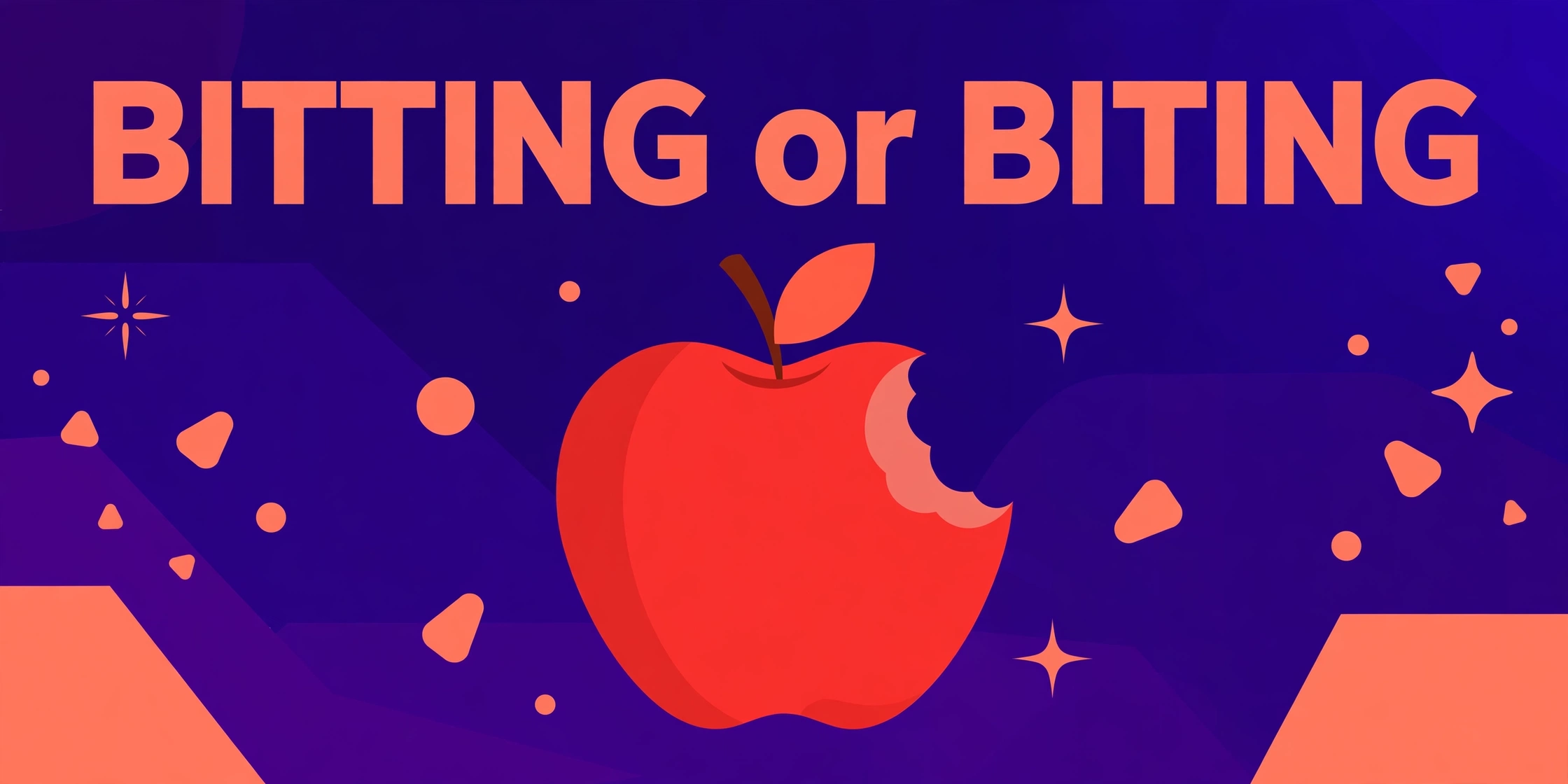
Bitting or biting? If you mean using your teeth, the answer is always biting — with one t. Bitting, with two t’s, is a real word, but it means something else entirely: fitting a horse with a bit, the metal mouthpiece of a bridle. The two words come from two different verbs, bite and bit, and the spelling rule that separates them is one of the most useful rules in English spelling. Learn it once, and this pair stops causing trouble.
Quick Answer
Biting is the present participle of bite (bite / bit / bitten): using your teeth to cut or grip something — “the dog is biting the rope”, “a biting wind”, “biting criticism”. Bitting is the present participle of bit (to fit a horse with a bit) — “bitting a young horse takes patience”. If your sentence is about teeth, write biting with one t. Bite has a long vowel, so its final t is never doubled.
What Does Biting Mean?
Biting is the -ing form of the verb bite, and it covers everything teeth do: cutting into food, gripping, nipping, stinging, and wounding. Cambridge gives the verb as “to use your teeth to cut into something or someone” (“He bit into the apple”), and the past forms as bit and bitten. The full family is bite / bit / bitten / biting, and it is irregular — the past tense is bit, not bited, and the past participle is bitten, not bit, in standard British English. (American English also accepts bit as a past participle in informal use, as in “I’ve been bit before”, but bitten is the standard form.)
- “The puppy is biting everything in the house.”
- “The fish aren’t biting today.”
- “Stop biting your nails.”
Biting is also an adjective in its own right, with two senses that Cambridge lists separately. The first is about cold: a biting wind is one that feels painfully cold, as if it were nipping at your skin. The second is about criticism: biting remarks are sharply critical words, accurate enough to sting. Both senses grow out of the literal meaning — cold and criticism both “bite” — and both are standard, formal English.
- “A biting wind blew in from the north.”
- “Her biting review of the play made the front page.”
What Does Bitting Mean?
Bitting is the -ing form of the verb bit — not bite, but the separate verb bit, meaning to put a bit into a horse’s mouth. A bit is the metal mouthpiece of a bridle, the part the reins attach to, and bitting a horse means fitting it with one, usually for the first time, as part of breaking it in and teaching it to respond to the reins.
- “Bitting a young horse is the most difficult part of taming it.”
- “The trainer spent the morning bitting the new mare.”
Bitting is a technical word. You will meet it in books about horses, in stable yards, and in veterinary writing, and almost nowhere else. It also has a nautical cousin: the verb bitt, meaning to secure a rope or cable around a bitt — a post on a ship’s deck — gives the same -ing form, bitting. Both senses are real, both are rare, and neither has anything to do with teeth.
That rarity is worth remembering, because it explains the shape of the confusion. Most people who write “bitting” do not mean the horse word at all. They mean biting, and they have doubled the t by mistake. The horse sense is the reason a spellchecker may not flag “bitting” — it is a real word, so the spellchecker leaves it alone — and the sentence sails on with the wrong word in it.
Bitting vs Biting at a Glance
| Word | From the verb | Meaning | How common |
|---|---|---|---|
| biting | bite (bite / bit / bitten) | Using teeth to cut or grip; bitingly cold; sharply critical | Very common, everyday English |
| bitting | bit (to fit a horse with a bit); also bitt (nautical) | Fitting a horse with a bit; securing a cable around a bitt | Rare, technical — horses and ships |
The Spelling Rule That Decides It
The reason bite becomes biting with one t is the doubling rule, and it is worth learning properly, because it settles dozens of words at once. When you add -ing (or -ed, -er, -est) to a verb, you double the final consonant only when the verb ends in a single consonant after a single short vowel in a stressed syllable. Sit becomes sitting, run becomes running, stop becomes stopping — short vowel, single consonant, double it.
Bite fails the test twice over. First, the vowel is long: bite is pronounced /baɪt/, with the diphthong /aɪ/, not the short /ɪ/ of bit. Second, the verb ends in a silent e, which is dropped before -ing rather than doubled. Drop the e, add -ing, and you get biting — one t, always. The same rule gives writing from write, hiding from hide, and liking from like.
Bit, the horse verb, passes the test. It is pronounced /bɪt/: a single short vowel /ɪ/ followed by a single consonant t in a stressed syllable. So the t doubles: bit becomes bitting, just as sit becomes sitting and hit becomes hitting. The double t is not decoration. It is the spelling telling you the vowel is short. That is the whole job of a doubled consonant in English: it marks the vowel before it as short.
| Verb | Vowel | Rule | -ing form |
|---|---|---|---|
| bite /baɪt/ | Long /aɪ/, silent e | Drop the e, do not double | biting |
| bit /bɪt/ | Short /ɪ/ | Double the t | bitting |
| sit /sɪt/ | Short /ɪ/ | Double the t | sitting |
| write /raɪt/ | Long /aɪ/, silent e | Drop the e, do not double | writing |
What the Dictionaries Say
Cambridge lists biting as an adjective with the two senses above — cold and critical — and gives the pronunciation as UK /ˈbaɪ.tɪŋ/ and US /ˈbaɪ.t̬ɪŋ/. Its entry for bite gives the verb senses, the past tense bit, and the past participle bitten. Merriam-Webster gives the same principal parts: bite / bit / bitten / biting.
Bitting does not appear as a headword in the general dictionaries, because it is a regular inflection of the technical verb bit rather than a word in its own right — the same way sitting is not a headword separate from sit. Its existence is confirmed by the verb’s entry and by specialist usage, and it is the form you will find in books on horsemanship. The important point for a writer is the asymmetry: biting is the everyday word you will use a hundred times, and bitting is the rare word you will use only when a horse is involved.
Pronunciation underlines the difference. Biting is /ˈbaɪ.tɪŋ/, with the long /aɪ/ of bite. Bitting is /ˈbɪt.ɪŋ/, with the short /ɪ/ of bit. Say them aloud and the vowel tells you which word you have: a long vowel means one t, a short vowel means two.
Correct vs Incorrect
| Correct | Incorrect | Why |
|---|---|---|
| “The dog is biting the rope.” | “The dog is bitting the rope.” | Teeth means bite, and bite + -ing is biting. |
| “A biting wind cut across the moor.” | “A bitting wind cut across the moor.” | The adjective is biting, from bite. |
| “Bitting the young horse took all morning.” | “Biting the young horse took all morning.” | Fitting a bit is bitting, from bit — and nobody should be biting the horse. |
| “Her biting comments stung.” | “Her bitting comments stung.” | Sharp criticism is biting. |
| “The fish aren’t biting today.” | “The fish aren’t bitting today.” | The idiom uses biting, from bite. |
Common Mistakes
The main mistake is doubling the t in biting. It is an easy error to make, because the doubling rule feels as though it should apply: bit doubles, sit doubles, hit doubles — so why not bite? The answer is the vowel. Doubling happens after a short vowel, and bite has a long one. If you can hear the difference between /baɪt/ and /bɪt/, you can spell the difference too.
A second mistake is the reverse: writing biting when a horse is being fitted with a bit. It is a rare error, because few people write about bitting horses, but it is a revealing one — it shows the writer does not know the horse word exists, and has guessed the spelling from bite.
A third mistake is confusing the past forms. The past tense of bite is bit (“the dog bit me”), and the past participle is bitten (“I have been bitten”). Writing “I have been bit” is accepted informally in American English, but bitten is the standard past participle in British English and in formal writing everywhere. And bitting is never a past form of bite — it is a present participle of a different verb.
Frequently Asked Questions
Is it bitting or biting?
If you mean using teeth, it is biting with one t — the -ing form of bite. Bitting with two t’s is a different word, the -ing form of bit, meaning to fit a horse with a bit.
Is bitting a real word?
Yes, but it is a technical one. Bitting is the present participle of the verb bit (to put a bit in a horse’s mouth), and also of the nautical verb bitt. Outside horse and ship contexts, you almost certainly mean biting.
Why is it biting and not bitting?
Because of the doubling rule. You double a final consonant before -ing only after a single short vowel. Bite has a long vowel /aɪ/ and a silent e, so the e is dropped and the t is not doubled: biting. Bit has a short vowel /ɪ/, so its t doubles: bitting.
What is the past tense of bite?
The past tense is bit (“she bit the apple”), and the past participle is bitten (“she has bitten the apple”). The full pattern is bite / bit / bitten / biting.
What does “a biting wind” mean?
It means a wind that feels painfully cold, as if it were nipping at your skin. Biting is used as an adjective here, and the same adjective describes sharply critical remarks: “biting criticism”.
Takeaway
Biting is the word for teeth, cold, and sharp criticism — the -ing form of bite, spelled with one t because bite has a long vowel and a silent e. Bitting is the word for fitting a horse with a bit — the -ing form of bit, spelled with two t’s because bit has a short vowel. The vowel is the whole story: long vowel, one t; short vowel, two. Hear the vowel, and the spelling follows.
Sources: Cambridge Dictionary, “biting” — dictionary.cambridge.org/dictionary/english/biting; Cambridge Dictionary, “bite” — dictionary.cambridge.org/dictionary/english/bite.