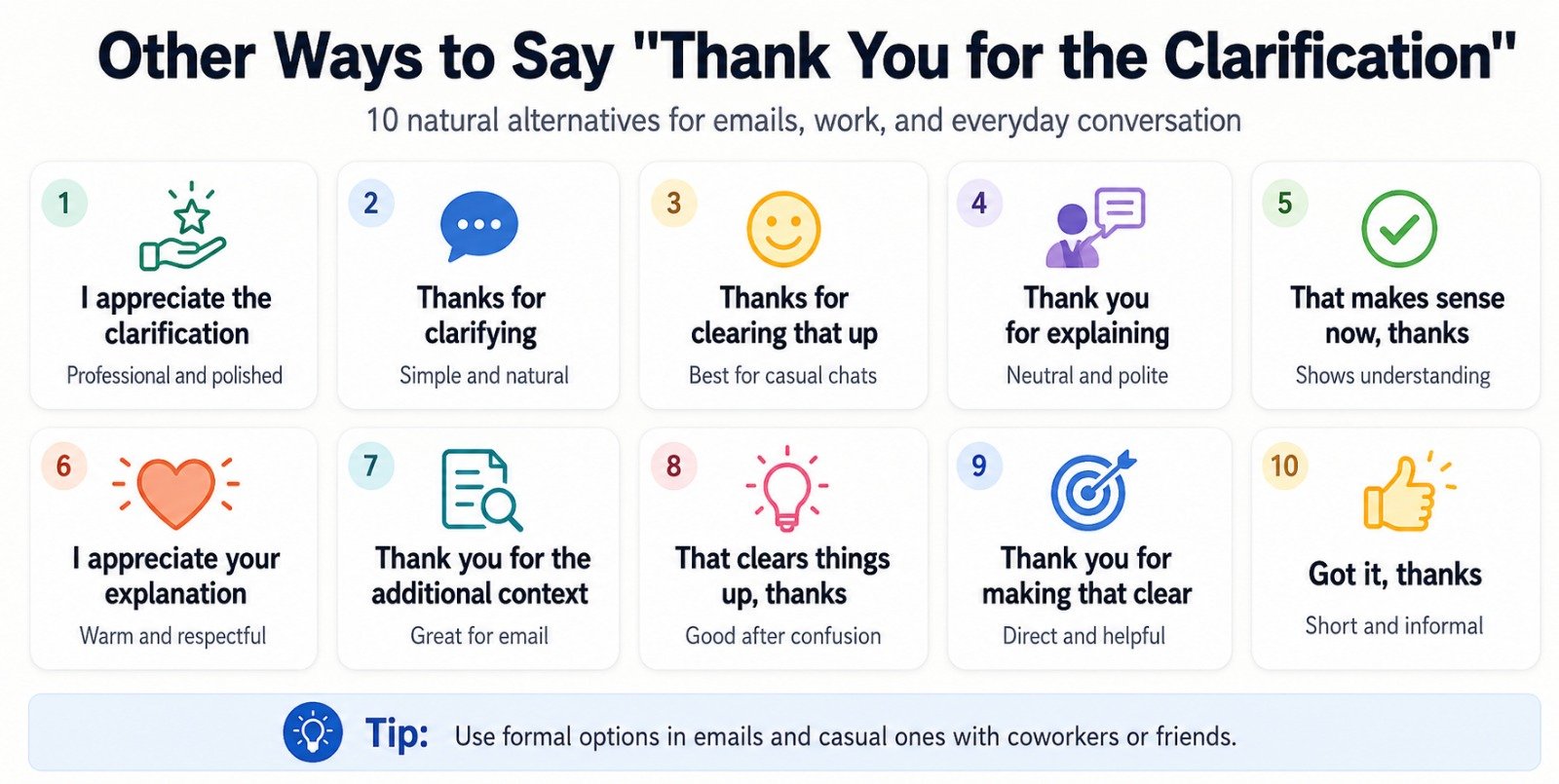
25 Other Ways to Say “Thank You for the Clarification” Professionally
When someone takes the time to explain a confusing point, correct a misunderstanding, or add missing details, “Thank you for the clarification” is a polite and natural response. It works especially well in emails, workplace conversations, academic discussions, and customer communication. Still, repeating the same phrase can make your writing sound mechanical.
Fortunately, there are plenty of other ways to say “Thank you for the clarification”, ranging from polished professional expressions to relaxed phrases such as “Thanks for clearing that up.” The best choice depends on who you’re speaking to, how formal the situation is, and whether you want to emphasize appreciation, understanding, or relief.
What Does “Thank You for the Clarification” Mean?
The thank you for the clarification meaning is straightforward: you are showing appreciation because someone has made information clearer. Perhaps an instruction was ambiguous, a deadline needed explaining, or you misunderstood part of an earlier message. The expression acknowledges that the additional explanation helped.
For example, if a manager explains which version of a document needs to be submitted, you might reply, “Thank you for the clarification. I’ll send the revised version this afternoon.” In this context, the phrase does more than say thanks; it confirms that you now understand what is expected.
Quick Comparison of Useful Alternatives
Not every alternative has exactly the same tone. Some emphasize gratitude, while others emphasize that the confusion has been resolved.
| Alternative | Tone | Best Used For |
|---|---|---|
| I appreciate the clarification | Professional | Emails, clients, managers |
| Thanks for clarifying | Neutral and friendly | Everyday work conversations |
| Thanks for clearing that up | Casual | Coworkers, friends |
| Thank you for explaining | Polite and neutral | General communication |
| I appreciate you explaining that | Warm and professional | Helpful detailed explanations |
| That makes sense now, thank you | Friendly | Confirming understanding |
| Thank you for the additional context | Professional | Meetings and email threads |
| I appreciate the additional information | Formal | Business correspondence |
| Thanks for elaborating | Neutral | Detailed discussions |
| Thank you for making that clear | Polite | Resolving uncertainty |
| I understand now, thank you | Direct | Spoken or written communication |
| That clears things up, thanks | Casual | Coworkers and informal messages |
Choosing among these expressions depends on what you want to acknowledge. “Thank you for the additional context,” for instance, suits a situation where new background information was provided, while “That clears things up” specifically signals that previous confusion has been resolved.
Professional Other Ways to Say “Thank You for the Clarification”
Professional communication benefits from wording that is polite without sounding overly stiff. These alternatives are useful when writing to managers, clients, customers, teachers, or colleagues.
They can also help you avoid repeating “Thank you for the clarification” throughout a long email exchange while maintaining an appropriate professional tone.
I Appreciate the Clarification
“I appreciate the clarification” is one of the closest alternatives. It sounds professional, concise, and sincere without being overly formal.
Example: “I appreciate the clarification regarding the revised deadline.”
Thank You for Explaining
This version works especially well when someone has taken time to explain a process, decision, requirement, or difficult idea.
Example: “Thank you for explaining how the approval process works.”
I Appreciate You Explaining That
This expression feels slightly warmer because it recognizes the other person’s effort rather than focusing only on the explanation itself.
Example: “I appreciate you explaining that. I understand the next steps now.”
Thank You for the Additional Context
Use this when the other person has supplied background information rather than simply corrected a misunderstanding.
Example: “Thank you for the additional context. That helps me understand why the schedule changed.”
I Appreciate the Additional Information
This is particularly useful in formal business correspondence when someone has provided missing details.
Example: “I appreciate the additional information regarding the contract terms.”
Thank You for Making That Clear
This is polite and direct. It tells the other person that their explanation successfully removed uncertainty.
Example: “Thank you for making that clear. I’ll follow the updated procedure from now on.”
Thank You for the Detailed Explanation
Use this when the person has provided more than a quick clarification and has taken time to explain something thoroughly.
Example: “Thank you for the detailed explanation of how the new system works.”
I Appreciate Your Guidance
This alternative is appropriate when the clarification also includes advice or direction. It is not a perfect substitute when someone has merely explained a fact.
Example: “I appreciate your guidance on how to handle the client’s request.”
Friendly Other Ways to Say “Thanks for Clarifying”
Not every conversation requires polished corporate language. With familiar coworkers, classmates, friends, or teammates, shorter expressions often sound more natural.
These versions of “thanks for clarifying” keep the appreciation while creating a warmer, more conversational tone.
Thanks for Clarifying
This is the simplest shortened version and sounds natural in both spoken English and workplace messages.
Example: “Thanks for clarifying. I wasn’t sure which file you meant.”
Thanks for Clearing That Up
Use this when there was genuine confusion and the person has resolved it.
Example: “Thanks for clearing that up. I thought the meeting had been moved to Friday.”
That Makes Sense Now, Thanks
This expression directly confirms that you understand the explanation.
Example: “That makes sense now, thanks. I can see why we need to complete that step first.”
Got It, Thanks
“Got it, thanks” is concise and informal. It works well in quick chats but may feel too casual in highly formal correspondence.
Example: “Got it, thanks. I’ll use the updated spreadsheet.”
That Clears Things Up, Thanks
This is particularly useful after resolving a misunderstanding or ambiguous instruction.
Example: “That clears things up, thanks. I was reading the instructions differently.”
Thanks for Explaining
Friendly and versatile, this phrase can be used when someone gives you a straightforward explanation.
Example: “Thanks for explaining. I didn’t realize the two options worked differently.”
I Get It Now, Thanks
This is clearly conversational and suits friends, classmates, or coworkers you know well.
Example: “I get it now, thanks. I was looking at the wrong column.”
Polite Other Ways to Say “Thank You for the Clarification”
Sometimes you want something warmer than a brief “thanks” without becoming overly formal. Polite alternatives are especially useful when the person has made an extra effort to help you understand.
The following expressions acknowledge both the information and the time someone spent providing it.
I’m Grateful for the Clarification
This sounds more appreciative than the standard phrase and suits situations where the clarification was genuinely helpful.
Example: “I’m grateful for the clarification, especially regarding the final submission requirements.”
Thank You for Taking the Time to Explain
This recognizes the other person’s effort and is appropriate when their explanation required time or detail.
Example: “Thank you for taking the time to explain the changes to me.”
I Appreciate You Clearing That Up
This combines a professional sense of appreciation with the more conversational phrase “clearing that up.”
Example: “I appreciate you clearing that up before we moved ahead with the order.”
Your Explanation Was Very Helpful
Instead of merely thanking someone, this tells them what effect their explanation had.
Example: “Your explanation was very helpful. I have a much clearer understanding of the process now.”
That Was Helpful, Thank You
This is simple, warm, and appropriate in many everyday professional situations.
Example: “That was helpful, thank you. I know what I need to change now.”
Thank You for Walking Me Through It
This works when someone explains a process step by step. It is less suitable when the clarification consisted of only one short factual answer.
Example: “Thank you for walking me through it. The setup process makes much more sense now.”
Other Ways to Say “Thank You for the Clarification” in an Email
Email wording should match your relationship with the recipient. A message to a client or senior manager generally benefits from “I appreciate the clarification” or “Thank you for the additional information,” while an internal email to a familiar colleague can comfortably use “Thanks for clarifying.”
You can also continue the sentence by confirming what you will do next. For example: “Thank you for the clarification. I’ll proceed with the revised figures.” This is useful because it shows not only appreciation but also that you understood the information and are ready to act on it.
I Appreciate the Clarification Regarding This
This version is useful when referring to one particular issue in a longer email conversation.
Example: “I appreciate the clarification regarding this. I’ll update the document accordingly.”
Thank You for Confirming
This works when the person has verified a detail rather than explained something complicated. Because of that difference, it is not always interchangeable with “Thank you for the clarification.”
Example: “Thank you for confirming that the meeting will begin at 10 a.m.”
Thank You for Providing More Detail
Use this when someone expands on information that was previously incomplete.
Example: “Thank you for providing more detail about the reporting requirements.”
I Appreciate the Clear Explanation
This is a slightly more personal way to acknowledge that an explanation was easy to understand.
Example: “I appreciate the clear explanation. I now understand how the figures were calculated.”
“Thank You for Clarification” or “Thank You for the Clarification”?
“Thank you for the clarification” is grammatically correct and usually sounds more natural when referring to a specific explanation someone has just provided. The article “the” points to that particular clarification: “Thank you for the clarification regarding the invoice.”
“Thank you for clarification” can appear in English, but it often sounds less natural when used as a standalone response. In normal conversation and email, “Thank you for the clarification” or simply “Thank you for clarifying” is generally smoother.
Is “Thanks for Clarifying” Correct and Polite?
Yes. “Thanks for clarifying” is grammatically correct and widely used. It is less formal than “Thank you for the clarification,” but it is still suitable for most everyday workplace communication.
The verb “clarifying” also makes the sentence feel more direct because you are thanking the person for the action they performed. For a formal client message, you may prefer “Thank you for clarifying” or “I appreciate the clarification,” while “Thanks for clarifying” works naturally with coworkers.
Can You Say “Thank You for the Clarification, Much Appreciated”?
People will understand “Thank you for the clarification, much appreciated,” but it can sound slightly compressed. More natural alternatives are “Thank you for the clarification. It’s much appreciated,” “I really appreciate the clarification,” or “The clarification is much appreciated.”
“Much appreciated” works particularly well as a concise acknowledgment, but it does not always replace the full phrase by itself. Saying only “Much appreciated” expresses gratitude without explicitly telling the reader that their clarification resolved your uncertainty.
Not Every Alternative Means Exactly the Same Thing
A good thank you for the clarification synonym should be selected according to what actually happened. “Thank you for confirming” means that someone verified information, while “Thank you for explaining” suggests they helped you understand something. “Thank you for the additional context” indicates that they supplied background information.
Similarly, “I appreciate your guidance” suggests advice or direction, and “Thanks for walking me through it” implies a more detailed, step-by-step explanation. These phrases overlap with “Thank you for the clarification,” but treating them as exact synonyms in every situation could subtly change your meaning.
“Good wording does more than sound polite; it tells the other person exactly what you appreciated.”
How to Choose the Right Expression
For formal emails, choose concise phrases such as “I appreciate the clarification,” “Thank you for the additional information,” or “Thank you for explaining.” They sound respectful without adding unnecessary emotion.
With familiar coworkers or friends, “Thanks for clarifying,” “That clears things up, thanks,” and “Got it, thanks” usually sound more natural. When someone has gone out of their way to help you, choose a warmer expression such as “Thank you for taking the time to explain.”
Frequently Asked Questions
Small differences in wording can change how professional, warm, or conversational your response feels. The answers below address some common questions that arise when choosing other ways to say “Thank you for the clarification.”
The key is to match your response to what the other person actually did. A clarification, confirmation, explanation, and piece of advice are related, but they are not always the same thing.
What Does “Thank You for the Clarification” Mean?
It means you appreciate someone providing information that made something easier to understand. It commonly follows an explanation, correction, or response that removes uncertainty.
What Is Another Way to Say “Thank You for the Clarification”?
A close professional alternative is “I appreciate the clarification.” You can also say “Thank you for explaining,” “Thanks for clarifying,” or “Thank you for making that clear,” depending on your desired tone.
Is “Thank You for the Clarification” Grammatically Correct?
Yes. A thank you for the clarification grammar check confirms that the sentence is natural and grammatically correct. “The clarification” refers to a particular explanation that has already been provided.
Is “Thanks for Clarifying” Professional?
Yes, in most workplaces. “Thanks for clarifying” is friendly and concise, making it appropriate for coworkers and routine business communication. For more formal correspondence, “Thank you for clarifying” sounds slightly more polished.
What Is a Formal Synonym for “Thank You for the Clarification”?
“I appreciate the clarification” is one of the strongest formal alternatives. “Thank you for the additional information” and “I appreciate your explanation” are also appropriate when they accurately describe what the person provided.
How Do You Thank Someone for Clarifying an Email?
You can write, “Thank you for clarifying. I understand the requirements now,” or “I appreciate the clarification. I’ll proceed accordingly.” Adding your next action confirms that you understood the message.
Can I Say “Much Appreciated” After a Clarification?
Yes. “Much appreciated” works well as a concise expression of gratitude. For smoother wording, try “The clarification is much appreciated” or “Thanks for clarifying. Much appreciated.”
Conclusion
There is nothing wrong with “Thank you for the clarification.” It remains one of the safest and most professional expressions when someone has helped resolve uncertainty. The best alternative depends on the situation: choose “I appreciate the clarification” for polished communication, “Thanks for clarifying” for everyday conversations, and a warmer phrase such as “Thank you for taking the time to explain” when someone has made an extra effort.
Small wording choices can make your response sound more natural and accurately reflect what you appreciated. Clarifyra focuses on those distinctions so you can choose language that matches your audience, relationship, and level of formality instead of relying on a one-size-fits-all synonym.
You May Also Read | Other Ways to Say “Thank You for Confirming” With Examples