Grill or Grille: Which Is Correct?
Grill or Grille: Which Is Correct?
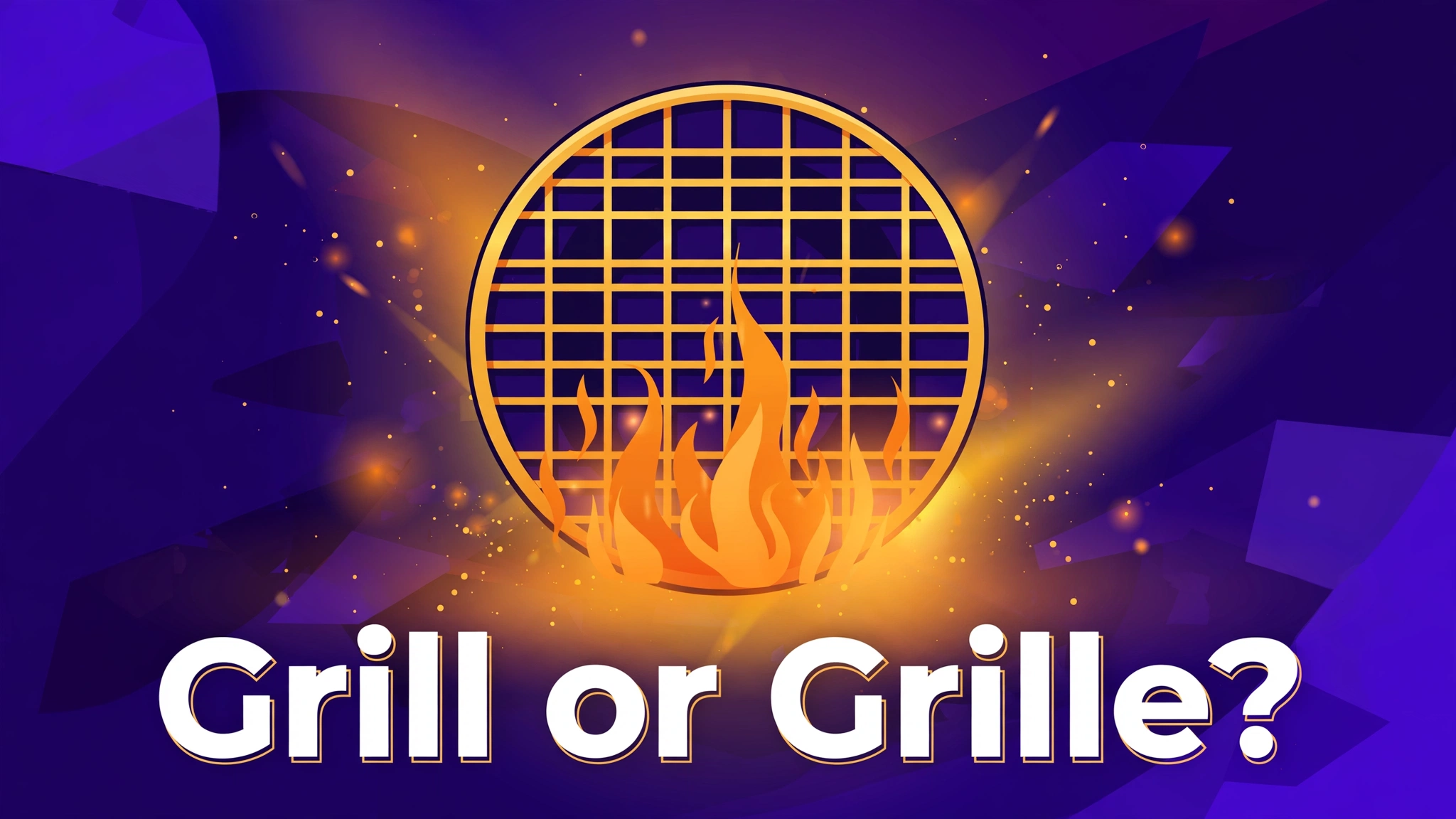
It depends on what you mean. Grill is the cooking device — and the verb meaning to cook over heat or to question intensely. Grille is a decorative or protective grating of metal bars, such as the front of a car or a window screen. They are pronounced identically (/ɡrɪl/) but are different words with different jobs.
Quick Answer: Use grill for the cooking device and for the verb (to barbecue, to interrogate). Use grille for a metal grating or screen — a car’s radiator grille, a window grille, a speaker grille. Collins defines a grille as “a framework of metal bars or wire which is placed in front of a window or a piece of machinery,” and American Heritage warns: not to be confused with grill — gridiron, barbecue, interrogate. Both are pronounced /ɡrɪl/.
What Does Each Word Mean?
Grill
Grill does the heavy lifting in everyday English. As a noun, it is the cooking apparatus: the metal grate you barbecue on, the restaurant device that sears steaks, or the food cooked on one (“a mixed grill”). As a verb, it has two senses: to cook over direct heat (“grill the peppers for five minutes”) and, informally, to question someone relentlessly (“The committee grilled the witness for hours”). American Heritage’s usage note sums it up neatly: grill means “gridiron; barbecue; interrogate.”
Grille
Grille is narrower and more specialized. Collins defines it as “a framework of metal bars or wire which is placed in front of a window or a piece of machinery, in order to protect it or to protect people.” Its typical homes are:
- Cars: the radiator grille — the slatted opening at the front that admits cooling air
- Buildings: decorative iron grilles over windows and doorways
- Electronics: the perforated screen covering a loudspeaker
- Service counters: the grated window at a ticket office or bank
Dictionary.com adds the same range: “a grating or openwork barrier, as for a gate, usually of metal and often of decorative design,” plus the car, speaker, and ticket-window senses.
Note the overlap: Collins lists grille as “also grill,” meaning the grating sense can occasionally be spelled grill — “radiator grill” is widely seen in American car writing. The reverse never holds, though: grille is never the cooking device and never the verb. When in doubt about the grating, grille is the more precise spelling.
Why Two Spellings? A Short History
Both words descend from the same Latin root, craticula — a gridiron, literally “little hurdle.” French split the inheritance: gril (masculine) kept the cooking sense, while grille (feminine) took the grating sense, a distinction that dates to about the 16th century. English borrowed both, at different times and for different purposes, and kept the French spelling distinction along with the meaning distinction. The word entered English in the mid-1600s (recorded 1655–65) with its grating sense intact.
So grille is not simply “the French spelling of grill” — in English they are two separate words that happen to share an ancestor, like cousins who kept the family name in different forms.
Pronunciation
Both are pronounced /ɡrɪl/ — a single syllable rhyming with drill and still. Collins gives (ɡrɪl) for grille, and Dictionary.com gives [gril] /grɪl/. No listener can distinguish them; only the spelling (and the context) tells them apart. Do not confuse grille with grillé (pronounced /griːˈjeɪ/), the French-derived adjective meaning “cooked on a grill” — that one has an accent and a different stress.
Examples in Sentences
- He fired up the grill for the barbecue. (cooking device)
- The restaurant installed a new grille over the serving hatch. (metal screen)
- She grilled the vegetables until they were charred. (verb: to cook)
- The journalists grilled the minister about the scandal. (verb: to interrogate)
- Chrome gleamed on the car’s front grille. (radiator grille)
- Voices came through the speaker grille, thin and metallic. (perforated cover)
- The bank teller spoke through the security grille. (grated window)
Correct vs Incorrect Usage
| Sentence | Verdict |
|---|---|
| Put the burgers on the grill. | ✓ Correct (cooking device) |
| Put the burgers on the grille. | ✗ Wrong — a grille is a grating, not a cooker |
| The car’s front grille was damaged. | ✓ Correct (radiator grille) |
| The police grilled the suspect. | ✓ Correct (verb: interrogated) |
| An iron grille protected the window. | ✓ Correct (metal screen) |
| An iron grill protected the window. | ~ Acceptable per Collins (“also grill”), but grille is more precise |
Common Mistakes to Avoid
1. Using “grille” for the barbecue
The most frequent mix-up. A grille never cooks anything. If heat and food are involved, the word is grill — no exceptions.
2. Using “grille” as a verb
There is no verb to grille in standard English. You grill food and you grill witnesses; the extra e never appears in the verb form, not even in “grilled” or “grilling.”
3. Assuming the pronunciation differs
Some writers pronounce grille in a French style — “greel” — by analogy with words like grillé. In English, grille is pronounced exactly like grill: /ɡrɪl/. The French pronunciation belongs to grillé, the adjective, which is a different word.
4. Overcorrecting “radiator grill” to “radiator grille”
Both appear in reputable sources — Collins explicitly allows grill for the grating sense. “Correcting” someone’s “radiator grill” is unnecessary; if you prefer precision, use grille in your own writing and leave others’ alone.
Frequently Asked Questions
Is “grille” just the fancy spelling of “grill”?
No. In English they are distinct words with distinct meanings: grill cooks or questions, grille screens or decorates. The shared root is Latin craticula, but the meanings diverged in French centuries before English borrowed them.
Which spelling for the front of a car?
Grille — “radiator grille” — is the standard and most precise spelling. “Radiator grill” is also seen and is acceptable (Collins lists it), but grille is the safer choice in edited writing.
Can “grille” be a verb?
No. The verb is always grill (grills, grilled, grilling), whether you mean cooking or interrogating.
Are they pronounced differently?
No. Both are /ɡrɪl/. Context and spelling are the only clues to which word is meant.
What is “grillwork”?
Grillwork is the collective noun for decorative metal grating — the craft and the product: “The balcony featured ornate grillwork.” It belongs to the grille family of meaning, spelled with one e-less grill.
Spotting the Right Spelling in the Wild
Once you know the distinction, you start seeing both words everywhere — and most writers get them right. Here is where each one typically appears:
- Restaurant menus and recipes: always grill — “char-grilled,” “grilled over oak,” “from the grill.” Food writing never uses grille, because nothing about a menu involves metal gratings.
- Car reviews and listings: almost always grille — “a bold new front grille,” “chrome grille surround.” This is the word’s most common modern habitat, and it is where the spelling matters most commercially.
- Architecture and interiors: grille for decorative metalwork — “wrought-iron grilles,” “brass grilles on the cabinet doors.” The related collective noun grillwork (“ornate grillwork on the balcony”) belongs to this meaning family despite its grill spelling.
- News and politics: always grill as a verb — “the panel grilled the nominee.” No metal grating is involved; the metaphor is heat and pressure.
- Audio equipment: grille — “speaker grille,” “microphone grille.” The perforated cover that protects the driver while letting sound through.
A useful test when you hesitate: substitute a synonym. If “barbecue” or “interrogate” fits the sentence, write grill. If “grating,” “screen,” or “lattice” fits, write grille. The synonyms never cross over, so they make reliable guides.
The Takeaway
Grill cooks and questions; grille screens and decorates. If heat, food, or interrogation is involved, write grill. If you mean a framework of metal bars — on a car, a window, or a speaker — write grille. They sound identical, so let the meaning choose the spelling.