30 Other Ways to Say “Thanks for the Invite” for Any Situation
“Thanks for the invite” is a simple, natural way to show appreciation when someone includes you in a party, dinner, meeting, celebration, or other event. Still, the same wording doesn’t fit every situation. You might want something warmer for a close friend, more polished for a work event, or shorter for a quick text.
The best alternative depends on your relationship with the person, how formal the invitation is, and whether you’re accepting or declining. Here are natural other ways to say “Thanks for the Invite” and guidance on choosing the right one.
What Does “Thanks for the Invite” Mean?
The thanks for the invite meaning is simply “thank you for inviting me” or “I appreciate being included.”
When you say it sincerely, you’re acknowledging that someone thought of you and included you in their plans.
For example:
“Thanks for the invite! I’d love to come to dinner.”
The phrase is especially common in casual conversation, text messages, and friendly social situations.
It can occasionally be used sarcastically, though. If your friends went somewhere without telling you, you might jokingly say:
“You all went out without me? Thanks for the invite!”
Tone and context make the intended meaning clear.
Quick Comparison: Which Phrase Should You Use?
| Phrase | Tone | Best For |
|---|---|---|
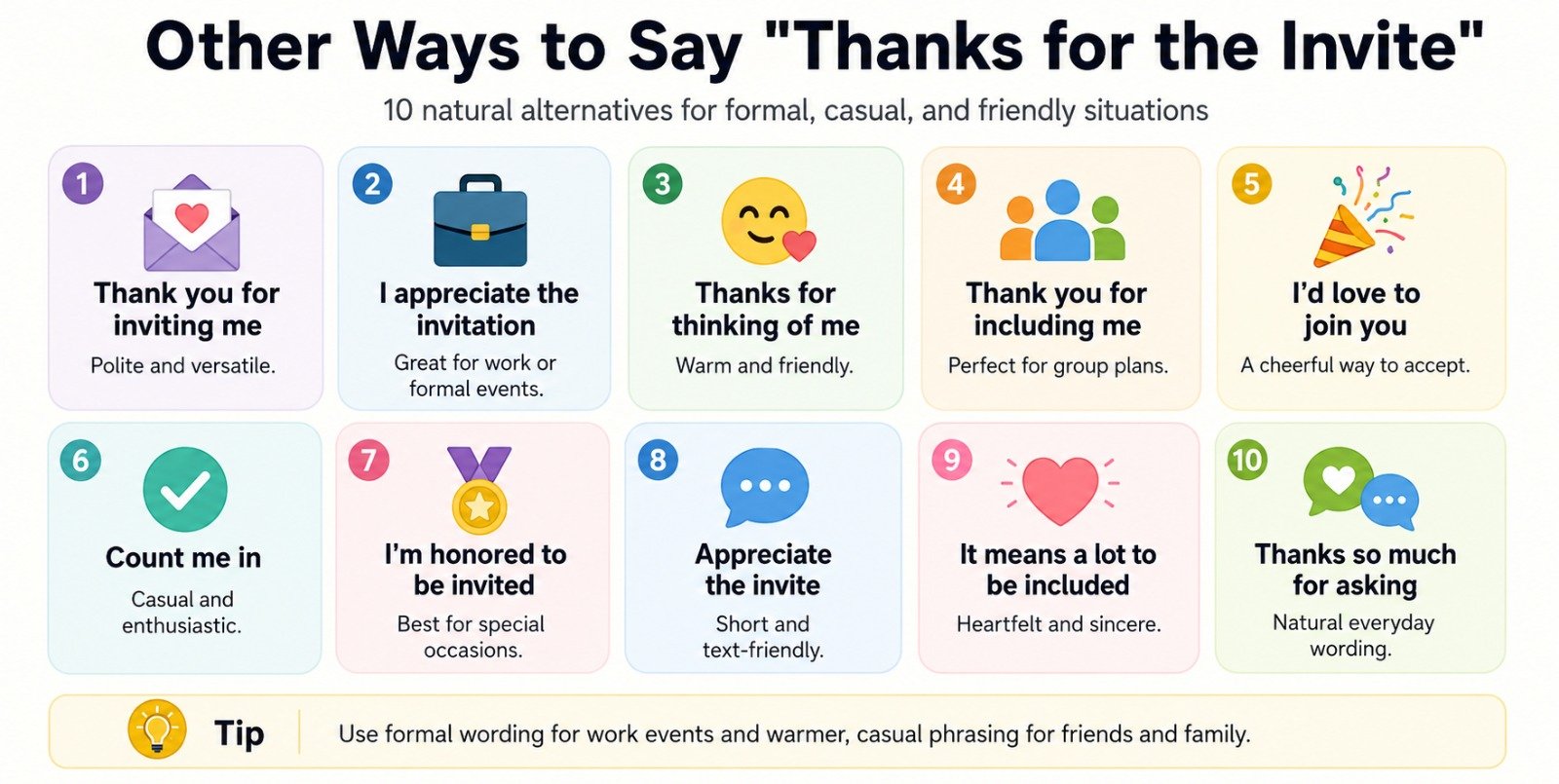
| Thank you for inviting me | Neutral and polite | Almost any situation |
| I appreciate the invitation | Professional | Work and formal events |
| Thanks for thinking of me | Warm and friendly | Friends and family |
| Thank you for including me | Warm and polite | Groups and gatherings |
| I’m honored to be invited | Formal and sincere | Important occasions |
| Count me in—thanks! | Very casual | Friends and texts |
| I’d love to join you | Friendly and positive | Accepting invitations |
| It means a lot to be included | Heartfelt | Close relationships |
| Thank you for extending the invitation | Formal | Business correspondence |
| Appreciate the invite! | Casual | Quick messages |
These phrases aren’t completely interchangeable. Saying “I’m honored to be invited” gives the invitation more importance than a casual “Thanks for asking me.” Likewise, “Count me in” confirms that you’re attending, while “Thanks for thinking of me” can work even if you later decline.
Professional Ways to Say “Thanks for the Invite”
A workplace invitation, business dinner, conference, networking event, or formal meeting usually calls for slightly more polished wording.
“I Appreciate the Invitation”
This is professional without sounding stiff.
Example:
“I appreciate the invitation and look forward to attending the reception.”
“Thank You for Extending the Invitation”
This sounds more formal and works especially well in professional emails or written correspondence.
Example:
“Thank you for extending the invitation. I would be pleased to attend.”
“Thank You for Including Me”
Use this when you’re being included in a meeting, project event, team gathering, or group discussion.
Example:
“Thank you for including me in the meeting. I’m looking forward to contributing.”
“I Appreciate You Thinking of Me”
This feels slightly warmer while remaining suitable for work.
Example:
“I appreciate you thinking of me for the networking dinner.”
“Thank You for the Opportunity to Join You”
This works particularly well when the invitation involves a professional opportunity rather than an ordinary social event.
Example:
“Thank you for the opportunity to join you at the industry roundtable.”
“I’m Grateful for the Invitation”
This is sincere and somewhat formal.
Example:
“I’m grateful for the invitation and delighted to take part in the event.”
Polite and Formal Other Ways to Say “Thanks for the Invite”
For weddings, ceremonies, formal dinners, award events, or invitations from someone you don’t know closely, these expressions can sound more appropriate.
“Thank You for the Invitation”
This is probably the safest formal alternative.
Example:
“Thank you for the invitation. We would be delighted to attend.”
“I’m Honored to Be Invited”
Use this when being invited feels meaningful or prestigious.
Example:
“I’m honored to be invited to celebrate such an important occasion with you.”
Avoid using it for something extremely casual, such as a quick coffee with a friend. It may sound unnecessarily grand.
“It’s Very Kind of You to Invite Me”
This emphasizes the host’s thoughtfulness.
Example:
“It’s very kind of you to invite me. I’d be happy to join you.”
“Your Invitation Is Greatly Appreciated”
This is polished and better suited to written communication than casual conversation.
Example:
“Your invitation is greatly appreciated, and I look forward to attending.”
“I’m Delighted to Be Included”
This sounds warm but sophisticated.
Example:
“I’m delighted to be included in the celebration.”
Friendly Ways to Say “Thanks for the Invite”
You don’t need formal language with friends, relatives, or people you know well. A warmer, conversational response usually sounds better.
“Thanks for Thinking of Me”
This is one of the most natural alternatives when someone includes you in their plans.
Example:
“Thanks for thinking of me! I’d love to come.”
“Thanks So Much for Inviting Me”
It’s simple, sincere, and slightly warmer than the original phrase.
Example:
“Thanks so much for inviting me. I’m really looking forward to it.”
“I’m So Glad You Invited Me”
This expresses enthusiasm as well as gratitude.
Example:
“I’m so glad you invited me. It sounds like a great night.”
“Thanks for Including Me”
Use this when joining an existing group or gathering.
Example:
“Thanks for including me. It’ll be nice to catch up with everyone.”
“Glad You Thought of Me”
A relaxed option for close friends.
Example:
“Glad you thought of me! I should definitely be free.”
“It Means a Lot That You Invited Me”
This works when the invitation has emotional significance.
Example:
“It means a lot that you invited me to celebrate with your family.”
Casual Ways to Say “Thanks for the Invite”
Casual responses can be shorter and more energetic, especially in texts and group chats.
“Appreciate the Invite!”
A concise alternative that sounds natural between friends.
Example:
“Appreciate the invite! I’m in.”
“Thanks for Asking!”
This works well when the surrounding conversation already makes the invitation clear.
Example:
“Thanks for asking! Saturday works perfectly.”
“Count Me In—Thanks!”
This combines gratitude with an immediate acceptance.
Example:
“Count me in—thanks! What time should I be there?”
“Awesome, Thanks for Inviting Me!”
This conveys enthusiasm and suits informal situations.
Example:
“Awesome, thanks for inviting me! I can’t wait.”
“Thanks—Sounds Fun!”
Short, easygoing, and ideal for texting.
Example:
“Thanks—sounds fun! See you Friday.”
Warm Ways to Thank Someone for Including You
Sometimes you want to acknowledge more than the invitation itself. These alternatives emphasize belonging, thoughtfulness, and appreciation.
“I’m Really Happy to Be Included”
This is especially natural for celebrations or group activities.
Example:
“I’m really happy to be included. It should be such a lovely evening.”
“That Was Thoughtful of You”
The focus here is on the person’s gesture.
Example:
“That was thoughtful of you. Thanks for inviting us.”
“I’m Touched That You Thought of Me”
This carries more emotion and should be saved for meaningful invitations.
Example:
“I’m touched that you thought of me for such a special occasion.”
“I Wouldn’t Want to Miss It”
This indirectly shows both appreciation and enthusiasm.
Example:
“Thank you for inviting me. I wouldn’t want to miss it.”
“I’m Looking Forward to Being There”
This works after you’ve already accepted the invitation.
Example:
“Thanks again. I’m looking forward to being there and celebrating with you.”
How to Say Thanks for the Invite When You’re Accepting
When accepting, it’s useful to combine appreciation with a clear yes.
A natural structure is:
Thank them + accept + optionally show enthusiasm
For example:
- “Thanks for inviting me. I’d love to come.”
- “I appreciate the invitation and would be happy to attend.”
- “Thanks for thinking of me! Count me in.”
- “I’d love to join you. Thanks so much for asking.”
- “Thank you for including me. I’m looking forward to it.”
A clear acceptance is particularly helpful when the host needs to know numbers for reservations, food, seating, or tickets.
How to Thank Someone When You Have to Decline
Gratitude doesn’t automatically mean you’re accepting.
If you can’t attend, acknowledge the invitation before politely declining:
“Thanks so much for inviting me. Unfortunately, I already have plans that evening, but I really appreciate you thinking of me.”
Or keep it shorter:
“Thank you for the invitation. I’m sorry I won’t be able to make it.”
For friends:
“Thanks for thinking of me! I can’t make it this time, but I hope you all have fun.”
You usually don’t need to provide a long explanation. A brief, respectful decline is enough.
Thanks for the Invite Short Messages
When you need a quick response, especially by text, you don’t have to write a full sentence.
“Thanks for the Invite!”
Simple and universally understandable.
“Thanks for Thinking of Me!”
A little warmer than the original.
“Appreciate the Invite!”
Short and relaxed.
“Thanks—Count Me In!”
Best when you’re accepting.
“Thanks! Can’t Wait.”
Enthusiastic and casual.
“Much Appreciated!”
Brief, though less personal.
“Thanks for Including Me!”
Good for group invitations.
“I’d Love To—Thanks!”
A natural acceptance in a text conversation.
“Thanks! See You There.”
Best when the details are already settled.
“So Kind of You to Ask!”
Warmer and slightly more expressive.
“Thanks for the Invite” or “Thanks for the Invitation”?
Both expressions are correct.
“Thanks for the invite” sounds more conversational and informal. It’s common when speaking with friends, coworkers, relatives, or people you know comfortably.
“Thanks for the invitation” sounds slightly more polished and is often preferable for formal events or professional correspondence.
For example:
Casual:
“Thanks for the invite to your barbecue!”
Formal:
“Thank you for the invitation to the annual awards dinner.”
The word invite can function as a noun in English, so using it this way isn’t inherently incorrect. The choice is mainly about tone.
How to Reply When Someone Says “Thanks for the Invite”
The other side of the conversation matters too. If someone thanks you for inviting them, a simple welcoming response usually works best.
“You’re Welcome!”
Universal and easy.
Them: “Thanks for the invite!”
You: “You’re welcome! Glad you can make it.”
“Of Course!”
Warm and informal.
Them: “Thanks for thinking of me.”
You: “Of course! It wouldn’t be the same without you.”
“My Pleasure”
More polished than “no problem.”
Them: “Thank you for the invitation.”
You: “My pleasure. We’re looking forward to having you.”
“Glad You Can Join Us”
This works especially well after the person accepts.
Them: “Thanks! I’ll be there.”
You: “Glad you can join us!”
“Happy to Have You”
Friendly and welcoming.
Them: “Thanks for including me.”
You: “Happy to have you!”
“No Problem—Hope You Can Make It”
Use this if they haven’t confirmed attendance yet.
Them: “Thanks for the invite.”
You: “No problem—hope you can make it!”
How to Respond to “Thanks for the Invite” When They Decline
If someone thanks you but says they can’t come, don’t pressure them.
Natural responses include:
- “No worries at all. Maybe next time!”
- “Of course! Sorry we’ll miss you.”
- “Totally understand. Hope to see you soon.”
- “No problem. Thanks for letting me know.”
- “We’ll miss you, but I hope you have a great evening.”
The goal is to acknowledge their response without making them feel guilty about declining.
What Does TFTI Mean?
The common thanks for the invite abbreviation is TFTI, meaning:
Thanks For The Invite.
It’s used mainly in texting, online conversations, memes, and social media.
It can be sincere:
“TFTI! Looking forward to Saturday.”
But it’s also frequently used jokingly or sarcastically when someone wasn’t invited:
“You guys went for pizza without me? TFTI 😂”
Because TFTI is highly informal, avoid it in professional emails or formal invitations.
Is “Thanks for the Invite” Ever Sarcastic?
Yes. Context can completely change the tone.
Imagine discovering that your friends went on a trip without asking you. Saying:
“Wow, thanks for the invite.”
may actually mean:
“I’m annoyed that you didn’t invite me.”
In speech, sarcasm is usually obvious from tone. In texting, emojis, context, or punctuation may provide the clue.
If you genuinely want to thank someone and there’s any chance the message could be misunderstood, add something positive:
“Thanks for the invite! I’m really looking forward to it.”
That removes ambiguity.
Choosing the Right Alternative
The strongest alternative isn’t necessarily the fanciest one. Choose wording that matches the relationship and situation.
For a client or manager, “I appreciate the invitation” sounds polished.
For a friend, “Thanks for thinking of me!” feels warmer.
For an important ceremony, “I’m honored to be invited” may fit.
For a quick text, “Appreciate the invite!” is enough.
And when you’re declining, a phrase such as “Thanks for thinking of me” lets you express genuine appreciation without accidentally suggesting that you’re attending.
A Note About “Thanks for the Invite Food Truck”
The phrase “thanks for the invite food truck” doesn’t function as a standard English expression or a normal alternative to “Thanks for the invite.” It appears to relate to a specific name, social-media phrase, business, or navigational query rather than the everyday language question covered here.
For ordinary writing and conversation, it shouldn’t be treated as another way to express gratitude for an invitation.
Frequently Asked Questions
What is another way to say “Thanks for the Invite”?
You can say “Thank you for inviting me,” “Thanks for thinking of me,” “I appreciate the invitation,” “Thank you for including me,” or “I’m grateful to be invited.” The best choice depends on how formal or personal the situation is.
What is a professional way to say “Thanks for the Invite”?
“I appreciate the invitation” is one of the most natural professional options. For something more formal, you could write, “Thank you for extending the invitation. I look forward to attending.”
How do you say “Thanks for the Invite” casually?
Try “Appreciate the invite!”, “Thanks for asking!”, “Count me in—thanks!”, or “Thanks for thinking of me!” These sound natural in texts and conversations with friends.
Can I say “Thanks for the invite” if I can’t attend?
Yes. Thanking someone for inviting you doesn’t mean you’re accepting. You could say, “Thanks so much for the invite. I can’t make it this time, but I really appreciate you thinking of me.”
Is “invite” or “invitation” more formal?
“Invitation” generally sounds more formal and polished, while “invite” is more conversational. Both can be correct nouns in modern English.
What should I reply when someone says “Thanks for the invite”?
Simple responses such as “You’re welcome,” “My pleasure,” “Of course,” “Glad you can make it,” or “Happy to have you” work well. Match the formality of your response to the relationship.
What is the abbreviation for “Thanks for the Invite”?
TFTI stands for “Thanks for the Invite.” It’s mainly used in texts and online communication. Depending on context, it can also be sarcastic when someone feels left out.
Final Thoughts
There isn’t one perfect alternative for every invitation. “Thank you for inviting me” is versatile, “I appreciate the invitation” fits professional situations, and “Thanks for thinking of me” feels warmer and more personal. Shorter options work well with friends, while important events often deserve more thoughtful wording.
The key is to match your response to the person, occasion, and level of formality rather than simply choosing the most impressive-sounding phrase. Clarifyra helps make distinctions like these clearer, so your words can sound natural and appropriate for the moment.
You May Also Read | Different Ways to Say Hi: 100+ Friendly, Cute and Flirty Greetings