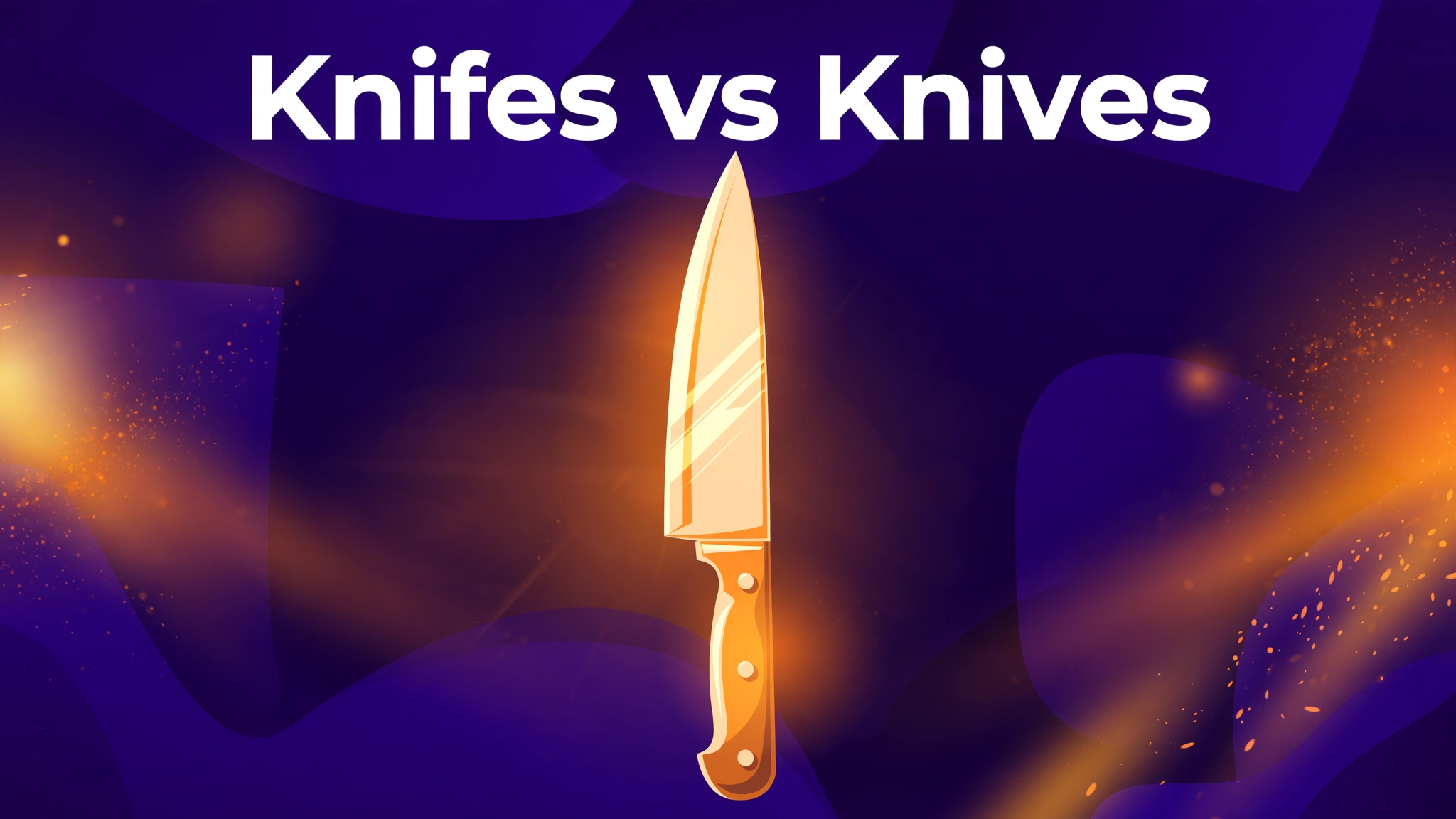
Knifes or Knives: Which Is Correct?
Of all the spelling questions in English, knifes or knives has one of the best twists: both spellings are real words. Knives is the plural of the noun knife — the only correct plural, in every dictionary. But knifes is not a misspelling either: it is the third-person singular of the verb to knife (“he knifes”). So the question is never really “which spelling is right?” but “which word is your sentence using — the noun or the verb?”
This is the same trap English sets with wolfs/wolves — and it catches even careful writers, because the verb to knife is rare enough that most people have never consciously met its -s form. Once you see the split, though, the rule is simple and permanent: counting cutting tools → knives; describing the verb’s action → knifes.
What the Dictionaries Say
Collins settles the whole question in a single language note attached to its knife entry:
| Dictionary | Verdict |
|---|---|
| Collins COBUILD (word forms) | “Word forms: plural knives, 3rd person singular present tense knifes, present participle knifing, past tense, past participle knifed.” Language note: “knives is the plural form of the noun and knifes is the third person singular of the present tense of the verb.“ |
| Collins (noun sense) | “A knife is a tool for cutting or a weapon and consists of a flat piece of metal with a sharp edge on the end of a handle.” Pronunciation: knife /naɪf/, plural knives /naɪvz/. |
| Collins (verb sense) | knife, transitive verb: “To knife someone means to attack and injure them with a knife.” Collins’s conjugation table: he/she/it knifes, knifing, knifed. |
| Collins (word origin) | Old English cnīf; related to Old Norse knīfr and Middle Low German knīf — the f → ves plural is an old Germanic inheritance, not a modern invention. |
The table gives you everything: one spelling per job. The noun’s family is knife → knives; the verb’s family is knife → knifes → knifing → knifed. They share an infinitive and nothing else. Notice too that the verb is transitive and narrow in meaning — it means to attack or injure a person with a knife, not to cut things in general. That narrowness matters, because it limits where knifes can ever correctly appear.
Knives: The Plural Noun
Knives is the plural you need in virtually every sentence about cutting tools. Kitchen knives, pocket knives, a set of steak knives, the knives in the drawer — the f voices to v and the word takes -es, pronounced /naɪvz/ (“nyvez”). Every major dictionary lists this as the standard plural with no alternative.
- “She keeps her kitchen knives razor sharp.”
- “The campsite shop sells pocket knives and multitools.”
- “Two knives, two forks — the table is set.”
- “He collects antique Bowie knives.”
This f → ves shift belongs to a well-known family of old Germanic nouns, and recognising the family makes the spelling feel less arbitrary: leaf → leaves, thief → thieves, wolf → wolves, half → halves, life → lives, self → selves, wife → wives. Not every -f noun joins in (roof → roofs, chief → chiefs, belief → beliefs), which is exactly why “knifes” looks plausible — it follows the regular rule, just not the rule this particular word obeys.
Knifes: The Verb Form (and Why You Rarely Need It)
Knifes is the present-tense form used with he, she, or it: “he knifes,” “she knifes.” It follows the most ordinary verb pattern in English — add -s, keep the stem: like he laughs, she lifts, it cuts. The f stays an f and the pronunciation keeps the hard /f/: /naɪfs/ (“nyfs”).
But here is the catch: the verb to knife means specifically to attack and injure someone with a knife (Collins). It is not the verb for cutting bread, carving turkey, or slicing vegetables — for those, English uses cut, slice, or carve. So legitimate sentences containing knifes are rare and almost always grim:
- “In the film’s climax, the assassin knifes the guard and slips inside.”
- “The report describes how the attacker knifes his victim without warning.”
In practice, news and fiction usually prefer the past tense (knifed: “She was knifed in the back”) or the participle (knifing), which is why the present-tense knifes feels unfamiliar even though it is perfectly regular. The unfamiliarity is the trap: because readers seldom meet knifes as a verb, they assume any knifes they see must be a misspelt plural — and writers, unsure, “fix” it the wrong way.
This noun–verb split with a twist is not unique to knife. The wolfs/wolves pair works exactly the same way: wolves is the plural noun, while wolfs is the third-person verb form (“he wolfs down his dinner”). If you can keep those two straight, you already know how to handle knifes and knives.
Why “Knifes” Looks So Right as a Plural
The error has a respectable logic behind it. The default English plural rule is “add -s,” and it works for the vast majority of nouns — cats, books, chiefs, roofs. A writer forming the plural of knife by analogy reaches for knifes automatically, and the result even passes a casual spellcheck, because knifes is a real word. The mistake is invisible to software and to the ear — /naɪfs/ versus /naɪvz/ is a subtle distinction in rapid speech — so it survives into print more often than most spelling errors.
The defence is a two-second grammar check: are you counting things, or describing an action? “How many?” → noun → knives. “He/she/it does what?” → verb → knifes. In practice, the answer is “counting things” roughly 99 times out of 100, because the verb to knife barely appears outside crime reporting and thrillers.
Correct vs. Incorrect
- ✓ “The drawer holds six steak knives.” (plural noun)
- ✗ “The drawer holds six steak knifes.” → ✓ knives
- ✓ “He knifes the rope to free himself.” — careful: spelled right, but the verb means to attack a person; for cutting rope, write “he cuts the rope.” (right spelling, wrong verb for the job)
- ✓ “She knives through his excuses.” — ✗ wrong: this metaphor doesn’t work either; the verb is literal, about physical attack. → “She cuts through his excuses.”
- ✓ “He was knifed in the back.” (past tense of the verb — Collins’s own example pattern)
- ✗ “She sharpened the kitchen knifes.” → ✓ knives
- ✗ “The knives his way through the crowd.” → ✓ “He knifes his way through the crowd.” (verb needs the -s form with an f)
Common Mistakes
1. Writing “knifes” as the plural. The core error, and by far the most common. The regular “add -s” instinct is strong, and spellcheck won’t flag it. But the plural of the noun is knives — full stop, in every dictionary.
2. Writing “knives” as the verb. The mirror-image mistake: “he knives his dinner” is wrong on two counts — the verb form keeps the f (“he knifes“), and anyway to knife means to attack a person, not to cut food. The sentence you want is “he cuts his dinner.”
3. Using the verb “to knife” for ordinary cutting. Because the noun is so common, writers assume the verb must be equally general. It isn’t — Collins defines it narrowly as attacking and injuring someone. Carving, slicing, chopping, and cutting all have their own verbs; reserve knife-as-verb for its dictionary meaning.
4. Pronouncing them identically and letting the spelling blur. Knives is /naɪvz/ (voiced v), knifes is /naɪfs/ (hard f). Keeping the v audible when you mean the plural reinforces the right spelling — the same spoken clue that separates wolves from wolfs.
5. “Correcting” a legitimate knifes. Proofreaders who know the plural rule sometimes “fix” a correct verb form: “the attacker knifes his victim” → “knives,” which is wrong. Before correcting, check the grammar: if it’s he/she/it + verb, knifes with an f is exactly right.
Frequently Asked Questions
Is “knifes” a real word?
Yes — but only as a verb form. Knifes is the third-person singular present tense of to knife (“he knifes”), listed in Collins’s word forms and conjugation table. It is never the plural of the noun.
What is the plural of “knife”?
Knives. Every major dictionary lists knives (/naɪvz/) as the standard plural, following the old f → ves pattern shared with leaves, thieves, and wolves.
Why is it “knives” and not “knifes”?
English inherited the f → ves plural from Old English sound patterns (Collins traces knife to Old English cnīf). The voiced v sits more naturally between vowels in speech, and the spelling eventually reflected it. Words like roof → roofs regularised differently, which is why the irregular ones have to be memorised.
Can “knife” be a verb?
Yes. To knife is a transitive verb meaning to attack and injure someone with a knife (Collins). Its forms are knifes, knifing, knifed. Note the narrow meaning — it is not a general verb for cutting.
How do you pronounce “knives” vs. “knifes”?
Knives is /naɪvz/ (“nyvez”) with a voiced v; knifes is /naɪfs/ (“nyfs”) with a hard f. The pronunciation difference mirrors the spelling difference.
Is it “a set of knifes” or “a set of knives”?
A set of knives. You’re counting the noun, so the plural is knives — “a set of steak knives,” “a drawer of knives.”
The Takeaway
Knives counts the tools; knifes conjugates the verb. The plural noun takes the v (“a drawer full of knives”), while the rare third-person verb keeps the f (“he knifes”) — and the verb itself means to attack with a knife, not to cut with one. Ask the two-second question — am I counting things or describing an action? — and this pair stops being a trap: nearly always, you’re counting, and the answer is knives.