In the Red Meaning: Definition, Origin and Examples
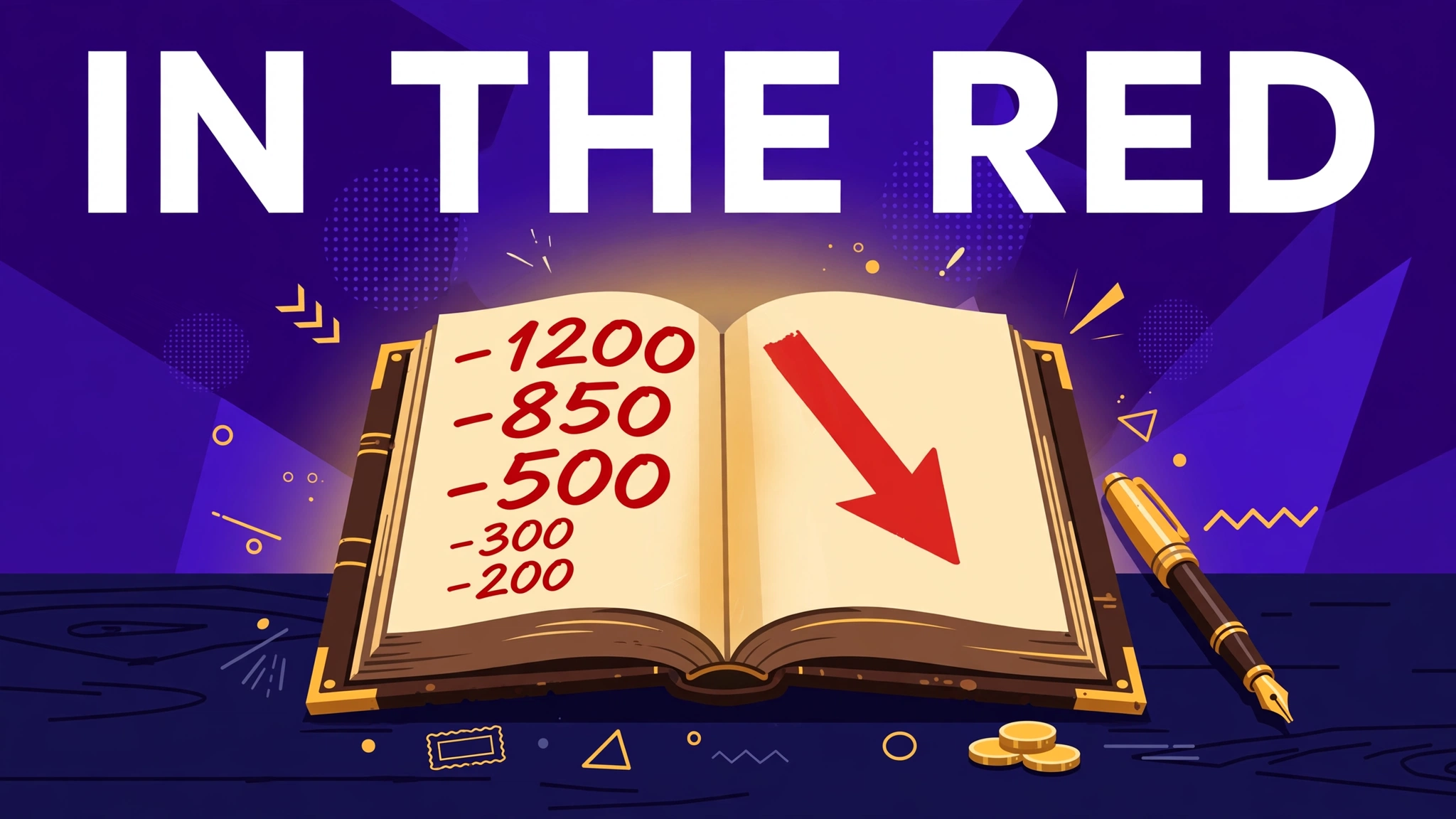
In the red means in debt, or operating at a loss. Cambridge’s dictionary lists it as an idiom — informal, C2 level: “If you or your bank account are in the red, you owe money to the bank,” and for businesses, “we mean it’s losing money.” The colour is not decorative: the phrase comes from the old bookkeeping practice of entering debits and losses in red ink — Merriam-Webster traces the noun sense to “the bookkeeping practice of entering debit items in red ink” — while profits went down in black. This article explains the idiom’s meaning, its ink-stained origin, and its partner phrase, in the black. It is a dictionary illustration of a piece of language, not financial advice.
Quick Answer
In the red (idiom) means in debt or losing money: a person, bank account, or business whose outgoings exceed income — “After the repairs, his account was in the red.” The opposite is in the black (profitable). The phrase comes from accountants’ red ink: losses and debits were written in red, profits in black, so a page full of red meant trouble.
What “in the red” means
The idiom has two closely related uses, and Cambridge defines both:
1. Personal finance — owing money. “If you or your bank account are in the red, you owe money to the bank.” This is the overdraft sense: your balance has gone below zero, or your debts exceed what you have. “After paying for the car repairs, his bank account was in the red.”
2. Business — operating at a loss. “If we say a business is in the red, we mean it’s losing money.” The company’s expenses outrun its revenue over the period in question. “The restaurant stayed in the red during its first year.”
Both senses share the same logic: more going out than coming in, recorded as a negative. A few more natural examples:
- “The club has been in the red for three seasons running.”
- “Most startups spend their first years in the red before turning a profit.”
- “She was £200 in the red by the end of the month.”
- “The airline slipped back into the red after fuel prices rose.”
Cambridge marks the idiom informal, and that is worth respecting: it belongs in journalism, conversation, and general writing, not in formal financial statements (which say “net loss” or “negative balance”). The fixed preposition is in — “in the red,” never “on the red” or “at the red” — and the verb is usually be, with go, slip, fall, and stay for movement into or within the state.
The origin: red ink in the ledger
The phrase is a fossil of hand bookkeeping. Before computers, accountants and clerks kept ledgers by hand, and a colour convention grew up: profits, credits, and positive balances in black ink; losses, debits, and deficits in red ink. A page — or a whole ledger — running red was readable at a glance as a business in trouble.
Merriam-Webster’s dictionary entry for the noun red makes the link explicit: “[from the bookkeeping practice of entering debit items in red ink]: the condition of showing a loss — usually used with the.” The related noun red ink gets its own entry — “the condition of showing a business loss” — with the etymology “from the use of red ink in financial statements to indicate a loss” and a first known use of 1926. That 1926 date is the earliest firmly dated evidence in a major dictionary for the red-as-loss vocabulary entering American business English; the idiom in the red belongs to the same 20th-century flowering.
Why red? Partly practical — red stands out on a page of black figures — and partly symbolic: red already carried warnings (danger, stop, blood) long before it carried debts. The convention was so deeply embedded that it survived the move to screens: to this day, accounting software and bank apps display negative balances in red. The metaphor outlived the ink.
One honest boundary: colourful accounts of the practice sometimes push the origin back to 15th- and 16th-century European merchants and double-entry bookkeeping. That is plausible — the colour convention is old — but the phrase “in the red” is a 20th-century coinage on the dictionary evidence. The ink is old; the idiom is modern.
In the red vs in the black
The idiom has a built-in opposite, born from the same ledger:
| Idiom | Meaning | Ledger origin | Example |
|---|---|---|---|
| in the red | In debt; operating at a loss | Losses and debits entered in red ink | “The firm ended the year £2m in the red.” |
| in the black | Profitable; financially healthy | Profits and credits entered in black ink | “After five years, the company is finally in the black.” |
Cambridge cross-references the two: its be in the red entry says “Compare: be in the black.” The pair is a matched set — learn them together. Related vocabulary from the same inkwell: red ink as a mass noun for losses themselves (“the studio has a lot of red ink to mop up” — Merriam-Webster’s current example), and the verb phrase bleed red ink, journalism’s favourite for a company losing money heavily.
Usage notes: temporary, persistent, and personal
Temporary vs structural. Being in the red is a condition, not a character trait. New businesses are routinely in the red while they invest ahead of revenue; a bad quarter can put a healthy firm temporarily in the red. The idiom turns serious when the condition looks structural — “in the red for the third year running” is a warning, not a phase.
Personal vs business. Cambridge’s two definitions keep these apart, and so should you. “I’m in the red this month” (personal, informal, mild) is a different weight from “the company is in the red” (business, potentially grave). The personal use often just means overdrawn; the business use means unprofitable.
Degree. The idiom takes amounts naturally — “£500 in the red,” “$2 million in the red” — and intensifiers: deeply in the red, heavily in the red, plunged into the red. It also pairs with its opposite for turnarounds: “from the red into the black.”
What it is not. In the red describes the state of the books, not a single expense. Spending £50 on dinner does not put you “in the red” unless your balance goes negative. And it has nothing to do with anger — that is seeing red, a different idiom from a different metaphor.
Common mistakes and confusions
“In the red” vs “seeing red.” Seeing red means becoming angry; in the red means being in debt. Same colour, unrelated idioms. “He was seeing red when he saw the bill” (furious) vs “he was in the red after paying the bill” (broke).
“In the red” vs “red tape.” Red tape is bureaucratic obstruction — a different red entirely, from the tape once used to bind official documents. No financial meaning.
Wrong preposition. It is always in the red. “On the red,” “at the red,” and “in red” (without the) are all wrong for this idiom — though “in red ink” is fine as a literal description.
Using it in formal financial writing. The idiom is informal (Cambridge). Annual reports say “reported a net loss of…”; journalists say the company “ended the year in the red.” Match the register to the document.
FAQs
What does “in the red” mean?
To be in debt or operating at a loss — outgoings exceed income. Cambridge: “If you or your bank account are in the red, you owe money to the bank”; of a business, “we mean it’s losing money.”
Where does “in the red” come from?
From bookkeeping: accountants entered losses and debits in red ink and profits in black, so a ledger full of red meant a business losing money. Merriam-Webster defines the noun red as “the condition of showing a loss” from exactly this practice, and dates red ink to 1926.
What is the opposite of “in the red”?
In the black — profitable, financially healthy, from the black ink used for profits in the same ledgers.
Can a person be “in the red,” or only a business?
Both. A person or bank account in the red owes money (usually overdrawn); a business in the red is losing money. The personal use is informal and usually milder.
Is “in the red” the same as “seeing red”?
No. Seeing red means becoming very angry; in the red means being in debt. Different idioms, different metaphors — don’t mix them.
The takeaway
In the red (idiom, informal) means in debt or losing money — a person overdrawn, a business unprofitable — with in the black as its profitable opposite. The colour comes from the accountant’s pen: red ink for losses, black ink for gains, a convention old enough to predate computers and vivid enough to survive on every banking app today. It describes the state of the books, takes amounts and intensifiers naturally, and should stay out of formal financial prose — where net loss does the same job in a suit.