Syncing Meaning: Definition, Examples and How to Use It
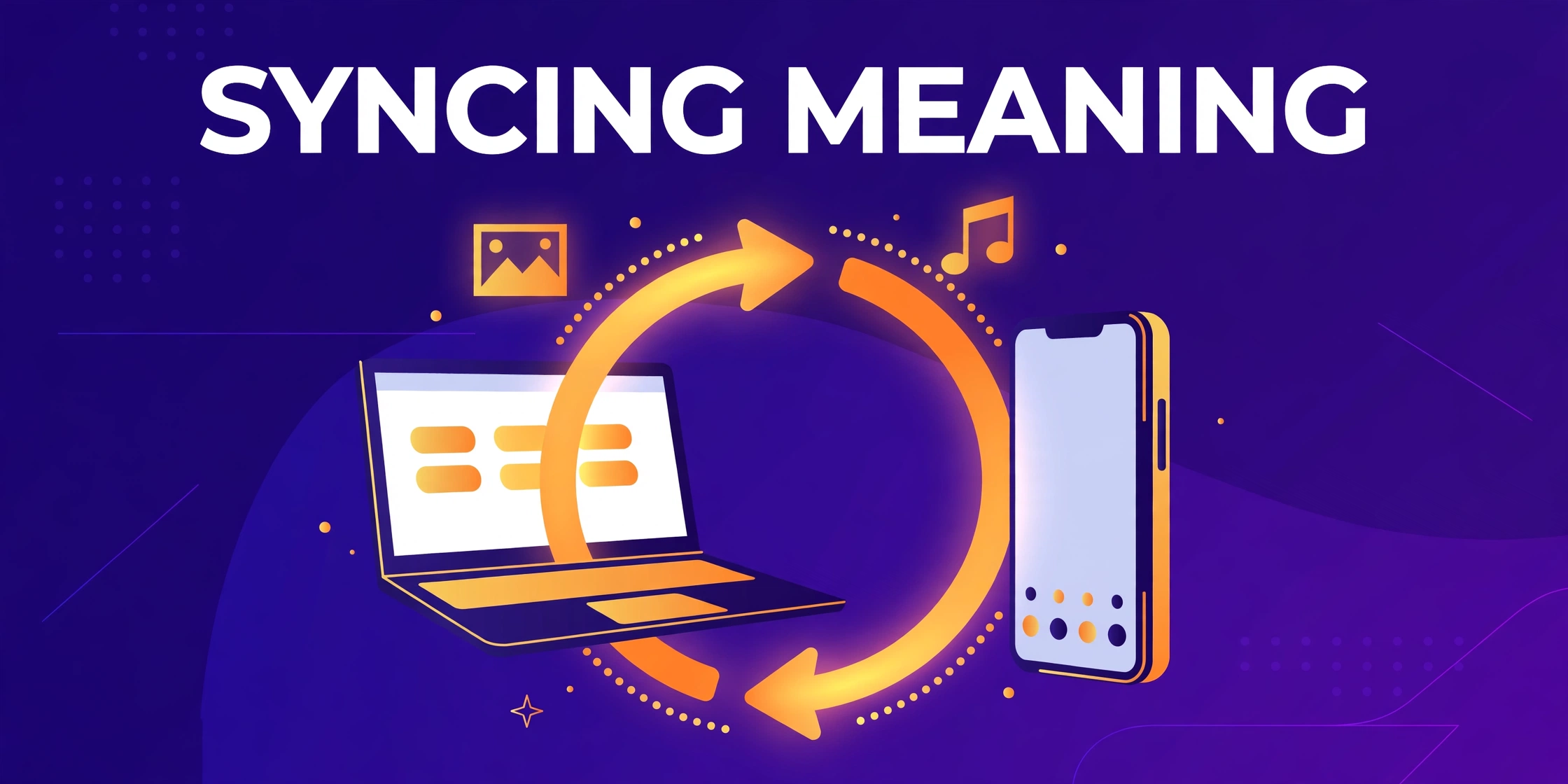
Syncing is the -ing form of the verb sync, and it means making two or more things match — in time, in step, or in content. When your phone says “syncing photos,” it is copying new photos to the cloud so that every device holds the same set. When dancers are syncing their moves, they are moving at exactly the same moment. When a film’s sound is syncing with its picture, the words you hear arrive at the same instant as the lips that speak them. One word, one idea — things lining up — applied to machines, to music, and to people.
Most people meet the word on a screen. A progress bar, a spinning icon, and the single word “Syncing…” is how millions of people first encounter it, usually with no explanation of what is actually happening. This guide explains what the dictionaries say, where the word came from, how its spelling works, and how to use it — and its idioms in sync and out of sync — without error.
Quick Answer: Syncing (pronounced SING-king, /ˈsɪŋkɪŋ/) is the present participle of sync, short for synchronize. It means making things happen at the same time, or making the information on two devices identical — “my phone is syncing contacts,” “the dancers are syncing their steps.” The past form is synced; the variant spelling synching also exists but syncing is the standard form.
What Does “Syncing” Mean?
The dictionaries agree closely on this word, and the agreement is worth setting out because the word has two distinct senses that people often blur together.
| Dictionary | Definition of sync |
|---|---|
| Oxford Learner’s Dictionaries (verb) | 1. “To happen at the same time or to move at the same speed as something; to make something do this.” 2. “To link data files between one computer or mobile device and another so that the information in the files on both machines is the same.” |
| Cambridge Dictionary | As an adjective/noun: “moving or happening at the same time and speed as someone or something else”; “agreeing with.” |
| Merriam-Webster | “Synchronize” — the verb meaning to make synchronous, to happen at the same time. |
Oxford marks sync as informal, and that is an important part of its character. It is the shortened, everyday form of the formal verb synchronize (British English also spells it synchronise). In a technical manual you might read “synchronize the devices”; in ordinary speech and on-screen messages, everyone says “sync.” The noun works the same way: sync is the informal noun for the state of being synchronized, as in “the two systems are in sync.”
Where the Word Came From
Sync is an abbreviation — a clipping of synchronize — and it is a young word by English standards. Oxford dates it to the 1920s, and Merriam-Webster dates the noun to 1929 and the verb to 1945. It was born in the cinema: the first “talkies” needed sound and picture to match exactly, and the technicians’ word for that matching was sync. A film whose sound did not line up with the actors’ lips was “out of sync,” and the term stuck.
From film, the word spread to music — lip-syncing, where a performer moves their lips to a recording — and then to electronics, where it took on its modern data sense.
How to Pronounce “Syncing”
Sync is pronounced /sɪŋk/ in both British and American English — “SINGK,” one syllable, rhyming with ink and think. The spelling looks as if it should sound like “sink,” but the vowel is the short i of sing, and the final sound is the ng of sing followed by a k.
Syncing is pronounced /ˈsɪŋkɪŋ/ — “SING-king,” with the stress on the first syllable. The past form synced is /sɪŋkt/ — “SINGKT,” one syllable. Note that the -ed here is pronounced /t/, not /ɪd/: because sync ends in the voiceless sound /k/, the ending follows the pattern of walked and linked, not of wanted.
Spelling: Syncing, Synced, and the Synch Variant
The spelling of this word family causes more trouble than its meaning, and it is worth getting straight.
| Form | Standard spelling | Notes |
|---|---|---|
| Base verb | sync | Also written synch, the less common variant. |
| Third person singular | syncs | “The app syncs your photos.” |
| Past simple / past participle | synced | “I synced my phone yesterday.” Variant: synched. |
| -ing form | syncing | “It is syncing now.” Variant: synching. |
Three points matter. First, the standard spelling is sync, not synch: Oxford lists synch as a variant, and Merriam-Webster calls it “less common.” Use sync in your own writing. Second, the past form is synced, not “sync’d” and not “synked.” Third, the -ing form is syncing — spelled with a single c and no doubling, because the base ends in a consonant cluster rather than a single consonant after a short vowel.
One more trap: the word is sometimes confused with cinch or written as “sink” by people who have only heard it. The spelling to remember is s-y-n-c — four letters, no vowel between the y and the n, and a c at the end doing the work of a k.
“Syncing” on Your Devices: What Is Actually Happening?
When a phone, tablet, or computer says it is syncing, it is doing one of a small number of things, and knowing which one explains most of the messages you will ever see.
- Copying new items: photos taken on your phone are uploaded to the cloud, or downloaded to your laptop. “Syncing photos” usually means this: making sure the newest items exist in both places.
- Updating changes: a contact edited on one device, a note changed on another, a calendar event moved — syncing applies the latest version everywhere, so no device holds an out-of-date copy.
- Matching deletions: delete a file on one device and syncing deletes it on the others too. This is the part people forget, and the reason a sync can surprise you: it mirrors removals as faithfully as additions.
The practical consequence is simple: syncing is not the same as backing up. A backup keeps a separate copy you can restore. A sync keeps two or more live copies identical — which means a mistake made on one device, including an accidental deletion, can be copied to the others. That is why services that sync also offer a trash or version history: the sync itself has no memory.
In Sync and Out of Sync
The noun sync has produced the two most useful idioms in the whole family, and both are used far beyond technology.
In sync means moving or working at exactly the same time and speed, or — figuratively — in agreement. “The two dancers were perfectly in sync.” “The team is in sync on the plan.” Oxford records both senses: the literal one of timing and the figurative one of agreement. The phrase is informal but fully standard, and it appears in business writing as readily as in conversation.
Out of sync is the opposite: not moving together, or not in agreement. “The sound was out of sync with the picture.” “His priorities are out of sync with the company’s.” The phrase carries a mild note of criticism — something that ought to match does not.
Two related phrases are worth knowing. Sync up (often with with or to) means to bring things into agreement: “Let’s sync up after lunch” is now a standard business phrase meaning “let’s meet and compare notes.” And lip-sync (also written lip-synch) means to move your lips in time with a recording, pretending to sing — the original show-business sense of the word, still in daily use.
Correct vs Incorrect
| Correct | Incorrect | Why |
|---|---|---|
| My phone is syncing my contacts. | My phone is synking my contacts. | There is no such spelling; the word is syncing, from sync. |
| I synced the two calendars yesterday. | I sync’d the two calendars yesterday. | Past form is synced, no apostrophe — it is not a contraction. |
| The dancers were in sync. | The dancers were in sink. | Sink is a basin or a verb meaning to go down; the idiom uses sync. |
| Please sync your files before the meeting. | Please synchronize your files before the meeting. | Not wrong — synchronize is correct — but sync is the normal, idiomatic choice. |
| The audio is out of sync with the video. | The audio is out of synch with the video. | Synch is a recognised variant, but sync is the standard spelling; use it consistently. |
| We need to sync up on Friday. | We need to syncronize on Friday. | Misspelling of synchronize; and in this idiom, sync up is the natural phrase. |
Common Mistakes
Writing “sink” for “sync”
The two words sound similar in fast speech — /sɪŋk/ against /sɪŋk/ — but they are spelled differently and mean different things. A useful memory aid: sync is short for synchronize, and it keeps the y of synchronize. If your sentence is about things matching, the word has a y in it.
Assuming syncing means backing up
As explained above, a sync mirrors changes — including deletions — across devices. If you delete a file and the deletion syncs, the file is gone everywhere. Treat syncing as a way of keeping devices identical, and keep a separate backup for anything you cannot afford to lose.
Mixing up “sync” and “synchronize” in formal writing
Both are correct, but they belong to different registers. Sync is informal; in a formal report or an exam, synchronize is the safer choice. In emails, messages, and on-screen text, sync is what everyone expects.
FAQs
What does “syncing” mean on my phone?
It means your phone is copying new or changed information — photos, contacts, messages, settings — to or from another device or a cloud service, so that all of them hold the same up-to-date information. It is the process of making copies match.
Is it “syncing” or “synching”?
Syncing is the standard spelling, and the one the dictionaries list first. Synching is the -ing form of the variant spelling synch; it is acceptable but less common. Pick one spelling and use it consistently — syncing is the safer choice.
What is the past tense of “sync”?
Synced — “I synced my phone this morning.” It is pronounced “singkt,” one syllable. The variant synched exists but is less common.
What does “in sync” mean?
Literally, moving or happening at exactly the same time and speed. Figuratively, in agreement or working well together — “the team is in sync.” The opposite is out of sync.
Is “sync” short for “synchronize”?
Yes. Sync is a clipped form of synchronize (British English also synchronise), first used in the 1920s for matching film sound to picture. Sync is informal; synchronize is the formal, full form.
The Takeaway
Syncing means bringing things into agreement — in time, in step, or in data. It is the -ing form of sync, the informal short form of synchronize, pronounced “SING-king.” On your devices it means making copies match; on a stage it means moving together; in conversation it means being on the same page.
Sources: Oxford Learner’s Dictionaries, “sync” (verb and noun); Cambridge Dictionary, “sync”; Merriam-Webster, “sync.” Definitions checked 13 November 2026.