Sickle Meaning: Definition, Examples and How to Use It
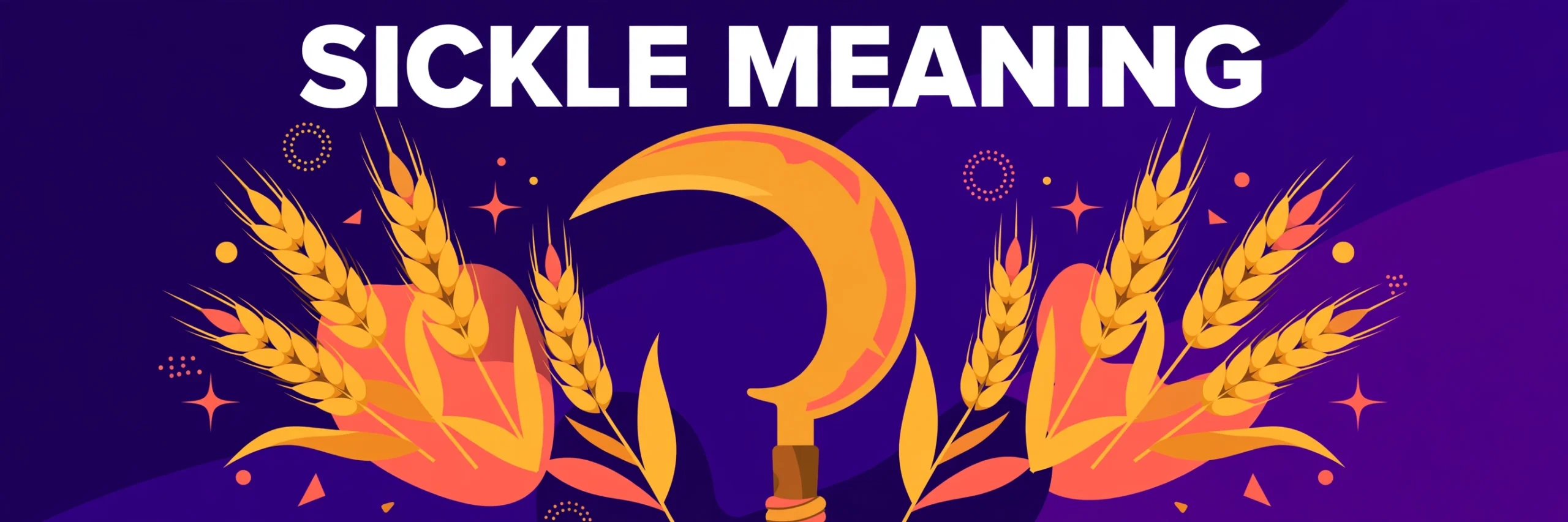
A sickle is one of humanity’s oldest tools: a short-handled blade curved like a crescent moon, used for cutting grain and grass by hand. It gave its name to a shape that turns up everywhere from the night sky to blood cells, and it ended up on a flag recognised around the world. Yet in modern English the word is more often met in compounds — sickle cell, sickle-shaped, hammer and sickle — than on its own, which is why its plain meaning is worth pinning down.
The key to the word is the curve. A sickle is not just any blade: it is a blade bent into a hook or crescent, sharp on the inside edge, designed to gather stalks into its curve and cut them in a single pulling stroke. Take away the curve and you have a knife; lengthen the handle and you have its big cousin, the scythe.
What the Dictionaries Say About “Sickle”
| Dictionary | Definition of sickle |
|---|---|
| Britannica Dictionary | “A tool with a curved metal blade attached to a short handle that is used for cutting grass, grain, etc.” |
| Oxford Languages (via bab.la) | UK noun: “A short-handled farming tool with a semicircular blade, used for cutting corn, lopping, or trimming.” Adjective sense: “having the shape of a crescent” — as in a sickle-shaped scar. |
| Cambridge (sickle cell anaemia) | US sickle cell anemia (UK sickle cell anaemia): “a form of anemia caused by a gene received from both parents”, in which the blood cells are distorted into a crescent shape. |
Every definition agrees on the same three features: curved blade, short handle, cutting crops. That agreement is useful because it immediately separates the sickle from its neighbours: a scythe has a long handle and is worked standing with both hands; a billhook is heavier, for thicker stems and branches; a knife is straight. The sickle is the one-handed harvest tool, worked close to the ground.
How to Pronounce “Sickle”: UK and US
There is no transatlantic difference here. Cambridge gives the same pronunciation on both sides:
- UK: /ˈsɪk.əl/ — SIK-uhl, stress on the first syllable
- US: /ˈsɪk.əl/ — SIK-uhl, identical
Say it in two beats: sik (rhyming with tick) plus a weak second syllable -uhl, like the ending of label. The k is sounded — it is not silent, despite the ckle spelling that tempts some readers toward “sigh-ull”. And keep it distinct from cycle (SY-kul, with a long i and an s sound at the start) and from psychic (SY-kik): all three share letters and sounds, but they are unrelated words.
How a Sickle Works — and Why the Curve Matters
A sickle is used in one hand, with the other hand gathering the crop. The worker draws the blade toward themselves across the base of the stalks; the curve traps the stems against the sharp inner edge and slices them in the same motion. Some sickles have a smooth edge, others a serrated one — the tiny teeth saw through tough cereal straw even when the blade is slightly dull, which mattered enormously before modern sharpening was routine.
The design is ancient and nearly universal. Curved harvesting blades appear in ancient Egypt, Mesopotamia, and across Asia and Europe, and the sickle remained the standard harvest tool for small fields and hillsides long after the scythe and the combine harvester arrived. It survives today wherever machines cannot go — steep terraces, small plots, gardens — and in many parts of the world it never left at all. Its shape also explains its second career as a symbol: a tool every peasant recognised, standing for agricultural labour itself.
Sickle vs Scythe: Don’t Mix Them Up
| Sickle | Scythe | |
|---|---|---|
| Handle | Short, one-handed | Long, two-handed |
| Blade | Strongly curved, semicircular or hook-shaped | Longer, more gently curved |
| Working posture | Crouched or bent, close to the crop | Standing, swinging from side to side |
| Best for | Small areas, edges, delicate or lodged crops | Large open fields of grass or grain |
| Synonym | Reaping hook, reap hook | — |
If a picture shows a figure standing upright swinging a long-handled blade through a meadow, that is a scythe — and, in art, often the Grim Reaper, who carries a scythe, not a sickle. If the figure is crouched, one hand gathering stalks and the other drawing a short hooked blade across them, that is a sickle.
The Sickle Shape: Sickle-Shaped, Sickle Cell, and the Crescent Moon
Sickle-shaped
Because the tool’s curve is so distinctive, sickle became a shape word. Anything crescent-like can be called sickle-shaped: a sickle-shaped scar, a sickle-shaped bay, the crescent moon itself, which poets have called a sickle in the sky. The adjective use is recorded by Oxford Languages (“having the shape of a crescent”), and it is the bridge to the word’s medical sense.
Sickle cell
In sickle cell disease (also called sickle cell anaemia in British English, anemia in American English), red blood cells that are normally round discs become distorted into crescent, sickle-like shapes when oxygen levels are low. Cambridge defines it as a form of anaemia “caused by a gene received from both parents” — it is hereditary, and the name comes purely from the shape the cells take. Note the spelling difference across the Atlantic: anaemia in the UK, anemia in the US. In this compound, sickle works as a modifier describing the shape; nobody would call a single cell “a sickle” on its own.
Hammer and sickle
The hammer and sickle pairs the industrial worker’s hammer with the peasant’s sickle as a single emblem. It was the emblem of the former Soviet Union and remains a widely recognised symbol of communism and of agricultural labour movements. Writers referring to it should keep the order fixed — “hammer and sickle”, never “sickle and hammer” — and note that the political meaning belongs to the emblem as a whole, not to the tool alone.
Examples of “Sickle” in Sentences
- The farmer cut the barley with a sickle, working along the edge of the field the machines could not reach.
- Most continued to use the same tools as their grandparents: scythes and sickles for reaping wheat and cutting grass.
- A thin sickle of moon hung above the rooftops.
- The doctor explained that in sickle cell disease, the red blood cells lose their round shape and become crescent-shaped.
- He hung the old sickle on the barn wall as a decoration, long after it had cut its last sheaf.
- The emblem on the poster was the hammer and sickle.
Correct vs Incorrect: “Sickle” in Use
| Correct | Incorrect / unidiomatic | Why |
|---|---|---|
| “She cut the grass with a sickle.” | “She cut the grass with a scythe.” (for a small garden patch) | A scythe is the long-handled field tool; a sickle is the short-handled one-handed tool. |
| “sickle cell disease” | “sickle disease” | The medical term is the compound sickle cell; “sickle” alone refers to the tool. |
| “a sickle-shaped moon” | “a sickle moon” (as a noun phrase) | For the shape, use the adjective sickle-shaped; “a sickle moon” is poetic licence, not standard prose. |
| “hammer and sickle“ | “sickle and hammer“ | The emblem’s name has a fixed order. |
| Pronounced SIK-uhl | Pronounced SY-kul | SY-kul is cycle, a different word entirely. |
Common Mistakes with “Sickle”
- Confusing it with a scythe. Short handle, one hand, crouching = sickle. Long handle, two hands, standing = scythe.
- Pronouncing it like cycle. The first vowel is short: sik, as in tick, not sy as in bicycle.
- Spelling it “sycle” or “sickel”. It is s-i-c-k-l-e, with the ck before the le.
- Using “sickle” for the disease. The disease is sickle cell disease (or sickle cell anaemia/anemia); the tool is a sickle.
- Assuming it is obsolete. The sickle is still a working tool in gardens, terraces, and smallholdings worldwide — not just a museum piece or a symbol.
FAQs About “Sickle”
What is a sickle used for?
Cutting grass, grain, and other crops by hand. The worker gathers stalks with one hand and draws the curved blade across their base with the other, slicing them in a single pulling stroke.
What is the difference between a sickle and a scythe?
Size and handling. A sickle is short-handled and one-handed, worked close to the ground; a scythe is long-handled and two-handed, swung standing in wide arcs across open ground.
What does sickle cell mean?
It describes red blood cells that have taken on a crescent, sickle-like shape instead of their normal round-disc shape. In sickle cell disease, this happens at low oxygen levels because of an inherited change in haemoglobin, and the misshapen cells can block small blood vessels.
Is “sickle” a verb too?
Rarely. Dictionaries record a rare agricultural verb sense (“to cut with a sickle”) and a medical verb sense for blood cells (“to assume a crescent shape”), but in ordinary writing sickle is a noun, and the verb uses are best avoided.
Why is the sickle a political symbol?
Because it was the universal hand tool of peasant farmers, it became a natural emblem of agricultural labour — paired with the industrial hammer in the hammer and sickle emblem of the former Soviet Union.
Takeaway
A sickle is a short-handled, crescent-bladed hand tool for cutting crops — smaller than a scythe, older than most farm machinery, and still in use. Say it SIK-uhl (never SY-kul), use sickle-shaped for the crescent shape, and reserve sickle cell for the medical compound. Remember the curve: it is the curve that cuts the crop, names the cell, and lights up the crescent moon.
Source for the dictionary senses quoted above: Britannica Dictionary’s entry for “sickle”.