Scrape Meaning: Verb & Noun Uses, Phrasal Verbs & Examples
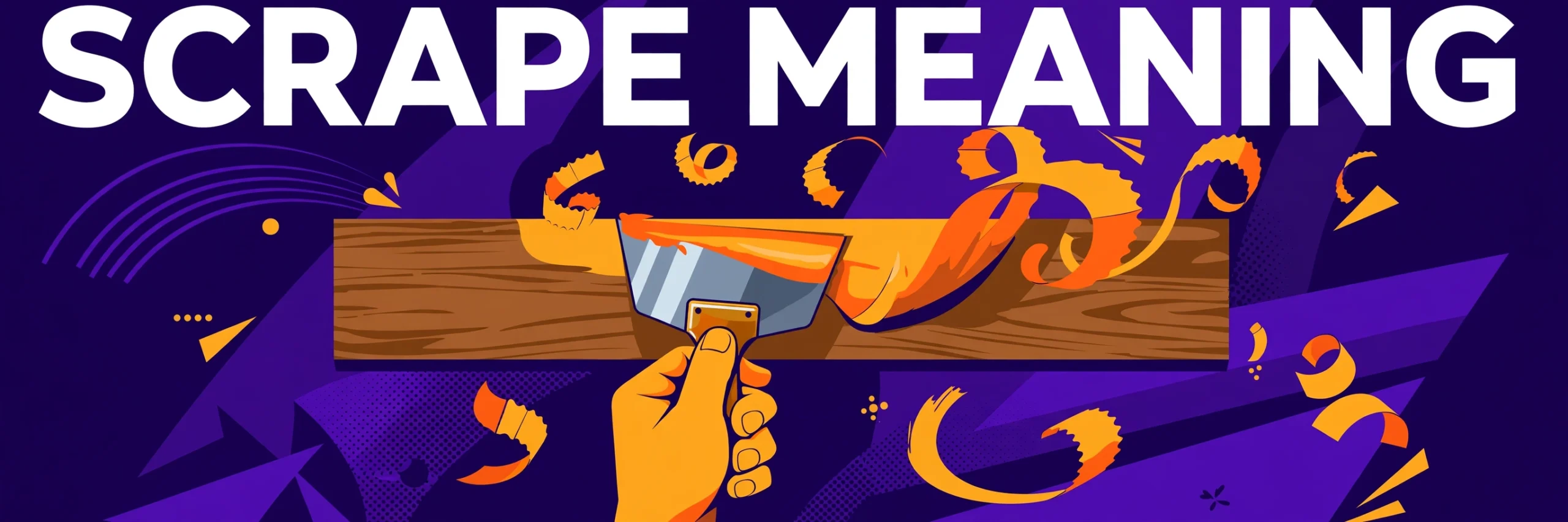
To scrape something is to drag a hard or sharp edge across a surface — and the word carries that rough, grating feeling into everything it does. You scrape paint off a wall, scrape your knee on concrete, scrape together enough money for rent, and scrape through an exam by a single mark. In every case the same picture is at work: something being pulled across something else, with effort, friction, and usually not much to spare.
Quick answer: Scrape means to remove something from a surface by rubbing it with a sharp or rough edge, or to damage a surface by rubbing it against something rough. As a noun, a scrape is a slight injury or mark from rubbing, or an awkward situation you have got yourself into (“getting into scrapes”). In phrasal verbs it means barely managing: scrape by (live with difficulty on little money), scrape through (only just pass), scrape together (gather with effort). Pronounced /skreɪp/ — SKRAYP. Forms: scrapes, scraping, scraped.
What does scrape mean?
Scrape is a verb and a noun with one physical idea at its centre: a surface meeting an edge. The Cambridge Learner’s Dictionary splits the verb into two main senses — DAMAGE (to damage the surface of something by rubbing it against something rough) and REMOVE (to remove something from a surface using a sharp edge) — and the noun into DAMAGE (the slight damage caused by rubbing) and SITUATION (a difficult or dangerous situation that you cause yourself). Merriam-Webster adds the further senses of collecting with difficulty (“scrape up the price of a ticket”) and barely managing (“barely scraping by”).
The word is old: it comes from Old Norse skrapa, replacing the Old English scrapian, “to scratch”, and its first known use in English dates to the 14th century.
How to pronounce scrape
Scrape is pronounced /skreɪp/ — SKRAYP — the same in British and American English. It rhymes with shape, grape, and tape. The spelling is regular: the silent e makes the a long, and the verb forms follow the standard pattern — scrapes, scraping, scraped. Note that scraping keeps the e dropped, as with all verbs ending in silent e: scrape → scraping, never “scrapeing”.
Do not confuse scrape with scrap — a small leftover piece, or a fight.
Scrape as a verb: the main senses
1. To remove something from a surface
This is the most common everyday sense: using a knife, a scraper, a spatula, or any sharp edge to take something off a surface.
- We’ll have to scrape the snow off the car before we go out.
- She scraped the burnt toast over the sink.
- Scrape the carrots and slice them thinly.
- He scraped the mud off his boots on the doorstep.
With this sense you will often see a particle: scrape off, scrape away, scrape out.
2. To damage a surface by rubbing it
- Jamie fell over and scraped his knee.
- The lorry scraped the side of my car as it passed.
- Her coat was too long, and the hem scraped along the pavement.
3. To make a harsh, grating sound
When two surfaces rub and the noise is unpleasant, scrape is the word for it.
- Chairs scraped loudly as everyone stood up.
- He scraped his bow across the violin strings and produced a horrible noise.
- I could hear the branches scraping against the window all night.
4. To collect or achieve something with difficulty
This is the figurative sense, and it is where scrape does some of its most characteristic work. The image is of gathering something bit by bit, the way you might scrape the last butter from a dish — nothing comes easily, and every bit counts.
- They managed to scrape together enough money for the deposit.
- She scraped up the price of a ticket by selling her old textbooks.
- France scraped a 3–2 win over Norway.
- He scraped a pass in the exam with 51 per cent.
The sports and exam examples are chiefly British — Cambridge Learner’s Dictionary marks “scrape a win/draw/pass” as UK — but the meaning is clear everywhere: to win or pass by the narrowest margin.
Scrape as a noun
The noun scrape has three main senses, all growing out of the verb.
A slight injury or mark
“He came away from the accident with only cuts and scrapes.” A scrape in this sense is a graze — the skin is rubbed raw but not deeply cut. It is a minor injury, and the word itself signals that: you would not call a broken leg a scrape.
An awkward situation
“She’s always getting into scrapes.” This is an informal, slightly old-fashioned British use: a scrape is a difficult or embarrassing situation, usually one you have brought on yourself. The phrase get into a scrape is the standard form. Collins lists this sense as “an embarrassing or distressing situation; predicament”. It is the noun behind the school-story hero who is always “in a scrape” — in trouble with a teacher, caught out of bounds, or explaining a broken window.
The phrasal verbs: scrape by, scrape through, scrape together
Cambridge Learner’s Dictionary lists three phrasal verbs under scrape, and they are worth learning as a set, because they are among the most useful things the word does.
| Phrasal verb | Meaning | Example |
|---|---|---|
| Scrape by / scrape along | To manage to live when you do not have enough money or other necessary things; also, to manage with difficulty to reach an acceptable standard | He lost his job, so the family had to scrape by on one small salary. |
| Scrape through (something) | To succeed in something, especially an exam, but only just | She scraped through the exam with the lowest passing grade. |
| Scrape something together | To collect something, especially money, with difficulty and in small amounts | We scraped together enough for a second-hand car. |
Scrape by and scrape through are close but not identical. Scrape by is about surviving on very little; scrape through is about passing a specific test or hurdle. You scrape by on a salary; you scrape through an exam.
There is also a newer, technical sense: in computing, to scrape a website is to extract and copy data from it automatically with a program — web scraping. Cambridge lists this as a verb sense (GET DATA). Note that scraping a website without permission can breach the site’s terms and, in some cases, the law.
Correct vs incorrect usage
| Correct | Incorrect | Why |
|---|---|---|
| She scraped the ice off the windscreen. | She scraped off the ice the windscreen. | With a noun object, the particle goes after the object: scrape the ice off. |
| He scraped his elbow on the wall. | He scraped his elbow from the wall. | Damage is caused on or against a rough surface, not from it. |
| They scraped by on very little money. | They scraped by with very little money easily. | Scrape by already means “only just manage” — adding easily contradicts it. |
| She scraped through her driving test. | She scraped through her driving test with flying colours. | “With flying colours” means easily and brilliantly; scrape through means only just. The two clash. |
| He got into a scrape at school. | He got into a scrap at school. | A scrape is an awkward situation; a scrap is a fight. Different words. |
Common mistakes with scrape
Confusing scrape with scratch
Scratch and scrape overlap but are not the same. A scratch is a thin, narrow mark made by something sharp — a claw, a nail, a key. A scrape is broader and flatter, made by rubbing over an area. You scratch an itch; you scrape your knee. A cat scratches; a car scrapes against a wall. When in doubt, ask whether the damage is a line (scratch) or a patch (scrape).
Confusing scrape with scrap
As noted above, scrap is a different word — a small leftover piece, or a fight. “He got into a scrape” (trouble) and “he got into a scrap” (a fight) describe different afternoons.
Using “scrape by” for easy success
Scrape by and scrape through both carry the idea of difficulty and narrow margins. Do not use them for comfortable success: “She scraped through with 98 per cent” is a contradiction. If it was easy, she sailed through; if it was close, she scraped through.
Forgetting the particle changes the meaning
Bare scrape means to rub or remove; scrape by, scrape through, and scrape together mean to manage with difficulty. The particle is not decoration — it carries the meaning. Dropping it (“We scraped enough money”) is possible but loses precision; adding the wrong one (“scrape by the money together”) is simply wrong.
Examples of scrape in real sentences
- Scrape the mud off your shoes before you come in.
- We scraped together the deposit by saving for a year and selling the old car.
- After the accident, he was lucky to escape with a few cuts and scrapes.
- The small shop barely scrapes by in the winter months.
- He scraped through the final exam by two marks.
- She’s always getting into scrapes — usually by speaking before she thinks.
Frequently asked questions
What does scrape mean in simple terms?
To rub a hard or sharp edge across a surface — either to remove something from it (scrape the paint off) or to damage it slightly (scrape your knee). It also means to manage something only with great difficulty.
What is the difference between scrape and scratch?
A scratch is a thin, narrow mark made by something sharp; a scrape is a broader patch of damage from rubbing over an area. You scratch with a claw or a key; you scrape your knee on concrete or a car against a wall.
What does “scrape by” mean?
To manage to live or get by with difficulty when you do not have enough money or resources. “We had to scrape by on one salary” means the money was barely enough.
What does “scrape through” mean?
To pass something — usually an exam or a selection — but only just, by the narrowest margin. “She scraped through with 51 per cent” means she passed, but only barely.
Is scrape a noun or a verb?
Both. As a verb it means to rub or remove with an edge; as a noun it means a slight injury or mark from rubbing, or an awkward situation you have got yourself into.
What is web scraping?
Using a computer program to extract and copy data from websites automatically. Cambridge lists it as a standard verb sense of scrape. It is a technical term, and scraping a site without permission may breach its terms of use.
The takeaway
Scrape is a physical word that never quite loses its physical feeling: an edge, a surface, friction, effort. Use it for removing things (scrape the paint off), for minor damage (scrape your knee), and for the figurative sense of barely managing (scrape by, scrape through, scrape together). Keep it apart from scratch (a thin mark) and scrap (a leftover piece or a fight), and remember that the phrasal verbs carry the idea of difficulty — so never pair them with easy success. Once you hear the grating sound inside the word, its meanings stop being a list and start being one picture.