Irrevocable Meaning: Definition, Examples and How to Use It
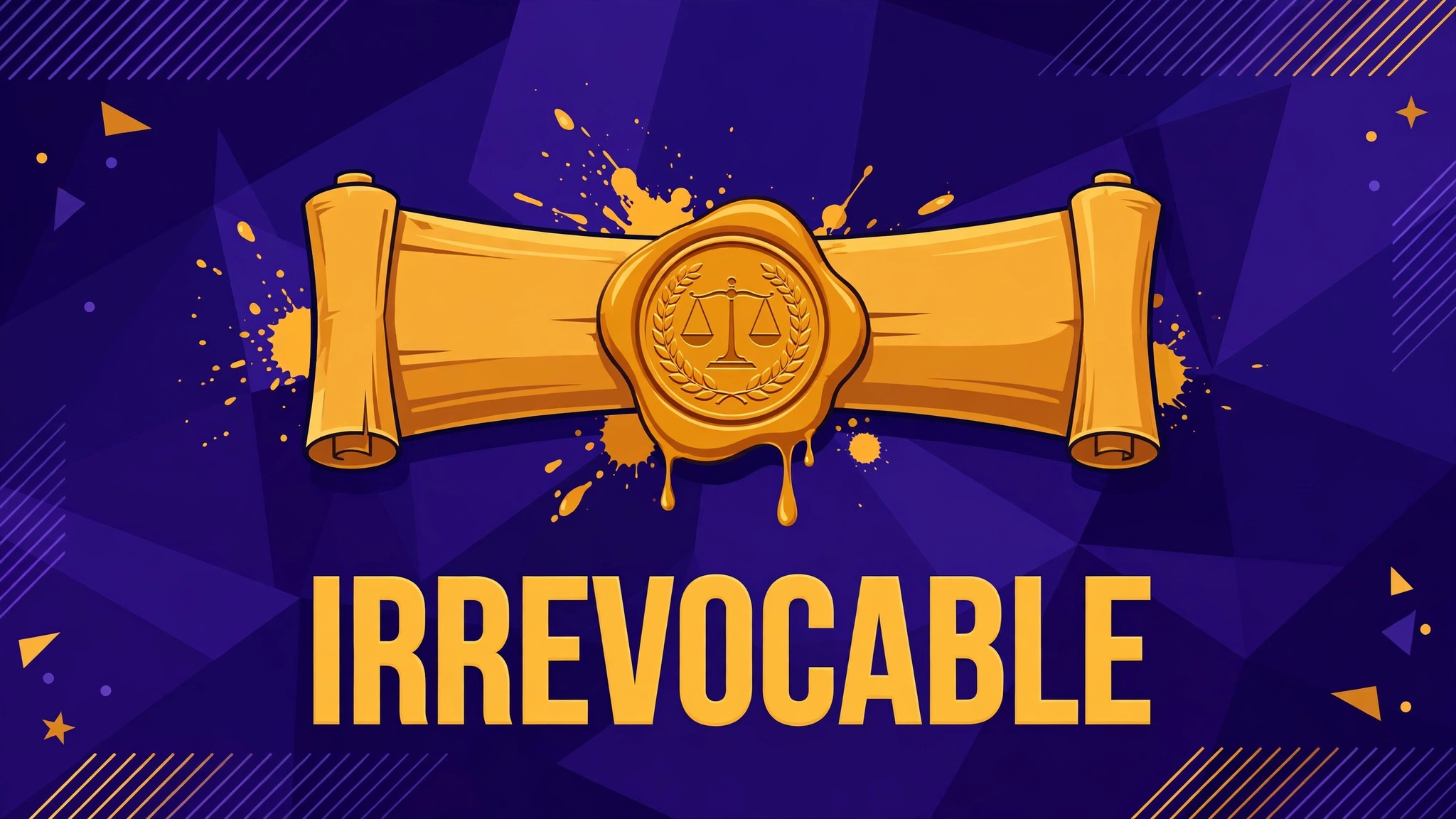
Irrevocable means impossible to change or take back — a decision, promise, or action described as irrevocable is final. It is a formal word, most often applied to decisions, offers, and legal arrangements where going back is no longer an option. This article gives the dictionary definition, pronunciation in British and American English, the word’s origin, real examples, how to use it naturally, and the common mix-ups to avoid.
Quick Answer
Irrevocable (UK /ɪˈrevəkəbl/, US /ɪˈrevəkəbl/) is a formal adjective meaning impossible to change, undo, or take back. Cambridge Learner’s Dictionary defines it as “that cannot be changed”; Merriam-Webster defines it as “not possible to revoke: unalterable”; Collins gives “not possible to change or undo,” with the example “He said the decision was irrevocable.” Its adverb form is irrevocably.
What does “irrevocable” mean? The dictionary definition
The major dictionaries agree, with small differences of emphasis:
- Cambridge Learner’s Dictionary: adjective, formal — “that cannot be changed.”
- Merriam-Webster: “not possible to revoke: unalterable.”
- Collins: “not possible to change or undo” — He said the decision was irrevocable.
- Webster’s 1913 (via later editions): “incapable of being recalled or revoked; unchangeable; irreversible; unalterable; as, an irrevocable promise or decree; irrevocable fate.”
Two things are worth noticing. First, every definition centres on the same idea: the word does not just mean “hard to change” — it means beyond changing. A difficult decision is still revisable; an irrevocable one is not. Second, Cambridge labels the word formal. You will meet it in legal documents, contracts, news reporting, and serious non-fiction far more often than in casual conversation, where people tend to say “final” or “can’t be taken back” instead.
The word usually attaches to decisions, promises, offers, decrees, judgments, and commitments — things that a person or institution declares and then cannot retract:
- “Once the offer is accepted, it becomes irrevocable.”
- “She made an irrevocable commitment to the cause.”
- “The ruling was final and irrevocable.”
- “He signed an irrevocable agreement.”
In each case, the point of using the longer, weightier word is emphasis: this is not merely settled, it is beyond recall.
Pronunciation
Cambridge gives the same transcription for both varieties:
- UK: /ɪˈrevəkəbl/ — “ir-REV-uh-kuh-bul”
- US: /ɪˈrevəkəbl/ — the same
The stress falls on the second syllable (“REV”), matching the stress of revoke, the word it is built on. Three small traps catch learners. First, the word begins with double r — i-r-r, not i-r. Second, the ending is spelled -able but pronounced like “-ubl,” with a reduced vowel (schwa), so it sounds like “kuh-bul,” not “kay-bul.” Third, the vowel before the stress is the short “i” of it, not the long “eye” of ice.
Origin: “not to be called back”
Irrevocable comes from Latin irrevocābilis — in- (“not”) joined to revocābilis (“that can be called back”), from revocāre, “to call back, recall, revoke.” The literal image is of a command or decision that cannot be called back once it has gone out — like an order shouted to an army already marching. The French form irrévocable carried it into English, and the English verb revoke (to officially cancel something) is its direct sibling.
This history explains why the word feels so at home in law. A revocable trust or offer can be cancelled by its maker; an irrevocable one cannot. The dictionary definitions are careful to cover both the ordinary and the legal sense: Merriam-Webster’s “not possible to revoke” leans legal, while Collins’s “not possible to change or undo” is broader. When the article below uses legal examples, it is illustrating the dictionary sense, not giving legal advice — whether a particular agreement is truly irrevocable is a question for a solicitor, not a dictionary.
Irrevocable vs irreversible: what’s the difference?
These two words are the most common mix-up, and they overlap — but they are not identical. Collins lists them as synonyms, which is true in loose use, yet a careful writer keeps a distinction:
| Word | Core idea | Typical subjects |
|---|---|---|
| Irrevocable | Cannot be taken back or cancelled | decisions, promises, offers, decrees, vows |
| Irreversible | Cannot be reversed in effect | damage, changes, processes, trends |
In short: irrevocable is about permission (nobody can retract it); irreversible is about possibility (nothing can turn it back). An irrevocable decision may or may not be reversible in practice — what the word claims is that it cannot be recalled. A promise is irrevocable; brain damage is irreversible. Using one where the other belongs (“an irreversible decision”) is understandable but less precise, since decisions are things people make and revoke, not physical processes to be reversed.
How to use “irrevocable” in sentences
Because the word is formal and absolute, it suits weighty moments and serious writing. Realistic examples:
- Decisions: “The board’s decision to close the factory was irrevocable, and the town knew it.”
- Promises and vows: “They exchanged irrevocable vows in front of their families.”
- Offers and contracts: “Under the terms of the sale, his acceptance was irrevocable for thirty days.”
- News and history: “The treaty made the border change irrevocable.”
- Everyday emphasis: “Once the email was sent, it felt irrevocable — there was no unsending it.”
The adverb irrevocably (also listed by Cambridge) lets you describe actions rather than nouns: “the landscape was changed irrevocably,” “the two friends were irrevocably divided.” Use it sparingly; the adverb is even more formal than the adjective.
A usage note on tone: because irrevocable claims finality, it can sound dramatic. In ordinary speech, saying “my decision is irrevocable” lands harder than “I’ve made up my mind” — closer to a proclamation than a remark. That weight is the word’s whole point, so reserve it for situations that genuinely deserve it, or use it deliberately for comic exaggeration (“her decision about the takeaway was irrevocable”).
Register: choosing the right level of formality
Irrevocable sits at the formal end of a scale, and part of using it well is knowing what sits below it. For ESL learners and careful writers, the same finality can be pitched at three levels:
| Register | Wording | Example |
|---|---|---|
| Formal | irrevocable | “The court’s judgment was irrevocable.” |
| Neutral | final, settled, binding | “The decision is final and binding.” |
| Informal | a done deal, no going back | “Once I quit, there was no going back.” |
Reaching for irrevocable in a text message to a friend will sound oddly grand — which is exactly why it works as deliberate emphasis or gentle humour. The rule of thumb: use the formal word in formal contexts, and earn the weight when you carry it into informal ones.
Common mistakes and confusions
Spelling it with one r. The word is i-r-r-e-v-o-c-a-b-l-e — the double r comes from in- + revoke. “Irevocable” is a misspelling, as is “irrevokable” with a k.
Stressing the wrong syllable. It is ir-REV-uh-kuh-bul, not IR-rev-uh-kuh-bul or ir-rev-oh-KA-bul.
Using it for things that are merely difficult to undo. If a booking can be cancelled with a fee, it is not irrevocable — expensive, perhaps, but not final. The word claims impossibility, not inconvenience.
Confusing it with irreversible. See the table above: revoking belongs to promises and decisions; reversing belongs to processes and effects.
Treating it as a casual synonym for “final.” In informal speech “final” or “settled” usually sounds more natural. Irrevocable is a deliberate, formal choice — use it where the formality fits: contracts, official statements, serious writing.
FAQs
What is the simple meaning of irrevocable?
It means something cannot be changed, undone, or taken back — especially a decision, promise, or agreement.
What is the opposite of irrevocable?
Revocable — something that can be cancelled or withdrawn, such as a revocable trust or a revocable offer. In everyday language, “changeable” or “reversible” are the plain opposites.
Is irrevocable a formal word?
Yes. Cambridge marks it formal. It is standard in legal, business, and official writing, and sounds deliberately weighty in ordinary speech.
What is the adverb form of irrevocable?
Irrevocably — e.g. “the town was changed irrevocably by the closure.” Cambridge lists it alongside the adjective.
What is the difference between irrevocable and irreversible?
Irrevocable means it cannot be taken back or cancelled (a decision, a promise); irreversible means it cannot be reversed in effect (damage, a process). One is about retracting, the other about turning back.
How do you pronounce irrevocable?
UK and US: /ɪˈrevəkəbl/ — “ir-REV-uh-kuh-bul,” with the stress on “REV” and a double r at the start.
Takeaway
Irrevocable is the dictionary’s word for finality: a formal adjective (from Latin irrevocābilis, “not to be called back”) meaning impossible to change, undo, or revoke. Use it for decisions, promises, and agreements that are truly beyond recall; pronounce it “ir-REV-uh-kuh-bul”; spell it with a double r; and keep it distinct from irreversible, its near-synonym for things that cannot be reversed in effect. When something is genuinely past the point of return, this is exactly the word the occasion calls for.