Collab Meaning: Definition, Examples and How to Use It
Collab is an informal shortening of collaboration — a joint project made by two or more people working together. It is the word of YouTube videos, music releases, fashion drops, and influencer partnerships: “their new collab just dropped.” Collins records it as slang in British English and informal in American English, pronounced /kəˈlæb/. It is not a word for formal writing — there, collaboration is the right choice. This article covers the definition, pronunciation, where the word lives, how it differs from collaboration, and the mistakes people make with it.
Quick Answer
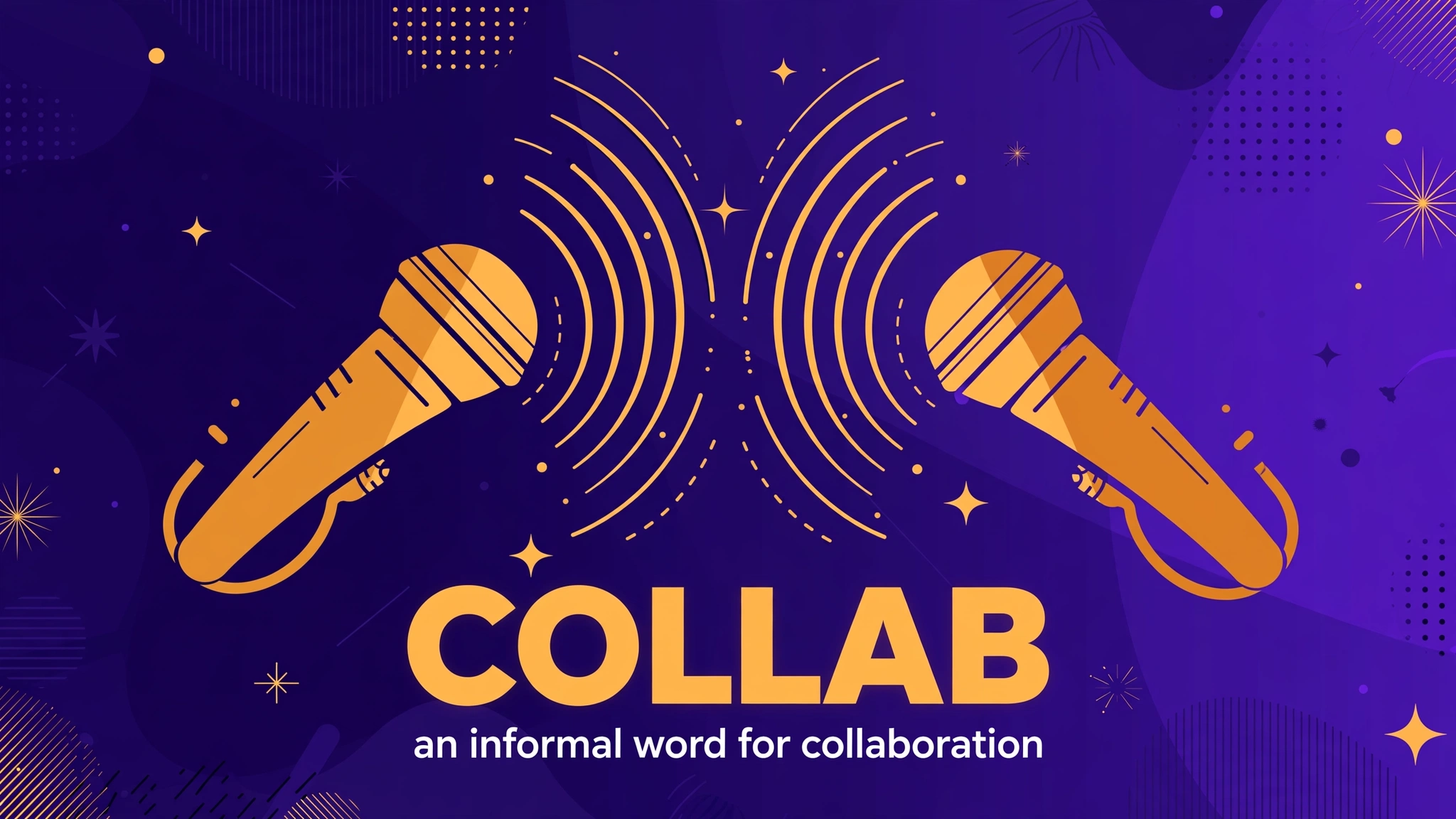
Collab (noun, informal) means a collaboration — a piece of work created jointly by two or more people, or the act of working together. “The fashion house announced a collab with the streetwear label.” It is slang (Collins, British English) / informal (Webster’s New World, American English), pronounced /kəˈlæb/. In formal writing, use collaboration instead.
What “collab” means
The core meaning is simple: collab = collaboration. It is a clipped form — English speakers cut the longer word collaboration down to its first two syllables, the same way advertisement becomes ad or laboratory becomes lab.
Collins records collab as a noun and labels it slang in British English. In American English, Webster’s New World College Dictionary (carried by Collins) calls it informal and defines it as “a collaboration, specif., an amateur video consisting of portions shot or created by different people.” Collins also lists collab. as an abbreviation with two readings: 1. collaboration, 2. collaborator.
So the word has two overlapping lives: it is both a casual shortening of collaboration and, in American usage, a word for the thing that is made together. Either way, the tone is informal. “They’re doing a collab” sounds like a creator talking to fans; “the two institutions announced a collaboration” sounds like a press release.
Pronunciation: UK vs US
There is no Atlantic split here — Collins gives the same pronunciation for both varieties:
- British English: /kəˈlæb/ — kuh-LAB (Collins British). Stress on the second syllable.
- American English: /kəˈlæb/ — kuh-LAB (Collins US / Webster’s New World). Identical.
The word is simply the first two syllables of collaboration — say colla-boration, drop the last three syllables, and you have it. One thing to avoid: do not rhyme it with “crab” fully — the stressed vowel is the flat a of lab, not collab rhymed with stab with a rounded first syllable. The first syllable is a weak kuh-, the way it is inside collaboration.
Where the word lives
Collab was born in creative internet culture and is still happiest there. Its natural habitats:
- Music. “Her collab with the DJ went platinum.” Two artists record together; the track is a collab.
- YouTube and streaming. This is the word’s original stronghold — Webster’s New World specifically defines it around amateur video made by different people. “The gaming channel just released a collab video with a popular streamer.”
- Fashion. “The hottest capsule collab of the year” (Collins example). Designer × brand limited releases are almost always collabs in the press.
- Influencer and social media culture. “They want to talk collab” (Collins example). Brands and creators negotiate collabs — joint posts, paid partnerships, gifted products.
- Gaming. Crossover events between games and franchises are routinely called collabs by players and studios alike.
- Business, but casually. Startup founders say “we’re doing a collab with the agency” in conversation; the contract will say collaboration or partnership.
Notice the pattern: wherever the audience is young, online, or creative, collab is the default. Wherever the audience is institutional — academia, law, government, formal business — collaboration keeps its place.
Can “collab” be a verb?
You will hear it constantly: “Let’s collab,” “we collabed last summer,” “they’re collabing on the album.” This verb use is completely normal in casual speech — but here is the honest dictionary picture: Collins records collab as a noun only. The verb use is an informal extension by analogy with collaborate, not a separately listed dictionary sense.
That is not the same as saying it is wrong. English speakers routinely turn noun clippings into verbs (email, text, DM all started as nouns). For everyday conversation, “let’s collab” is unremarkable. For writing, keep the verb collaborate and the noun collaboration — “we collaborated on the project” never sounds out of place, while “we collabed” does in anything formal.
Collab vs collaboration
The difference is register — how formal the situation is — not meaning:
| Situation | Say | Example |
|---|---|---|
| Casual conversation, social media, texts | collab | “This collab is going to be huge.” |
| News reporting on music/fashion | collab | “The capsule collab sold out in hours.” |
| Work email, press release | collaboration | “We are pleased to announce our collaboration with…” |
| Academic writing, CVs, reports | collaboration | “The study was produced in collaboration with…” |
A useful test: if you would shorten other words in the same sentence (saying photo instead of photograph, info instead of information), collab fits. If the sentence demands full forms, so does this one.
Common mistakes and confusions
Using “collab” in formal writing. The single most common error. A CV that says “led several collabs” reads as careless; “led several collaborations” reads as professional. Match the word to the room.
Writing “colab.” The spelling is collab — double l, from collaboration. Do not confuse it with Google Colab, the cloud notebook product, which is a proper noun with a single l after co- (short for collaboratory, a play on laboratory). Different word, different origin, capital C.
The plural. Collabs is the normal plural (“she’s done three collabs this year”) — fine in informal contexts. In formal writing, the plural is collaborations.
Treating “collab.” with a full stop as the same word. In writing, collab. (with the period) is an abbreviation, most often for collaboration — but Collins also records it as an abbreviation of collaborator, the person. In speech there is no period, and the person-sense of “collab” (“she’s my collab on this”) is rare; collaborator is the safe word for the person in any register.
Overusing it with older audiences. Collab marks the speaker as internet-native. With an audience that lives in formal registers, the word can sound unserious even when the project is real. Read the room, not just the dictionary.
Examples in sentences
- “The fashion house announced a collab with the streetwear label.”
- “Her collab with the producer topped the charts in a week.”
- “Is there anything as sad as last year’s collab?” (Collins example)
- “The gaming channel just released a collab video with a popular streamer.”
- “They want to talk collab” — i.e. discuss a possible joint project (Collins example).
- “This garbling doesn’t sound like an affordable clothing collab, though” (Collins example) — showing the word’s natural home in fashion talk.
- “Our two studios are doing a collab on the winter update,” said the developer.
FAQs
Is “collab” a real word?
Yes. Collins records it as slang (British English) and informal (American English); Webster’s New World defines it as a collaboration, especially an amateur video made by different people. It is real but informal — not a word for formal writing.
What is the difference between “collab” and “collaboration”?
Meaning: nothing. Register: everything. Collab is the casual, spoken, internet-native form; collaboration is the neutral, written, formal form. Use collaboration in emails, reports, CVs, and academic writing.
How do you pronounce “collab”?
/kəˈlæb/ — kuh-LAB, stress on the second syllable. The pronunciation is the same in British and American English.
Can “collab” be used as a verb?
In casual speech, yes — “let’s collab” is completely normal. But Collins lists it as a noun only, so in writing (and anywhere formal) use collaborate: “we collaborated on the project.”
What is a “collab video”?
A video made jointly by two or more creators — each films a portion, and the parts are combined. Webster’s New World even builds this into the American definition of collab: “an amateur video consisting of portions shot or created by different people.”
Is “colab” (Google Colab) the same thing?
No. Google Colab is a proper noun — a cloud notebook service whose name plays on collaboratory. The informal word is spelled collab, double l, from collaboration.
The takeaway
Collab is the informal, internet-era form of collaboration — a joint project, recorded by Collins as slang (British) or informal (American), pronounced kuh-LAB. It owns music, YouTube, fashion, and creator culture, and it even works as a verb in casual speech (“let’s collab”). But it stays out of formal writing: in a CV, a report, or a press release, the word is collaboration. Match the word to the room, and the clipping will serve you well.