Caravan Meaning: Definition, Origin and Examples
Caravan Meaning: Definition, Origin and Examples
Ask a Briton what a caravan is and they will picture a white box on wheels towed behind a car on a rainy holiday. Ask an American and they may picture a line of camels crossing a desert — or reach for the word trailer instead. Both pictures are correct. Caravan is a noun (and, less commonly, a verb) with two great branches of meaning: a group of travellers journeying together, and a vehicle you can live in. A Persian word that crossed the Silk Road now covers everything from ancient trade routes to British holiday parks.
What the Dictionaries Say
Cambridge leads with the British vehicle sense: a caravan is “a vehicle on wheels for living in, pulled by a car etc” — adding the note “camper American” — with the example we hitched the caravan up to the car. It also records the travellers’ sense: a caravan of merchants.
Merriam-Webster’s learner’s dictionary gives the travellers’ senses first: “a group of people or animals traveling together on a long journey especially through the desert,” and “a group of vehicles (such as cars or wagons) traveling together.” Collins is the most complete, listing in American English: (1) “a group of travelers, as merchants or pilgrims, journeying together for safety in passing through deserts, hostile territory, etc,” (2) “a caravan of trucks” or “a camel caravan,” (3) “a large covered vehicle for conveying passengers, goods, a sideshow, etc; van,” and (4) chiefly British, “a house on wheels; trailer.”
So the full map looks like this: the journey sense (people, animals, or vehicles travelling together), the vehicle sense (split by dialect — British caravan versus American trailer/camper/RV), and a verb sense (“to travel in or as if in a caravan” — Collins’s example: they caravaned through Egypt).
How to Pronounce Caravan (UK and US)
The pronunciation is essentially the same in British and American English:
- UK: /ˈkærəvæn/ — “KA-ruh-van”
- US: /ˈkærəvæn/ — “KA-ruh-van”
The stress is on the first syllable, KA, which uses the short “a” of cat — never the “a” of cake. The word has three syllables: ka-ruh-van. The most common learner error is stressing the second syllable (“kuh-RA-van”), which no native speaker does. Keep the weight on the front and let the rest of the word trail behind, like the vehicle itself.
Where the Word Comes From
Caravan has one of the most romantic etymologies in the dictionary. Merriam-Webster traces it through Italian caravana to Persian kārvān; Collins gives the chain as Italian carovana from Persian kārwān, dating the English word to the 1590s–1600s, with first recorded use of the noun in 1588. The Persian root goes deeper still: Middle Persian kārawān, from an Old Persian word meaning “people” or “subjects.”
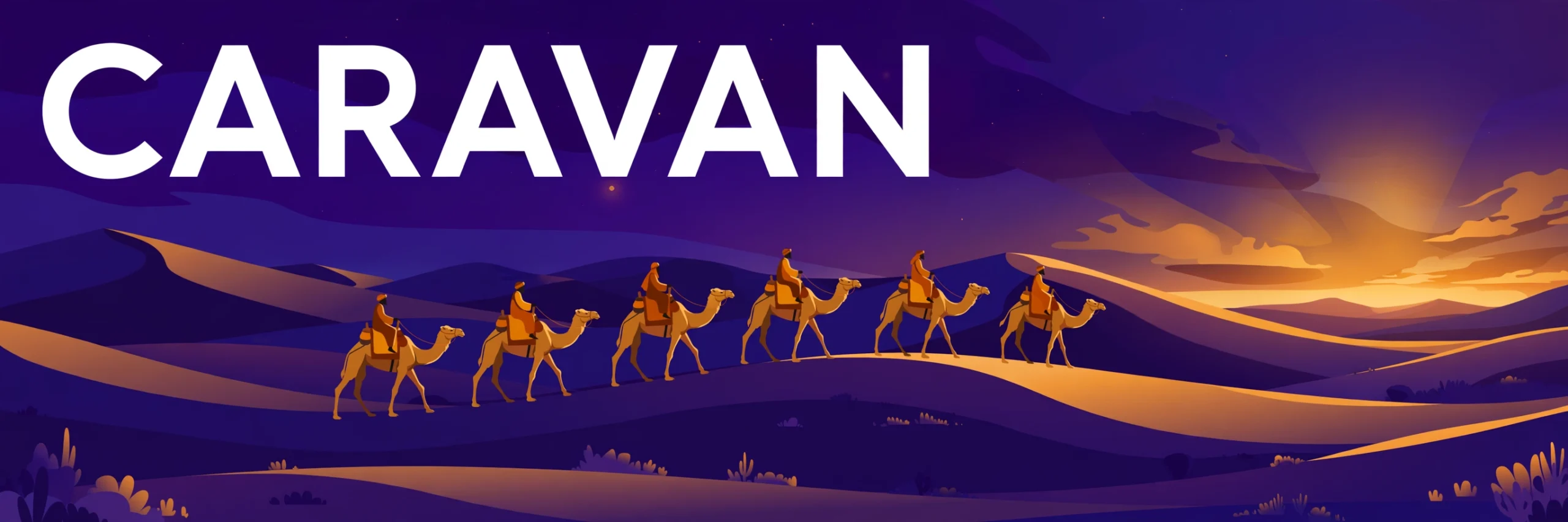
The word travelled the route it describes. Persian kārvān named the companies of merchants who crossed the deserts of Central Asia by camel along the Silk Road — travelling in numbers for safety against bandits and the desert itself. It passed into French (caravane) and Italian during the age of the Crusades and the great overland trade, and from there into English in the late 16th century, exactly when English merchants and travellers were first writing about the East in detail.
The vehicle sense came later: from a “company of travellers” to the “covered wagon” such a company used, and eventually — in 20th-century Britain — to the towed holiday home. The related words preserve the old world: a caravanserai was the fortified inn where caravans rested, and a caravaneer was the leader of a caravan.
The British–American Split
This is the practical point that confuses learners most. In British English, caravan as a vehicle is an everyday word: caravan parks, caravan holidays, static caravans (ones that stay put on a site). In American English, the vehicle is a trailer, a camper, or an RV (recreational vehicle) — caravan for the vehicle sounds distinctly British or old-fashioned to American ears.
But Americans do use caravan freely in the journey sense: “a caravan of trucks,” “a caravan of SUVs heading to the campsite,” “a camel caravan.” And in news writing, “caravan” has become the standard term for a large group of people travelling together overland — used, for example, for groups of migrants moving through Central America toward the US border. That usage is simply the ancient desert sense applied to a modern journey.
One more American note: the Dodge Caravan was a famous minivan sold from the 1980s onward. It is a brand name borrowing the word’s travelling connotations — not a dictionary sense, and not a reason to capitalise the word in ordinary writing.
Examples in Real Contexts
- We hitched the caravan up to the car. (Cambridge’s example — British vehicle sense)
- A caravan of merchants crossed the desert. (Cambridge’s example — travellers’ sense)
- They caravaned through Egypt. (Collins’s example — verb sense)
- Trucks caravaned food and medical supplies to the flood’s survivors. (Collins’s example — verb, carrying sense)
- We caravaned to the campsite. (Merriam-Webster’s example — travelling in a group of vehicles)
- Every summer they take the caravan to the coast. (British holiday usage)
- A camel caravan moved slowly across the dunes at dawn.
Common Mistakes
- Spelling: It is caravan — c-a-r-a-v-a-n. Learners sometimes write “carravan” (double r) or “caraven.” The verb forms double the n in British spelling: caravanning, caravanned (American usage sometimes writes “caravaning,” “caravaned” with a single n — both appear in dictionaries).
- Using the vehicle sense with Americans: Saying “we stayed in a caravan” to an American may draw a blank — say “camper” or “travel trailer” instead.
- Capitalising it: caravan is a common noun. Only capitalise for brand names (Dodge Caravan) or at the start of a sentence.
- Confusing caravan with convoy: A convoy is a group travelling together for protection, usually with an organised escort (military or official). A caravan is broader — any group journeying together. All convoys are caravans in the loose sense; not all caravans are convoys.
- “Caravan” vs “caravanserai”: The caravan is the travelling group; the caravanserai is the inn where it stopped. Related, not interchangeable.
FAQs
Is a caravan the same as an RV?
Roughly, with a dialect difference. In British English, a caravan is a towed living vehicle; in American English the equivalent is a travel trailer or camper. An RV (recreational vehicle) in American usage usually means a motorised one — what the British would call a motor caravan or motorhome.
What is a “static caravan”?
A caravan (in the British vehicle sense) that stays permanently on a site — common in UK holiday parks. It has wheels but is not designed to be towed around regularly.
Can “caravan” be a verb?
Yes. To caravan means to travel in a caravan — in a group of vehicles or as a travelling party. They caravaned through Egypt. It is far less common than the noun, and Merriam-Webster dates the verb to 1885, three centuries after the noun.
Where does the word “caravan” come from?
From Persian kārvān (“company of travellers”), via Italian and French, entering English in the late 1500s. It originally named the merchant companies crossing Asian deserts by camel on the Silk Road.
The Takeaway
Caravan is a Persian word that walked the Silk Road into English: a group of travellers journeying together, and — in British English — the wheeled home they tow behind the car. Remember the dialect split (trailer/camper in American English), stress the first syllable, and save the capital letter for the minivan.