Best by Date Meaning: What Does ‘Best by’ Mean on Food?
Open almost any packet in your kitchen and you will find a date stamped on it — and, very often, the words best by printed just above it. Most people read that date the way they read the expiry date on a carton of milk: as a deadline after which the food is no longer safe. That reading is wrong, and it is expensive: confusion over date labels is one of the largest drivers of household food waste, with perfectly good food thrown away because a quality date was mistaken for a safety date.
A best by date is not a safety warning. It is the manufacturer’s opinion about when the food will taste and look its best. That single distinction — quality, not safety — is the whole meaning of the phrase. This article explains what it means, how it differs from “use by” and “sell by”, and what to do when the date has passed.
What Does “Best by Date” Mean?
An honest point first: “best by date” is not a headword in the major dictionaries. You will not find an entry in Cambridge, Oxford Learner’s, Merriam-Webster, or Collins, because it is a phrase built from ordinary words — best, by, and date — rather than a word in its own right. Its meaning comes from the bodies that regulate food labelling: the US Department of Agriculture (USDA) and the Food and Drug Administration (FDA), and the Food Standards Agency (FSA) in the United Kingdom.
What those bodies say is consistent. The USDA states that a “Best if Used By/Before” date indicates when a product will be of best flavour or quality, and that “it is not a purchase or safety date” — and that, except for infant formula, dates “are not an indicator of the product’s safety and are not required by Federal law.” The UK’s GOV.UK labelling guide says the same in plainer language: “Use-by dates relate to the safety of food, whereas best before dates relate to quality.”
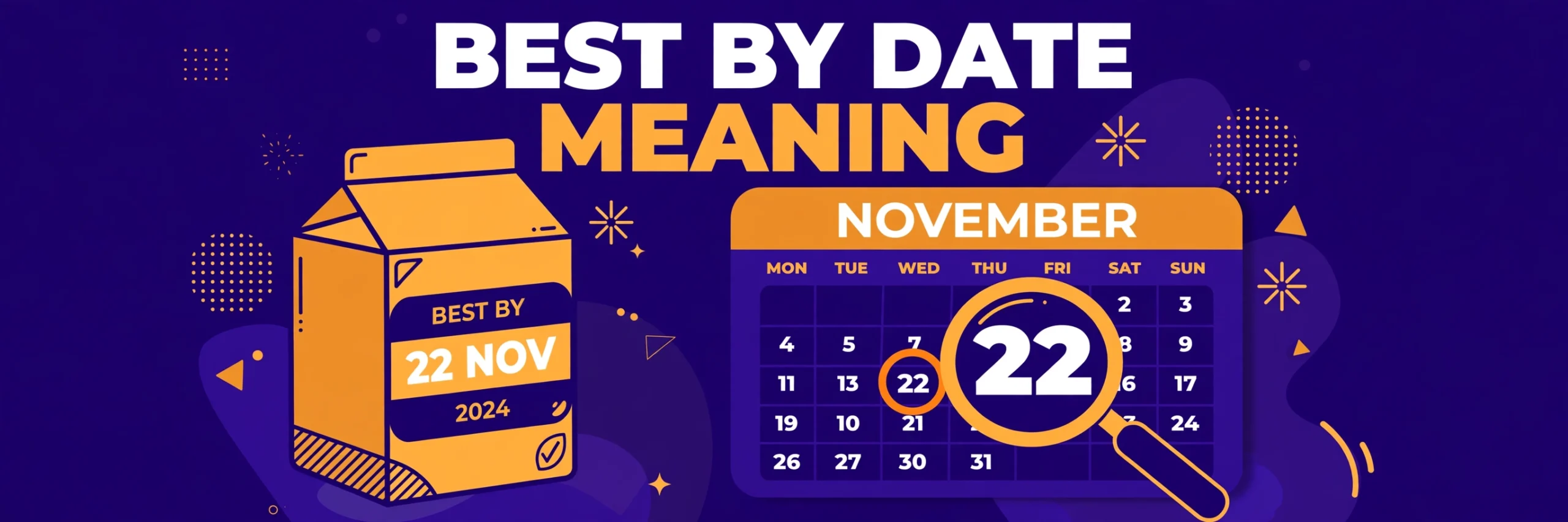
So the phrase breaks down like this: best is the food at its best — its intended flavour, texture, and aroma. By marks the end of the period during which the manufacturer can stand behind that quality. Read together, “best by 22 November” means “we expect this to be at its best until 22 November” — not “this becomes dangerous on 23 November.”
Quality, Not Safety: The One Distinction That Matters
Food goes bad in two different ways. Safety is about whether eating it could make you ill — harmful bacteria in perishable food. Quality is about whether it is still as good as meant to be — crisp crackers going soft, cereal losing its crunch, coffee losing its aroma.
A best by date is entirely about the second of these. After the date passes, the food’s quality may decline: biscuits soften, spices fade, tinned food may darken slightly. But the food does not become unsafe on that day. The USDA is explicit: “The quality of perishable products may deteriorate after the date passes; however, such products should still be safe if handled properly.” The condition matters — the food must have been stored as instructed, and you must still check it. A swollen tin, a broken seal, mould, or an off smell are signs of spoilage that override any date.
The date is also the manufacturer’s judgement, not a laboratory measurement: predicting when a food will no longer be of adequate quality is not an exact science, as the USDA acknowledges. Different manufacturers use different terms and may choose different dates for the same product — “Food producers use all kinds of different phrasing on their packaging,” notes MD Anderson’s food-safety guidance.
Best By vs Use By vs Sell By vs Expiry Date
The confusion comes largely from the other phrases printed on packets. They look alike, but they mean different things, and mixing them up is how good food ends up in the bin.
| Label phrase | What it means | Who it is for |
|---|---|---|
| Best by / Best if used by | When the food is expected to be at its best flavour and quality. Quality, not safety; food is usually fine after it if stored properly. | The consumer |
| Best before | The UK equivalent of “best by”. Same meaning: quality, not safety. Also shown as “best before end” (BBE). | The consumer (UK) |
| Use by | The last date recommended for peak quality. In the UK this is a safety date: do not eat food past it. In the US it is a quality recommendation, except on infant formula, where it is a safety and nutrition deadline. | The consumer |
| Sell by | An inventory date telling the shop how long to display the product. Not a safety date; food is usually fine for days or weeks after it. | The shop, not you |
| Freeze by / Use or freeze by | The date by which the food should be cooked or frozen. Found on meat and other perishable foods. | The consumer |
| Expiration date | In the US, only infant formula is legally required to carry one. Never use formula after the date — the nutrients may have degraded. | The consumer |
The “use by” row deserves attention, because the US and the UK treat it differently. In the UK, a use by date is a safety date, set by law on foods that go off quickly, such as meat products and ready-to-eat salads — and it is a criminal offence to sell food after its use by date. In the US, “use by” is a manufacturer recommendation for peak quality, and the only date with legal force is the one on infant formula. The same two words, two different legal realities.
In the United States the standard phrase is “best by”, usually written in full as “best if used by” — the wording the USDA and FDA recommend, because research showed it helps consumers understand the date is about quality. In the United Kingdom the standard phrase is “best before”. The legal position differs too: in the US, except for infant formula, dating is not required by federal regulations and manufacturers add dates voluntarily; in the UK, most prepacked foods must show either a use by or a best before date. From 1 July 2026, California’s AB660 law requires manufacturers there to use only “Best if used by” for quality and “Use by” for safety.
What Should You Do After the Best By Date Passes?
Use your senses, and use them honestly. The USDA’s position is that food not showing signs of spoilage “should be wholesome and may be sold, purchased, donated and consumed beyond the labeled ‘Best if Used By’ date.” Check the packet first — an intact seal, no swelling, no mould — then look, smell, and taste a little. Stale crackers and faded spices are quality problems; mould, sour smells, and sliminess are spoilage, and the food should be thrown out.
Remember what kind of food it is. Dry goods — pasta, rice, flour, canned soup, breakfast cereal — hold up best and are often fine for weeks or months beyond the date when sealed and stored properly. Fresh meat, dairy, and ready meals carry use by dates, not best by dates, and the rules for them are stricter. Never apply this to infant formula, where the date is a genuine deadline. One warning cuts the other way: the FSA has stressed that the “sniff test” must never be used on food past its use by date — “You can’t always smell (or taste) the bacteria that cause food poisoning.”
Common Mistakes With “Best By” Dates
Treating “best by” as an expiry date. An expiry date says the product should not be used after that day; a best by date says it may not be at its best after that day. In the US, only infant formula has a true expiry date.
Throwing food away on the date itself. The date is the last day of best quality, not the first day of danger. A box of cereal dated today is not poison tomorrow morning.
Assuming the dates are legally standardised. In the US there is no uniform system for food dating — the USDA says so directly — and manufacturers choose their own wording and dates. The date is a guide from one manufacturer, not a measurement.
Ignoring storage instructions. A best by date only holds if the food has been stored as the label says: “store in a cool, dry place,” “keep refrigerated once opened.” A packet left open in a damp cupboard may go stale long before its date, and a properly sealed tin may outlast it by months.
Frequently Asked Questions
Is food safe to eat after the best by date?
Usually, yes — if stored properly and showing no signs of spoilage. The USDA states that food not exhibiting signs of spoilage should be wholesome and may be consumed beyond the labelled date. The exception is infant formula, which must never be used after its use by date.
What is the difference between “best by” and “use by”?
“Best by” is a quality recommendation: the food is at its best before that date. “Use by” is the last date recommended for peak quality in the US — and in the UK it is a safety date, meaning the food should not be eaten after it. In both countries, “use by” dates appear on foods that spoil faster, such as meat, dairy, and ready meals.
What does “best before” mean?
“Best before” is the British equivalent of the American “best by”: the food is expected to keep its quality — flavour, texture, and appearance — until that date, when stored as instructed. After it, the food is usually still safe to eat but may not be at its best.
How long after the best by date is food still good?
There is no single answer: it depends on the food and how it has been stored. Dry, sealed goods such as pasta, rice, and canned foods often remain good for weeks or months past the date. When in doubt, check the packet, the smell, and the appearance — and if anything seems off, throw it out.
The Takeaway
A best by date is the manufacturer’s promise about quality, not a warning about safety. It tells you when the food will be at its best — and nothing more. Food past the date is usually still safe if stored properly and showing no sign of spoilage; what it may have lost is its freshness. Keep the three phrases apart — best by for quality, use by for the stricter deadline, sell by for the shop — and remember the single exception: infant formula.
Sources: USDA Food Safety and Inspection Service, “Food Product Dating”; GOV.UK, “Understanding food labelling” (Food Standards Agency guidance); Virginia Cooperative Extension, “Understanding Dates on Labels of Donated Food”; University of Georgia Extension, “Best by vs. sell by” (food-safety guidance); MD Anderson Cancer Center, “Sell by, best by and use by dates: 5 things to know”. “Best by date” is not a headword in Cambridge, Oxford Learner’s, Merriam-Webster, or Collins; the meaning given here follows the labelling authorities named above, and the component words “best”, “by”, and “date” are standard dictionary words. No external links are included.