Uncle Sam Meaning: Definition, Origin and Examples
“Uncle Sam” is an informal name — and a familiar pictured figure — for the United States or its government. When people say “Uncle Sam wants you,” “paying Uncle Sam,” or “Uncle Sam stepped in,” they are not talking about a real uncle. They are personifying the country: turning an institution into a person so it can act, ask, pay, or demand. This article defines the term properly, gives the pronunciation in British and American English, explains how the figure looks and why, traces the origin honestly (including the famous Samuel Wilson story and why historians debate it), and shows how to use the name naturally without overusing it.
Quick Answer
Uncle Sam (UK /ˌʌŋ.kəl ˈsæm/, US /ˌʌŋ.kəl ˈsæm/) is an informal way of referring to the United States, or especially the US government. Cambridge Dictionary defines it as “the US, or its government, sometimes represented by an image of a tall, thin man with a white beard and a tall hat.” It takes capital letters, has no article in most uses (Uncle Sam, not “the Uncle Sam”), and is commonest in journalism, political speech, and everyday talk about tax, military service, or federal action.
What does “Uncle Sam” mean? The dictionary definition
The major dictionaries are unusually consistent here:
- Cambridge Dictionary: “the US, or its government, sometimes represented by an image of a tall, thin man with a white beard and a tall hat.”
- Oxford Learner’s Dictionaries: “a way of referring to the United States of America or the US government (sometimes shown as a tall man with a white beard and a tall hat)” — with the example “He owed $20,000 in tax to Uncle Sam.”
- Merriam-Webster: “the U.S. government” and “the American nation or people.”
- Collins COBUILD: “Some people refer to the United States of America or its government as Uncle Sam,” labelled mainly US and journalism.
Two senses run together in everyday use. In its narrower sense, Uncle Sam is specifically the federal government — the body that collects income tax, runs the armed forces, and spends public money. “Uncle Sam picked up the tab” after a federal grant, or “Uncle Sam wants a cut” at tax time, both use this sense. In its broader sense, it is the nation as a whole — the country personified. “The world looked to Uncle Sam” after a crisis is about the United States acting on the stage, not just a department in Washington.
Grammatically, Uncle Sam is a proper noun treated as masculine (Uncle Sam wants you; Uncle Sam tightened his belt), taking a singular verb, and resisting the except when the pictured figure is meant (“the Uncle Sam on the poster”). Personification is the point — governments do not normally want or demand, but a person with a name can.
The pictured figure: what Uncle Sam looks like
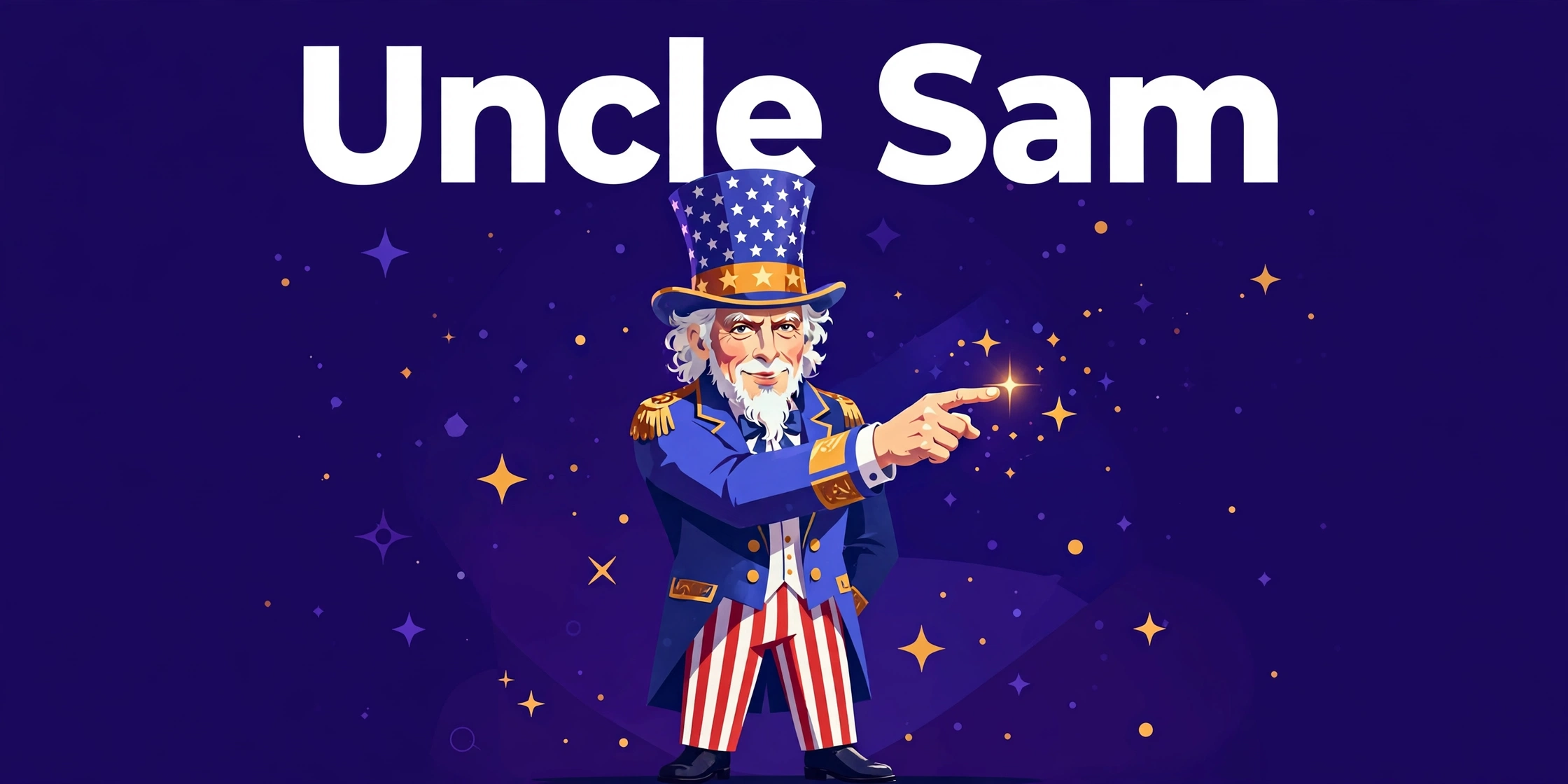
Cambridge and Oxford both mention the image because the visual is inseparable from the name. The conventional Uncle Sam is a tall, lean older man with white chin whiskers or a white goatee, a blue tailcoat, red-and-white-striped trousers, and a tall top hat with a band of white stars on blue. Collins and the American Heritage tradition add the detail that the trousers echo the flag’s stripes while the hat carries its stars-and-stripes colouring.
That appearance was not fixed from the start. Early American personification leaned on Brother Jonathan — a rustic New England figure from the Revolutionary era. Uncle Sam displaced him during the 19th century, and cartoonists gave him the sterner look we recognise. Thomas Nast, who also shaped the modern Santa Claus and the party donkey and elephant, popularised a white-bearded Sam in the 1860s and 1870s.
The most famous image came later. James Montgomery Flagg painted the pointing Uncle Sam in 1916 and adapted it for the 1917 recruiting poster “I Want YOU for U.S. Army,” using his own face as the model. Printed by the millions and revived in the Second World War, that poster fixed the pointing finger in popular memory — which is why “Uncle Sam wants you” still echoes even in sentences about taxes or jury duty.
Pronunciation
There is almost no British–American split to warn about. Both Oxford and Cambridge give:
- UK: /ˌʌŋ.kəl ˈsæm/ — “UNG-kul SAM”
- US: /ˌʌŋ.kəl ˈsæm/ — the same
Two points catch learners. First, uncle begins with the short “u” heard in cup (/ʌ/), not the “oo” of uncle misread as “oon-cle.” The k sound links straight into the l: “UNG-kul.” Second, the stress is light on Uncle and firm on Sam — the name behaves like most two-word names, with the second element carrying the weight. Sam rhymes with ham and jam.
Origin: the initials, the meat-packer, and what is actually known
Every dictionary agrees on the linguistic seed: Uncle Sam is an expansion of the letters U.S., the abbreviation for the United States. Merriam-Webster’s etymology says exactly that — “expansion of U.S., abbreviation of United States” — and dates the first known use to 1803. Oxford’s word origin echoes it: early 19th century, “said … to have arisen as an expansion of the letters US.” Collins notes the 19th-century interpretation of letters stamped on army supply boxes during the War of 1812.
The celebrated human story attached to that seed needs care. It runs like this: Samuel Wilson, a meat-packer in Troy, New York, supplied barrels of beef and pork to the United States Army during the War of 1812. The barrels were stamped “U.S.” to mark government property. Wilson was known locally as “Uncle Sam,” and soldiers from Troy who knew him joked that the initials stood for their supplier. The joke spread through the camps, a Troy newspaper printed it, and the nickname widened from “Wilson’s provisions” to everything stamped U.S., then to the government itself. In September 1961, Congress recognised Samuel Wilson as “the progenitor of America’s national symbol of Uncle Sam,” and Troy still calls itself the Home of Uncle Sam.
That story is not invented out of nothing — Wilson existed, he did supply the army, and the Troy connection is early. But the dictionaries are deliberately cautious. Oxford says “said … to have arisen,” Collins says “apparently a humorous interpretation,” and the Oxford English Dictionary has noted that later statements connecting the name with particular officials named Samuel “appear to be unfounded” — a reminder that the U.S. → Uncle Sam wordplay could have arisen without any historical Sam, the way folk etymology fastens a tidy personal tale onto a pun. Naval evidence from 1810 already uses “Uncle Sam” for the government, and the first newspaper appearance commonly cited is the Troy Post of 7 September 1813, which treats the phrase as already current.
The honest position — and the one this article takes — is to present both layers: the linguistic origin in the initials U.S. is secure; the Samuel Wilson barrel story is the traditional explanation, officially honoured, but not provable in its neat anecdotal form. National personifications often acquire a birth story after the fact, and the 1961 recognition tells you how much Americans wanted the figure to have a human namesake, not that every detail happened as retold.
How to use “Uncle Sam”
Uncle Sam works best where the government acts like an agent — taking, giving, asking, insisting:
- Taxes and money owed. “She paid Uncle Sam an extra $4,000” means she paid federal tax; “Uncle Sam will take his share first” is about withholding.
- Military and national service. “Uncle Sam wants you” works straight (enlistment) or ironically (any federal summons).
- Federal help or intervention. “After the flood, towns looked to Uncle Sam for rebuilding money” — the federal purse, not the population.
- The country acting abroad. “Uncle Sam sent aid” uses the broader, nation-as-actor sense.
Attested examples show the range: Oxford’s “He owed $20,000 in tax to Uncle Sam”; Collins’s “They are ready to defend themselves against Uncle Sam’s imperialist policies”; Merriam-Webster’s “Uncle Sam wants you to join the Army!” The phrase is informal to journalistic — at home in headlines and conversation, out of place in contracts or formal diplomatic prose, where “the United States government” is required. Its tone can be affectionate, weary, or hostile depending on the speaker.
Common mistakes and confusions
Writing “uncle sam” in lower case. It is a proper noun; dictionaries capitalise both words: Uncle Sam, Uncle Sam’s. Lower case looks like a real family member.
Adding “the” everywhere. You pay Uncle Sam, as you would a named person. “The” belongs mainly with the picture: “the Uncle Sam on the poster.”
Confusing the personifications. Brother Jonathan is the earlier American figure; Columbia/Lady Liberty the female one; John Bull is British. They are a family of national figures, not interchangeable labels.
Presenting the Samuel Wilson story as certain. The strong answer names Wilson, Troy, the War of 1812, and the 1961 recognition — then notes the hedging. Certainty beyond that over-claims.
Using Uncle Sam for any American. A tourist dressed as Uncle Sam is not Uncle Sam. The name denotes the state or nation, not individual citizens.
FAQs
What does Uncle Sam mean in simple words?
It means the United States, especially its government. If a headline says “Uncle Sam spends more,” it means the US federal government is spending more money.
Is Uncle Sam a real person?
The figure is a personification, not a person. The name is traditionally traced to Samuel Wilson, a Troy, New York meat-packer from the War of 1812 era — but that origin story, while officially honoured by Congress in 1961, is debated by historians and hedged by dictionaries.
Why is Uncle Sam shown with a white beard and a tall hat?
Because 19th-century cartoonists — notably Thomas Nast — standardised that tall, lean, white-whiskered figure in patriotic dress, and James Montgomery Flagg’s 1916–17 pointing poster made it unforgettable. The beard, blue coat, striped trousers, and starred top hat are conventional, not a uniform anyone wore.
What is the difference between Uncle Sam and the US government?
None in denotation, everything in flavour. “The US government” is the neutral, formal term. “Uncle Sam” is the informal, personified version — suited to journalism and conversation, too familiar for legal or academic formality.
How do you pronounce “Uncle Sam”?
UK and US alike: /ˌʌŋ.kəl ˈsæm/ — “UNG-kul SAM,” with the main stress on Sam.
Takeaway
Uncle Sam is the United States wearing a face: an informal, capitalised personification of the US or its government, pictured as a tall, white-bearded man in patriotic dress. He grew from the letters U.S., picked up a beloved but contested birth story about a Troy meat-packer in the War of 1812, and was fixed in the world’s imagination by Nast’s cartoons and Flagg’s pointing poster. Use him where a personified government helps the sentence — taxes, recruiting, federal action — and reach for the formal name where precision matters more than colour.