Nubian Meaning: Definition, Origin and Examples
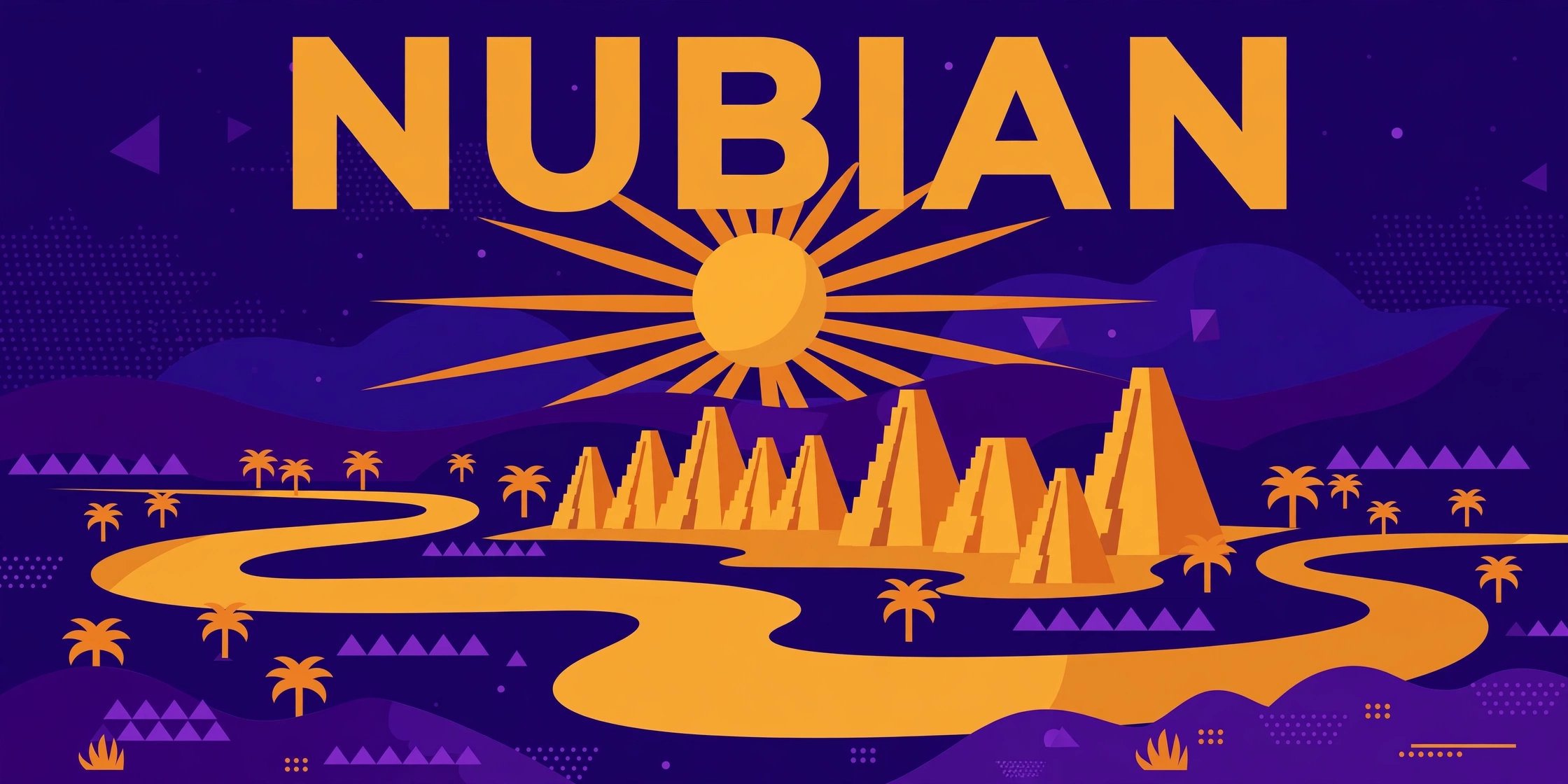
Nubian means “of Nubia” — the Nile region in what is now southern Egypt and northern Sudan — and, as a noun, a person from that region or one of the languages spoken there. It is both a noun (a Nubian, two Nubians) and an adjective (Nubian art, the Nubian Desert), and it is always written with a capital N, because it comes from the place name Nubia. The word’s real difficulty is not what it means, but which sense you are looking at: an ancient kingdom, living people, or a language.
Quick Answer
Nubian (UK /ˈnjuːbɪən/, US /ˈnuːbiən/ — also /ˈnjuːbiən/) can be a noun or an adjective. As a noun it means a native or inhabitant of Nubia, the region along the Nile in southern Egypt and northern Sudan, or the language (or languages) spoken by Nubians. As an adjective it means of or relating to Nubia, its people, their language or their culture. Always capitalise it. Collins also records an informal adjective use for Black culture more generally; the historical dictionary sense referring to an enslaved person is historical only and must never be used for a person today.
What does “Nubian” mean?
The learner dictionaries give this word unusually thin coverage: it has no full entry in the current Cambridge Dictionary or Oxford Learner’s Dictionaries results, so you have to go to the larger desk dictionaries, Collins and Merriam-Webster. That is itself useful information — Nubian is common in history writing, museum labels and news about Egypt and Sudan, but it is not core learner vocabulary. What the desk dictionaries say agrees closely, with one revealing difference.
- Collins, British English. Noun 1: “a native or inhabitant of Nubia, an ancient region of NE Africa”; noun 2: “the language spoken by the people of Nubia.” Adjective 3: “of or relating to Nubia or its inhabitants”; adjective 4, labelled informal: “of or relating to Black culture.”
- Merriam-Webster. Noun 1a: “a native or inhabitant of Nubia”; 1b: “a member of one of the group of dark-skinned peoples that formed a powerful empire between Egypt and Ethiopia from the 6th to the 14th centuries”; 2: “any of several languages spoken in central and northern Sudan” — followed by Nubian as an adjective.
- Collins, American English (Webster’s New World). Adjective: “of Nubia or its people, language, or culture.” Noun: “a person born or living in Nubia,” and “a group of Chari-Nile languages spoken in Nubia.”
Three things follow. First, the place is the key: every definition runs through Nubia. Second, the “language” sense is not one stable thing. Collins British says “the language spoken by the people of Nubia”; Merriam-Webster says “any of several languages spoken in central and northern Sudan”; Webster’s New World says “a group of Chari-Nile languages”; Random House (also published by Collins in the US) says “the Nilo-Saharan language of the Nubians.” The dictionaries are reflecting a genuine classification problem: modern Nubians speak several related languages, and linguists group that family differently. Writing “the Nubian language” is therefore less precise than the dictionaries themselves are. Third, two further American senses — Random House’s historical “History: a Nubian or Black slave” and its specialist “a Nubian horse” — belong to older or specialist usage, not to what the word means in a sentence written today.
Where is Nubia?
Merriam-Webster’s geographical entry gives the whole picture in one sentence: Nubia is a “region and ancient kingdom in northeastern Africa along the Nile in southern Egypt and northern Sudan.” Collins British calls it “an ancient region of NE Africa.” Keep that pairing — region and ancient kingdom, southern Egypt and northern Sudan — because Nubian is used in both directions at once.
In history writing, Nubian usually looks backwards, to early kingdoms along the Nile including the Kingdom of Kush; Merriam-Webster’s sense 1b points to peoples who “formed a powerful empire between Egypt and Ethiopia from the 6th to the 14th centuries.” In present-day writing, it points to living communities: “a native or inhabitant of Nubia” is a present-tense definition, and the language senses describe languages spoken now in Sudan. Context — a date, a tense, Kush versus the modern Nile Valley — tells you which Nubia a sentence means. One usage caution follows from the map: Nubia is not a modern country. It straddles Egypt and Sudan, so Nubian is not interchangeable with Egyptian or Sudanese; it names the region, people and culture, not a passport. This article keeps the history brief deliberately: the dictionaries themselves keep the geography to a sentence or two, and fuller history belongs to encyclopaedias, not to a word definition.
Pronunciation: UK and US
British English: /ˈnjuːbɪən/ — “NYOO-bee-ən,” three syllables, stress on the first.
American English: /ˈnuːbiən/ and /ˈnjuːbiən/ — “NOO-bee-ən” and “NYOO-bee-ən.”
Collins British gives /ˈnjuːbɪən/. Collins American gives (ˈnubiən, ˈnjubiən) — two recognised American starts, one without the “y” glide and one with it; Random House gives (ˈnuːbiən, ˈnjuː-), the same pair. This is the familiar pattern by which American English often drops /j/ after n where British English keeps it (compare news or nuclear). Neither American form is an error, and the stress stays on the first syllable everywhere. The place name follows suit: Merriam-Webster gives Nubia as “NOO-bee-uh,” “NYOO-bee-uh.” The spelling is simply Nubia + -an: N-u-b-i-a-n. Collins dates the formation to Middle English, 1350–1400; Merriam-Webster gives the first known use as the 15th century — the ordinary gap between a modelled formation date and the surviving written record.
Noun and adjective: the two jobs the word does
As a countable noun, Nubian means a person: a Nubian, the Nubians, many Nubians — Collins’s “native or inhabitant.” It behaves like other demonyms (Ethiopian, Chilean), taking articles and plurals in the ordinary way. As an adjective it means “of Nubia”: Nubian art, Nubian kingdoms, Nubian languages, the Nubian Desert. Merriam-Webster enters the Nubian Desert separately as a geographical name, “desert in northeastern Sudan between the Red Sea and the valley of the Nile River” — a proper name, so both words are capitalised. The commonest slip is mixing the two region words: Nubia is the place, Nubian is the person, language label or describer. “In Nubia” locates; “Nubian pottery” classifies. “People from Nubian” and “the Nubia language” mix them up; “Nubian speakers” and “the language of Nubia” keep them apart. The -an ending does the same work as in Egypt → Egyptian: it turns a place into a person-word and a describer-word at once.
Usage: when “Nubian” is neutral, and when to pause
In its core senses Nubian is neutral and descriptive — the region, the ancient kingdoms, the languages, the culture, and people who identify as Nubian — just as Canadian is the ordinary word for a person from Canada. No dictionary warning label attaches to those senses, and none is needed. The pauses come at the edges:
| Use | How to handle it |
|---|---|
| People, region, language or culture of Nubia, ancient or modern | Neutral and descriptive; the standard use. Capitalise it. |
| Collins British adjective 4, informal: “of or relating to Black culture” generally | Recorded, but labelled informal. Prefer the precise word — African, Black, African-American where accurate — rather than borrowing Nubian as a loose synonym. |
| Random House historical sense: “a Nubian or Black slave” | Historical only. Quote it only when discussing historical texts; never use it for a person today. |
| As a decorative compliment with no connection to Nubia | Avoid. Say what you mean (beautiful, regal, striking) instead of using a people’s name as a label. |
Recording a sense is not recommending it. Where a writer reaches for Nubian to mean “Black” in general, a more exact word almost always says the thing better, without borrowing someone’s homeland to do it. Nubian names real people, living as well as ancient, and it works best when that connection stays visible.
Correct vs. incorrect
Correct: “The gallery displays Nubian pottery alongside Egyptian pieces.”
Correct: “Nubians today live on both sides of the Egypt–Sudan border.”
Correct: “He is studying the Nubian languages spoken in northern Sudan.” (plural, matching Merriam-Webster’s “any of several languages”)
Incorrect: “nubian” with a small n — capitalise it in every sense.
Incorrect: “She is from Nubian.” The place is Nubia: “She is from Nubia,” or “She is Nubian.”
Incorrect: Using Nubian as a synonym for Egyptian or Sudanese.
Common mistakes
Assuming “Nubian” only means “ancient”
The word is so often met in Egyptian-history contexts that readers take it for a dead civilisation’s name. The dictionaries say otherwise: “native or inhabitant” is a present-day definition, and the language senses describe languages spoken now in Sudan. Check the tense before deciding.
Writing “the Nubian language” as if there were exactly one
Merriam-Webster says “any of several languages”; Webster’s New World says “a group of … languages.” Unless a source names a specific language, Nubian languages is the safer phrase.
Dropping the capital, or dropping the place
Lower-case “nubian” is an error, not a style choice. And using Nubian with no thought of Nubia at all — as a compliment or a synonym for “Black” — loses the precision that makes the word useful.
FAQs
What does “Nubian” mean in simple terms?
“Of Nubia,” the Nile region in southern Egypt and northern Sudan. A Nubian (noun) is a person from there, or one of its languages; Nubian (adjective) describes things from there — Nubian art, the Nubian Desert.
How do you pronounce “Nubian”?
British /ˈnjuːbɪən/ (“NYOO-bee-ən”); American /ˈnuːbiən/ or /ˈnjuːbiən/ (“NOO-bee-ən,” “NYOO-bee-ən”). Three syllables, stress first.
Is “Nubian” a noun or an adjective?
Both, under one capitalised headword: “a Nubian” (person); “Nubian culture” (of Nubia, its people, language or culture).
What is the difference between “Nubia” and “Nubian”?
Nubia is the region; Nubian is the person, language label or describer formed from it (Nubia + -an, Middle English, per Collins).
Is “Nubian” offensive?
Not in its core senses: it is the neutral name for the people, region, languages and culture of Nubia. Care is needed only at the edges — Collins’s informal “Black culture” sense, and the historical enslaved-person sense, which belongs in historical quotation only.
Should “Nubian” be capitalised?
Yes, always. It comes from the proper name Nubia and is headworded with a capital N in every sense.
Takeaway
Nubian (UK /ˈnjuːbɪən/, US /ˈnuːbiən/) means “of Nubia”: a person from the Nile region of southern Egypt and northern Sudan, one of its languages, or anything of that region, people, language or culture. Collins and Merriam-Webster agree on that core and hedge, instructively, on the language sense — say Nubian languages unless one language is named. Capitalise it, keep ancient and modern contexts apart, and leave the informal and historical edge senses in the dictionary, where their labels tell you how far to trust them.