Eustress Meaning: Definition, Examples and Eustress vs Distress
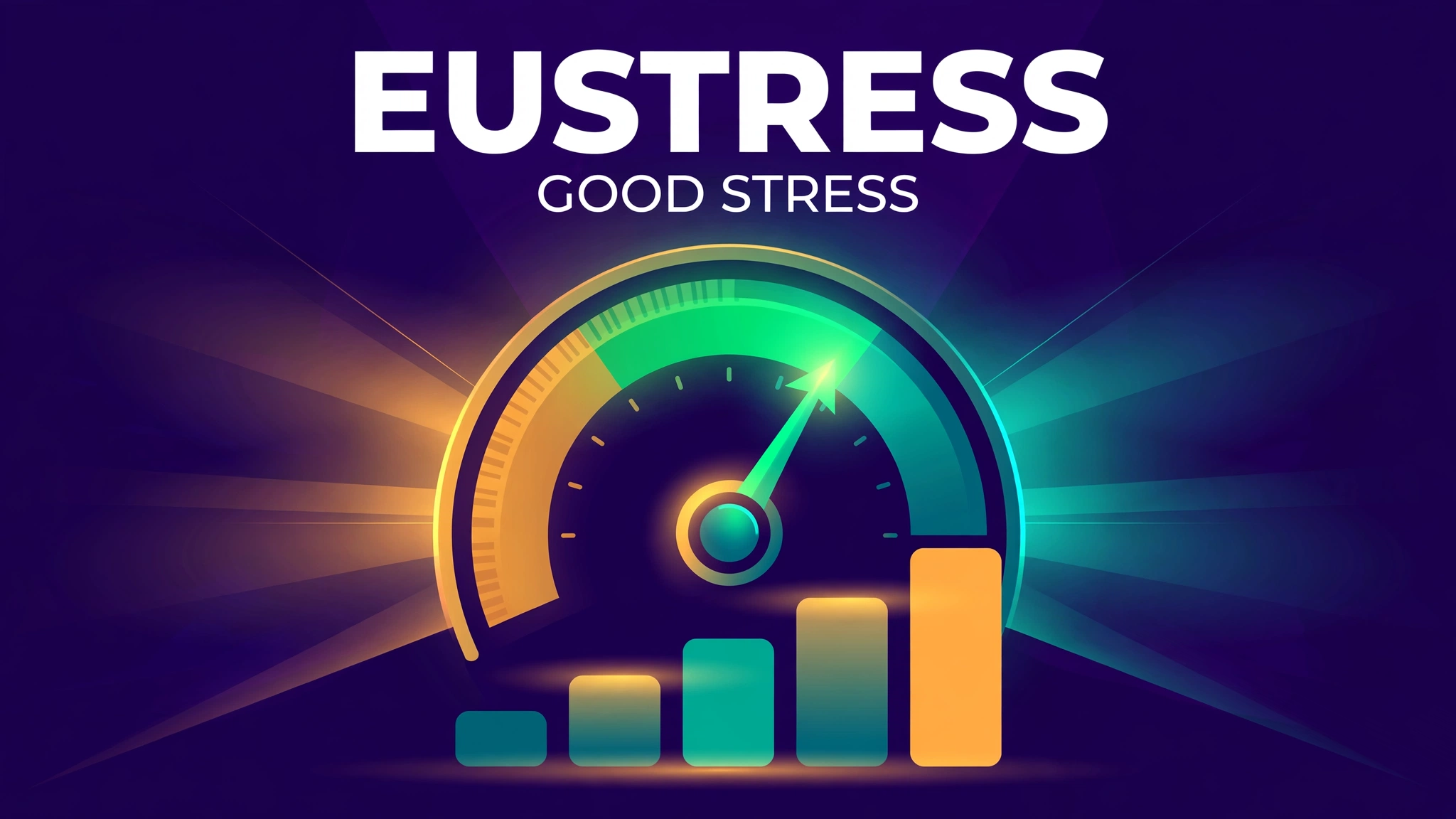
Eustress is the good kind of stress: the motivating, energising pressure you feel before a big game, a deadline you care about, or the first day of a job you wanted. It comes from the Greek prefix eu-, meaning “good,” plus stress — literally “good stress.” The word was coined by endocrinologist Hans Selye, the founder of modern stress research, to separate stress that helps us perform and grow from distress, the harmful kind that wears us down. If you’ve ever felt nervous-but-excited and risen to the occasion, you’ve experienced eustress.
Quick Answer
Eustress (pronounced “YOO-stress,” /ˈjuːstres/) is positive, beneficial stress — the kind that motivates you, sharpens your focus, and improves performance. Merriam-Webster defines it as “a positive form of stress having a beneficial effect on health, motivation, performance, and emotional well-being.” Hans Selye coined it from Greek eu- (“good”) + stress, as the opposite of distress.
What eustress means, exactly
Merriam-Webster’s definition — “a positive form of stress having a beneficial effect on health, motivation, performance, and emotional well-being” — captures the term precisely. Dictionary.com phrases it as “physical, mental, or emotional tension that is caused by something positive or is psychologically or physically beneficial.” In psychology, eustress is the stress response working for you: your heart beats faster, your attention narrows, and your energy rises — but instead of feeling threatened, you feel challenged, capable, and engaged.
Two things define eustress, and both matter:
- The demand is challenging but manageable. The task stretches you without exceeding what you believe you can handle.
- You perceive it positively. Eustress is not defined by the event itself but by your response to it. The same public speech can be eustress for one person (exciting, a chance to shine) and distress for another (dread, fear of humiliation).
That second point is why psychologists describe eustress with words like hope, meaning, and active engagement: you want the outcome, you believe effort will get you there, and the pressure feels like fuel rather than a burden.
Who coined “eustress”?
The word comes from Hans Selye (1907–1982), the Hungarian-Canadian endocrinologist often called the father of stress research. Selye introduced the scientific concept of stress in the mid-20th century — most famously in The Stress of Life (1956) — arguing that the body responds to any demand, pleasant or unpleasant, with the same basic pattern of adaptation. Because popular usage had made “stress” mean only the bad kind, Selye coined a pair of terms to split it: distress (from Latin dis-, “bad” or “apart”) for harmful stress, and eustress (from Greek eu-, “good” or “well” — the same prefix in euphoria and eulogy) for the beneficial kind. He set out the distinction in the 1970s, notably in Stress Without Distress (1974), and psychology textbooks have taught it that way ever since: as OpenStax’s Psychology puts it, “Selye (1974) pointed out that not all stress is harmful… This kind of stress, which Selye called eustress (from the Greek eu = ‘good’), is a good kind of stress associated with positive feelings, optimal health, and performance.”
His key insight still holds up: stress itself is not the enemy. A life with no demands at all is not healthy — it’s understimulating. What matters is the dose, the duration, and whether you experience the demand as a challenge you can meet or a threat you cannot.
Eustress vs. distress
Selye’s two terms describe opposite ends of the stress experience. The contrast is easiest to see side by side:
| Eustress (“good stress”) | Distress (“bad stress”) | |
|---|---|---|
| Typical triggers | A promotion, a competition, an exam you’ve prepared for, a wedding you’re excited about, a challenging project | Debt, chronic overwork, illness, conflict, grief, demands that feel uncontrollable |
| How it feels | Excitement, focus, motivation, “butterflies” that feel like energy | Anxiety, dread, frustration, feeling overwhelmed |
| Your sense of control | “This is hard, but I can handle it.” | “This is too much; I can’t cope.” |
| Duration | Usually short-term and tied to a specific goal | Often prolonged or open-ended |
| Effect on performance | Improves it — sharper attention, better effort | Undermines it — poor concentration, exhaustion, mistakes |
| Afterwards | Satisfaction, relief, confidence, growth | Fatigue, burnout, lowered well-being if it persists |
One subtlety is worth knowing: the body’s immediate stress machinery — raised heart rate, cortisol, adrenaline — is largely the same in both cases. As one summary used by Cambridge Dictionary puts it, “The body itself can not physically discern between distress or eustress.” The difference lies in your appraisal of the situation and in how long the state lasts. That is also why eustress can tip over into distress: a thrilling workload that never lets up eventually depletes the same resources it once mobilised.
Examples of eustress
Eustress shows up anywhere a welcome challenge asks something of you. Common examples include:
- Starting a new job or a promotion — new responsibilities, a steeper learning curve, and the energising wish to prove yourself.
- Competing — the pre-game nerves an athlete feels, which heighten alertness and effort.
- Exams and deadlines you care about — revision pressure that sharpens memory and focus (research shows moderate stress can improve recall of studied material).
- Exercise — physical training is a deliberate, beneficial stressor: it temporarily loads the body so it adapts and grows stronger.
- Big happy events — planning a wedding, expecting a baby, moving to a home you’ve chosen, travelling somewhere new.
- Performing — giving a speech, playing music, acting: the stage-fright buzz that, in the right dose, makes a performance electric.
- A challenging project — learning a new skill, launching something of your own, solving a problem that matters to you.
Notice the pattern: every example involves effort toward something you value, with an end in sight and a real chance of success. Remove any of those — the value, the endpoint, or the chance — and the same demand slides toward distress.
How eustress improves performance
Psychologists have long described an inverted-U relationship between arousal and performance, often linked to the Yerkes–Dodson law: as stress rises from zero, performance improves — you become alert, energised, and focused — until it reaches an optimal peak. In OpenStax’s summary, a person at that peak “feels fully energized, focused, and can work with minimal effort and maximum efficiency.” Push past the peak, though, and the same system turns against you: stress “becomes excessive and debilitating, or what Selye termed distress,” and performance falls away.
Eustress is life on the rising side of that curve. It explains why a completely pressure-free week can feel flat and why the right deadline can produce your best work. It also explains why coaches, teachers, and managers talk about “good pressure”: the goal is not to eliminate stress but to keep it in the zone where it sharpens rather than swamps you.
Can eustress ever be bad for you?
Mostly, eustress is genuinely beneficial — it is associated in research with life satisfaction, hope, and well-being. But two honest qualifications apply:
- Duration matters. Eustress is designed by the body as a short burst. If a “positive” demand becomes constant — the dream job that requires 80-hour weeks for a year — the physiological cost accumulates just as it does with distress, and exhaustion follows.
- Perception can change. A stressor you welcomed can become distress if you lose control of it: the exciting project that loses funding, the happy move that turns chaotic. Eustress and distress are not fixed labels for events; they describe your ongoing relationship with them.
So the healthiest reading of Selye’s idea is not “seek more stress,” but “seek the right challenges, in doses you can recover from.” Rest after exertion is part of the system, not a failure of it.
Is “eustress” in the dictionary?
Yes — mostly. Merriam-Webster and the Cambridge Dictionary both carry full entries for eustress, and it is standard vocabulary in psychology. Its dictionary footprint is still thinner than everyday words, though, which reflects its technical origins: Collins, for example, has listed eustress as a monitored new-word submission (“stress that is perceived as being positive or beneficial,” credited as coined by Hans Selye) rather than a long-established headword, and it does not appear in the Oxford Advanced Learner’s Dictionary. That is typical of terms that live first in a specialist field: psychologists have used eustress for fifty years, while general dictionaries have adopted it more cautiously. When you use it with general readers, a quick gloss — “positive stress” — is a kindness.
Common mistakes
Thinking eustress means “no stress.” Eustress is real stress: heart rate up, cortisol flowing. It is the quality of the experience — challenging, meaningful, manageable — that makes it eustress, not the absence of pressure.
Assuming every pleasant event produces eustress. A holiday, a windfall, or a wedding can overwhelm as easily as energise. If the demands outrun your sense of control, the result is distress wearing a party hat.
Assuming every unpleasant event produces only distress. The reverse error: a tough workout, a hard course, or caring for someone through a difficult week can be stressful and deeply worthwhile — eustress often feels effortful in the moment.
Misspelling or mispronouncing it. It is spelled eustress (eu + stress) and pronounced “YOO-stress.” It is not “ustress,” and the eu- is the same “good/well” prefix you see in euphoria, eulogy, and euthanasia — don’t confuse it with those words, several of which have very different meanings.
FAQs
What is eustress in simple words?
Eustress is “good stress” — the excited, motivated pressure you feel when facing a challenge you want to meet, like a competition, an exam you’ve prepared for, or the first day of a new job. It helps you focus and perform at your best.
Who coined the word “eustress”?
The endocrinologist Hans Selye, founder of modern stress research. He built the word from Greek eu- (“good”) + stress and set out the eustress/distress distinction in the 1970s, notably in Stress Without Distress (1974).
What is the difference between eustress and distress?
Distress is stress experienced as harmful and overwhelming; it drains you and, when prolonged, harms health and performance. Eustress is stress experienced as a positive challenge; it energises you and improves performance. The body’s alarm reaction is similar — the difference is the situation, your sense of control, and how long it lasts.
What are some examples of eustress?
Starting a new job, training for a race, preparing for an important exam, planning a wedding, performing on stage, taking on a challenging project, and exercising are all classic examples.
How do you pronounce “eustress”?
“YOO-stress” — /ˈjuːstres/. The first syllable rhymes with “you,” and the stress falls on it.
Can too much eustress be harmful?
Yes, if it never switches off. Eustress is healthy as a short burst tied to a goal; if positive demands become chronic, the same stress system gets depleted and the experience tips into exhaustion and distress. Recovery time is part of the deal.
Takeaway
Eustress is Selye’s word for stress that works for you: a positive form of pressure — from Greek eu-, “good” — that improves health, motivation, and performance when the challenge feels meaningful and manageable. Its opposite, distress, is the same machinery turned harmful by overload and helplessness. You don’t need a stress-free life; you need the right stress, in the right dose — and the wisdom to rest when the challenge is done.