Tittle or Title: What’s the Difference?
If you have ever typed tittle when you meant title — or paused over the phrase “every jot and tittle” and wondered what a tittle actually is — you are not alone. The two words look almost identical, they sound almost identical, and they share the same Latin ancestor. Yet in modern English they do entirely different jobs. One is the everyday word for the name of a book, film, song or job. The other is a small, rather old-fashioned word for the tiniest mark on a page. Getting them mixed up is understandable; getting them right takes about thirty seconds once you see the distinction clearly.
Quick Answer
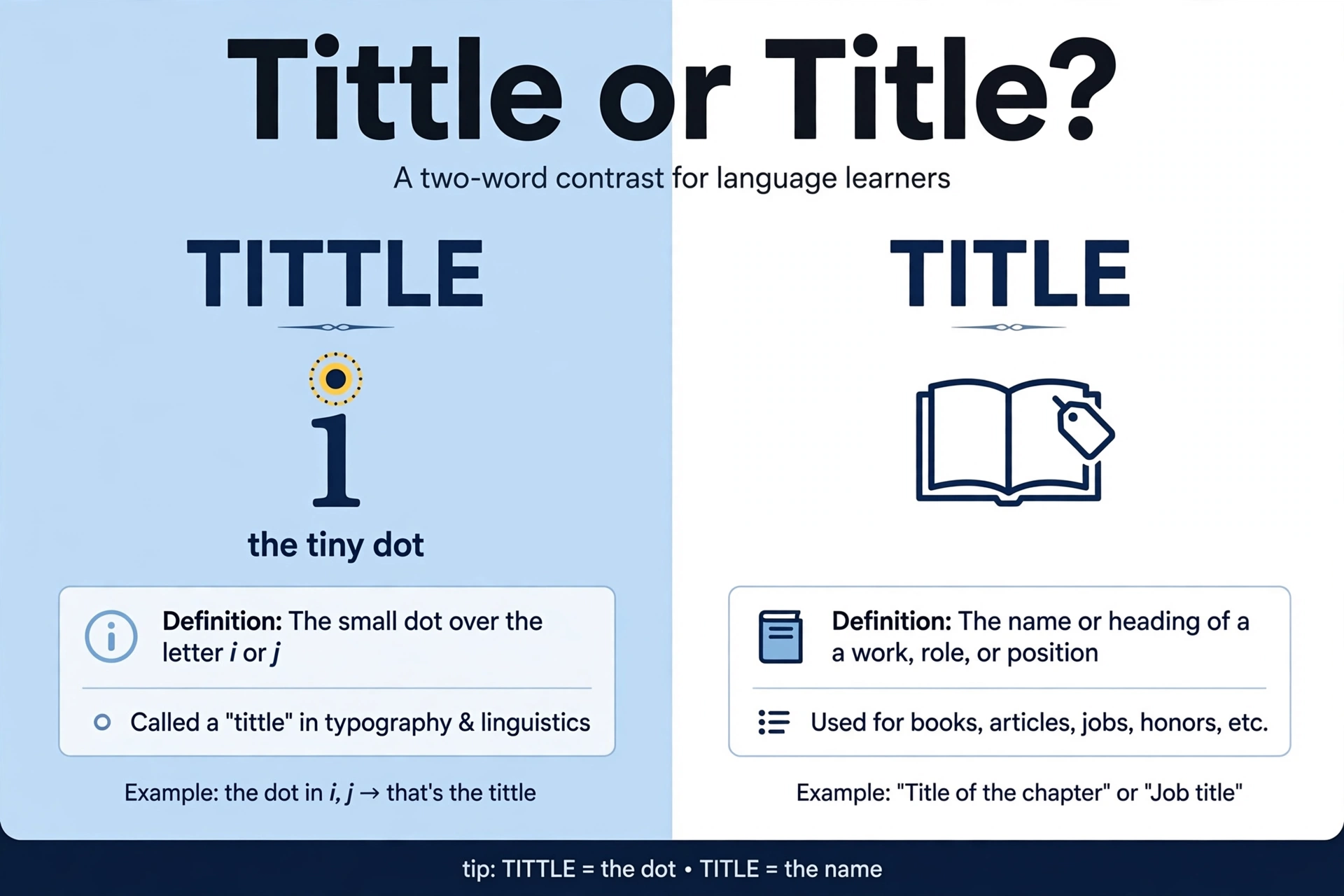
Title is the word you want in almost every situation: it is the name of a book, article, film or piece of music, a word like Mr, Dr or Professor used before a name, a job name such as Operations Manager, or a championship won in sport. Tittle is a real but uncommon noun meaning a tiny mark — most famously the dot over the letters i and j — or, by extension, a very small amount of something, as in “not a tittle of evidence”.
What the dictionaries say
It helps to start with what the reference books actually record, because both words are listed in all the major dictionaries — tittle is not a misspelling, and it is not slang. It is simply rare.
Tittle
Cambridge Dictionary lists tittle (/ˈtɪt.əl/ in British English, /ˈtɪt̬.əl/ in American English) as a noun with two related senses. The first is labelled old-fashioned: “a very small amount”, illustrated with sentences such as “without a tittle of evidence” and “she cares not a tittle about me”. The second is more technical: “a small mark that is written or printed above or below a letter, or is attached to it”, with the example “Diacritical marks are all those little jots and tittles that appear over, under, and even through various letters.”
Collins English Dictionary gives the same picture. In British English, tittle (/ˈtɪtəl/) is “a small mark in printing or writing, especially a diacritic” and also “a jot; particle”. The American English entry in Collins (drawn from Webster’s New World) defines it as “a dot or other small mark used as a diacritic” and “a very small particle; iota; jot”. The Oxford entry, via Oxford Languages, likewise records tittle (UK /ˈtɪtl/) as “a tiny amount or part of something” and, in an archaic sense, “a small written or printed stroke or dot”.
In practical terms, when people talk about the tittle in typography, they usually mean one very specific thing: the dot that sits on top of a lowercase i or j. That little dot is not decoration — it is part of the letter itself. Typographers also use tittle more broadly for small distinguishing strokes, which is why you will see it in discussions of Hebrew vowel points and medieval manuscripts.
Title
Title (/ˈtaɪ.təl/) is one of the workhorse nouns of English, and Cambridge, Collins and Merriam-Webster all record a cluster of everyday senses:
- The name of a creative work. “The title of the film was An Unreasonable Man.” This covers books, articles, chapters, paintings, songs and films. As a verb, to title something is to give it that name: “He titled his autobiography Beneath the Underdog.”
- A form of address. A word such as Mr, Mrs, Ms, Dr or Professor placed before a name to show status, profession or marital status. Forms that ask for your “name and title” are asking for this.
- A job name. “Her title is Director of HR and Training.” Collins phrases it as “a name that describes their job or status in an organisation” — job title is the fixed phrase here.
- A rank or honour. A word or phrase such as Sir, Dame, Lord, the Prince of Wales or Queen of Scots, indicating high rank. “He gave up the title of CEO” sits between this sense and the job sense.
- A sporting championship. To “hold”, “win”, “defend” or “retain” a title is to be the reigning champion: “He retained his title as world chess champion.”
- A legal right to ownership (formal and legal English). “Who holds the title to the property?” In publishing, a related trade sense counts books themselves as titles: “The publisher has 30 titles on its current list.”
Notice the spelling difference in the middle of the word. Title has one t after the initial Ti-: T-I-T-L-E. Tittle doubles it: T-I-T-T-L-E. That extra t is the whole visual distinction, and it mirrors the pronunciation only faintly — title has a long “y” sound (/aɪ/), while tittle has a short “i” (/ɪ/), rhyming with little. In careful speech the two do not sound the same at all.
Where the confusion comes from
The mix-up is not carelessness. The two words are historically the same word. Collins traces tittle to the 14th century, from Medieval Latin titulus meaning “label”, itself from Latin titulus meaning “title, inscription”. Merriam-Webster gives the same origin for title: Middle English, from Anglo-French, from Latin titulus. Oxford notes that tittle in Middle English originally denoted a small symbol (it was even used for the division sign ÷), and that in medieval Latin titulus had come to mean “small stroke, accent”.
So the family tree forks like this: the Latin word for an inscription or label gave English both the grand sense — the name attached to a book or a person — and the miniature sense — the tiny stroke attached to a letter. Over centuries, title took the large, public meanings and tittle kept the small, technical ones. They are cousins, not variants of each other. You cannot swap them.
The phrase that keeps tittle alive is “jot and tittle”, from the King James Bible (Matthew 5:18). Here jot stands for the smallest letter and tittle for the smallest stroke. The idiom means “every tiny detail”: “The rules have not been altered one jot or tittle since.”
How to choose, every time
Ask yourself one question: am I naming something, or am I talking about a tiny mark or amount?
| If you mean… | Use | Example |
|---|---|---|
| The name of a book, article, film, song, chapter | title | I can’t remember the title of that novel. |
| Mr, Mrs, Dr, Professor before a name | title | Please state your full name and title. |
| A job name | title | Her job title is Operations Manager. |
| A championship or honour | title | She defended her world title last night. |
| The dot over i or j | tittle | The dot on a lowercase i is called a tittle. |
| A tiny amount (old-fashioned) | tittle | There was not a tittle of evidence against him. |
| Every smallest detail (idiom) | tittle | Follow the instructions to the last jot and tittle. |
A useful memory hook: tittle rhymes with little, and it means something little. Title contains the idea of a label large enough to go on a cover. If you can replace the word with name, you want title. If you can replace it with speck or dot, you want tittle.
Correct vs. incorrect examples
Correct: The title of her new book is The Salt Road.
Incorrect: The tittle of her new book is The Salt Road. (Tittle cannot mean the name of a work.)
Correct: In this font, the tittle of the j is round rather than square.
Incorrect: In this font, the title of the j is round rather than square. (A letter does not have a title; it has a tittle.)
Correct: He was given the title of assistant manager.
Incorrect: He was given the tittle of assistant manager.
Correct: The prosecution failed to present a tittle of evidence. (Formal, old-fashioned — most writers today would say “a shred of evidence”, but the sentence is correct.)
Incorrect: The prosecution failed to present a title of evidence.
Correct: She holds the title of Professor of Linguistics.
Incorrect: She holds the tittle of Professor of Linguistics.
Common mistakes
Writing “tittle” for a book or job name
This is by far the most frequent error, usually a typing slip that autocorrect misses because tittle is a genuine dictionary word. Spellcheckers will not save you here. A quick proofread for the doubled tt is worthwhile in anything professional: CVs, article headlines, and bibliographies are the places where “the tittle of the report” tends to embarrass.
Writing “title” for the dot on an “i”
Less common, but it does appear in design blogs and student essays. If you are writing about letterforms, diacritics or handwriting, the dot is a tittle. Using title in “the title of the i” will read as a mistake to anyone who knows the term.
Assuming “tittle” is not a word
Because it is rare, some writers assume it must be an error and “correct” it in quotations. Do not. In the biblical phrase and in older prose, tittle is deliberate and precise. Changing “every jot and tittle” to “every jot and title” destroys the idiom.
Mispronouncing them as identical
In British English, title is /ˈtaɪtəl/ (“TY-tul”) and tittle is /ˈtɪtəl/ (“TIT-ul”). In American English the middle consonant of tittle is often flapped — /ˈtɪt̬əl/ — which can make it sound closer to title in rapid speech, but the vowel difference (long y versus short i) remains. Reading them aloud differently is a good final check.
FAQs
Is “tittle” a real word?
Yes. Cambridge, Collins and Oxford all list it as a noun. It is uncommon and somewhat old-fashioned in its “tiny amount” sense, but it is fully standard English, and in typography it is the precise technical term for the dot over i and j.
What is the dot on top of the letter “i” called?
A tittle (also called a superscript dot). It is considered part of the letter itself, not an added accent. When another diacritic sits above the letter, as in í, the tittle is normally omitted to make room for it.
What does “every jot and tittle” mean?
It means “every smallest detail, without exception”. The phrase comes from Matthew 5:18 in the King James Bible, where jot stands for the smallest letter and tittle for the smallest stroke. Today you might write: “The contract was checked to the last jot and tittle.”
Can “title” ever mean something small?
Not in modern standard English. Title can be short — a one-word film title, for instance — but the word itself never means “a tiny amount” or “a small mark”. That territory belongs entirely to tittle.
Why do the two words look so similar?
Because they descend from the same Latin word, titulus. One branch kept the sense of a label or inscription large enough to name a book or a person (title); the other kept the sense of a small stroke or mark (tittle). Same root, opposite scales.
Takeaway
Reach for title whenever you are naming something — a book, a film, a job, a form of address, a championship. Reserve tittle for the tiny stuff: the dot on an i, a diacritical stroke, or (in deliberately old-fashioned phrasing) the smallest imaginable amount. Remember that tittle rhymes with little and means something little, and you will never confuse the two again.